
Leaving Kyoto in the early hours, with a station bento in your bag and a seat on a limited express, you swap the temple city for a hot spring town built around a willow-lined canal. At the end of the line, guests stroll in cotton yukata and wooden sandals from one bath house to the next, and the click of the geta carries along the water. Kinosaki Onsen sits in Hyogo Prefecture, and the trip there is a train ride that belongs to the experience.
How do you get to Kinosaki Onsen from Kyoto?
You go by train: Kinosaki Onsen has its own station on the JR San’in Main Line, and three limited express services call there, named Kinosaki, Hamakaze and Kounotori. The reservation requirement is the detail that shapes the trip, because reservations are required for the limited express trains serving Kinosaki Onsen. So the plan starts with choosing a service and holding a seat on it, before you think about the hour you want to leave.
What decides everything else is how you want the day to feel. A limited express is the train built for this kind of journey: fewer stops, a reserved seat, and a ride you can spend looking out the window rather than watching for your station.
A local train, which stops at every station, suits short distances and does not suit a long run to the coast, so it plays a minor role here. Think of the ride as the first part of the onsen day, a slow handover from the city to the hot spring town.
The place at the other end rewards a calm arrival. Kinosaki is an onsen town in the Kansai region, within Toyooka City, yet it is distinct from the city around it in geography and in character.
Its first hot springs came into use in the 8th century, and the town today still revolves around its public baths and the ryokan, the traditional inns, that surround them. You arrive at a station, step out, and the whole town is made for walking in a robe.
Japanese trains have a reputation for being always on time, which lets you plan the day to the minute. That matters when you are fitting a long morning ride around a ryokan check-in, a first bath and an evening meal.
Ways to get to Kinosaki Onsen from Kyoto
Limited express trains: Kinosaki, Hamakaze and Kounotori
These are the three services that stop at Kinosaki Onsen station on the JR San’in Main Line. Each runs under its own name, so when you look up the timetable you choose among Kinosaki, Hamakaze and Kounotori rather than searching for a single train. Reservations are required on all of them, which means you hold a specific seat for a specific departure.
This is the way for anyone who wants the trip to feel like part of the vacation. You settle into your seat, watch the landscape change from city streets to rural scenery, and step off at a station that exists for the hot springs. It suits couples headed to a ryokan, friends planning a night of bath hopping, and anyone who prefers one clear train to a chain of transfers.
A good habit is to bring your own breakfast or lunch, since a station bento eaten on the train is a small ritual of Japanese rail travel. Keep a light bag within reach, and leave the heavy luggage for the ryokan to deal with once you arrive.
Rapid and local trains on the JR network
Local trains in Japan stop at every station, which makes them ideal for short distances. Rapid trains skip the smaller stations and do not require a supplement. Both are part of the everyday rail network, and they are what commuters and locals ride between neighboring towns.
For a trip to a hot spring town, they are a way to travel only if you enjoy the rhythm of ordinary rail: stations announced one after another, schoolchildren boarding, platforms changing with every stop. They do not carry the reservation requirement that the limited express services do, so they appeal to travelers who like to improvise. For a day of bathing, though, people want to reach the town and start soaking, and that is where the named limited express services come in.
Options compared
| Option | Best for | What to know |
|---|---|---|
| Limited express (Kinosaki, Hamakaze, Kounotori) | Travelers who want a direct run to the hot spring town | Serves Kinosaki Onsen station on the JR San’in Main Line, and reservations are required |
| Rapid train | Travelers who like to travel on ordinary rail | Skips smaller stations and needs no supplement |
| Local train | Short distances between nearby stations | Stops at every station |
Rapid and local trains belong to the general network, and they are described for what they are: one skips the smaller stations without a supplement, the other stops everywhere.
If you are planning an overnight stay, the limited express fits naturally with a ryokan booking. You fix your day around a seat on a named train, then your check-in, then your first walk to the baths. Tourists staying in many of the ryokan in Kinosaki can receive a free pass to all seven public bath houses, so the afternoon can become a loop among them: Kouno-yu, Mandara-yu, Goshono-yu, Ichino-yu, Yanagi-yu, Jizou-yu and Satono-yu.
Making a day of it
A town with a history of 1,300 years as an onsen resort does not need a long list of add-ons. It needs time to walk the canal, step into a bath house, and sit with a cup of tea afterward.
Leaving Kyoto and arriving in the hot spring town
Choose a limited express departure that lets you reach town with the afternoon still ahead of you. Trains in Japan have a reputation for punctuality, so the seat you reserved translates into an arrival you can plan around. Step out at Kinosaki Onsen station, and the first thing you notice is how the place is organized around bathing rather than sightseeing.
If you are staying at a ryokan, the usual rhythm is to settle in, change into a yukata, and head out. Guests wander the streets in these light robes with wooden sandals, and part of the pleasure is that nobody dresses for the street. Evening brings the traditional dinner served at the inn, often built around seafood from the nearby coast, which suits the slow pace of the day.
Bath houses, the canal and the pace of the day
Seven public bath houses stand within the town, each with its own name and its own character. Some guests try to visit all of them, moving from one to the next with a small towel in hand, stopping for a snack, a sweet or a cold drink between baths. Others pick two or three and linger. Both approaches fit the town, which has no deadline attached to it.
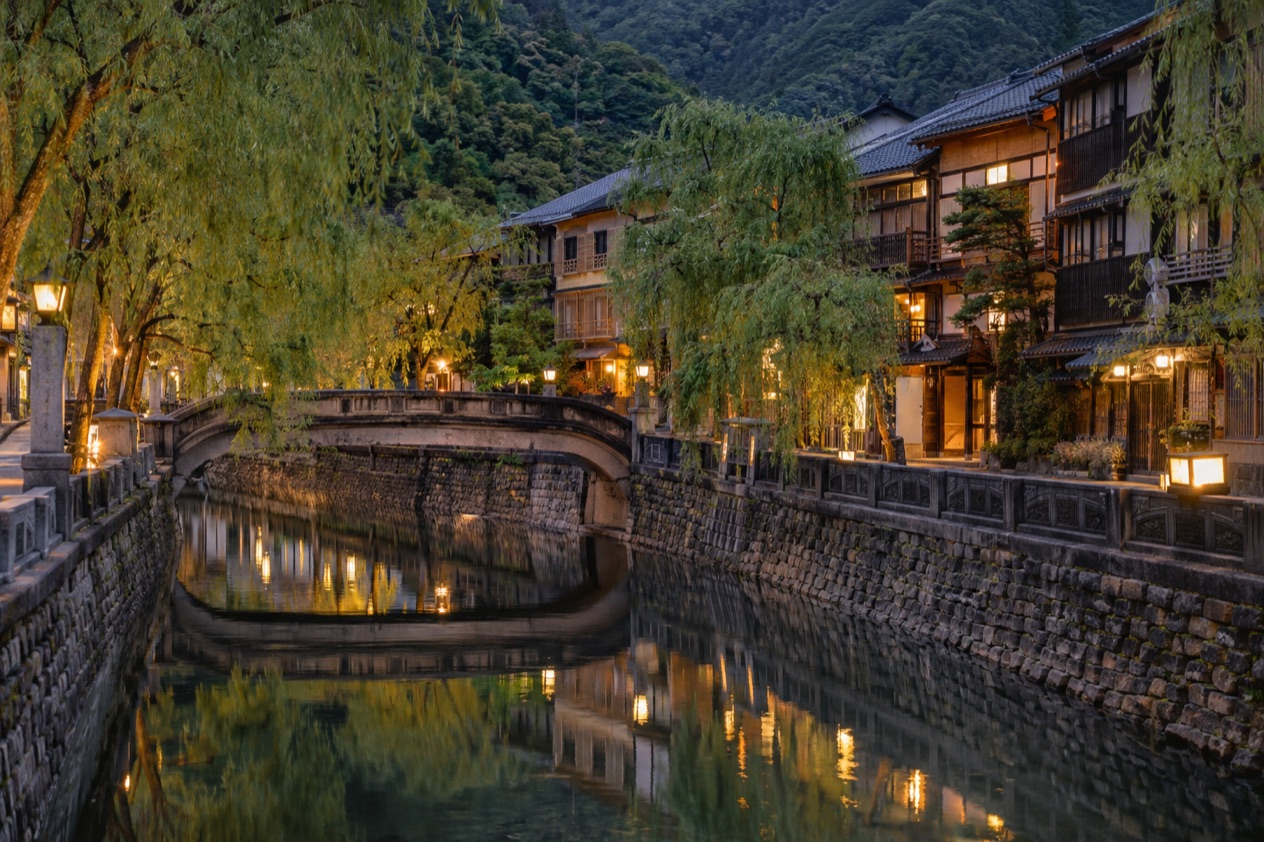
Between baths, the canal is the thing to follow. Willows lean over the water, small bridges cross it, and the lanes beside it fill with the sound of sandals in the evening. Shops sell local sweets and crafts, and little stalls offer treats to eat as you walk. Bring a small bag for your towel and toiletries, and carry little else.
How long to stay
A single night gives the fullest version of the trip, because the evening and the morning are when the town does what it does best: a bath before dinner, a walk in the yukata afterward, and another soak before the ride back. A day trip is possible in the sense that the station is a place you can reach and leave on the same train line, but the experience compresses. If your schedule allows only one day, plan on fewer baths and a slower lunch, rather than rushing to check them all off.
When you head back to Kyoto, remember the same reservation requirement applies to the limited express on the return. Reserve your seat for the way home at the same time as the way out, so the end of the visit is as settled as the start.
Good to know before you go
The two things to settle before leaving Kyoto are a reserved seat on one of the three limited express services and a ryokan that includes the pass to the public bath houses. Beyond that, bring a small towel bag for the baths, wear comfortable shoes for the walk to the station, and keep your plans loose once you arrive. The town is built for wandering, and the rhythm of bath, stroll, tea and dinner is the whole itinerary.
Sources
- Wikipedia, Kinosaki Onsen (https://en.wikipedia.org/wiki/Kinosaki_Onsen), checked October 11, 2026
- Wikivoyage, Kinosaki (https://en.wikivoyage.org/wiki/Kinosaki), checked October 11, 2026
- Japan National Tourism Organization, trains and buses (https://www.japan.travel/en/guide/how-to-travel-by-train-and-bus-in-japan/), checked October 11, 2026
- Japan National Tourism Organization, traveling by rail (https://www.japan.travel/en/guide/traveling-by-rail/), checked October 11, 2026
- Japan National Tourism Organization, getting around Japan: trains, subways, buses, taxis (https://www.japan.travel/en/plan/getting-around/), checked October 11, 2026