
A morning departure from Kyoto Station means a concourse full of travelers heading for platforms in every direction, and a train that carries you out past the suburbs toward a city of wide lawns, stone lanterns and deer waiting for crackers. Nara sits on the Kyoto side of the Kansai region as a place of big temples and old capital grounds, and reaching it takes little more than a ride on a regular commuter line. What follows lays out the trains, the buses and the airports around the trip, and what to do once you step off at the other end.
How do you get to Nara from Kyoto?
The direct way is the JR Miyakoji rapid service, which leaves Kyoto and serves JR Nara Station without a change, and the ride takes a little over half an hour to Kintetsu Nara Station on the Kintetsu side. Two stations serve the city, JR Nara Station and Kintetsu Nara Station, and both put you within reach of Nara Park and the old merchant quarter of Naramachi. Kyoto is north of Nara in the sense that the two cities are linked by a single commuter corridor, and the trains on it are part of ordinary daily life for people who live between them.
What decides your choice is mostly where you want to arrive and what else is in your plans. The JR line starts in the Kyoto Station building itself, so if you are coming off the Tokaido Shinkansen or staying near the station, you walk to the platform and go. The Kintetsu side puts you at Kintetsu Nara Station, the closer of the two to the park and the deer, with the shopping arcades of the old town close by.
The JR Nara Line is operated by West Japan Railway Company, known as JR West, and is described as a commuter line in the Osaka, Kobe and Kyoto metropolitan area. Its official termini are Kyoto and Kizu, but every train continues past Kizu on the Yamatoji Line to Nara Station.
That detail matters for the traveler, because it means you do not have to figure out a change at Kizu. You board at Kyoto and ride to Nara on the same train.
Along the way the line passes Uji, a town known for its historic landmarks, which makes the ride more than a transfer. Cost depends on the ticket you choose, and several regional passes cover Kyoto and Nara together.
Ways to get to Nara from Kyoto
The Shinkansen at Kyoto Station
The Tokaido Shinkansen is the line that brings travelers to Kyoto, and Kyoto Station is where it meets the Nara Line. The station building, designed by architect Hiroshi Hara, houses a shopping mall, a hotel, a movie theater and the Isetan department store under one roof. It is a lot of building to cross, so allow yourself a moment to find the Nara Line signs, which carry the line color brown.
The bullet train does not take you to Nara itself. Its role is to deliver you to Kyoto, and from there you change to the Nara Line, which connects at the same station along with the Tokaido Main Line and the San’in Main Line. If you arrive by Shinkansen from farther away and want Nara the same day, this is the chain: Shinkansen to Kyoto, then the Nara Line onward.
JR Nara Line: rapid and local trains
The JR trains come in two kinds on this corridor. Rapid trains skip the smaller stations and need no supplement, while local trains stop at every station and suit shorter hops along the way. The Miyakoji rapid service is the one that serves JR Nara Station directly from Kyoto, and it is the train to look for on the departure board.
Choose the local train if you want to stop somewhere between, such as Uji, and continue later. The line keeps the same route either way, ending at JR Nara Station, from which you can change to the Sakurai Line toward Tenri and Sakurai, or head west toward Horyuji. The Kansai Area Pass covers rides across Kyoto, Nara and other cities in the region, which suits a traveler who plans to keep moving between them.
Kintetsu limited express
Kintetsu Railway runs the other main rail service into the city, ending at Kintetsu Nara Station in the historic center. From Osaka-Namba the limited express takes thirty-five minutes and costs 520 yen more than the regular express, which takes five minutes longer. From Kyoto Station, Kintetsu Nara Station is reachable in just over half an hour.
This is the option for travelers who want to land close to Nara Park. Kintetsu Nara Station and JR Nara Station both give access to the park and Naramachi, but the Kintetsu terminal is the one most associated with the lawns and the temple approaches. It is a fit for anyone combining Nara with an evening back in Osaka, since the Kintetsu Nara Line runs between Osaka Namba and Nara.
Bus
Buses matter in Nara more than on the way in. Nara Kotsu operates an extensive bus network across the prefecture, including areas the rail lines do not reach, and the Gurutto buses in Nara City cost 100 yen per trip. A bus also takes visitors to Heijo Palace and Horyuji Temple, two sites away from the park.
Think of the bus as the tool for the second half of the day, once the train has done its work. The Nara 1-Day Pass is valid for one day and covers Nara Park and the Nishinokyo areas, which is where the bus network and the major sights overlap.
Plane
No airport sits in Nara. The closest are Osaka International Airport (Itami) and Kansai International Airport, both in Osaka Prefecture, and each is about one hour and fifteen minutes from Nara by bus and train. For someone flying into the region and heading straight to Nara, that is the route, and it does not pass through Kyoto at all.
If your plan is to start in Kyoto, a flight has no place in the trip. The rail lines already link the two cities, and the airports matter only for the days when you arrive in or leave Kansai.
Options compared
| Option | Time each way | Best for | What to know |
|---|---|---|---|
| JR Miyakoji rapid on the Nara Line | Direct service, no change | Leaving from the Kyoto Station building | Serves JR Nara Station and needs no supplement |
| Kintetsu train | Just over 30 minutes | Arriving at Kintetsu Nara Station | Both stations give access to Nara Park and Naramachi |
| JR local train | Stops at every station | Breaking the ride at towns on the way | Ends at Nara Station on the Yamatoji Line |
| Kintetsu limited express from Osaka-Namba | 35 minutes | Pairing Nara with Osaka | Costs 520 yen more than the regular express |
| Nara buses | Varies by route | Heijo Palace, Horyuji and the wider prefecture | Gurutto buses in the city cost 100 yen per trip |
| Plane via Itami or Kansai International | About 1 hour 15 minutes from the airports to Nara | Arriving in Japan and going straight to Nara | Bus and train from the airport |
The two rail options are close in what they do, and the choice usually comes down to the station at each end. JR starts inside Kyoto Station and ends at JR Nara Station, while Kintetsu ends at Kintetsu Nara Station, which is the stop you remember when you picture the deer and the temple grounds.
Travelers use one for the trip out and the other for the way back, which lets them see both stations and both approaches to the old town. Nothing about the trip demands it, but the two stations open on different parts of the center.
Making a day of it
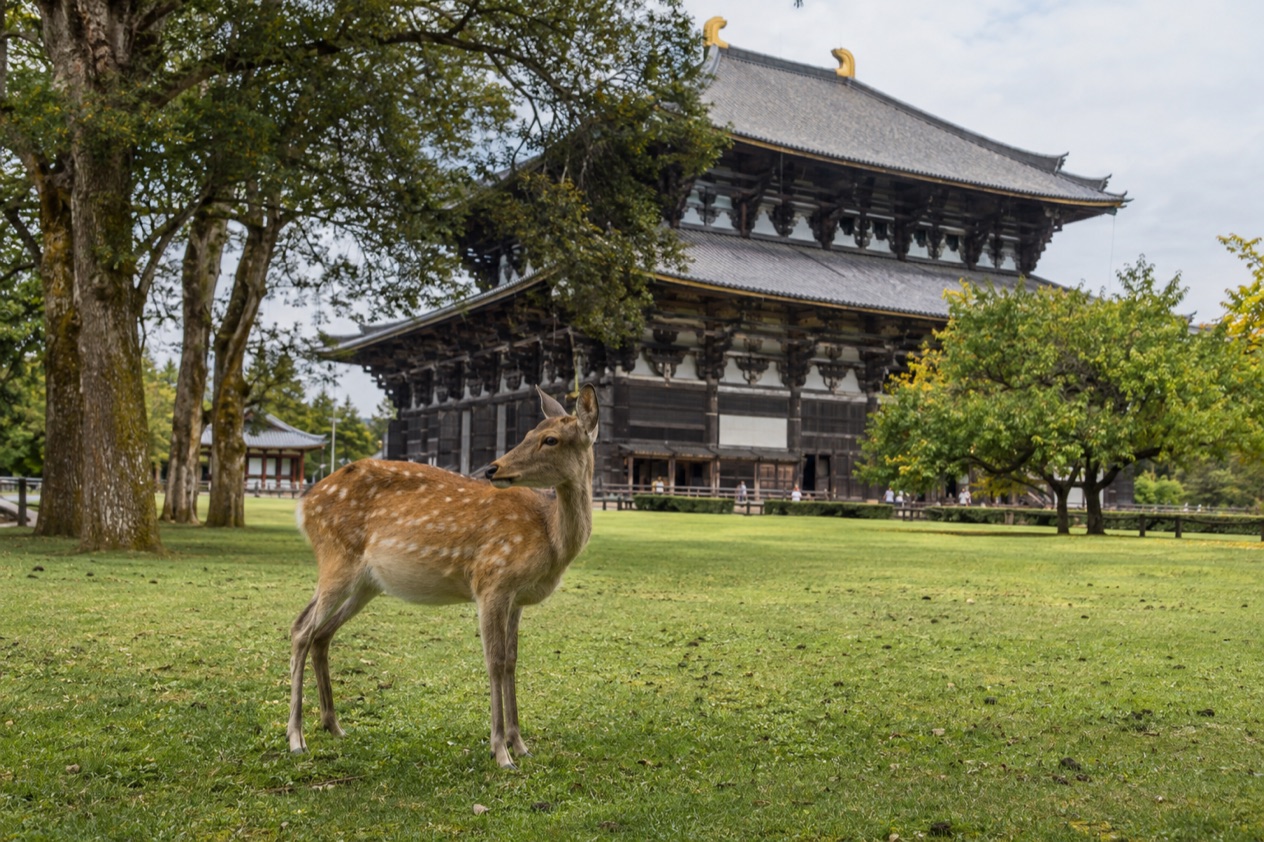
A day in Nara fits the shape of the town. The park at the foot of Mount Wakakusa holds the deer, the temples and the approach roads, and everything else spreads outward from there. Start with the deer, tame animals that visitors approach and feed with crackers sold along the roadside. The deer were once believed to be messengers of the gods, and the crackers vendors and the bowing animals are part of the scene.
Todai-ji Temple and the Great Buddha are the two names that most often come with Nara, and together with the deer they stand as symbols of the city. Walking from either station to the temple gives you the park lawns, the stone lanterns and the long approach paths in sequence. Nara has three World Heritage sites, covering ancient monuments, sacred mountain trails and some of Japan’s oldest temples and shrines.
Naramachi and the old town
Naramachi is the old merchant quarter, reached from Nara Station or Kintetsu Nara Station, and it makes a change of pace after the open park. The streets are lined with traditional wooden townhouses, with small shops and cafes tucked inside them. It is a place to walk slowly, step into a craft shop and stop for tea or a sweet.
Nara’s food leans on regional habits, such as pickles, kakinoha-zushi (sushi wrapped in persimmon leaves) and tea-based sweets. Naramachi is where those small meals are easiest to find, and a lunch here breaks the day neatly between the park in the morning and the next stop in the afternoon.
Heijo Palace and Horyuji
A bus takes visitors to Heijo Palace and Horyuji Temple. Heijokyo was Japan’s first capital, dating back 1300 years to the Nara Period, and the palace grounds give a sense of how large that early city was. The site is open ground, so it suits a visit when you want space after the busier park.
Horyuji is reached by bus as well, and from Nara Station you can also change to the train line heading west toward Horyuji.
A stop at Uji on the way
The Nara Line is well known among travelers because it links two historic destinations, Uji and Nara, and the line makes a day out of both. Taking the local train lets you step off at Uji, see its landmarks, and board again toward Nara. It adds an extra stop without any change of route.
If you want that stop, plan Nara as the second half of the day and keep the park and the temple for the afternoon. The Kansai Area Pass, which covers Kyoto and Nara among other cities, fits a day of hopping on and off like this. If you only have time for Nara itself, ride straight through on the rapid train.
Good to know before you go
Japanese trains have a reputation for being always on time, which lets travelers plan to the minute, and that holds on the Kyoto to Nara corridor as much as anywhere. Two passes cover the area: the Kansai Area Pass for rail across the region, including Kyoto and Nara, and the Nara 1-Day Pass for Nara Park and Nishinokyo. An adult or child pass holder on the Kansai Area Pass can accompany up to two children aged 1 to 5 for free.
| Fee | Amount | Who pays |
|---|---|---|
| Kansai Area Pass, 1 day | 2,800 yen | Adults, 12 years and over |
| Kansai Area Pass, 1 day | 1,400 yen | Children, 6 to 11 years old |
| Kansai Area Pass, 2 days | 4,800 yen | Adults |
| Kansai Area Pass, 3 days | 5,800 yen | Adults |
| Kansai Area Pass, 4 days | 7,000 yen | Adults |
| Nara 1-Day Pass | 600 yen | Adults |
| Nara 1-Day Pass | 300 yen | Children |
Sources
- West Japan Railway Company, Kansai Area Pass (https://www.westjr.co.jp/global/en/ticket/pass/kansai/), checked October 11, 2026
- Wikipedia, Kintetsu Nara Line (https://en.wikipedia.org/wiki/Kintetsu_Nara_Line), checked October 11, 2026
- Wikipedia, Kyoto Station (https://en.wikipedia.org/wiki/Kyoto_Station), checked October 11, 2026
- Wikipedia, Nara Line (https://en.wikipedia.org/wiki/Nara_Line), checked October 11, 2026
- Japan National Tourism Organization, Nara (https://www.japan.travel/en/destinations/kansai/nara/), checked October 11, 2026
- Official Nara Travel Guide, getting around Nara (https://www.visitnara.jp/getting-around-nara/), checked October 11, 2026
- Official Nara Travel Guide, first-time visitors (https://www.visitnara.jp/for-first-time-visitor/), checked October 11, 2026
- Japan National Tourism Organization, trains and buses (https://www.japan.travel/en/guide/how-to-travel-by-train-and-bus-in-japan/), checked October 11, 2026
- Japan National Tourism Organization, traveling by rail (https://www.japan.travel/en/guide/traveling-by-rail/), checked October 11, 2026
- Japan National Tourism Organization, getting around Japan: trains, subways, buses, taxis (https://www.japan.travel/en/plan/getting-around/), checked October 11, 2026
- Wikipedia, Shinkansen (https://en.wikipedia.org/wiki/Shinkansen), checked October 11, 2026
- Wikipedia, Tōkaidō Shinkansen (https://en.wikipedia.org/wiki/T%C5%8Dkaid%C5%8D_Shinkansen), checked October 11, 2026