
A fjord goes quiet before the first tour boat of the day, then a crack like distant thunder rolls across the water as ice lets go of a glacier face. Gulls wheel, a harbor seal surfaces and the smell of spruce and cold salt hangs in the air. Alaska is a place of huge landscapes and small, friendly towns, made for travelers who want mountains, ice, wildlife and a good plate of fish.
What are the best things to do in Alaska?
The best things to do in Alaska are the great landscapes and the animals that live in them, tied together by a handful of towns, a historic railroad and long northern nights. Here are the essentials, each one developed further on the page.
- Stand in front of Mendenhall Glacier near Juneau and watch a river of ice meet a lake.
- Look up at Denali, the tallest mountain in North America, from Denali National Park and Preserve.
- Take a boat into the fjords of Kenai Fjords National Park out of Seward, where glaciers, sea cliffs and marine wildlife share the same views.
- Spend time in Glacier Bay National Park and Preserve, a protected landscape of ice and water that is also a UNESCO World Heritage Site.
- Watch brown bears in Katmai National Park and Preserve, a park known for them and for the Valley of Ten Thousand Smokes.
- Ride the Alaska Railroad through the middle of the state, from Seward through Anchorage and Denali to Fairbanks.
- Look for the northern lights from Fairbanks on a clear night in the dark months.
- Eat salmon, halibut and king crab, the three plates that say Alaska most clearly.
Alaska is so large that no trip covers it all, so travelers pick a region and let it fill the days. Southcentral has Anchorage, Seward and the Kenai Peninsula, the Interior has Denali and Fairbanks, and Southeast has Juneau and the Inside Passage towns. Each one rewards a slow pace, a flexible plan and a layer for when the wind comes off the ice.
The season you choose changes the list. Fall colors paint the tundra and hillsides from late August through September, the aurora comes with the dark nights of late August through early April, and winter sports are best from November through March.
Sights and landmarks in Alaska
Alaska’s landmarks are mostly natural ones, but its towns carry real stories too: Gold Rush boomtowns, Native cultures that have lived on this coast for thousands of years, and a state capital that no road reaches. Wooden boardwalks, totem poles, harbors full of fishing boats and a very big sky shape the feeling of a first visit.
Mendenhall Glacier and Juneau
Juneau is the capital of Alaska and is not connected by road to the rest of the North American highway system, so you reach it by air or water. That fact shapes the whole town, from its steep streets climbing out of the harbor to the floatplanes buzzing overhead and the cruise ships lined along the waterfront.
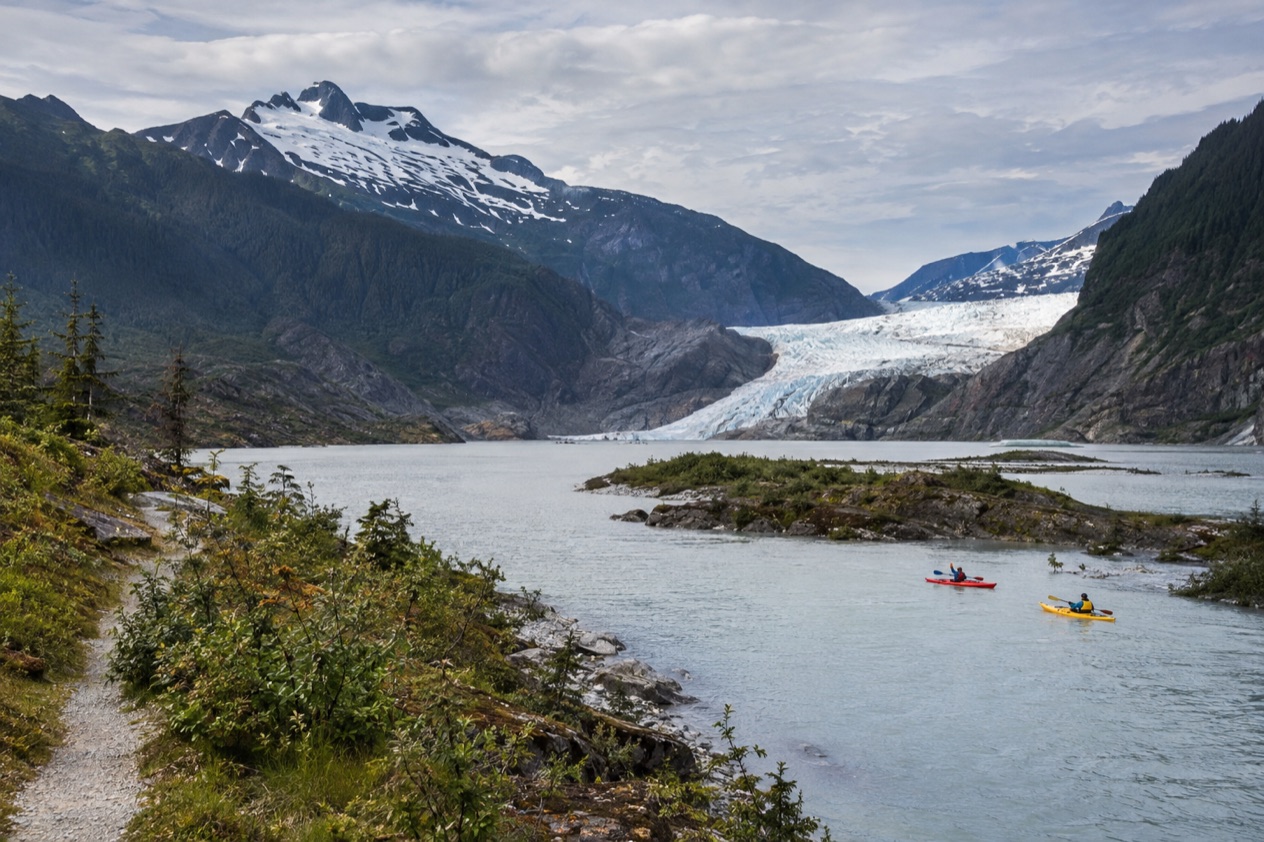
Mendenhall Glacier is the town’s great landmark, a long tongue of blue-white ice about 13.6 miles in length that ends at a lake dotted with small icebergs. It sits inside the 5,815-acre Mendenhall Glacier Recreation Area, part of the Tongass National Forest. You come for the view of the face, the sound of meltwater and the forest around it, and the light changes constantly, so a gray, drizzly day looks different from a bright one but just as striking.
Alaska SeaLife Center in Seward
The Alaska SeaLife Center stands on Railway Avenue in Seward, a harbor town at the head of Resurrection Bay. It is a nonprofit marine science center and a place to meet the cold-water animals of the state up close, which makes it a good companion to a day out on the water.
Inside, the exhibits bring together the seabirds, fish, seals and other creatures of Alaska’s coast. It is the sort of stop that gives meaning to what you see from a boat afterward, because you start to recognize what is flying, diving and swimming around you.
The Alaska Railroad and the White Pass line
The Alaska Railroad is a landmark you ride rather than visit. Its main line runs for over 470 miles between Seward on the southern coast and Fairbanks near the center of the state, passing through Anchorage and Denali National Park. Through the window you see rivers, spruce forest, mountain ranges and, on some days, the high white shape of Denali.
Its excursions climb through steep, rocky country that stampeders once crossed on foot with their supplies on their backs. The ride is as much a history lesson as a scenic trip.
Totem poles, Gold Rush towns and the Tongass
Southeast Alaska is where the Tlingit, Haida and Tsimshian peoples carved the totem poles that now stand in town parks and cultural centers. Ketchikan and Sitka are known for them, and walking among the poles, reading about the crests and families they honor, is one of the most thoughtful ways to spend an hour.
All around those towns is the Tongass National Forest, the largest national forest in the United States. It gives the region its dense green backdrop of spruce and hemlock, with mist hanging in the trees. Skagway’s wooden storefronts and Sitka’s Russian-era onion-domed church add other layers to the same coast.
Outdoor things to do in Alaska
Alaska’s wildlands are vast, and finding wildlife often takes knowledge and preparation. Watching Alaska’s wild creatures in their natural setting is a thrill for Alaskans and visitors alike, and the state’s wildlife viewing program can point out viewing opportunities, help you learn about the animals and provide safety tips.
Animals are always a chance, never a promise. You may see moose along a road, whales from a boat or bears at a river, and you may also see a gray sky and a quiet forest. The landscape itself is the sure thing.
Denali National Park and Preserve
Denali is the highest mountain in North America at 20,310 feet, and the national park around it was established on February 26, 1917. The mountain often hides in cloud, so seeing the summit is a lucky moment rather than a guarantee. When it appears, it rises over the tundra with a scale that makes the foothills look small.
The Denali Park Road runs 92 miles from the George Parks Highway to Kantishna, and it is the way into the park’s wild interior. Along it you look out over braided rivers, open tundra and mountain valleys where caribou, Dall sheep, moose and grizzlies sometimes appear. Bring binoculars and patience, and let the landscape set the pace.
Kenai Fjords National Park
Kenai Fjords National Park covers 669,984 acres on the Kenai Peninsula, west of the town of Seward. Its coast is a maze of fjords where glaciers spill from the Harding Icefield toward the sea. Boat trips from Seward are the way people see this scenery, and you may spot sea otters, puffins, seals or whales along the way.
Exit Glacier is the only portion of the park accessible by road, which makes it the place to stand beside the ice on land. It is a quieter experience than the boat, with the sound of wind and meltwater and the scent of the cold air coming off the glacier.
Glacier Bay National Park and Preserve
Glacier Bay lies in Southeast Alaska, west of Juneau, and covers 3,223,384 acres of mountains, fjords and tidewater glaciers. It is part of the Kluane/Wrangell-St. Elias/Glacier Bay/Tatshenshini-Alsek UNESCO World Heritage Site, inscribed in 1979. For travelers it is a place to see from the deck of a ship or a small vessel, as ice, rock and water slide by.
What you see depends on the weather and the light, from distant peaks to the blue walls of a glacier face. Listen for the crack and roar when ice breaks free. Calving is a chance, never a promise, but it is one of the great sounds of the north.
Katmai and its brown bears
Katmai National Park and Preserve is in southwest Alaska on the Alaska Peninsula, about 290 miles from Anchorage. It is notable for its brown bears and for the Valley of Ten Thousand Smokes, a volcanic landscape of ash and rock. The nearest significant town is King Salmon, where the park headquarters stands about 5 miles down the Naknek River from the park entrance.
Bear watching here is about patience and respect for the animals. You may see bears feeding along the water, and you follow the park’s rules for staying safe around them. The remoteness of the landscape is part of the appeal, a place where wildlife seems to set the schedule.
Northern lights, winter sports and fall color
Aurora season in Alaska is late August through early April, and Fairbanks, at about latitude 64.8, is a well-known base for watching it. The viewing season there runs roughly from August 21 to April 21. If the weather is clear and you stay at least three nights, it is highly likely that you will see the aurora.
Auroral activity tends to be more intense around the fall and spring equinox, so the likelihood over Interior Alaska is roughly twice as high then as at the solstices. Winter sports are best from November through March, and the fall colors come late August through September. Those are three different Alaskas, each worth the trip.
Day trips from Alaska
Because Alaska is so big, day trips start from a base town: Anchorage, Seward, Juneau or Fairbanks. The outings below are the ones that match the places described above, and each one gives you ice, water or wildlife in a single outing.
Mendenhall Glacier from Juneau
Mendenhall Glacier sits about 12 miles from downtown Juneau, so it is the natural outing from the capital. People go to see the face of the glacier across the lake, to walk in the forest and to take photographs that never quite capture the blue of the ice.
A cloudy or rainy day does not ruin it. Mist on the water and low clouds around the peaks give the scene a brooding mood, and the light often shifts within the hour. It suits anyone who wants a big glacier without a long journey, and pairs well with a stroll through Juneau’s old streets afterward.
Seward, Exit Glacier and Resurrection Bay
Seward is a harbor town at the southern end of the Alaska Railroad’s main line, which links it with Anchorage. It makes a base for visiting Kenai Fjords National Park, where Exit Glacier is the one part of the park reachable by road.
Seward suits travelers who like a lot of variety in a small place: glacier, fjord, aquarium and fishing harbor all within one town’s reach. Wear layers and bring a camera, because you move between forest, water and ice in a single day.
Glacier Bay from Juneau
Glacier Bay National Park and Preserve lies west of Juneau, and for travelers in the capital it is the big outing for a day devoted to ice and wild water. You go for the landscape: tidewater glaciers, steep mountains and the quiet of a place with few signs of people.
It suits those who like to watch rather than do, and who are happy to spend hours looking at a shoreline for a whale or a bear. Dress for cold air coming off the ice, and keep your camera ready for the moment a glacier calves.
Katmai and other bigger outings
Katmai National Park and Preserve is far from Anchorage on the Alaska Peninsula, and its gateway is King Salmon. It is the outing for travelers whose main wish is to see brown bears in their own landscape. The distance makes it more of an expedition than a casual excursion.
Smaller outings fill in the rest: Skagway and the White Pass and Yukon Route Railway for Gold Rush history, and Fairbanks for a night under the aurora in season. Each one is built around a single, strong idea, which is what makes Alaska day trips satisfying.
What to eat in Alaska
Eating in Alaska starts with the water. Salmon, halibut and king crab are the three names you will see on menus from Ketchikan to Anchorage, and they are served in every style from a casual harbor counter to a white-tablecloth dining room.
Salmon comes grilled on a cedar plank, smoked until it flakes, cured as lox or tucked into a chowder. Smoked salmon is the classic edible souvenir, and a slice on a cracker with cream cheese is a simple, satisfying snack for a boat deck or a train seat. The fish is part of the identity of the state, and the rivers where it spawns feed bears, eagles and people alike.
Halibut is the mild, white-fleshed fish that shows up as fish and chips, with a crisp golden batter and a squeeze of lemon. Travelers make a point of ordering it at least once in a harbor town, with a view of the boats that might have caught it. King crab arrives in big, spiny legs cracked at the table, sweet and rich with melted butter.
Beyond seafood, Alaska has a cozy comfort-food side. Reindeer sausage is grilled and served on a bun with onions, sourdough pancakes are a nod to the Gold Rush prospectors who kept starter alive, and birch syrup adds a woodsy, tangy note to breakfast. Berries such as blueberries and salmonberries turn up in jams, pies and sauces.
Drinks lean toward the craft side. Small breweries across the state pour amber ales, stouts and seasonal beers, often named for glaciers, mountains or the Gold Rush.
Look for the places where locals eat: harbor shacks, brewpubs, small bakeries and cafés with a wall of local art. A bowl of fish chowder with a hunk of bread, eaten while the weather changes outside the window, tells you as much about the place as any sight.
Things to do in Alaska at night
The great night activity in Alaska is looking up. Aurora season runs from late August through early April, and in Fairbanks the sky between April 22 and August 20 does not get dark enough to see the lights, even if the display is spectacular. Outside that window, a clear night is the thing to wait for.
In Fairbanks, a stay of at least three nights and clear weather make seeing the aurora highly likely. People watch from open fields and lodges, bundled in warm layers, sipping hot drinks and glancing up between conversations. Activity tends to be stronger around the equinoxes, so early fall and spring are the times when the odds improve.
The lights can be a faint gray glow or a moving green curtain, and no one can say which until it happens. That uncertainty is part of the charm. Travelers pass the waiting hours with a book, a card game or a quiet talk by a window.
When there is no aurora, evenings are for small-town pleasures. Anchorage has brewpubs, restaurants and live music rooms, while Juneau and Skagway have historic saloons where Gold Rush stories are part of the decor. A long dinner of seafood, a walk along the harbor and an early night after a big day outdoors are the usual rhythm.
In the darker months, winter sports add their own nights. From November through March, the season is on, and lodges and towns glow against the snow. After a day outside, the best finish is a warm room, a hot meal and a window facing the sky.
Things to do in Alaska with kids
Children in Alaska find their wonder in animals and ice. The Alaska SeaLife Center in Seward lets them meet marine creatures up close, and a boat trip in Kenai Fjords National Park gives them a chance to look for otters, seals, puffins and whales from the rail.
Mendenhall Glacier near Juneau is a glacier a child can see in a single outing, with a lake full of floating ice and a forest around it. Standing in front of a wall of blue ice, hearing meltwater and watching the clouds move, is the kind of moment that stays with a young traveler for a long time.
The Alaska Railroad turns distance into entertainment. Its main line passes through Seward, Anchorage, Denali National Park and Fairbanks, and kids can watch for moose, rivers and mountains from the window. A train ride suits families who want a way to see the land without the strain of constant driving.
Wildlife viewing is a good way to teach patience. Alaska’s wildlands are vast, and finding animals often requires knowledge and preparation, so talk with children beforehand about what you might see and how long looking can take. The state’s wildlife viewing program can provide safety tips, and following them matters most when bears or moose are near.
Distances are the main thing to keep in mind. Alaska is huge and mostly without roads, and Juneau is not reachable by road at all, so travel days can be long for small children. Plan one big outing a day, leave room for rest, and let the glaciers, boats and animals be the highlight rather than a crowded list.
A kid’s trip to Alaska can also include simpler pleasures: spotting eagles over a harbor, tasting a salmon dip or a blueberry treat, skipping stones at a lake, and listening to the stories of Gold Rush towns. Those small moments often turn out to be the ones children talk about at home.
Good to know before you go
Alaska is so large that you should think about how much you want to spend before you go, because getting between regions takes time and planning. Juneau cannot be reached by road, and most of the state is without roads, so air, rail and water are how travelers move around. The Alaska Railroad covers the middle of the state from Seward to Fairbanks.
Choose your season by what you want to see: fall colors from late August through September, the aurora from late August through early April, and winter sports from November through March. Pick one or two regions, leave space in the schedule for weather, and let the landscape do the rest.
Sources
- Alaska.org, trip ideas (https://www.alaska.org/trip-ideas), checked October 11, 2026
- Alaska.org, first trip (https://www.alaska.org/expert-advice/first-trip-to-alaska), checked October 11, 2026
- Wikipedia, Alaska (https://en.wikipedia.org/wiki/Alaska), checked October 11, 2026
- Wikipedia, Denali National Park and Preserve (https://en.wikipedia.org/wiki/Denali_National_Park_and_Preserve), checked October 11, 2026
- Wikipedia, Kenai Fjords National Park (https://en.wikipedia.org/wiki/Kenai_Fjords_National_Park), checked October 11, 2026
- Wikipedia, Glacier Bay National Park and Preserve (https://en.wikipedia.org/wiki/Glacier_Bay_National_Park_and_Preserve), checked October 11, 2026
- Wikipedia, Katmai National Park and Preserve (https://en.wikipedia.org/wiki/Katmai_National_Park_and_Preserve), checked October 11, 2026
- Wikipedia, Mendenhall Glacier (https://en.wikipedia.org/wiki/Mendenhall_Glacier), checked October 11, 2026
- Alaska SeaLife Center, Seward (https://www.alaskasealife.org/), checked October 11, 2026
- White Pass and Yukon Route Railway, Skagway (https://www.wpyr.com/), checked October 11, 2026
- University of Alaska Fairbanks Geophysical Institute, Aurora forecast (https://www.gi.alaska.edu/monitors/aurora-forecast), checked October 11, 2026
- Alaska Department of Fish and Game, Wildlife viewing (https://www.adfg.alaska.gov/index.cfm?adfg=viewing.main), checked October 11, 2026