
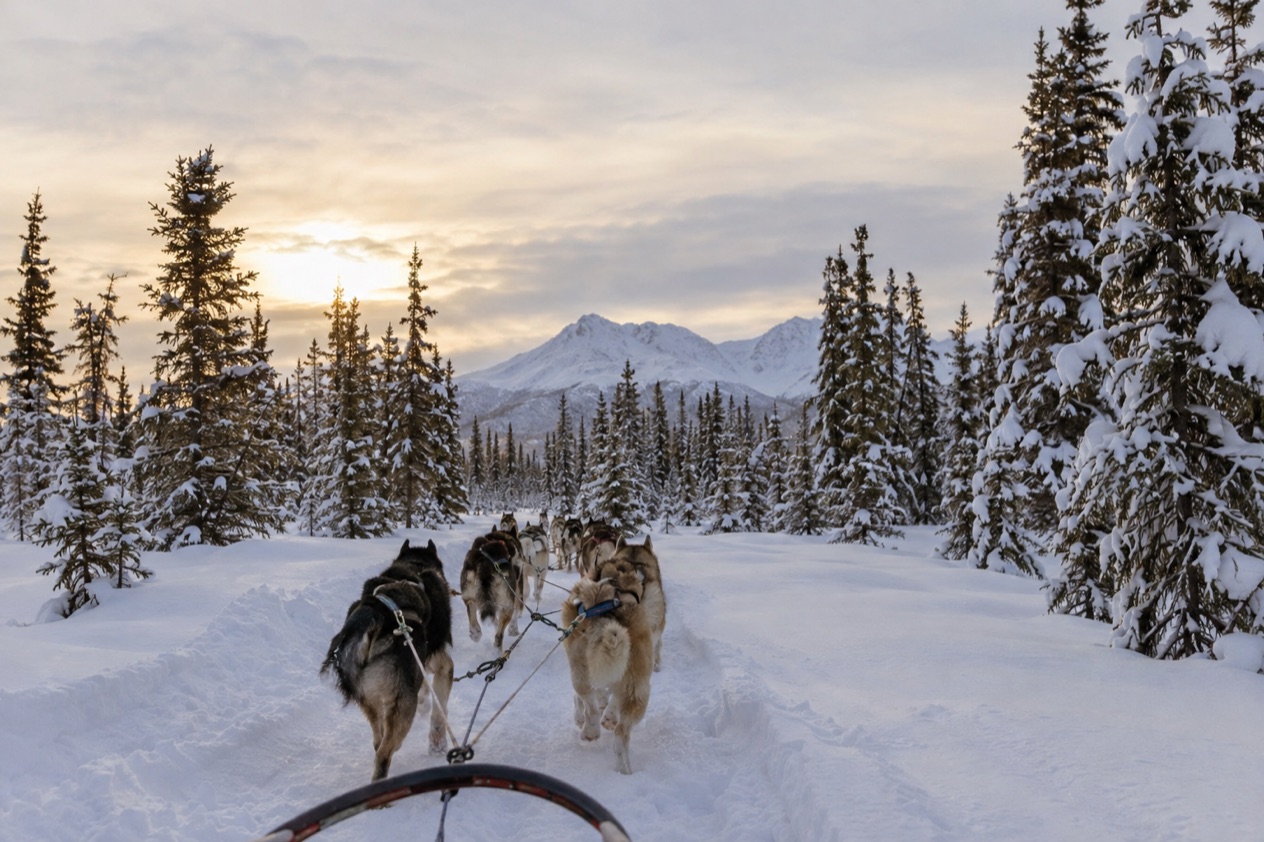
A team of huskies waits in harness, yipping and leaning into the lines, and then goes silent the moment the sled starts to glide. That hush, broken only by paws and runners on snow, is what people remember. In Alaska it happens around Anchorage, in the kennels of Denali and in the winter towns of the Interior, and it is described as the quintessential Alaska adventure.
Where can you go dog sledding in Alaska?
The places to start are Anchorage, Denali National Park and Preserve, and the Fairbanks area, each offering a different side of mushing culture. Anchorage is the one with a stated season for riding, Denali is the place to meet working sled dogs and learn how they live, and Fairbanks gathers its dog sledding into winter festivals.
What you find depends on whether you want to ride, to watch, or to understand the animals. Riding is the heart of the experience for most people, but spending an afternoon around the dogs themselves, seeing how they greet their rangers and how they sit in the snow, is a close second.
Anchorage
Dog sledding in Anchorage typically runs from October through March, which makes the city the most straightforward base for a winter ride. Flights reach Anchorage from U.S. cities across the country in winter, and the city can also be reached by road in winter, so you do not need to plan around a remote bush airstrip to get to the start line.
Anchorage also offers summer dog sledding, a surprise for anyone picturing mushing only as a snowbound activity. The experience changes with the calendar, but the dogs, the harnesses and the sense of being pulled along by a team that loves to run stay the same. This is also the city where the Iditarod begins each year, so the sport is part of the local identity, not just a tourist attraction.
Denali National Park kennels
Denali has kept a team of canine rangers for nearly its entire history, since the park was set aside in 1917. Its first superintendent, Harry Karstens, bought the first seven sled dogs for patrolling the park boundaries in 1922. Today the dogs at Denali are the only sled dogs in the United States that help protect a national park and the wildlife, scenery and wilderness in it.
In summer, rangers and dogs give demonstrations of a traditional Alaskan way of travel, and the program includes a tour of the kennels and a chance to visit Denali’s Alaskan huskies. It is a chance to watch the team work, not to ride, and the rangers explain why sled dogs were so central to getting around the park. There are no fees or reservations for the demonstrations.
The kennels have no parking, and groups cannot park there in any season. You can walk from the Denali Visitor Center on the Roadside Hiking Trail, about 2 miles each way, mostly uphill on the way to the kennels. In summer a free shuttle, the Sled Dog Demonstration Shuttle, boards at the Denali Visitor Center bus stop and needs no ticket or reservation.
| Denali sled dog program | Hours |
|---|---|
| Sled dog demonstrations, June 1 through early September | 10 am, 2 pm and 4 pm |
| Free shuttle from the Denali Visitor Center | 9:20 am, 1:20 pm and 3:20 pm |
| Kennels in summer | Generally 9:30 am to 4:30 pm |
| Kennels, late September through the winter | Saturdays and Sundays, 1 pm to 4 pm |
Fairbanks and winter festivals
Fairbanks does not have a single sledding address, but it has a winter calendar that puts mushing in a festive setting. Denali Winterfest, which runs from the end of February to the beginning of March, features dog sledding alongside a 5K race, snowshoeing, hiking and park ranger programs. It is a good fit if you like your dogs with a side of other winter activities.
The Fairbanks area also has Chena Hot Springs, where a Dog ATV Tour is part of the activity list. It is a different kind of ride from a sled, so it suits visitors who want to be around the dogs even when the trail is not under snow.
When is the season?
Dog sledding in Anchorage typically runs from October through March, and the broader winter calendar stretches from the Winter Solstice Celebration in December to the Iditarod in March. Alaska also offers things in summer, including summer dog sledding in Anchorage and the Denali demonstrations, so you can meet the dogs outside the snow season.
Late fall and early winter
From late September through the winter, the Denali kennels shift to a weekend schedule, open Saturdays and Sundays only. The summer demonstrations are over by then, since they run from mid-May to mid-September, but you can still visit the dogs and see them in their cooler-weather rhythm. When most of the Denali Park Road is closed and vehicle access to the park is limited, winter mushing routes become one of the best ways to experience the backcountry of Denali.
Visitors who own their own dogs are welcome to mush or skijor in the park, which is a small reminder that the sport here is not only a show. Most travelers will not bring a team, but it explains why the park keeps its own dogs and why the kennels are so central to the place.
December brings the Winter Solstice Celebration to Downtown Fairbanks during the week of December 21. Fireworks light up the sky, something you cannot see in the summertime. Even if you are not riding a sled that week, the town is a good place to feel the season, with the cold, the lights and the sense that the long night is being celebrated rather than endured.
Late winter: ice art and Winterfest
Late February and March are the busiest stretch for winter events. Ice art sculptures are displayed around Fairbanks from mid-February to the end of March. The World Ice Art Championships, held late February through March, features over 80 ice sculptures by international carvers, and the International Ice Art Classic adds ice slides and an ice playground.
Denali Winterfest overlaps this window with dog sledding and the rest of its program. Pairing sculpture viewing with a dog sledding outing is a natural way to build a Fairbanks winter trip, since the festival season gives you something to do on the days you are not on a trail.
The Iditarod in March
The Iditarod Trail Sled Dog Race is an iconic winter event in Alaska. It begins with a ceremonial start in Anchorage on the morning of the first Saturday in March, when mushers run from Anchorage to Eagle River before the race proper heads north and west. Watching teams leave the city streets is a spectacle in itself, with crowds, barking dogs and the feeling that a long journey is starting.
The modern race is an endurance run of about 1,100 miles that usually lasts ten to eleven days, weather permitting. The trail was established on the path between Nenana and Nome after the 1925 serum run, and sled dogs once delivered the mail in Alaska in the late 1800s and early 1900s. Those who cannot be in Anchorage can follow along on Iditarod.com, where visitor access includes race standings, short video previews and free live broadcasts.
How do the tours work?
A dog sledding outing is built around the team itself, and knowing how a team is organized makes every ride and demonstration more rewarding. In Alaska, sled dogs traditionally pull side by side in pairs, not in a fan shape, and the sleds are typically the built-up type with a high rail on each side.
Meeting the team
The lead dog is crucial, which is why mushers take extraordinary care of these animals. Behind the leaders you may find point dogs, which are optional, and at the back are the wheel dogs, powerful animals that help pull the sled out from the snow. Watching which dog takes which place tells you a lot about how a team thinks.
The dogs themselves vary. Siberian Huskies and Alaskan Malamutes are the main types used for recreational sledding because of their strength, speed, endurance and ability to withstand cold.
Alaskan huskies are popular for racing, valued for endurance, good eating habits, speed and a dedication to running even when tired. Malamutes were thought to be bred by the Malimiut Inupiaq people of Alaska’s Norton Sound region, and the breed became extremely valuable to prospectors and settlers during the Klondike Gold Rush of 1896.
Demonstrations at Denali
The ranger-led demonstrations are the clearest example of how an outing is organized. They last half an hour, and rangers and dogs show how a traditional mode of Alaskan travel works. Afterward you can tour the kennels and meet the huskies, so the visit is part show, part introduction to the working life of the dogs.
In early and late season, from mid-May to mid-September, one or two demonstrations a day are offered, and the schedule grows to three daily in the peak weeks. The free shuttle leaves the Denali Visitor Center roughly 40 minutes before each one. The shuttles serve the entrance area, the kennels and other stops along the park road up to mile 15.
Chena Hot Springs Dog ATV Tour
At Chena Hot Springs, the Dog ATV Tour is one of the activities on offer, with its details laid out in the table. It is a short outing, and the age minimum means families with older children can join together.
| Tour | Price | Duration | Minimum age |
|---|---|---|---|
| Dog ATV Tour, Chena Hot Springs | $65 per person | 30 minutes | 5 and up |
What a sled is for
The built-up Alaskan sled with its high side rails is designed for carrying lighter items such as clothing, a reminder that mushing here began as a way to move people and supplies across the country. A sled dog is simply a dog trained to pull a land vehicle in harness, most commonly a sled over snow, and that plain definition covers everything from a Denali ranger’s team to an Iditarod racer.
Even the Alaskan Malamute has a larger history, serving in World War II mainly as a search and rescue dog in Greenland and helping Rear Admiral Richard Byrd reach the South Pole. Those stories are the backdrop to every outing, whether you ride, watch or simply visit the kennels.
Good to know before you go
The Denali kennels follow a seasonal rhythm, with weekend-only hours from late September through the winter, so plan a visit around those days. Most of the Denali Park Road is closed in winter, and the kennels have no parking in any season, so budget time to walk or take the shuttle in summer.
The Chena Dog ATV Tour carries its own price, and the Denali demonstrations are free, so costs on a dog-focused trip range widely. Check the Iditarod’s start date each year, as it falls on the first Saturday in March.
Sources
- Visit Anchorage, dog sledding (https://www.anchorage.net/winter/things-to-do/dog-sledding/), checked October 11, 2026
- Wikipedia, Dog sled (https://en.wikipedia.org/wiki/Dog_sled), checked October 11, 2026
- Wikipedia, Sled dog (https://en.wikipedia.org/wiki/Sled_dog), checked October 11, 2026
- National Park Service, Denali National Park & Preserve, plan your visit: kennels (https://www.nps.gov/dena/planyourvisit/kennels.htm), checked October 11, 2026
- National Park Service, Denali National Park & Preserve, plan your visit: sled dog demonstrations (https://www.nps.gov/dena/planyourvisit/sled-dog-demonstrations.htm), checked October 11, 2026
- Iditarod Trail Committee, the Iditarod (https://www.iditarod.com/), checked October 11, 2026
- Explore Fairbanks, winter events (https://www.explorefairbanks.com/events/winter-events/), checked October 11, 2026
- Wikipedia, Alaskan Malamute (https://en.wikipedia.org/wiki/Alaskan_Malamute), checked October 11, 2026
- Chena Hot Springs Resort, activities (https://www.chenahotsprings.com/activities), checked October 11, 2026
- National Park Service, Denali National Park & Preserve, plan your visit: directions (https://www.nps.gov/dena/planyourvisit/directions.htm), checked October 11, 2026
- National Park Service, Denali National Park & Preserve, plan your visit: courtesy shuttle buses (https://www.nps.gov/dena/planyourvisit/courtesy-shuttle-buses.htm), checked October 11, 2026