
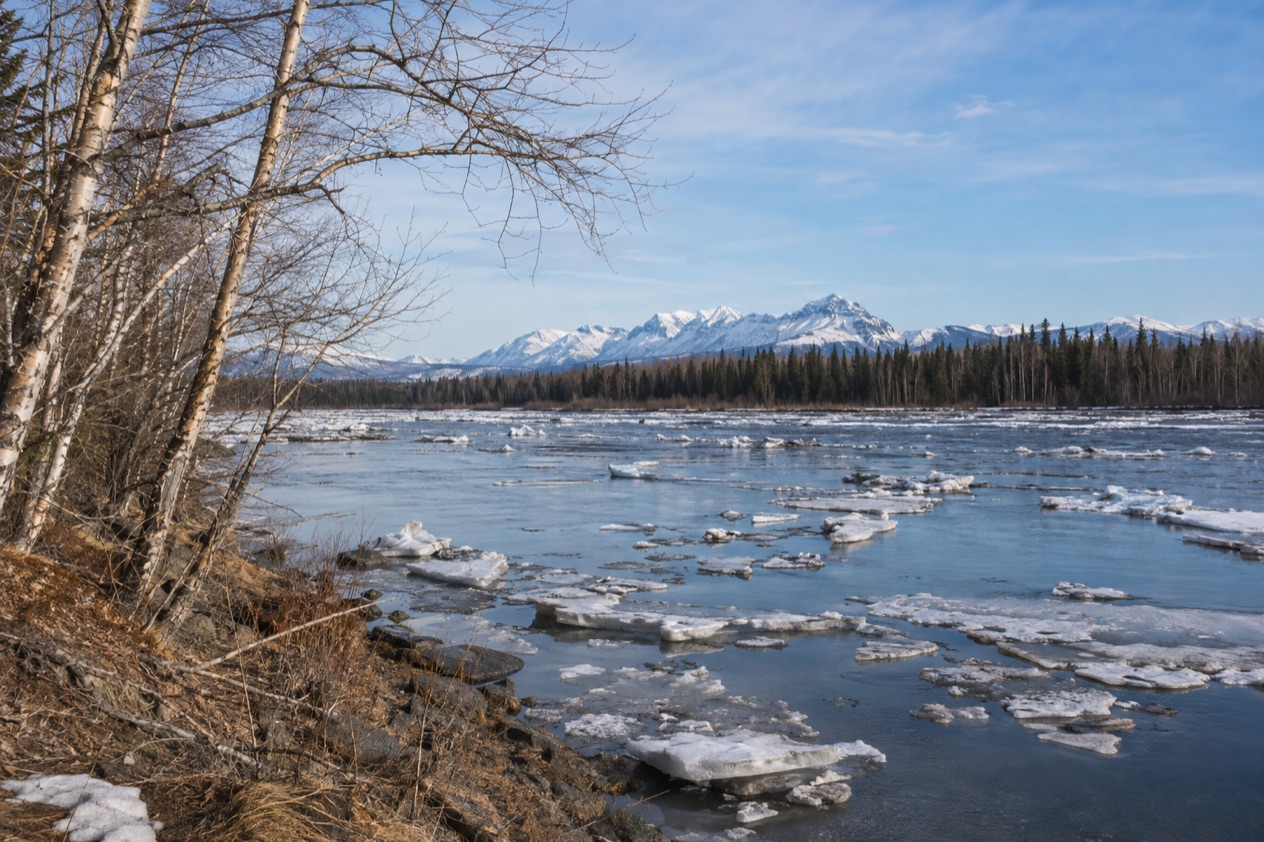
On the bank of the Tanana River in Nenana, people stand with coffee and watch a tripod planted out on the ice, waiting for the moment the river lets go. Somewhere a clock is ticking, and a lot of Alaskans have a few dollars riding on the exact minute. Spring in Alaska is the season of that wait: snow going gray, roads opening one section at a time, and Denali’s long road creeping a little farther each week.
What is spring like in Alaska?
Spring in Alaska is a season of thaw and half-open doors, when winter lingers in the shade and the first summer services have not yet started. It looks different in every corner of the state, and in many places it is the muddy, in-between stretch that locals call breakup.
The state is too big for one climate. Juneau and the Southeast are wet country, with more than 50 inches of precipitation in a typical year, and some pockets of the Southeast get several times that. Anchorage is far drier, with 16 inches of precipitation a year. The northern side of the Seward Peninsula is technically a desert.
On the North Slope and in Utqiaġvik, the northernmost city in the country, snow can fall in any month, so spring there is a matter of degrees. Plan each stop on its own terms and do not expect one season to apply across the map.
What spring does bring everywhere is a change of mood. Days stretch out, people come outdoors, and the talk in cafés and at gas stations turns to when the ice will go and when the roads will open. It is a quiet time to visit, with the feeling of a place getting ready.
Breakup on the Tanana River at Nenana
Nenana is a small river town on the Alaska Railroad line, and its spring belongs to the Nenana Ice Classic. The contest asks one question: at what exact time will the ice on the Tanana River break up?
The tripod stands on the river ice between the highway bridge and the railroad bridge, tied by a line to a clock on shore. When the ice moves and carries the tripod away, the line snaps and stops the clock. That frozen time decides the winners.
The river freezes in the fall and by early April the ice is at its thickest, so the breakup is a dramatic thing, a slow groan and then a sudden shifting. The table gives the pattern from the record. Afternoons have been the favorite hour for the ice to go, which is why the riverbank fills after lunch when the weather is turning.
| Tanana River at Nenana | Record |
|---|---|
| Average peak ice thickness, on April 1 | 41 inches |
| Earliest ice melt date on record | April 14 |
| Latest ice melt date on record | May 20 |
| Most common melt time | Between noon and 4:00 PM |
Denali in the shoulder weeks
At Denali National Park and Preserve, the park counts spring from early or mid-April until May 19. In those weeks the park is quiet and the snow is slowly pulling back from the road. The main visitor center is the Winter Visitor Center at mile 1.4 on the Denali Park Road, and it is also where visitors pay the entrance fee.
The season has its own rhythm. The road opens in stages depending on snow, and the mountain country feels wide and empty before the summer buses begin. Healy, the small town 11 miles north of the park entrance, keeps some year-round lodging open, so a night nearby is possible while the rest of the area wakes up.
What can you do?
In spring you can join a statewide guessing game, drive the first stretch of Denali’s famous road, camp for free at the park entrance, and watch an Alaska tradition play out on a frozen river. The activities are modest and tied to the thaw, and that is much of the charm.
Play the Nenana Ice Classic
Tickets are on sale from February 1 through April 5 throughout Alaska, and buyers must be 18 or older. You write down a guess for the day and minute the tripod will fall, then wait.
The contest is a non-profit charitable gaming organization, and its proceeds help many volunteer and non-profit groups. Over 10 million dollars in prize money has been paid out since it began, which explains why gas stations and shops across the state have the tickets by the register in the weeks before the deadline.
Even if you are not in Nenana, you can follow the river. A live webcam of the Tanana, provided by Borealis Broadband, gives a view of the ice and the tripod. In Nenana itself, watching from the bank between the two bridges is the whole experience, and the afternoon is when people tend to gather. It suits anyone who likes a small-town ritual with a bit of suspense.
Drive the Denali Park Road as it opens
In spring the Denali Park Road opens first to Savage River at mile 15 and then to Teklanika River at mile 30, sometime in April or early May depending on snow conditions. Before the summer bus system begins, that means a window when you can travel into the park in your own vehicle, with the mountains and the tundra opening out as you go. Dates move with the weather, so the road you see on one trip may end earlier or later than on another.
Tsenesdghaas Na’ Trailhead, near milepost 231 on the George Parks Highway, opens to vehicles on May 1, or later if snow is still on the ground. It gives you another way into the park’s country once the snow gives way. Backpacking in Denali is possible year-round with a free backpacking permit, so spring is also open to people who want to walk in.
Camp at Riley Creek
Riley Creek Campground, at the park entrance, stays open through spring and camping there is free through mid-May. The Bear Loop of the campground is open year-round, and camping there is free from mid-September to early May.
Nights can still be cold and the ground wet from the melt, so this is a season for people who like simple camping and quiet surroundings. It also puts you a short step from the Winter Visitor Center.
Follow the Iditarod story
The Iditarod is the great sled dog race across Alaska, and its story carries into the thaw season. The ceremonial start is in downtown Anchorage at Fourth Avenue and D Street, where spectators watch the mushers depart.
The official restart is in Willow, 80 miles north of Anchorage, the day after. From there the trail climbs through Rainy Pass in the Alaska Range, passes towns such as Skwentna, McGrath and Unalakleet, follows the Bering Sea shore and ends in Nome.
Spectators can fly to a checkpoint such as Skwentna, a 40-minute flight from Anchorage, to see the mushers. In Nome, the finish is at the burled arch on Front Street, and a Widow’s Lamp is lit there until the last musher arrives. Standing at the arch, you feel how long the trail is and how many people it keeps waiting.
What is not open yet?
The big summer machinery of Denali is not running yet, and the deepest parts of the Denali Park Road are still closed to private vehicles or waiting on snow. The spring pattern is simple: things open in stages, from the park entrance outward, as the snow lets go.
The far reaches of the Denali Park Road
Savage River at mile 15 and Teklanika River at mile 30 are the first targets, and beyond them the road is not part of the spring picture. Transit bus service begins on May 20. On that day private vehicles are restricted beyond Savage River, so the open-road window ends. If you want to go deeper into the park by road, that is a summer experience, not a spring one.
The park defines spring as ending on May 19, so that date is a clean line. Before it, the road feels like a long approach to something larger. After it, the park shifts into its busy summer routine.
| Place or service | Spring detail |
|---|---|
| Denali Park Road to Savage River (mile 15) | Opens in April or early May, depending on snow |
| Denali Park Road to Teklanika River (mile 30) | Opens in April or early May, depending on snow |
| Tsenesdghaas Na’ Trailhead | Opens to vehicles May 1, or later if snow remains |
| Transit buses on the Denali Park Road | Begin May 20 |
| Private vehicles beyond Savage River | Restricted from May 20 |
| Riley Creek Campground free camping | Through mid-May |
| Winter Visitor Center (mile 1.4) | Main visitor center until early May |
Winter services winding down
The Winter Visitor Center is the main visitor center at Denali from late September through early May, and that is where visitors can pay the entrance fee. As spring moves into May, the park changes gear and the main focus shifts away from the winter operation. The free camping at the Riley Creek Campground also comes to an end in mid-May, and the Bear Loop’s free season ends in early May.
The Tanana River itself is a reminder that not everything has opened. Until the ice goes out, the tripod stands on a frozen river and the clock keeps running. It is a good image for the whole season: the sense that something large is about to happen.
Good to know before you go
Spring dates move with snow and ice, so the Denali road and trailhead openings are given as windows rather than fixed days. Snow can still fall in the far north in any month, and the Southeast stays wet. Nenana tickets are for adults only and the fee is below. Backpacking in Denali needs a free permit.
| Fee | Amount | Who pays |
|---|---|---|
| Nenana Ice Classic ticket | $3.00 | Anyone 18 or older buying a ticket |
Sources
- Wikipedia, Nenana Ice Classic (https://en.wikipedia.org/wiki/Nenana_Ice_Classic), checked October 11, 2026
- National Park Service, Denali National Park & Preserve, plan your visit: shoulder season (https://www.nps.gov/dena/planyourvisit/shoulder-season.htm), checked October 11, 2026
- Wikipedia, Climate of Alaska (https://en.wikipedia.org/wiki/Climate_of_Alaska), checked October 11, 2026
- Wikipedia, Iditarod Trail Sled Dog Race (https://en.wikipedia.org/wiki/Iditarod_Trail_Sled_Dog_Race), checked October 11, 2026