
In the cottonwoods along the Chilkat River, bald eagles sit shoulder to shoulder on bare branches, and the air carries the thin, odd chatter of birds that sound smaller than they look. Behind them the mountains drop straight into the Lynn Canal, and the parade ground of an old army post sits quiet in the mist. Haines is a small port community in Southeast Alaska, built for people who like their travel slow, outdoors and close to local life.
What are the best things to do in Haines?
The best things to do in Haines are watching eagles on the Chilkat River, walking around Fort William H. Seward, learning about the Tlingit who have lived here for generations, and driving the Haines Highway toward the Yukon. Around those four, the town fills in with museums, a brewery, seafood and long evenings by the water.
- Watch the eagles of the Alaska Chilkat Bald Eagle Preserve, where the gathering between October and February is the reason many people come at all.
- Walk the grounds of Fort William H. Seward, a National Historic Landmark where old officers’ houses now shelter shops, studios and restaurants.
- Look at Tlingit art, from carved poles to the woven designs of the Chilkat people, and learn whose country you are standing in.
- Drive the Haines Highway as far as your day allows, along the route of the old Dalton Trail toward Haines Junction in the Yukon.
- Stop at the town’s small museums, which tell the story of the fort, the gold-rush trails and the eagles themselves.
- Plan around the Southeast Alaska State Fair, four days of festivities on the last weekend of July.
- Eat seafood and drink local beer in a town where the menu follows the water.
- Spend an evening watching light change over the Lynn Canal, the longest fjord in the state.
Haines rewards people who give it time. It is a handful of good places close together, set in a valley that feels much bigger than the town.
Right now, in the second week of October, the eagles are the story. The gathering is just beginning to build along the river, and the rest of the town is quieter than it is in the height of summer. If you want the valley at its most atmospheric, this is a very good moment to arrive.
Sights and landmarks in Haines
The sights of Haines are modest in scale and rich in story: a former army fort, small museums run with obvious pride, and a waterfront that still works for a living. You can see most of them on foot over a day or two, and each one tells you something about why this corner of the Lynn Canal matters.
Fort William H. Seward
Fort Seward was an army post, and it was declared a National Historic Landmark in 1978. Its big white buildings, with their porches and tidy rooflines, face a wide parade ground, and the whole place has the look of a small college campus dropped between the mountains and the water. Some of the structures are open to the public as businesses and restaurants, so a stroll here easily turns into a coffee, a browse through a gallery or a meal.
Walk the perimeter slowly. The former officers’ houses line one side, the barracks-style buildings another, and you will notice how the layout still follows the plan of a military post. Look for carvers and artists at work in the studios around the grounds, because crafts and arts are part of daily life here, and the setting suits them.
The fort is best in soft or low light, when the white clapboard glows against dark spruce. It suits anyone who likes history without a ticket window, and it works well as a first walk after arriving, since it gives you your bearings in town.
Tlingit art and heritage
Long before the fort, this was Tlingit country. The Chilkat Tlingit lived along the Chilkat River and on the Chilkat Peninsula, and the Chilkoot Tlingit lived nearby, together controlling one of the mountain passes into the Yukon interior. That control of the trade route shaped everything about the region, and it is the reason the Dalton Trail later followed the same ground.
In Haines, that heritage shows up in carved poles, in clan house designs and in the formline art that appears on gallery walls and in shop windows. The Chilkat style of weaving, with its flowing, geometric figures, is among the most recognized art forms of the Northwest Coast. Treat any ceremonies or gatherings as the community’s own, and look at what is publicly displayed with the attention it deserves.
If you buy art, ask who made it and where they are from. Many local artists are glad to talk about their work, and a conversation is often the best souvenir.
Museums and the waterfront
Haines has a small cluster of museums, and they suit a gray afternoon well. The Sheldon Museum tells the story of the town, from Tlingit life and the gold-rush years to the building of the fort. The American Bald Eagle Foundation shows mounted birds and explains the science of the gathering, which gives context before you head to the river.
The Hammer Museum is a quirky stop, entirely devoted to a tool most of us never think about. It sounds like a joke and turns out to be a charming little collection, and it is the kind of place that makes people smile on the way out.
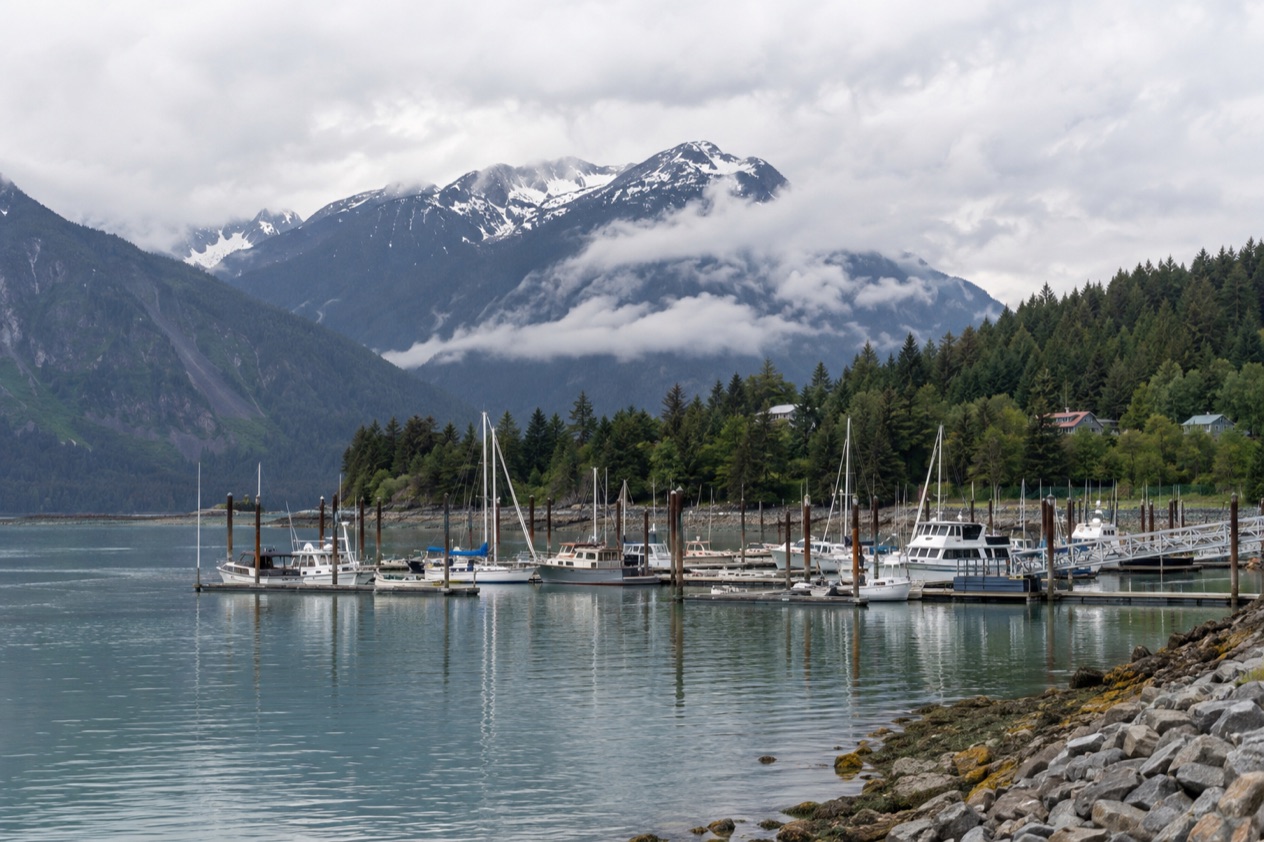
Down at the harbor, fishing boats and small craft sit against the backdrop of the fjord. Stand at the edge and look across the Lynn Canal. The water is wide and cold, the mountain walls are steep, and you quickly see why this is Alaska’s longest fjord.
Smaller landmarks include the old fort’s former buildings now used as lodging and studios, and the Main Street shops with their local books, prints and handmade goods.
Outdoor things to do in Haines
Outdoors in Haines means eagles first, then river valleys, mountain views and the long reach of the Lynn Canal. The landscape is big and mostly wild, and the best way to take it in is to pick one or two things a day and let them take their time.
The Alaska Chilkat Bald Eagle Preserve
The preserve is a state park and wildlife refuge near Haines, and it covers 49,320 acres, mainly along the Chilkat River, with sections along the Klehini and Tsirku rivers. Between 200 and 400 bald eagles live here all year. Then, between October and February, the numbers swell dramatically, and Haines has the largest concentration of bald eagles in the world.
Up to 4,000 eagles have been observed during the annual Fall Congregation. They come to feed on the late salmon that run in the river, and the open water, kept from freezing by the flow beneath the gravel, draws them in. You may see birds lined along the cottonwoods, dropping to the bars, squabbling over fish and lifting off together in a rush of wings.
Bring binoculars and patience. Eagle watching is mostly about waiting, then suddenly watching a flurry of activity. Go to the river with no agenda beyond looking, and give it a good stretch of time. Because this is wildlife, sightings are always a chance, never a promise.
The Lynn Canal and its mountains
Haines sits on the shores of the Lynn Canal, and the fjord defines the view from almost everywhere in town. Mountains rise steeply on both sides, and in autumn the peaks may carry fresh snow while the valley floor is still wet and green and gold. Cloud often sits low on the slopes, then lifts to show a ridge you had not noticed.
A walk along the shore, with no destination, is one of the best ways to see it. Watch for seabirds, for the movement of small boats and for the changing color of the water as the weather shifts. This is a place to look rather than to swim, because the water here is cold.
Haines Airport sits on the Haines Highway about 4 miles west of town, and arriving by air gives you a sense of how the fjord and valleys fit together. From the ground, the same geography makes the town feel tucked into the edge of something much larger.
Rivers, valleys and wildlife watching
Beyond the main river, the Klehini and Tsirku sections of the preserve extend the wild country around Haines. These are quieter corners of the valley, shaped by glacial water and braided gravel bars, and they are worth knowing about if you like to see how the landscape changes from one stretch to the next.
Alaska wildlife is a matter of chance. Eagles are the reliable headline here in the right months, but the valley is also home to other animals, and any outing can bring a surprise. Follow the posted rules of the preserve and of the agencies that manage it, and keep your attention on the landscape as much as on your camera.
Dress for weather that can change quickly, and keep your plans loose. A flexible day outdoors in Southeast Alaska often turns out better than a rigid one.
Day trips from Haines
The day trips from Haines mostly follow the one road out of town, the Haines Highway, and the river valleys that branch from it. This is the only road access to Haines from the rest of the continent, and it leads through some of the most open country in the region.
The Haines Highway toward Haines Junction
The Haines Highway connects Haines with Haines Junction in the Yukon, passing through British Columbia on the way. The Alaska section is part of Alaska Route 7, and about 45 miles of the whole 152-mile road lie in Alaska. The Canadian border is 39 miles from Haines, and the junction with the Alaska Highway at Haines Junction is 147 miles from town.
For a day trip, people go as far as time and curiosity allow rather than aiming for the far end. You leave the fjord behind, climb through a valley of spruce and cottonwood, and gradually enter a drier, more open landscape that feels very different from the coast. The change is the point of the drive.
Because the road crosses an international border, anyone planning to go beyond the Alaska section should look into what that involves before setting out. The border is a real part of this drive, and it is worth planning around.
The Dalton Trail and Klukshu
The Haines Highway follows the route of the old Dalton Trail, running from the port of Haines inland for about 110 miles to Klukshu, Yukon, and then continuing on to Haines Junction. The trail began as a Tlingit trade route over the mountains, and later became a path for prospectors and cattle drives during the gold-rush era.
Knowing this changes the drive. You are not just on a road, you are following a corridor that people have used for a very long time. The Chilkat Tlingit controlled one of the mountain passes into the Yukon interior, and the valley you pass through is the same one that carried goods in both directions.
Klukshu is a name worth keeping in mind as a landmark on the way. It suits travelers who like their road trips with a bit of history behind them.
The Klehini and Tsirku river valleys
Not every day trip needs to cross a border. The Klehini and Tsirku rivers form parts of the Alaska Chilkat Bald Eagle Preserve, along with the main Chilkat River, and exploring these valleys gives a sense of how the whole watershed works together.
A day spent following the river valleys is a good way to see how the same water that feeds the eagles in autumn shapes the whole landscape. Stop where the road allows, look at the gravel bars and the standing trees, and notice how the light moves across the mountain walls.
This kind of day suits anyone who prefers to look closely at one place rather than rush toward a distant destination. Pair it with a visit to the museums for context, and the valley starts to make sense as a connected whole.
What to eat in Haines
Eating in Haines means seafood first, and a small-town menu shaped by the cold water and the river. The town is small, so the choices are not endless, but the food tends to be honest, local and often made by people who live here.
Salmon is the center of the Alaska table. You may find it grilled, smoked, baked on a plank or turned into chowder, and in a place where the same fish feeds the eagles outside the window, it feels especially fitting. Halibut is another staple, often served as fish and chips with a crisp, golden coating, and you will meet Dungeness crab and shrimp on menus when they are in season.
Smoked fish deserves its own mention. Smoking is an old way of preserving the catch, and in Southeast Alaska it remains both a tradition and a craft. A little smoked salmon, a piece of bread and something hot to drink make a very good lunch.
The restaurants in the old officers’ buildings at Fort Seward make a pleasant setting for a meal, with their porches and high windows. Elsewhere in town you will find casual cafés, bakeries and small kitchens where the daily special is written on a board.
Beer here tends toward hearty styles that suit the climate, and a pint beside a window with a view of the mountains is hard to beat.
For something sweet, look for local baked goods, berry pies and jams. Wild berries are part of Alaska cooking, and you may see them on dessert menus or in jars at local shops. Coffee is also taken seriously, and a hot cup is a good companion on a cool, damp morning by the river.
Bring an appetite for simple, well-made food rather than elaborate dining. A day outside, a warm meal and good conversation are the pattern, and it works.
Things to do in Haines at night
Nights in Haines are quiet and unhurried. This is not a place of clubs and late-night crowds, and the pleasure is in a warm room, a good drink and the dark outside the window.
A natural first stop is a pub or brewery, where locals and visitors share long tables and talk about the day. Conversation is the main entertainment, and it tends to range from eagles and weather to the roads and the news of the valley. If there is live music, it is usually small and local, and it suits the room.
A dinner at Fort Seward is another good evening. The old buildings feel different after dark, with lit windows around the parade ground and the mountains disappearing into the sky. Walk the grounds before or after your meal, and you will see why the fort is so pleasant when the day is done.
At this time of year, the evenings are getting longer and darker as autumn deepens. That makes it a good moment for indoor pleasures: a book, a meal, a fireplace. It also means the sky can be worth a look on clear nights, though the aurora is only ever a chance, never a promise, and no one should plan an evening around it.
In the summer, the fair and other community events give the town a livelier evening feel. The Southeast Alaska State Fair, held on the last weekend of July over four days, brings music, food and gatherings that draw people from around the valley.
A last option is simply to walk to the water. The harbor after dark, with boat lights reflecting on the Lynn Canal and the mountains a darker shape against the sky, is a good way to end the day. Bring a warm layer, take your time and let the quiet do its work.
Things to do in Haines with kids
Children in Haines tend to be won over by the animals, the open space and the sense of a town small enough to explore. It is a place where curiosity does most of the work.
The eagles are an obvious draw. Many kids enjoy spotting the huge birds along the river, counting how many sit in a single tree and watching them swoop for fish. Bring binoculars, let them take turns looking and invite them to notice details, such as the white heads, the yellow beaks and the way the birds squabble.
The American Bald Eagle Foundation, with its mounted birds, gives children a close look at animals that are hard to see up close in the wild. The Hammer Museum, with its odd collection of tools, tends to amuse people of all ages. The Sheldon Museum adds stories of the gold rush and of Tlingit life, which can spark questions about how people lived here long ago.
Fort Seward offers plenty of room to run on its wide parade ground, and the old buildings make good material for imagination. Ask children to picture the soldiers who once lived here, and the place comes to life.
Keep a few practical things in mind. Weather in Southeast Alaska can be damp and cool, so layers and waterproof gear help a lot. Distances in the valley are real, so build in time for breaks, snacks and a flexible pace.
If you plan to drive the Haines Highway with children, treat it as a big outing and bring what you need for the day. The road crosses an international border, and that adds a step worth planning for.
Good to know before you go
Haines is a small town, and its main sights sit close together, which makes it a place to take at an unhurried pace. The only road out of town is the Haines Highway, and the airport sits on that road about 4 miles west of town.
Some services and attractions in Haines may operate on their own seasons, so it is wise to confirm the specific places you plan to visit. Eagle season, from October to February, is the main draw in the colder months, and the fair on the last weekend of July is the main event of summer.
Sources
- Wikivoyage, Haines (https://en.wikivoyage.org/wiki/Haines), checked October 11, 2026
- Wikipedia, Haines, Alaska (https://en.wikipedia.org/wiki/Haines,_Alaska), checked October 11, 2026
- Wikipedia, Haines Highway (https://en.wikipedia.org/wiki/Haines_Highway), checked October 11, 2026
- Wikipedia, Chilkat Bald Eagle Preserve (https://en.wikipedia.org/wiki/Chilkat_Bald_Eagle_Preserve), checked October 11, 2026
- Wikipedia, Southeast Alaska (https://en.wikipedia.org/wiki/Southeast_Alaska), checked October 11, 2026
- Wikipedia, Tlingit (https://en.wikipedia.org/wiki/Tlingit), checked October 11, 2026