
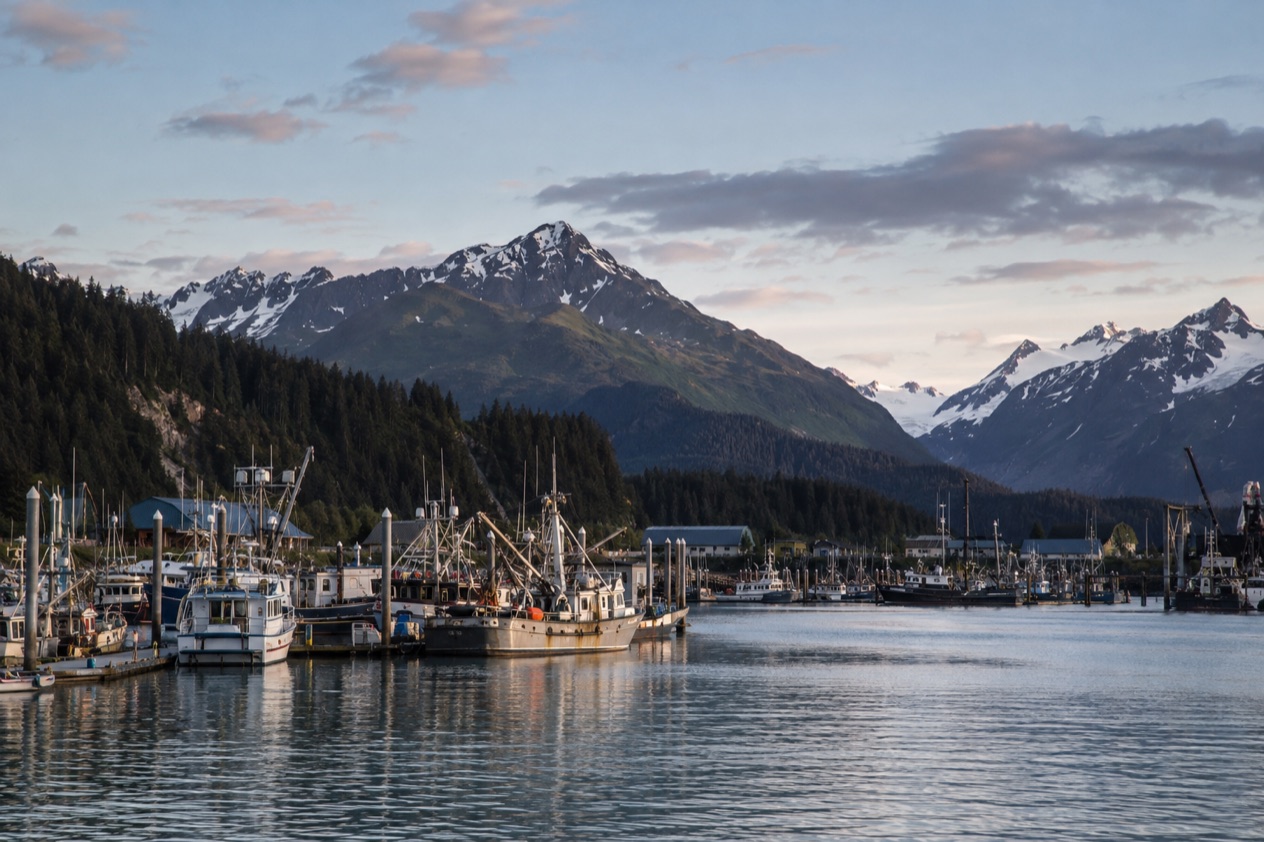
Along the small boat harbor in Seward, masts clink, gulls argue over fish scraps, and fishing boats ease in past Mt. Marathon, which rises steeply behind the rooftops. The town sits at the head of Resurrection Bay with mountains on one side and the waters of Kenai Fjords National Park on the other. It is a working port with a glacier at its doorstep, and it suits travelers who want boats, fish, trails and a main street that is easy to wander.
What are the best things to do in Seward?
The best things to do in Seward all revolve around the water, the ice and the mountains that frame the town, and most can be reached without going far from the harbor. Here are the essentials, each one developed further on.
- Walk toward Exit Glacier, the only part of Kenai Fjords National Park that you can reach by road, and see an active glacier up close.
- Spend a few hours at the Alaska SeaLife Center, the state’s only public aquarium and a working rehabilitation center for marine mammals.
- Take a boat out along the coast of Kenai Fjords National Park, where most visitors reach the park’s tidewater scenery.
- Fish Resurrection Bay, because Seward has a deserved reputation as one of Alaska’s premier sportfishing destinations.
- Stand at Mile 0 of the Iditarod Trail on the shoreline at the southern end of town.
- Stroll the boat harbor and the waterfront to watch boats come and go, and to see how the town earns its living.
- Ride the Alaska Railroad’s Coastal Classic, a train trip that winds along Turnagain Arm on its way to town.
- Look up at Mt. Marathon from the streets, the peak that frames every view of Seward.
Seward’s slogan is ‘Alaska Starts Here,’ and the first day usually proves the point. The town is small enough that you rarely need to plan around distances, and the days feel natural rather than scheduled.
Seward is also the ancestral homeland of the Alutiiq, or Sugpiaq, people, and the shoreline you walk was theirs long before it was a railroad terminus. Keep that in mind as you move between the harbor, the museum exhibits and the park, because the landscape here has a much longer story than the one told by the town’s dock signs.
Sights and landmarks in Seward
The landmarks of Seward are modest in number and generous in setting, so the town rewards slow walking more than a checklist. Every street seems to end at either water or mountain, and the best sights are often the views between the buildings.
The Alaska SeaLife Center
The Alaska SeaLife Center sits on the shore of Resurrection Bay and is the state’s only public aquarium. It is also Alaska’s only permanent marine mammal rehabilitation facility, which means that what you see is part display and part hospital. The center opened in May 1998 and is accredited by the Association of Zoos and Aquariums, placing it among the top tier of such facilities.
Inside, the exhibits focus on the animals of Alaska’s cold coastal waters. Depending on the day, you may see harbor seals, Steller sea lions, sea birds such as puffins, and fish and invertebrates from the bay itself. Windows let you watch animals both above and below the surface, which is the part people linger over longest.
The center suits anyone with an interest in marine life, and it is a natural counterpart to a boat trip, since you learn what the animals are before you look for them in the wild. Tickets, donations and memberships are handled through the center’s website.
The boat harbor and waterfront
Seward Boat Harbor was established in 1964 and is a certified Alaska Clean Harbor. It is a real working harbor, with fueling stations, potable water, electrical service and sewage pump-outs for the boats that tie up here, along with heavy lifts for hauling vessels out of the water. You will see fishing boats, charter boats and tour vessels sharing the same docks.
Walking the docks and the shoreline path is one of the quieter pleasures in town. You can watch crews unload and clean fish, read the names on the hulls, and look across the bay to the mountains that drop into it. Sea birds work the harbor constantly, and sea otters and seals sometimes appear in the water near the docks.
Mile 0 of the Iditarod Trail
At the southern end of Seward, the shoreline carries a marker for Mile 0 of the Iditarod Trail. The trail’s name is known far beyond Alaska because of the sled dog race that follows part of it, and standing at its starting point gives the town a link to that long winter history.
The marker also points to why Seward exists. It was a port at the head of an ice-free bay, a point where goods and travelers moved inland. Today the Alaska Railroad’s southern terminus is here, and the railroad owns about 328 acres in town, including the cruise ship terminal and docks. Over 200,000 people and all types of cargo pass through its facilities each year.
Downtown, the depot and the mountain view
Downtown Seward is a few blocks of small shops, galleries, cafés and local bars, easy to walk and rarely hurried. Look for murals, gift shops selling Alaska-made goods, and the places where fishermen and visitors end up at the same tables. Mt. Marathon is the backdrop to almost every street, and the town’s Fourth of July is built around the footrace up and down it.
The Seward Folly, a local newspaper published on Thursdays, carries news and events for the town, and the city’s online events calendar lets anyone submit an event. Pick up a copy or look at the calendar and you will often find something small and local, from a community gathering to a gallery opening, that never makes it into a guidebook.
Outdoor things to do in Seward
Outdoor Seward is defined by Kenai Fjords National Park, which borders the town and was established in 1980 to protect the glaciers of the Harding Icefield. The park holds over 600,000 acres, and visitors reach it in two main ways: by road to Exit Glacier, and by water along its coast. The rest of the park is open to boats, airplanes and hikers.
Exit Glacier and the Harding Icefield trail
Exit Glacier is the only part of Kenai Fjords National Park accessible by road, reached by a spur road off the Seward Highway. A system of hiking trails leads from the Exit Glacier area to the glacier’s terminus and up to the Harding Icefield. Visitors can walk close to an active glacier, and the ice you see is retreating, which gives the place a feeling of time moving visibly.
In the summer season, rangers lead walks to the glacier daily. The park also asks visitors to check Current Conditions and Alerts for the status of Exit Glacier Road. Exit Glacier is accessible year-round, but when snow arrives, usually in mid-November, the road closes to cars and opens to snow machines, dogsleds, fat-tire bicycles and cross-country skiers.
| Activity | Times | Length |
|---|---|---|
| Ranger-led walk to Exit Glacier (summer season) | Daily at 10 am, 11 am, 1 pm and 2 pm | 1 to 2 hours |
Boat trips along the Kenai Fjords coast
Visitors primarily reach the coast of Kenai Fjords National Park by water, and Seward is the town where that happens. Boats leave from the harbor and head out into Resurrection Bay and beyond, toward a coastline where mountains meet the water and glaciers reach the sea. The trips are the most direct way to see the park’s wider landscape.
On the water, you may see sea birds, sea otters, seals or whales, though sightings are chances and never promises. The scenery itself, with steep rock walls, waterfalls and ice, is the dependable part. Boat choices vary by operator, so look at each company’s own description of its route and season before choosing.
Sportfishing in Resurrection Bay
Seward has a well-deserved reputation as one of Alaska’s premier sportfishing destinations. The harbor is lined with charter boats, and the town’s culture reflects it, with fish being cleaned on the docks and photographed on the scale at the end of the day. Even if you never pick up a rod, watching the catch come in is part of the town’s character.
For anglers who want to go beyond the bay, the Kenai Peninsula as a whole is a fishing region, and the Kenai River in particular is renowned for king salmon fishing. If you want to stay overnight in wilder country, the peninsula has many public-use cabins and wilderness lodging options.
Other ways into the park
Beyond Exit Glacier and the coast, the park is reached by boat, airplane and hiking, and key places include the coast, Exit Glacier and the Harding Icefield. Overnight options in the park include camping and cabins. These are for travelers who want more than a day visit, and they depend on each operator and the park’s own rules.
Day trips from Seward
Seward is the sort of town where the biggest day trips begin almost at the edge of town, and the longer ones follow the highway toward Anchorage. Seward is easily accessible from Anchorage, which also means it works as a base for exploring more of the Kenai Peninsula.
Exit Glacier as a day of its own
A spur road off the Seward Highway leads to the area, and from there the trails go to the glacier’s terminus and up toward the Harding Icefield. Take a ranger-led walk in the summer season if you want the story of how the ice has changed.
The place suits travelers who like to see a glacier from the ground, with moving ice, rock and meltwater all within sight. Pair it with a meal back in town, and leave the afternoon open if the trail pulls you farther. Remember that the road closes to cars once snow arrives, usually in mid-November.
A boat day in Kenai Fjords National Park
A boat trip into the park is the other classic outing from Seward. The coast is the park’s main attraction, and getting there by water means you cross Resurrection Bay and reach a shoreline where glaciers descend from the Harding Icefield. You see the landscape the way the park describes it, shaped by ice and open to the sea.
Wildlife is a chance rather than a promise, so go for the scenery and treat any animals as a gift. The trip suits people who want to see a lot without long walking, and it sits well alongside a visit to the SeaLife Center on another day, which helps you recognize what you spot.
The Seward Highway to Girdwood and Turnagain Arm
The Seward Highway is designated a National Forest Scenic Byway, a State Scenic Byway and an All-American Road, and it runs through the Kenai Mountains, Chugach National Forest and along Turnagain Arm. Driving part of it as a day outing gives you mountains plunging toward the water and stops in places like Girdwood.
The Alaska Railroad’s Coastal Classic covers the same country by train, winding along Turnagain Arm where the Chugach Range mountains drop directly to the sea, with a brief stop in Girdwood. National Geographic Traveler ranked it among its Top Ten Train Rides in North America. Both ways suit travelers who like to watch the landscape change from a window.
Farther along the Kenai Peninsula
The Kenai Peninsula reaches far beyond Seward, and its towns draw people for different reasons. Homer marks the terminus of the paved highway system of North America, and Anchor Point is the most westerly point on the contiguous highway system. The Kenai River, known for king salmon, is another draw.
These are places to treat as separate stops on a longer trip rather than quick additions to a Seward visit. If you are weighing how much of the peninsula to see, let your interests lead, whether that is fishing, small towns or the road itself.
What to eat in Seward
Eating in Seward means eating from the water, and the first thing people order is fish. A town with a working harbor and a sportfishing reputation puts halibut, salmon and other local catches at the center of its menus, often cooked simply so the fish speaks for itself.
Halibut, salmon and the day’s catch
Halibut and salmon are the foundation of the Alaska plate. Halibut turns up battered and fried with chips, grilled with lemon, or tucked into tacos, while salmon is grilled, smoked, baked on a cedar plank or served as chowder’s richer cousin. If a restaurant says its fish came in on a boat from this harbor, ask what is fresh that day.
Seafood chowder is another staple, and a bowl of it with bread is a natural lunch after a morning outdoors. Smoked salmon, packed to carry home, is a food gift that people in Alaska often choose. Fish tacos and fish and chips round out the casual side of the town’s cooking.
Casual cafés, bakeries and breweries
Downtown has cafés and bakeries that serve breakfast sandwiches, pastries and strong coffee, useful before a boat departure or a trailhead. Many small Alaska towns have a local brewery or two, and Seward fits the pattern, with beer to pair with a plate of fish or a burger after a day outside.
Food trucks and seasonal stands appear around the waterfront, and the town’s casual style means you rarely need to dress up. The Seward Wilderness Collective Farmers Market, held on Saturdays in the alley next to The Ranting Raven, is where you find fresh produce, art and goods from local makers. Check the town’s events calendar for its current schedule.
Alaska flavors to look for
Beyond fish, look for the foods people associate with Alaska. Reindeer sausage is common at casual stands, wild berries show up in jams, pies and syrups, and spruce tip flavors sometimes appear in drinks and sweets. Birch syrup, made from tree sap, is another regional specialty that makes a good edible souvenir.
A final tip for the table is to ask about the specials. In a fishing town, the best dish is often not on the printed menu, and servers will usually tell you what came in recently. Let the specials guide the order, and leave room for a slice of berry pie.
Things to do in Seward at night
Evenings in Seward are unhurried and centered on the harbor, a few bars and the porches of local restaurants. This is not a town with a late-night scene, but it has a comfortable rhythm of dinner, a walk and a drink, and the mountains stay in view as the light changes.
A walk along the harbor after dinner
The simplest evening plan is to eat early and then walk the waterfront. Boats rock at their moorings, lights come on in the buildings along the shore, and sea birds settle on the docks. It is a slow, restful hour, and the sound of halyards against masts becomes the background.
If you want a longer stroll, follow the shoreline toward the marker for Mile 0 of the Iditarod Trail at the southern end of town. Bring a jacket, since evenings near the water can feel cooler than the town streets. Daylight varies by time of year, so let the light set the length of your walk.
Bars, live music and local gatherings
Downtown has bars and pubs where fishing crews, locals and travelers mix at the same counters. Some host live music, and a few serve food late enough to make them a fallback after a long day. The mood is casual, and conversation tends to start easily, often about the day’s catch or the next trip.
For something scheduled, the city’s online events calendar lists local happenings, and anyone can submit an event. The Seward Folly, published on Thursdays, also carries news and events. Look at both to see whether a community event or a gallery night coincides with your stay.
Quiet options when the town winds down
If you prefer a quiet evening, a lodge porch or a bench by the water is enough. Travelers use the night to plan the next day’s outing, whether a boat trip or the road to Exit Glacier. Reading, journaling or simply watching boats settle in for the night all fit the pace.
Remember that Seward is also a cruise port and a rail terminus, so some evenings feel busier around the waterfront and depot when a ship or a train has arrived. Other nights the town feels almost empty by comparison, and either way a seat with a view is easy to find.
Things to do in Seward with kids
Children in Seward have an easy time finding wonder, because the town is built around animals, boats and ice. The Alaska SeaLife Center is the obvious first stop, and the harbor, the glacier and the railroad add more to the list.
The Alaska SeaLife Center for curious kids
At the Alaska SeaLife Center, children can watch sea birds, seals, sea lions and fish from close range, and they often press against the windows to follow an animal underwater. Because the center is a rehabilitation facility as well as an aquarium, it also gives older kids a chance to learn why wild animals sometimes need help.
The center covers a large site on the shore of Resurrection Bay, so allow time to move at a child’s pace. It works well as a rainy-day plan, and it also pairs naturally with a boat trip, because kids who have seen the animals indoors recognize them outside. Tickets are handled through the center’s website.
Exit Glacier and ranger programs
Exit Glacier gives children a chance to see real ice, and the ranger-led walks in the summer season are a way to hear the glacier explained in plain terms. Rangers lead walks daily and the walks last 1 to 2 hours, so consider your children’s attention span before choosing one.
The park’s trails vary, and only you can judge what suits your family, so look at the trail descriptions the park gives before setting out. Keep children close to marked paths and follow the park’s rules around the glacier. A day at Exit Glacier often becomes the memory kids bring home first.
The harbor, the train and the water
The harbor is a free show for children, with boats arriving and leaving, fish being unloaded and birds hovering for scraps. Let them count the boats, look for otters and seals, and read the funny boat names. It is the sort of place where a half hour turns into two without anyone noticing.
A train trip on the Alaska Railroad can also be a treat, particularly for children who like windows and moving scenery. The water in Alaska is cold, so keep children away from edges and docks, and treat the shoreline as a place for looking rather than playing in. Plan the day around the shortest legs of travel your family can handle.
Good to know before you go
Seward is a small port city with a population of about 2,700, located at the head of Resurrection Bay, and most of what you want sits close together. Many of its services depend on the season, so look at each operator’s own schedule before building a plan. The transportation options from Anchorage are laid out here.
| Way to reach Seward | Season |
|---|---|
| Alaska Railroad Coastal Classic (also boards in Girdwood) | Daily, May 13 to September 14 |
| Park Connection bus | Twice daily, mid-May to mid-September |
| Motorcoach or driving on the Seward Highway | Seward Highway |
Sources
- Visit Seward (https://www.seward.com/), checked October 11, 2026
- Seward, cruise ship terminal (https://www.seward.com/maritime/dock-facilities/seward-cruise-ship-terminal/), checked October 11, 2026
- Seward, boat harbor (https://www.seward.com/maritime/dock-facilities/seward-boat-harbor/), checked October 11, 2026
- Alaska.org, dest seward (https://www.alaska.org/destination/seward), checked October 11, 2026
- Wikivoyage, Seward (https://en.wikivoyage.org/wiki/Seward), checked October 11, 2026
- Wikipedia, Seward, Alaska (https://en.wikipedia.org/wiki/Seward,_Alaska), checked October 11, 2026
- Wikipedia, Seward Highway (https://en.wikipedia.org/wiki/Seward_Highway), checked October 11, 2026
- Alaska SeaLife Center, Seward (https://www.alaskasealife.org/), checked October 11, 2026
- Wikipedia, Alaska SeaLife Center (https://en.wikipedia.org/wiki/Alaska_SeaLife_Center), checked October 11, 2026
- National Park Service, Kenai Fjords National Park, plan your visit (https://www.nps.gov/kefj/planyourvisit/index.htm), checked October 11, 2026
- Wikipedia, Kenai Fjords National Park (https://en.wikipedia.org/wiki/Kenai_Fjords_National_Park), checked October 11, 2026
- Wikipedia, Exit Glacier (https://en.wikipedia.org/wiki/Exit_Glacier), checked October 11, 2026
- Seward, Silver Salmon Derby and events (https://www.seward.com/events/), checked October 11, 2026
- Alaska Railroad, Coastal Classic (https://www.alaskarailroad.com/ride-a-train/our-trains/coastal-classic), checked October 11, 2026
- Wikipedia, Kenai Peninsula (https://en.wikipedia.org/wiki/Kenai_Peninsula), checked October 11, 2026
To plan your stay
- Best Time to Visit Seward: Summer Daylight, Weather by Month and Things to Do in Each Season
- Where to Stay in Seward: Downtown, the Boat Harbor, Mt. Marathon Streets and Lodges Outside Town
- Seward from Anchorage: the Seward Highway, the Coastal Classic Train and the Park Connection Bus
- Know Before You Go to Seward: Getting There, Weather, Bears and Local Habits