
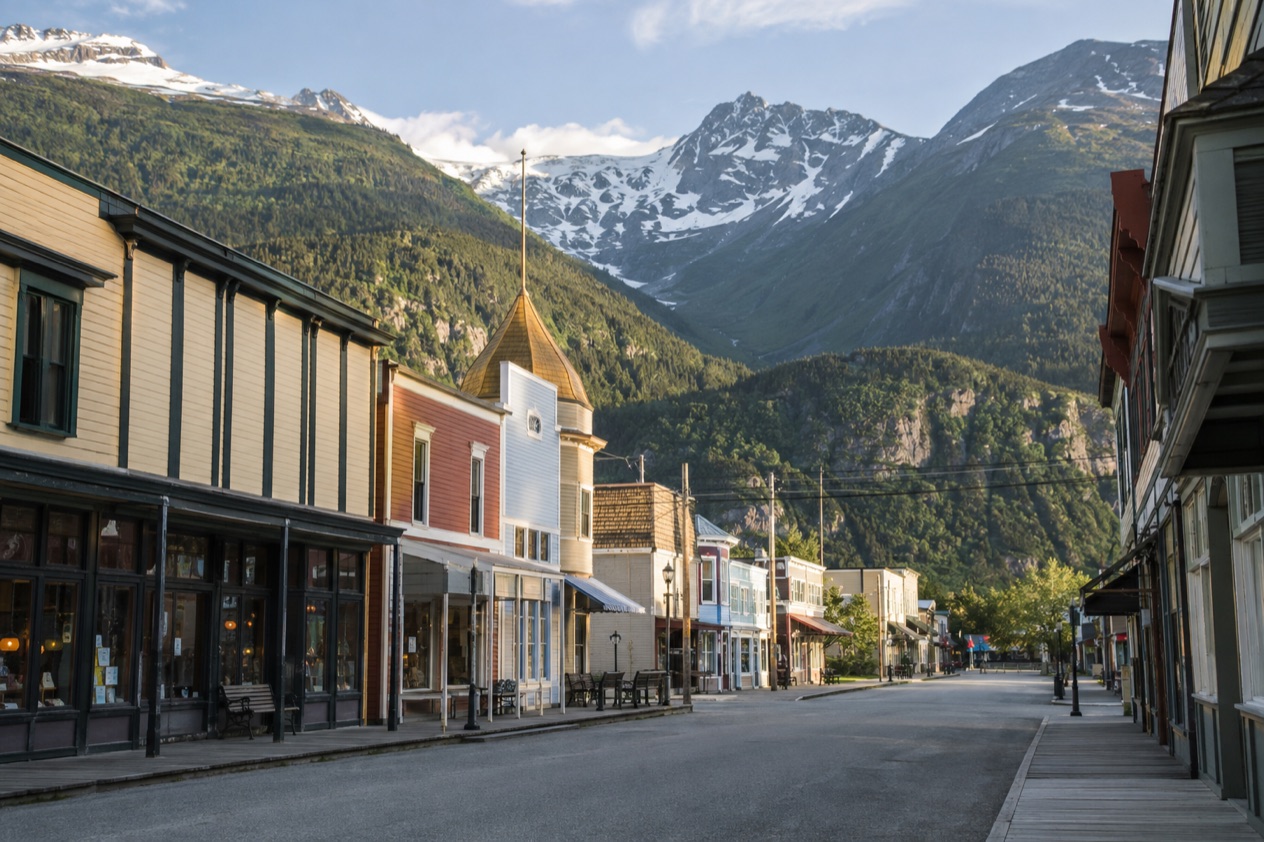
A steam-era whistle drifts down Broadway while boots clump along the wooden boardwalks, past false-front saloons and storefronts painted in the colors of 1898. Skagway is a small town in Southeast Alaska that still lives inside its gold rush story, and the story is the reason to come. It suits history lovers, train riders, hikers and families who want a place where the past is something you walk through.
What are the best things to do in Skagway?
The best things to do in Skagway are the ones that put you inside the Klondike gold rush: its streets, its museums, its railroad and its trails. Everything else, from the food to the evening saloons, grows out of that history. These are the essentials, each told in more detail in the sections that follow.
- Start at the National Park Service visitor center in the restored rail depot, where the film and the daily ranger chats set the scene for everything else in town.
- Walk the Historic District, a collection of gold rush buildings that are part of Klondike Gold Rush National Historical Park.
- Ride the White Pass and Yukon Route, the narrow-gauge railway that climbs out of the port and is an International Historic Civil Engineering Landmark.
- Visit Dyea, the old boom town that is now a quiet natural area and the start of the Chilkoot Trail.
- Hike on the Chilkoot Trail, the route stampeders carried their year’s supplies over, in the season when rangers are on duty.
- Drive Highway 98 toward Carcross and Whitehorse, the only road that leads out of town to the rest of the continent.
- Sit down in a saloon on Broadway in the evening, where the gold rush mood carries on after the day crowds thin out.
- Let children earn a Junior Ranger badge, a task that takes them up and down Broadway.
Skagway can be explored on your own without a guide, and a variety of commercial tours are also on offer. The town’s population is under a thousand, but it doubles in the summer tourist season, so the feel of the streets changes with the calendar. Cruise ships are a regular part of that picture, and tourism is a large part of the local economy.
The town is compact, which is part of its charm. You can pass from a museum to a boardwalk to a saloon without ever needing to think about transport. The things that need a vehicle, a train seat or a boot-trail are the ones that lead out of town toward the pass, the valley and the border country.
Sights and landmarks in Skagway
Skagway’s landmarks are its gold rush buildings, its park museums and the old depot that now serves as the park’s front door. Instead of one headline monument, the town offers a whole street of them. The historic district holds about a hundred buildings from the gold rush era, and walking among them is the main sightseeing activity.
A sensible order is to begin with the park’s introduction, then wander Broadway with that background in your head, then step into one or two museums for the details. Most of the town’s sights are close enough to each other that a day on foot covers a great deal.
The National Park Service visitor center
The visitor center sits in the restored 1898 rail depot at 2nd and Broadway, a building that already belongs to the story it tells. It is the recommended starting point for a visit to Klondike Gold Rush National Historical Park, and it is where you learn about programs, tours and the film. Inside, the National Park Service also presents a multi-media telling of the Skagway story, a good fit for history buffs.
The film, Gold Fever: Race to the Klondike, runs 24 minutes in the theater and gives a clear sense of why tens of thousands of people headed north. Ranger chats are offered daily, and the topics change, so ask at the desk what is on. The rangers pick subjects they care about, and the talks may be held in the theater or outside, which makes them feel more like conversation than lecture.
One thing to know is that the park no longer offers ranger-led walking tours. The depot remains a starting point for self-guided exploration, so you pick up your bearings here and then set out along the street on your own.
The Historic District and Broadway
The Historic District is made of gold rush boomtown buildings, and many of them are part of the national park. Broadway is the spine of it, lined with wooden boardwalks, old hotels and storefronts that once served prospectors in need of supplies, a bed or a drink. Walking it slowly, reading the facades and glancing into doorways, is a pleasure that does not need a ticket.
The town’s reputation from the rush years was rowdy, a place of gamblers, con men and tired travelers. The saloons and hall fronts still carry that flavor, and a few buildings are decorated in ways that make them easy to recognize, such as one whose front is covered in driftwood pieces. Look up as well as ahead, since signs, balconies and rooflines hold much of the character.
The street rewards a second pass at a different time of day. When the crowds of a ship day have moved on, the boardwalks go quiet and you can hear your own footsteps on the planks, which is when the old town feels most like itself.
Museums and smaller stops
There are four National Park Service museums in Skagway that cover Klondike gold rush history, and together they fill in what the street only hints at. Expect objects, photographs and stories of the people who passed through, from the ones who struck it lucky to the many who turned back. They are the place to understand the Canadian rule that each person bring a year’s supply of food, typically around 1,150 pounds, over the passes.
The Pantheon Saloon, further up Broadway, doubles as the spot where young visitors plan their activities and earn Junior Ranger badges. Adults can treat the stop as one more piece of the street’s scenery. Dyea, the second boom town, belongs to the park as well and is covered under day trips.
The White Pass and Yukon Route depot area and the working railroad are also landmarks in themselves. Even if you do not ride, the sight of the narrow-gauge cars waiting at the port gives a sense of how the town was built around moving people and freight toward the interior.
Outdoor things to do in Skagway
Skagway’s outdoors are tied to the routes of the gold rush: a railroad that climbs toward the pass, a trail that crosses it on foot and an old valley town now returned to the woods. Mountains rise straight up from the town, and the whole setting is part of what the town promotes, history together with natural beauty.
This is a place where the landscape explains the history. You see why stampeders found the passes so punishing, and why a railroad through the same terrain was such a feat of engineering that it earned a landmark designation.
The White Pass and Yukon Route Railway
The White Pass and Yukon Route is a narrow-gauge railroad linking the port of Skagway with Whitehorse, the capital of Yukon. Built in the mining years, it now operates purely for the tourist trade during the summer months, starting at the port. The railway was reopened between Skagway and White Pass in 1988 for tourist passengers only, and it is an International Historic Civil Engineering Landmark.
On the train you see the country that the prospectors had to cross on foot, from the vantage point of a seat. The White Pass trail itself was nicknamed Dead Horse Trail because so many pack animals died on it, and looking out the window gives that name a sharper edge. Excursion bookings are handled by the railway, and the summit excursion is among the trips it runs.
| Route | Length (miles) |
|---|---|
| Original line, Skagway to Whitehorse | 107 |
| Active track, Skagway to Carcross | 67.5 |
| Chilkoot Trail, Dyea to Bennett | 33 |
The Chilkoot Trail
The Chilkoot Trail runs from Dyea, Alaska, to Bennett, British Columbia, following the route that most prospectors took through the ports of Dyea and Skagway. It begins at Dyea, a ghost town and campground only 15 minutes from Skagway. Today it is a hiking trail through a landscape layered with relics of the rush.
The official hiking season, when rangers are on duty and the trail crew is on site, usually begins in late May and ends in early September. Demand is highest from June through August. Hikers moving between the United States and Canada are traveling across a border, so the details of that crossing are best taken from the agencies that manage the trail.
Even if you only walk a little way from the trailhead, the sense of history is strong. Think of the Canadian authorities’ demand that each person arrive with a year of food, and the trail stops being a recreational route and becomes a very hard day at work for thousands of people.
Day trips from Skagway
The day trips from Skagway follow the same lines as its history: down the valley to Dyea, up the pass toward Canada and along the one road out of town. Only one road connects Skagway to the rest of the continent, Highway 98, and it leads to Whitehorse, Yukon, by way of Carcross. Skagway is also the northern terminus of the Alaska Marine Highway ferry network, which is how the town connects to the rest of the region by water.
Southeast Alaska is a large region with a land area of tens of thousands of square miles, and its largest cities are Juneau, Sitka and Ketchikan. Skagway itself is far smaller than any of them, which explains why a day out of town tends to mean a landscape rather than another city.
Dyea and the old boom town
Dyea is the closest outing, 15 minutes from Skagway, and it is part of Klondike Gold Rush National Historical Park. It was once a boom town at the foot of the Chilkoot route, a crowded port of tents and warehouses. Now it is a natural area, a ghost town with a campground, where the buildings have mostly returned to the ground and the forest does the talking.
Go for the sense of how quickly a city can rise and vanish. You see the quiet that replaced the noise, and you stand at the start of the trail that so people climbed. It suits history lovers who like places with little left to see but a lot to imagine, and walkers who want somewhere open after the boardwalks.
Pair Dyea with a morning at the visitor center beforehand. The film and the museum displays give you the names and the scale, and then the valley feels like a place with a past rather than just a pretty clearing.
Carcross along Highway 98
Carcross, in Yukon, lies on Highway 98, the road that leaves Skagway for Whitehorse. It is also where the active track of the White Pass and Yukon Route currently ends, 67.5 miles from Skagway. So Carcross can be reached either by road or on the line the railroad currently runs, and both routes cross the same mountain country that stopped so people in 1898.
The point of the trip is the change of scene. You leave the coastal mountains of Alaska behind and enter Yukon, a different territory with its own towns and its own version of the Klondike story. It suits travelers who like a long day of looking out the window, and who are curious about the other end of the line that starts at Skagway’s port.
Because the route crosses an international border, it is a trip with its own paperwork, and the rules are the ones set by the border agencies.
Whitehorse, the end of the original line
Whitehorse, the capital of Yukon, was the original destination of the railroad, 107 miles from Skagway in the line’s first form. Highway 98 reaches it by way of Carcross. It is a much bigger place than Skagway and a different kind of day, more about the Yukon side of the story than the Alaskan coast.
A trip here is for people who want to see where the gold rush traffic was heading, and how a territory grew around it.
What to eat in Skagway
Eating in Skagway means Alaskan seafood, hearty comfort food and a few local drinks, served in rooms that often look like they belong to the gold rush. Salmon and halibut are the fish most associated with Southeast Alaska, and they turn up grilled, fried in batter or smoked. Menus in town tend to follow the seafood of the coast and the appetites of travelers who have spent the day outdoors.
There is no need to hunt for fine dining. The pleasure here is simpler: a plate of fish after a long day, a warm bowl of chowder, a pastry from a bakery on Broadway. The setting does half the work, with wooden floors, old photographs on the walls and the smell of a kitchen that has been cooking for crowds since morning.
Salmon, halibut and the catch of the coast
Fish and chips made with halibut is a staple of Alaska’s coastal towns, with a crisp batter and flaking white fish, usually eaten with something sharp to cut the richness. Grilled salmon is the other standard, often served with rice and vegetables, and smoked salmon appears as a spread, a plate or a gift to take home. Crab is another Alaska favorite and often shows up as legs or in cakes.
Expect the kind of place that cooks fish simply and lets the quality do the talking. It suits travelers who want a proper Alaskan meal after the train or the trail, and it makes a good ending to the day in the Historic District.
Comfort food, sourdough and sweets
Sourdough is tied to the Alaska and Klondike story, since prospectors carried starters north and nursed them through the winter. You find it as bread, as pancakes at breakfast and in sandwiches. A morning in town often starts with a plate of pancakes or a sourdough bun and strong coffee, which is exactly what the miners would have recognized.
For something sweet, look for bakeries and small cafés along Broadway with cinnamon rolls, cookies and pies. Reindeer sausage, a northern specialty, sometimes appears on menus as a hot dog or breakfast side. It tastes a little like a leaner, smokier sausage and is worth trying once.
Beer, saloons and a drink with history
Drinking is part of the gold rush story, and the saloons on Broadway lean into it. A local brewery makes beer in town, a natural thing to order with a plate of fish. The older-looking bars serve the classic pours, and part of the experience is the room itself, with its long counter, brass and photographs.
If you prefer something warm, coffee shops stay busy through the day with espresso drinks and hot chocolate. A pause in one of them is a practical way to rest between museums and boardwalk walks.
Things to do in Skagway at night
Evenings in Skagway are quiet and atmospheric, centered on Broadway’s saloons and the walk between them. This is not a town of clubs and late crowds. After the day’s visitors have returned to their ships or hotels, the boardwalks empty and the old buildings regain a stillness that suits the history around them.
Because the summer population doubles for the tourist season, the evening mood depends on who is in town. Some nights feel lively, others hushed. In either case, the choices are modest, and the pleasure is in simplicity: a drink, a table, a stroll.
Saloons on Broadway
The saloons are the main evening entertainment, and the Pantheon Saloon is one of the stops on Broadway that carries the era’s name. Inside, you find the dark wood, the long bar and the faint feeling that you have walked into a scene from the rush years. Live music and stories are part of the tradition in this kind of room, though what is on varies by night.
Pick one place, order a drink, and let the room set the tone. If you move on to a second saloon, you notice how each has its own character, one a little rowdier, another a little more reflective. It suits couples and small groups who like conversation more than noise.
A quiet walk through the Historic District
When the day crowds have gone, the Historic District is most evocative. The boardwalks creak, the signs glow and the false fronts stand against the mountains behind. It is a good time for the photographs that were impossible at midday and for reading the facades you hurried past.
Take a slow walk to the depot, past the old hotels and back along Broadway. The town is small enough that you will not need a plan, and the evening gives you a different version of the same streets. It suits anyone who likes to see a place alone with itself.
Dinner and a slow evening
A long dinner is the other natural evening, with seafood or comfort food in a room with history on the walls. Eating late in a town like this is not about the menu so much as about stretching the day, sitting with the day’s stories and watching the street outside the window.
After dinner, a coffee or dessert makes a pleasant coda. There is no need to rush, and the combination of food and old-town atmosphere is what most evenings in Skagway are made of.
Things to do in Skagway with kids
Children in Skagway get a hands-on way into the gold rush through the Junior Ranger program, a railroad ride and space to roam in places like Dyea. The town turns history into a kind of treasure hunt, and a child with a badge to earn tends to look at old buildings with more attention than usual.
Junior Rangers on Broadway
Junior rangers can plan their activities and earn their badges at the Pantheon Saloon, further up Broadway in Skagway. The program gives young visitors a purpose, with tasks that send them to the park’s sites and ask them to look closely. It is a way of turning a walk down the street into a mission.
Begin at the visitor center, where the staff can explain what is available. The 24-minute film is a good way to introduce the story to older children, and a ranger chat may offer a more personal moment, with a ranger talking about a subject they love.
The train and the old boom town
The White Pass and Yukon Route is a draw for any child who likes trains, a narrow-gauge line that climbs into the mountains and operates in the summer months. Seeing the country from a window gives children a feel for the terrain, and the nickname Dead Horse Trail tends to leave an impression, a memorable piece of history to share on the ride.
Dyea offers a different kind of outing, open and quiet, with room to wander where a town once stood. It works well as a contrast to the busy Broadway, and children can imagine the tents and crowds that filled the valley. The distance is just 15 minutes from town.
Keeping the day comfortable
A day in Skagway is mostly on foot, and the town is compact, which helps. Mix indoor stops, such as the film and museums, with time on the boardwalks and in cafés, and children are less likely to tire of any one thing. Mountain weather in Southeast Alaska can change, so a layer for each child is a sensible habit.
Treat the Chilkoot Trail as an adult-scale undertaking rather than a family outing. It crosses an international border over many miles, and the official hiking season runs from late May to early September. Dyea and the Historic District are better matches for younger children.
Good to know before you go
Skagway is a small town, and most of what you came for lies within the Historic District and the park’s sites. Highway 98 is the only road out, and the Alaska Marine Highway ferries end here.
Many seasonal services, including the White Pass and Yukon Route and the Chilkoot Trail’s ranger season, operate only during the summer months, so visitors between October and May should read the National Park Service’s winter guidance. The Skagway Convention and Visitors Bureau is the official visitor department, and M & M Tours is the only tour brokerage contracted by the Municipality of Skagway.
Sources
- Skagway Convention and Visitors Bureau (https://www.skagway.com/), checked October 11, 2026
- Skagway, things to do (https://www.skagway.com/things-to-do), checked October 11, 2026
- Wikivoyage, Skagway (https://en.wikivoyage.org/wiki/Skagway), checked October 11, 2026
- Wikipedia, Skagway, Alaska (https://en.wikipedia.org/wiki/Skagway,_Alaska), checked October 11, 2026
- National Park Service, Klondike Gold Rush National Historical Park (Skagway), plan your visit (https://www.nps.gov/klgo/planyourvisit/index.htm), checked October 11, 2026
- White Pass and Yukon Route Railway, Skagway (https://www.wpyr.com/), checked October 11, 2026
- Wikipedia, White Pass and Yukon Route (https://en.wikipedia.org/wiki/White_Pass_and_Yukon_Route), checked October 11, 2026
- Wikipedia, Chilkoot Trail (https://en.wikipedia.org/wiki/Chilkoot_Trail), checked October 11, 2026
- Wikipedia, Klondike Gold Rush (https://en.wikipedia.org/wiki/Klondike_Gold_Rush), checked October 11, 2026
- Wikipedia, Southeast Alaska (https://en.wikipedia.org/wiki/Southeast_Alaska), checked October 11, 2026
To plan your stay
- Best Time to Visit Skagway: Summer Trains, Chilkoot Trail Season, Weather and Quiet Months
- Where to Stay in Skagway: Broadway, the Port and Rail Depot, and the Highway 98 Side
- Skagway from Juneau: The Ferry Route, Highway 98 and a Day in Town
- Know Before You Go to Skagway: Ferry and Highway Access, Klondike Park, Weather and Bears