
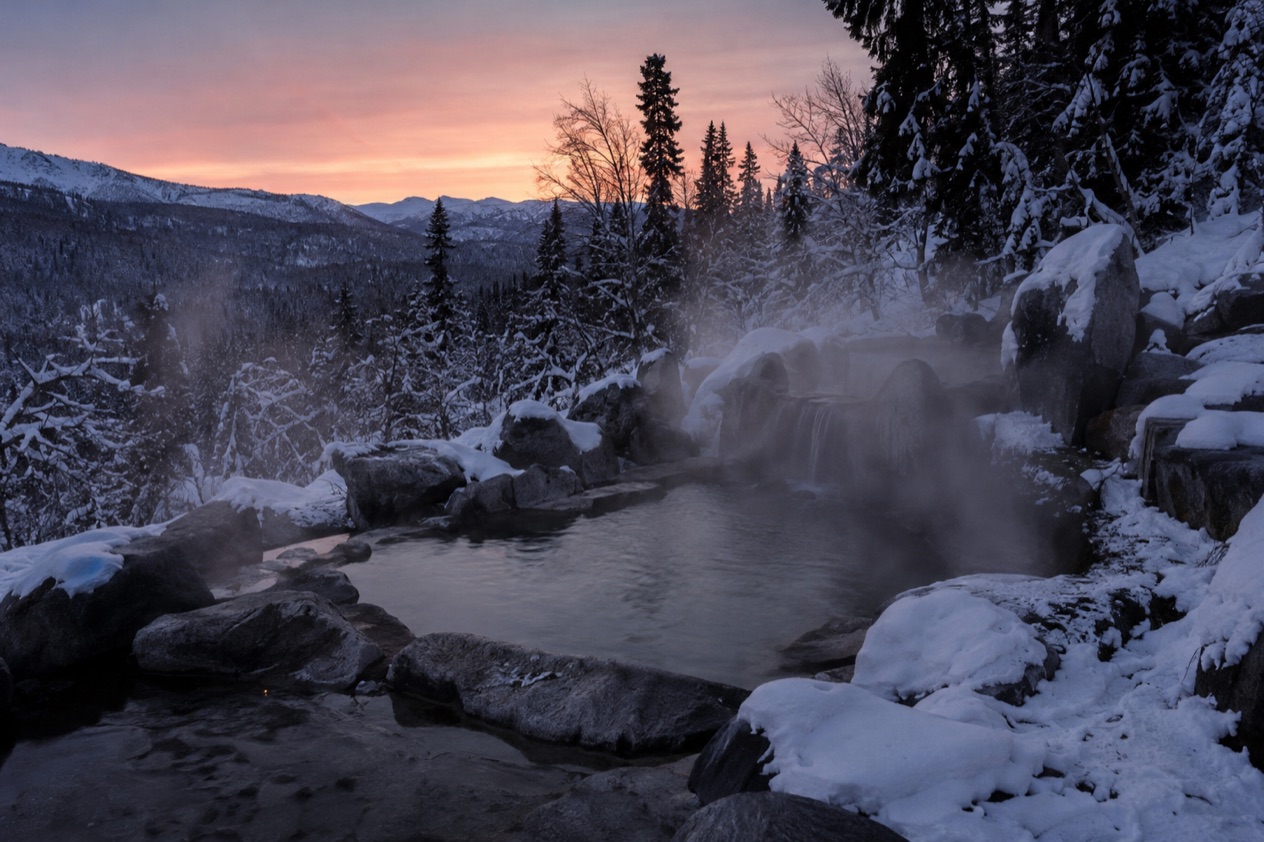
Steam lifts off a pool of hot water while the air around it is cold enough to frost your hair, and above the spruce a pale green band may begin to shimmer. That scene belongs to Chena Hot Springs, a resort outside Fairbanks where soaking is as much a cold-weather pleasure as a warm one. The springs are open all year, but the long dark evenings from late summer into spring give the water its character.
Where are the hot springs in Alaska?
It is a full resort rather than a roadside pool, with lodges, cabins, yurts, tours, a museum made of ice and even a retired airliner parked on the grounds. People come for the soak and stay for everything that surrounds it.
The natural hot springs are open for soaking year-round, which changes what a visit means from one season to the next. In summer the water is a warm break between forest rides and long evenings. In winter it becomes the reason to be outside at all, with snow on the ground and the chance of northern lights overhead.
A resort that began with gold miners
Chena Hot Springs was founded more than a century ago by two gold mining brothers, Robert and Thomas Swan. Miners in the Fairbanks area worked hard and cold, and a spring of naturally hot water in the hills was a rare comfort. The brothers saw that other people would want to reach it too.
By 1911 twelve small cabins had been built to house visitors, which is how a mining claim started turning into a place to stay. Today the resort still offers lodges, private cabins and yurts, all steps from the hot springs. That closeness matters on a winter night, when the walk between your door and the water is short and the cold is sharp.
Soaking in the Pool House and Rock Lake
There are two ways to get into the hot water. The Pool House is the main soaking facility, and guests who are not staying overnight can buy a day pass. Rock Lake is a geothermal feature on the resort grounds where visitors can also soak, and it has a more natural, outdoor feel than the Pool House.
What makes soaking here different from a spa is the setting. You are in the Alaskan wilderness, with forest around you and open sky overhead, and in the cold months steam rolls off the water into the dark. The resort says the hot springs are open for soaking even beneath the aurora borealis, so a clear night can turn an ordinary soak into something you remember for years.
Heat that runs the whole place
The same geothermal heat that fills the pools also powers the resort and its greenhouses. Chena Hot Springs uses two geothermal power plants of the Organic Rankine cycle type, and they were the first of their kind in Alaska. The resort presents itself as a leader in renewable energy, and the setup is unusual enough that it adds a second reason to visit.
The plants have had a clear effect on the bills. Since July 2006 the cost of electricity at the resort has fallen from 30 cents per kilowatt-hour to 5 cents. For a place far from the main grid, that is a real change, and it explains why greenhouses can sit beside a lodge in the northern forest.
Which can you visit?
At Chena Hot Springs Resort you can soak in the Pool House or Rock Lake, walk through the Aurora Ice Museum, take a winter aurora tour or a summer ride, and stay overnight in a lodge, cabin or yurt. The choices shift with the season, so it helps to think of the resort as two different places, one for the dark months and one for the green ones.
The Pool House and the Aurora Ice Museum
The Pool House is the place for a long, unhurried soak, whether you arrive as a guest or only for the day.
Pairing the two works well. Warm up in the water, then walk among sculptures made of ice, or do it in the other order and finish with the heat. The museum tour suits visitors who want something to see rather than something to do.
| Site | Open | Admission |
|---|---|---|
| Pool House day pass | Year-round | Adults $20, children $17 |
| Aurora Ice Museum Tour | Year-round | Adults $20, children $15 |
Winter nights: aurora and snowmachines
The Aurora Viewing Tour carries guests by SUSV, a tracked vehicle, to Charlie Dome, where the sky opens out in every direction. Heated yurts and hot drinks are provided, so waiting for the lights is a warm affair rather than an endurance test. The aurora is never guaranteed, but a tour like this puts you somewhere with a wide view when it does appear.
Winter also brings Electric Snowmachine tours on silent, electric snowmobiles along trails the resort describes as pristine. The quiet is the point. Without an engine roar, you hear the snow, the trees and your own breath.
Summer rides and trails
When the snow is gone, the resort turns to wheels and hooves. The Electric ATV Tour is a single-rider ride down Monument Creek Trail through summer forest, mud and rugged terrain. There is also a Side x Side ATV tour, a Dog ATV Tour and horseback riding, which gives different ages and tastes something to choose from.
These rides are a counterweight to the soaking. Families with younger children have the most options in the Dog ATV and Side x Side tours.
| Activity | Duration | Minimum age | Price |
|---|---|---|---|
| Winter aurora viewing tour | 5 hours | 2 years | $125 per person |
| Summer ATV tour | 45 minutes | 16 years | $95 per rider |
| Side x Side ATV Tour | 45 minutes | 5 years | $75 per person |
| Dog ATV Tour | 30 minutes | 5 years | $65 per person |
| Horseback riding | Up to 60 minutes | 12 years | From $90 |
A DC-6 on the grounds
One surprise at the resort is a Douglas DC-6A aircraft named Good Grief, which is on display after its final flight on October 2, 2016. It is an odd sight in the northern forest, a large propeller airliner standing where you would expect only spruce and snow. Plenty of visitors will want a photograph beside it on the way to or from the water.
What should you know before you go?
Know the season, the winter road and the light. The hot springs are open year-round, but what surrounds them changes sharply between the aurora months and the green ones, and some activities belong to only one of those halves of the year.
Aurora season at Chena
Aurora viewing season at Chena Hot Springs runs from late August to mid-April, so a trip taken now, in October, falls well inside it. The lights can be visible especially around the March equinox, which is a useful time to remember when planning a late-winter soak. As with any natural display, they are a chance and not a promise, and clear skies matter.
If you want to look for the aurora near Fairbanks without joining a tour, the University of Alaska Fairbanks names a number of recommended viewing sites. These include:
- Chena Lakes Recreation Area and Tanana Lakes Recreation Area
- Cleary Summit and the town of Ester
- Wickersham and Murphy Domes, and Haystack Mountain on the Elliot Highway
- Turnouts along the Elliot, Steese and Parks Highways and along Chena Hot Springs Road
- Nordale Road, and the Ballaine Road turnout near the Goldstream Creek bridge
Winter roads and rental cars
Outside urban centers in Alaska, winter roads are generally not cleared down to the pavement, and sand is used instead of salt. That means a rental car may not have appropriate tires for the conditions. Some rental companies also prohibit their vehicles on several named highways, so the rental agreement is worth reading before any winter drive.
None of this changes the draw of the water, but it does shape how a winter trip is planned. The aurora tour in the SUSV is one way to reach the open sky at Charlie Dome without driving it yourself, since the vehicle carries guests out and back.
Pairing a soak with Fairbanks winter events
A winter stay at the springs fits neatly with the festivals in Fairbanks. The Winter Solstice Celebration in Downtown Fairbanks takes place during the week of December 21, with fireworks you cannot see in the summertime. From mid-February to the end of March, ice art sculptures are displayed around the city.
The World Ice Art Championships run from late February through March and feature over 80 sculptures by international carvers. The International Ice Art Classic adds ice slides and an ice playground. In mid-March the Open North American Championship sled dog race comes to Fairbanks, and spectators can watch along the edge of Creamer’s Field, at the Tanana Valley State Fairgrounds and at the Fairbanks Golf Course.
At the end of March or early April, the International Curling Bonspiel brings curlers from across the country and Canada, and the event is themed, so teams dress up while they curl. After a day among sculptures, sleds or costumed curlers, a hot soak is a fitting way to settle in.
Good to know before you go
Matching the activity to the season is the main thing. The aurora tour and the snowmachine rides belong to winter, the ATV rides belong to summer, and the springs and the ice museum stay open throughout. Alaska observes Alaska Day on October 18 as a state holiday, an extra date to keep in mind for an autumn visit. Aurora season is already under way, and the soak is there whether or not the sky cooperates.
Sources
- Chena Hot Springs Resort (https://www.chenahotsprings.com/), checked October 11, 2026
- Wikipedia, Chena Hot Springs (https://en.wikipedia.org/wiki/Chena_Hot_Springs), checked October 11, 2026
- Explore Fairbanks, winter events (https://www.explorefairbanks.com/events/winter-events/), checked October 11, 2026
- Wikivoyage, Alaska (https://en.wikivoyage.org/wiki/Alaska), checked October 11, 2026
- University of Alaska Fairbanks Geophysical Institute, Aurora forecast (https://www.gi.alaska.edu/monitors/aurora-forecast), checked October 11, 2026