
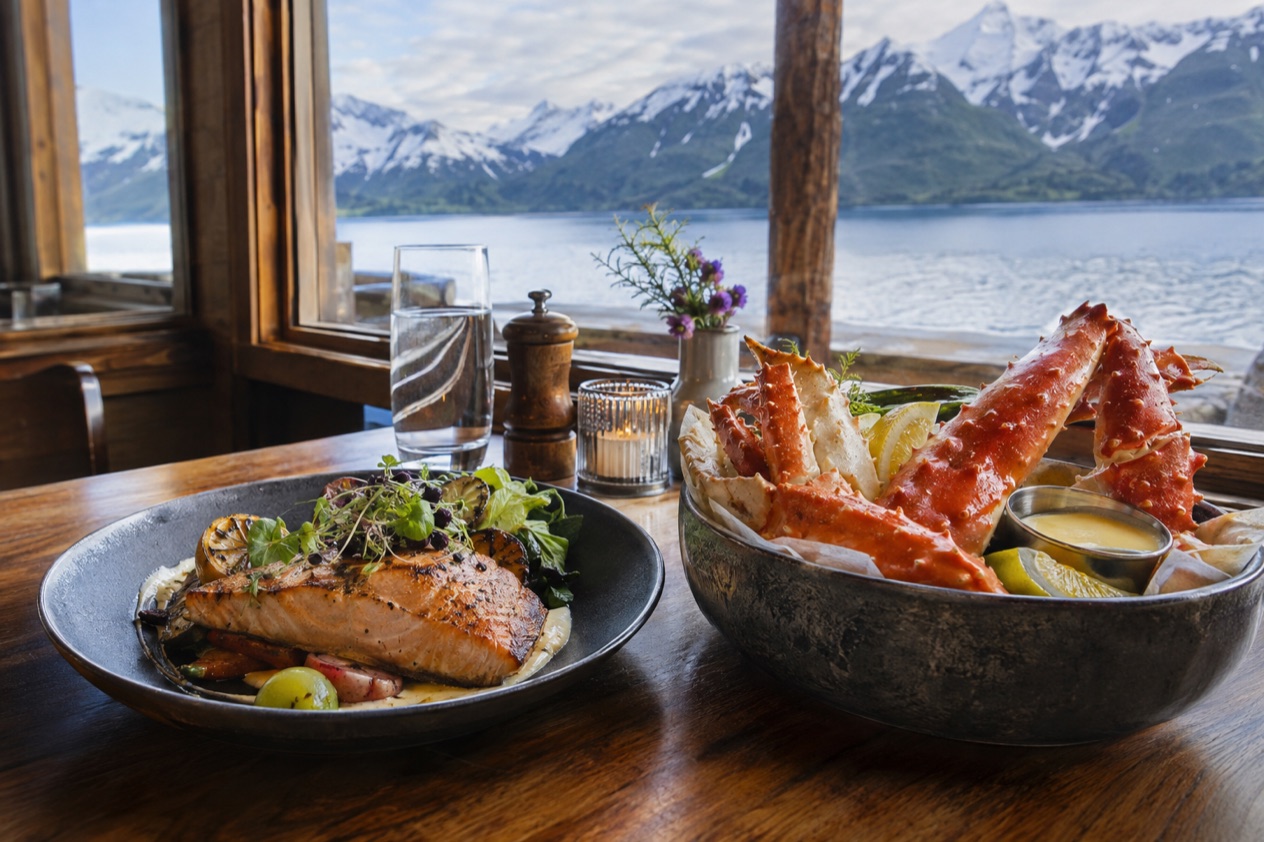
A platter of crab legs arrives at the table still steaming, the shells a deep orange-red and so long they hang over the plate. You crack one open, pull out a single thick column of white meat, and dip it in melted butter with a squeeze of lemon.
Alaska king crab is the centerpiece meal of a northern trip, and it comes from the cold waters off the state’s western and southern coasts. Here is where it is caught, where to look for it on a plate, and what shapes its season.
Where does Alaska king crab come from?
It comes from the cold, deep waters of the North Pacific, and in Alaska the main fishing grounds are the Bering Sea and Norton Sound. The animal on your plate is the red king crab, also known as the Kamchatka crab or simply the Alaskan king crab. It is native to the Bering Sea and the Gulf of Alaska, among other areas, and it is the largest of all the king crab species.
| Red king crab | Measure |
|---|---|
| Average male landed in the Bering Sea | 6.4 lb (2.9 kg) |
| Maximum leg span | 5.9 ft (1.8 m) |
| Usual depth of adults | More than 656 ft (200 m) |
A crab that lives far below the surface
Adult red king crabs usually live well beyond the reach of anything a casual angler could drop over a rail, down on sandy and muddy bottoms. That is part of why crab is a product of working boats and not of tourist excursions. What reaches the dock has been hauled up from the dark, cold floor of the sea.
The size explains the legs on the plate. A single crab can stretch wider than a grown man is tall, and the males that come out of the Bering Sea are heavy enough that one animal makes a serious meal for several people. Most of the meat is in the legs and claws, which is why they are sold and served as clusters.
Why it is called red
The name is a little misleading, because a living red king crab tends to look burgundy. The bright red-orange everyone pictures is the color it turns once cooked. If you ever see a photo of a crab on the deck of a boat, it will look darker and duller than the one in front of you at dinner.
Red king crab also sells for more per pound than the other king crab species sold commercially, which is why it holds the top spot on a seafood menu. A menu that says Alaskan king crab is usually pointing at this animal and its reputation for thick, sweet leg meat.
Bering Sea and Norton Sound
The Bering Sea is the name most associated with king crab, thanks to the long tradition of crab boats working out of the western Alaska ports. Norton Sound is the other fishing area where red king crab is most commonly caught. Both are remote, stormy, cold waters, far from the road system that most visitors travel on.
There is a sober side to the story. Red king crabs are slowly declining in their native far eastern coastal waters, for reasons that are still unclear, and fishing controls set by the United States in the 1980s and 2000s have not stopped that. It is one more reason to treat a crab dinner as an occasion and not as an everyday plate.
Where can you eat it?
You eat it in the seafood restaurants and waterfront eateries of Alaska’s coastal towns, where crab legs are served cracked or whole, with butter and lemon beside them. Juneau is a good town to organize a seafood evening around, because the city has a strong local food and drink identity and a compact downtown you can cover on foot between courses.
A crab dinner in Juneau
Downtown Juneau sits against the water, and an evening here can begin at the Alaskan, a hotel and bar more than a century old and the state’s oldest operating hotel. Its old walls give a drink before dinner some atmosphere. Locals use the word Alaskan for another thing too: a glass, can or bottle of beer from Juneau’s Alaskan Brewery.
A cold Alaskan beer is a natural companion to a plate of shellfish, since the sweet crab meat sits well beside a crisp, malty glass. The brewery is in Lemon Creek, the valley between downtown and the airport, where a bright blue hanging glacier looms over the same neighborhood as Costco and the brewery itself. It is an odd, very Juneau mix of ice and errands.
The town’s layout is simple to follow. The Road, the main highway, is called Egan Drive between downtown and Mendenhall Valley and then Glacier Highway, which runs on until it ends around mile marker 40. Past Auke Bay lies Out-the-Road, the least populated and wildest part of Juneau you can reach by motor vehicle. Downtown is where the restaurants cluster, so the evening can stay on foot.
Other fish worth ordering beside the crab
A meal built around crab can easily widen into a fish tasting. Juneau has plenty of Dolly Varden, a trout the Lower 48 markets as Arctic char, and it makes a gentler, more everyday plate beside the richness of crab. Ordering both lets you compare shellfish and fish in one sitting.
Pacific halibut is the other great Alaska catch. Homer calls itself the Halibut Capital of the World because of the large volume of sport and commercial halibut fishing in the area, and halibut and chips is a staple of the seafood shacks in that part of the state. It is a firm, white, mild fish, an easy partner for anyone who wants variety next to a crab feast.
How to enjoy a crab leg
King crab is made to be eaten slowly. The legs are thick and spiny, so a cracker or a pair of kitchen shears does the work, and the meat usually slides out in one long piece. Keep the butter warm, add lemon, and pace yourself, because this is a meal to linger over with a drink and company.
It suits groups who like to share a big platter, couples who want one splurge dinner, and anyone curious about what the legendary Bering Sea fleet actually brings home. Children who like shellfish often enjoy the hands-on cracking as much as the taste.
When is the season?
The season belongs to the fishing fleet and its managers, not to the restaurant calendar, and the crab’s own life explains why. Because adults live deep on sand and mud, they are taken by boats working the Bering Sea and Norton Sound, and what lands on your plate depends on what those boats bring in.
Why the crab follows the fishery, not the visitor
A traveler’s summer and a crab’s fishing season are two separate calendars. A boat leaves a western Alaska port when the fishery opens, works the grounds, and returns to a dock where the catch is processed and shipped. By the time a leg reaches a Juneau or Homer kitchen it has already traveled a long way, often chilled or frozen to hold its flavor.
That is why a menu can show crab in a month when the grounds are quiet. The seafood trade moves product around the state and well beyond it, so a town far from the Bering Sea can serve the same animal as a harbor on its shore.
A shrinking resource
The steady decline of red king crab in its native far eastern waters means the fishery is watched closely. Rules set in past decades have not turned the numbers around, and the reasons are not fully understood. For a visitor, the practical meaning is simple: the crab you order is a limited, carefully managed product, and its availability can change from one season to the next.
Halibut keeps a different calendar
If crab is not on the menu, halibut often is, and its year is easy to read. Pacific halibut spawn in winter, with activity peaking from December through February, mostly off the edge of the continental shelf in deep water. The fish live on or near the bottom and prefer cold water, from the high 30s to the mid-40s in degrees Fahrenheit.
Fishing for halibut is regulated by the International Pacific Halibut Commission, whose United States and Canadian members meet yearly to set the rules for the coming season. Anglers generally take fish of 15 to 20 lb, though much larger fish are regularly caught. The record sport-caught halibut weighed 459 lb and came from Dutch Harbor near Unalaska, a number that tells you how big the fish of this coast can grow.
Most anglers fish with bait, especially herring, but also squid, octopus, cod pieces or other small bottom fish. Taken together, crab and halibut show how much of Alaska’s table is set by the sea, its depth, its cold and the rules that govern the catch.
Good to know before you go
King crab is the splurge dish of an Alaska trip, so plan it as a deliberate treat and enjoy it slowly. Once you leave the main towns, kitchens can be small and menus short, so be flexible about what ends up on your plate.
Sources
- Wikipedia, Alaskan king crab (https://en.wikipedia.org/wiki/Alaskan_king_crab), checked October 11, 2026
- Travel Juneau, local lingo and FAQs (https://www.traveljuneau.com/discover-juneau/local-lingo-faqs/), checked October 11, 2026
- Wikipedia, Pacific halibut (https://en.wikipedia.org/wiki/Pacific_halibut), checked October 11, 2026