
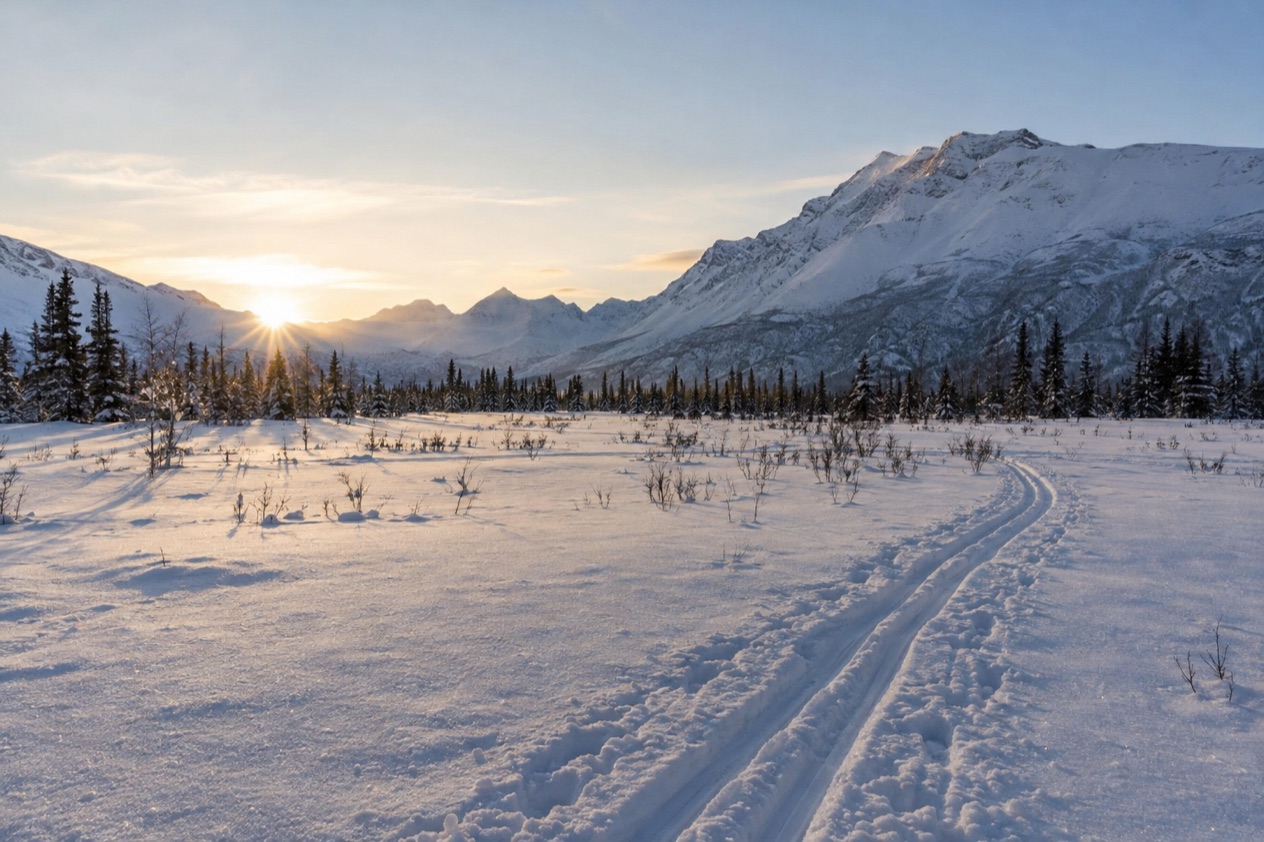
The tram at Girdwood swings up the mountain with skis racked on the outside and a restaurant waiting at the top, while the Chugach Mountains fill every window. Farther north, skiers climb the unplowed road at Hatcher Pass on skins, and near Anchorage the groomed trails are busy with people gliding on skinny skis. Alaska skiing means a big lift-served resort, open backcountry and cross-country trails, all within reach of the state’s largest city.
Where can you ski in Alaska?
The main places are Alyeska Resort in Girdwood for lift-served downhill skiing, Hatcher Pass for backcountry and groomed trails, and the Anchorage area for a wide menu of winter sports. Each one feels different, and together they cover most of what a visiting skier wants.
Alyeska Resort, Girdwood
Alyeska is the largest ski area in the state, set in Girdwood in the heart of the Chugach Mountains. It lies about 45 minutes outside Anchorage, and the town gives the place a small mountain-village feel. The name comes from an Aleut word meaning “great land of the white to the east,” which suits the snowy slopes.
The mountain has a lift system of eight lifts, including an aerial tram, two high-speed quad chairs, fixed-grip quads, a double chair and two magic carpets. The terrain skews toward the challenging side, with most of the trails rated more difficult or most difficult and a smaller share rated easiest. The vertical drop is generous, and the highest lift-served point is reached by Chair 6.
Skiers can stay at Hotel Alyeska at the base of the tram, and ski-in/ski-out accommodations are available. At the top of the tram you find a restaurant, a bar and a gift shop, and the Mt. Alyeska Roundhouse, an octagonal building listed on the National Register of Historic Places, now holds a museum of local ski history. After the lifts close, the resort’s Nordic Spa is there for tired legs, and dining ranges from Forte and Seven Glaciers restaurants to a cafe.
| Feature | Figure |
|---|---|
| Trails | 73 |
| Lifts | 8 |
| Vertical drop, lift-served | 2,500 feet |
| Vertical drop, total | 3,200 feet |
| Highest lift-served point (Chair 6) | 2,750 feet |
| Lift capacity | 10,335 skiers per hour |
Hatcher Pass
Hatcher Pass is a mountain pass through the southwest part of the Talkeetna Mountains, with Palmer and Wasilla the nearest cities. Most of it lies inside the Hatcher Pass East Special Management Area, 75,000 acres of wilderness.
The road over the pass is unpaved and minimally maintained, and its central portion is usually closed by snow to cars. That closure is what makes winter here special: the road is heavily traveled by snowmachines and skiers.
Backcountry alpine skiing is the draw for experienced skiers, while the groomed skate and diagonal trails near Hatcher Pass Lodge and the museum suit cross-country skiers. The Hatcher Pass Lodge in Independence Valley offers food and lodging, so a day on the snow can end with a meal indoors. Summit Lake State Recreation Site, a small alpine park with a shallow cirque lake, sits in the same landscape and is a favorite launch site for paragliders in warmer months.
Anchorage and the Chugach
In winter Anchorage visitors can ski, skate, dog sled, snow bike, watch the northern lights and take flightseeing tours over the Chugach Mountains and the Alaska Range. Clear winter skies keep pilots flying, so the mountains you ski can also be seen from the air. The city’s winter list includes downhill, cross-country, snowboarding and heli-skiing, which makes it a practical base for a mixed ski trip.
When is the season?
The season depends on where you ski: Hatcher Pass runs from autumn to late April, while the lift-served winter at Alyeska is built around nights and holidays you can see in the schedule.
Hatcher Pass: autumn to late April
Backcountry alpine skiing at Hatcher Pass generally extends from late September to late April. That is a long window, and it begins just as the central road is usually closed by snow, a closure that lasts from late September to July. Groomed skate and diagonal trails near the lodge and the museum typically run from October to April, so cross-country skiers can start earlier in the autumn than most visitors expect.
Winter and spring are when snowmachines and skiers share the closed road. October is the very start of the groomed season, which suits skiers who like to be among the first on fresh tracks.
Alyeska: nights, holidays and deep snow
Alyeska averages 650 inches of snowfall a year at the top of the Glacier Bowl Express chairlift and 209 inches at the base. That gap explains why the upper mountain can feel like a different place from the village below, with deeper snow high up and gentler conditions near the hotel.
Night skiing runs Thursday through Saturday from 4 pm to 9 pm, and nightly from late December to early January. Skiing under the lights during the long dark days of midwinter is a memorable part of the Alyeska experience, with the lifts glowing against the mountain. In spring the resort hosts Spring Carnival, one of its signature events alongside the Blueberry Festival and the Fall Food Drive.
Winter events around the ski months
The Winter Solstice Celebration in Downtown Fairbanks takes place during the week of December 21, with fireworks that can be seen only in winter. From mid-February to the end of March, ice art sculptures are displayed around the city, and the World Ice Art Championships, held late February through March, features over 80 ice sculptures by international carvers.
Denali Winterfest runs from the end of February to the beginning of March in Denali National Park, with dog sledding, a 5K race, snowshoeing, hiking and ranger programs. The Open North American Championship sled dog race takes place in mid-March, and the International Curling Bonspiel follows at the end of March or early April.
What kinds of skiing are there?
Alaska offers lift-served downhill, backcountry touring, cross-country on groomed trails, night skiing and guided heli-skiing and cat-skiing. Anchorage’s winter list also includes snowboarding and snowshoeing for those who prefer something other than skis.
Lift-served downhill
At Alyeska the trail mix tilts toward the hard end, with 11% of the trails rated easiest, 52% more difficult and 37% most difficult. Beginners have two magic carpets, and stronger skiers have the tram and the high-speed quads to reach the upper terrain. With eight lifts and a capacity of 10,335 skiers per hour, the mountain moves a lot of people.
The tram is also useful if you want a view without skiing: it carries visitors to a restaurant, bar and gift shop at the top. Hikers can take the North Face trail to the summit in the warmer seasons for what the resort calls epic views.
Backcountry and cross-country
Hatcher Pass is the backcountry choice. The pass reaches an elevation of 3,886 feet, and the wilderness around it gives plenty of room to roam. Because the road is unplowed in winter, you travel on snow past the places where cars stop in summer.
For cross-country skiers, the groomed skate and diagonal trails near Hatcher Pass Lodge and the museum are the focus, and Anchorage’s winter list also names cross-country skiing among its activities. Skate skiing and classic diagonal stride both have groomed tracks, so you can choose your style.
Heli-skiing and cat-skiing
Heli-skiing and cat-skiing tours are offered as winter activities at Alyeska Resort, and Anchorage also lists heli-skiing among its winter options. These trips take skiers into terrain beyond the lifts, with a helicopter or a snowcat doing the climbing. Back at the resort, the Black Diamond Club offers accommodations and hospitality with regional knowledge, and the Alaska Wildlife Conservation Center and Northern Lights viewing are listed as other winter activities from Alyeska, which gives a day off the snow something to fill it.
Good to know before you go
Hotel guests at Alyeska who stay two nights or more can decline housekeeping and receive a $5 per day dining voucher. The central road over Hatcher Pass is usually closed by snow to cars from late September to July, so winter travel there is on skis or snowmachines. More winter information is available on the Visit Girdwood website.
Sources
- Alyeska Resort, winter (https://www.alyeskaresort.com/winter/), checked October 11, 2026
- Alyeska Resort, Girdwood (https://www.alyeskaresort.com/), checked October 11, 2026
- Visit Anchorage, winter things to do (https://www.anchorage.net/winter/things-to-do/), checked October 11, 2026
- Wikipedia, Alyeska Resort (https://en.wikipedia.org/wiki/Alyeska_Resort), checked October 11, 2026
- Wikipedia, Hatcher Pass (https://en.wikipedia.org/wiki/Hatcher_Pass), checked October 11, 2026
- Explore Fairbanks, winter events (https://www.explorefairbanks.com/events/winter-events/), checked October 11, 2026