
A Tlingit canoe glides toward the shore with cedar paddles raised to the sky, a request for permission to enter clan territory, and the people on the beach answer with songs and drumming. Moments like that explain Alaska Native art better than any label on a wall. Carvings, weavings, regalia and dance live in Juneau, Anchorage, Fairbanks and Ketchikan, in museums, cultural centers, a state park of totem poles and the gatherings where the art is worn and used.
What is Alaska Native art?
Alaska Native art is the work of the state’s Indigenous peoples: carved, woven, sewn, painted, sung and danced, and made by communities with their own languages and histories. The Iñupiat, Aleut, Yupik, Eyak, Tlingit, Haida, Tsimshian and several Northern Athabaskan groups all belong to that story. There is no single Alaska Native style, and the first lesson on any visit is that a cedar mask from the rainforest coast and a piece from the Arctic come from very different worlds.
Much of it was never made to hang on a wall. A carved pole tells a family’s history, a robe marks a clan, a drum carries a song, a basket holds food. When you look at a piece in a museum case, try to picture it in use, on a shoulder, in a house or at a gathering, because that is where its meaning comes from.
Southeast Alaska: Tlingit, Haida and Tsimshian art
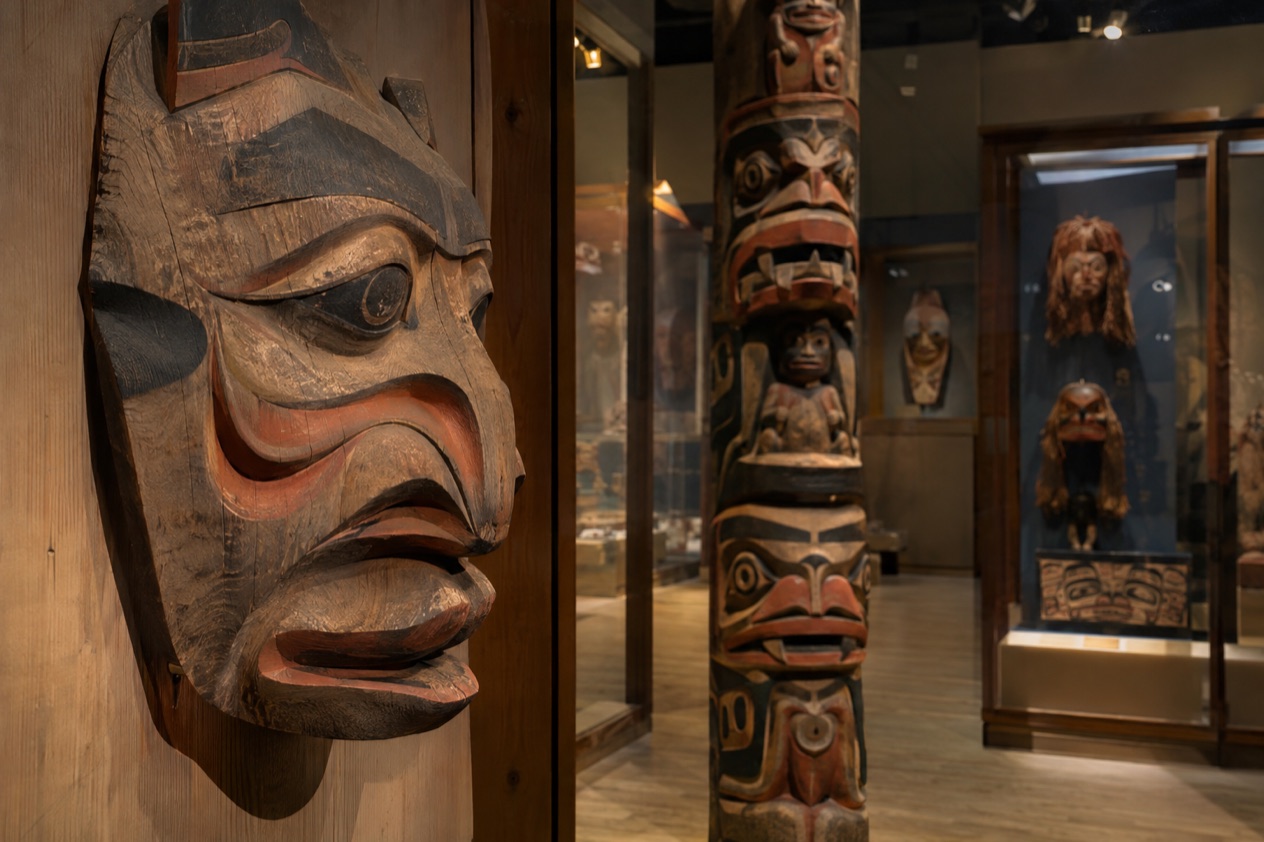
The art of the rainforest coast is the one most visitors recognize first: totem poles, painted house fronts, bentwood boxes, carved masks and woven blankets. Its visual language is built on formline, a flowing system of swelling and tapering lines that turns ravens, eagles, bears, orcas and wolves into patterns. Look for the oval shapes that repeat inside a design and for the way one animal’s body folds into another’s.
The Tlingit homeland historically stretched along the coast and across almost the whole Alexander Archipelago, and the Chilkat, Chilkoot and Taku Tlingit each belong to a particular river country. Chilkat weaving, with its fringed robes of mountain goat wool and cedar bark, takes its name from the Chilkat Tlingit. Haida and Tsimshian artists share this coast, and Sealaska Heritage Institute works to advance all three cultures.
Arctic, interior and southwest traditions
Farther from the coast the materials change with the land. Iñupiat and Yupik artists work in walrus ivory, baleen, driftwood and sealskin, producing delicate carvings of animals, dance masks and ornately sewn parkas. Yup’ik masks can be playful and strange, with attached hoops, feathers and extra faces that represent the spirits a dancer calls up.
In the interior, Athabascan artists are known for beadwork, with floral patterns on moosehide gloves, bags and jackets, along with birchbark baskets. Along the Aleutian chain, Unangax̂ weavers make grass baskets so fine that they feel like cloth. Alutiiq artists carry on mask carving and basketry around the Gulf of Alaska. These pieces connect to hunting, fishing and travel on the land and water, which remain living practices for many communities.
Art that belongs to people and place
Alaska Native life is tied to land held through regional corporations rather than reservations, a result of the Alaska Native Claims Settlement Act. That is why you will not find a reservation to visit the way you might elsewhere in the country.
You will find cultural centers, village sites, corporation-run stores and artists’ own tables. In Juneau, Tlingit names on buildings, maps and signs come with interpretation, so the language itself is part of what you see around you.
Where can you see it?
You can see Alaska Native art in Juneau, Anchorage, Fairbanks and just outside Ketchikan, in places that range from a downtown cultural building to a forest park of poles. Each one tells a different part of the story, so pairing two of them gives a fuller picture than any single stop.
Juneau: Sealaska Heritage and Celebration
The Walter Soboleff Building in downtown Juneau is the headquarters of Sealaska Heritage Institute, a nonprofit founded to advance Tlingit, Haida and Tsimshian cultures. Its first floor holds an ongoing cultural exhibit, and the story is told by the people who know it best. The Áak’w Kwáan and T’aakú Kwáan, the Tlingit peoples of the Juneau area, are part of the background to everything on display.
The Sealaska Heritage Store sits in the same city, and it is where visitors can buy artwork by Southeast Alaska Native artists. The institute also produces Celebration, Alaska’s second-largest Native gathering, held every other year. Thousands of Native people come to Juneau in June of even-numbered years, and regalia carrying years of clan history comes out for dances performed in new and old ways. Celebration is also broadcast live statewide.
Across the water, the traditional Tlingit village of Hoonah, near Glacier Bay, is home to the Xúnaa Ḵáawu. On an ordinary day in Juneau, the best way to start is simply to walk downtown and notice the Tlingit place names, then step into the building where those names are explained.
Anchorage: Alaska Native Heritage Center
The Alaska Native Heritage Center, on Heritage Center Drive in Anchorage, presents all of the state’s Native peoples in one place. Its six Village Sites are outdoor spaces you walk through, each showing how a different cultural group built homes and lived on its land. Walking tours of the sites run daily in the summer season and take a good part of a morning or afternoon.
This is the stop for seeing the range of Alaska Native cultures side by side, from the Arctic to the coast to the interior. Café Di’eshchin keeps summer hours and closes for the winter season, so it makes a natural pause between tour and exhibits when it is open.
| Site | Open |
|---|---|
| Alaska Native Heritage Center, Village Site walking tours (60 to 90 minutes) | Daily in the summer season, departing the Crossroads at 9:15AM, 11:15AM, 1:15PM and 2:15PM |
| Café Di’eshchin, Alaska Native Heritage Center | Daily 9AM to 5PM in the summer season, closed in winter |
| University of Alaska Museum of the North, Fairbanks | Daily 9AM to 5:30PM, admission sales close at 5PM |
| Alaska Native Heritage Center ticket | Amount |
|---|---|
| Alaska Resident adult (18 and older, ID required) | $15 |
| Alaska Resident child (4 to 17, ID required) | $13 |
| After 4PM | 50% off the ticket price |
| Children 3 and younger, ANCSA members, Indigenous individuals with tribal enrollment or Tribal ID, Southcentral Foundation guests | Free |
Fairbanks: the Museum of the North
The University of Alaska Museum of the North stands on the UAF campus on Yukon Drive in Fairbanks. Its galleries bring together Alaska Native cultures, wildlife, natural wonders and Arctic dinosaurs under one roof, and the art collection reaches across two thousand years of Alaska art. That long span lets you see how ancient carving traditions connect to the work of living artists.
The museum is also a place to learn about research by its own scientists. Bus 142 is not on public view at the museum at the moment, since it is in offsite storage while funds are raised for an outdoor exhibition site. Plan the visit around the art and Native cultures galleries and let the rest fill the day.
Ketchikan: Totem Bight State Historical Park
Totem Bight State Historical Park lies at Mile 10.5 of the North Tongass Highway, north of Ketchikan, on the former site of a traditional Native campground called Mud Village or Mud Bight Village. Here a collection of totem poles stands together with a replica of a traditional chieftain’s house. The carvings on that house were done by Charles Brown, a Tlingit of Saxman.
A Civilian Conservation Corps project built the community house and raised fifteen totem poles, most of them replicas of nineteenth-century poles. Walking among them is a slow experience, since each pole rewards a long look at its stacked figures. The historic site covers a small part of the park’s acres and is listed on the National Register of Historic Places.
How do you buy it responsibly?
You buy Alaska Native art responsibly by buying from the artist, or from a place that sells the work of Native artists, and by treating every piece as the work of a named person from a specific community. Souvenir shops stock carved ravens and printed formline, but a design is not the same as a piece made by an artist who carries that tradition.
Start with Native-run sources
In Juneau, the Sealaska Heritage Store, owned and operated by Sealaska Heritage Institute, sells artworks by Southeast Alaskan Native artists. The institute’s online shop offers its artworks to people who are not in town. A store connected to a Native cultural organization gives you a clear line from your purchase back to the artist, and the staff can tell you about the person who made the piece.
Cultural centers and museum shops are also good places to look for artists’ names. When you see a piece you like, ask who made it, which community they come from and what the design means. A genuine piece usually has a story attached, and the question itself shows respect for it.
Ask the questions that matter
A few simple questions sort most situations. Is the maker named? Is the maker Alaska Native? Which people or region does the design belong to? Totem and clan crests are the property of particular families, so a pole-shaped souvenir is not a neutral decoration. Be wary of a carving with no maker at all, and of a price so low that it could not pay an artist for the hours the work takes.
Regalia, ceremonial pieces and robes are woven into clan history, which Celebration shows clearly when it brings them out for dances. Admire them where they are shown and do not expect them to be for sale. What you take home should be made for sharing: prints, jewelry, small carvings, baskets, beadwork and sewn goods.
Food gifts and bringing a piece home
If a gift involves fish, the rules fall on the seller. The Department of Revenue issues Fisheries Business Licenses, which are required for all processing or exporting activities, and a seller who sells by the pound must have scales that are tested and approved each year. Buying from a licensed business is a quiet way to support people who follow the rules.
Alaska Natives also hold the right to harvest whales and other marine mammals under the Marine Mammal Protection Act, which shapes the materials some art is made from. If a piece includes marine mammal parts, ask the maker or the store about it before you buy, and keep any papers they give you. A good seller will answer without hesitation.
Good to know before you go
The Alaska Native Heritage Center runs its walking tours and its café in the summer season only, so winter visitors will find the exhibits rather than the village walk. The Museum of the North keeps daily hours, which makes it a steady choice in Fairbanks.
Celebration comes only in even-numbered years, in June, and a visit in an odd-numbered year is better spent at the Walter Soboleff Building and the Sealaska Heritage Store. Totem Bight is a short stretch north of Ketchikan along the North Tongass Highway.
Sources
- Sealaska Heritage Institute (https://www.sealaskaheritage.org/), checked October 11, 2026
- Alaska Native Heritage Center (https://www.alaskanative.net/visit), checked October 11, 2026
- Wikipedia, Tlingit (https://en.wikipedia.org/wiki/Tlingit), checked October 11, 2026
- Wikipedia, Alaska Natives (https://en.wikipedia.org/wiki/Alaska_Natives), checked October 11, 2026
- University of Alaska Museum of the North (https://www.uaf.edu/museum/), checked October 11, 2026
- Wikipedia, Totem Bight State Historical Park (https://en.wikipedia.org/wiki/Totem_Bight_State_Historical_Park), checked October 11, 2026
- Travel Juneau, Native heritage (https://www.traveljuneau.com/discover-juneau/juneaus-native-heritage/), checked October 11, 2026
- Alaska Department of Fish and Game, licenses (https://www.adfg.alaska.gov/index.cfm?adfg=fishlicense.main), checked October 11, 2026
- Alaska Department of Fish and Game, Wildlife viewing (https://www.adfg.alaska.gov/index.cfm?adfg=viewing.main), checked October 11, 2026