
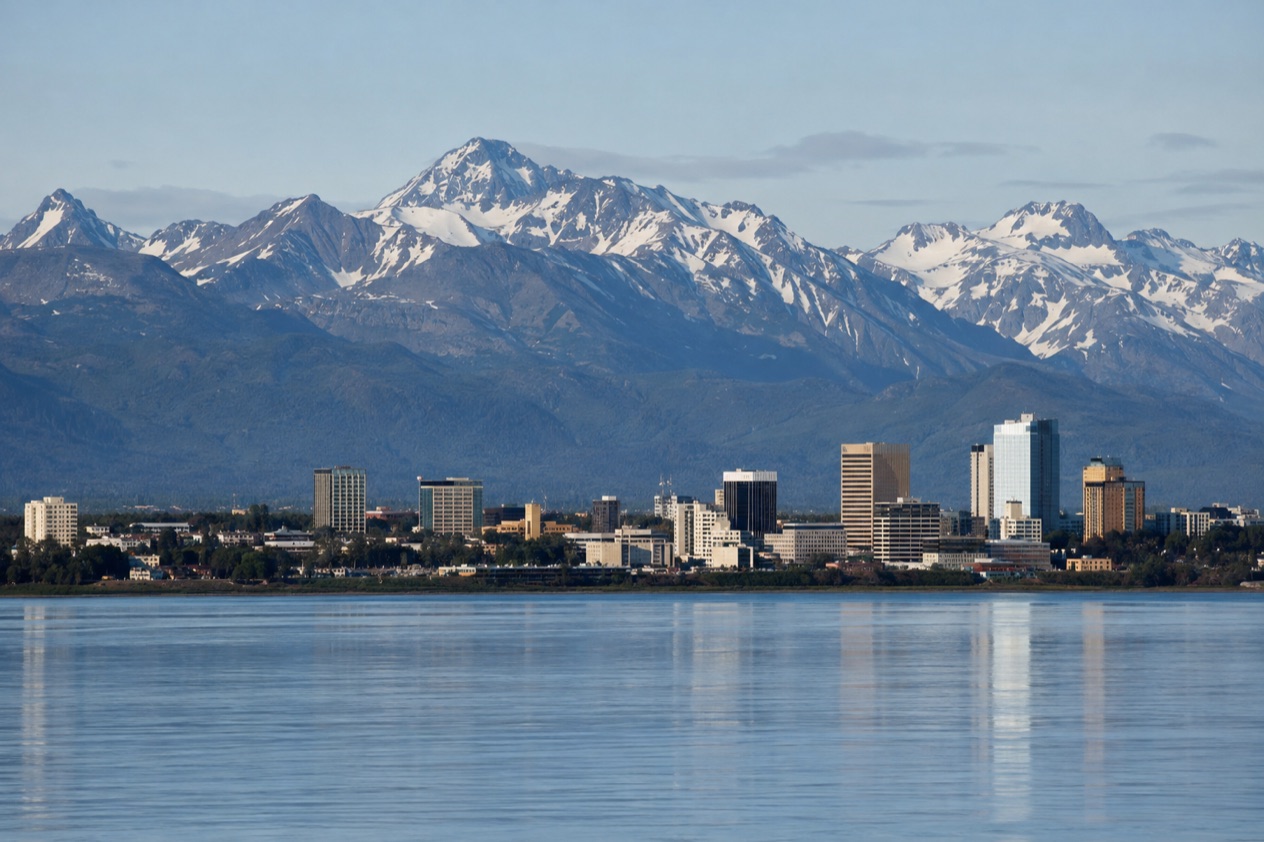
A cow moose browsing beside a bike path, a floatplane lifting off a small lake, and a wall of mountains standing at the end of a downtown street: this is an ordinary afternoon in Anchorage. The city sits at the head of Cook Inlet with wilderness pressing in on every side, so a museum morning can lead straight into a trail afternoon. It suits travelers who want one base for culture, wildlife and mountain scenery, and who like a city that keeps its wild edges close.
What are the best things to do in Anchorage?
The city is the main gateway to the state, and travelers spend at least three days here, which leaves room for the museums, a mountain trail, a flight or a boat day, and a good dinner built around seafood.
Alaska is large and mostly roadless, and Anchorage is where much of it becomes reachable in a single day. The essentials below are each developed in the sections that follow, but they give a sense of how the days can fit together.
- The Anchorage Museum, a big downtown museum of art, history and science, is the best single introduction to the state.
- The Alaska Native Heritage Center shares the heritage of Alaska’s 11 major cultural groups in one place.
- Chugach State Park, with its mountain trails, begins within a few miles of downtown.
- Flightseeing tours by floatplane, fixed wing or helicopter lift off from Merrill Field and Lake Hood.
- Wildlife viewing runs from moose in the city to the birds and occasional bears of the Anchorage Coastal Wildlife Refuge.
- Day trips reach Girdwood, Eklutna, Eagle River and the tidal flats of Turnagain Arm.
- Winter brings dog sledding, skiing, skating and the chance to see the northern lights.
- Seafood, reindeer sausage and Alaska craft beer make up an evening worth planning around.
Pick the season with the list in mind. Summer opens the trails, the boats and the long evenings. Winter has its own program of snow, sled dogs and festivals, and Anchorage stays active through it rather than going quiet.
A good first day usually starts with the museum, because it explains what you will see everywhere else, from the Dena’ina homeland under the city to the railroad that created it. From there the choices fan out: a trail, a flight, a drive to a nearby town, or an evening in the downtown restaurants and breweries.
Sights and landmarks in Anchorage
Anchorage is a young city by most standards, and its sights tell a compressed story: a Dena’ina homeland, Russian influence, a gold rush, a railroad camp that became a city, and a catastrophic earthquake. The museums and cultural centers cover all of it, and visiting them first makes the rest of an Alaska trip easier to read.
The Anchorage Museum
The Anchorage Museum stands in walkable downtown Anchorage and is a large museum of art, history, ethnography, ecology and science. It opened in 1968, and Condé Nast Traveler has named it one of its Top 50 Museums to Visit in the U.S. The permanent galleries run from Alaska history to Alaska art, so a visitor can cover the whole state in one building.
The Smithsonian Arctic Studies Center is the part people remember. It shows Alaska Native artifacts on long-term loan from the Smithsonian Institution, and it pairs well with a later visit to the Heritage Center because the objects make more sense once you have heard the people behind them speak.
The Imaginarium Discovery Center fills its science galleries with hands-on exhibits about Alaska’s natural world. It works as a break in the middle of a long gallery visit, whether you travel with children or not. The museum is open in every season, so it is as useful on a snowy day as on a bright summer evening.
The Alaska Native Heritage Center
The Alaska Native Heritage Center opened in 1999 as an educational and cultural institution, and it describes itself as Alaska’s premier cultural destination. It shares the heritage of the state’s 11 major cultural groups, among them the Athabaskan, Tlingit, Haida, Yup’ik, Alutiiq, Unangax and Inupiaq peoples. It sits ten miles from downtown Anchorage.
The point of a visit is to hear Alaska Native peoples explain their own traditions, beliefs and ways of life, group by group, rather than reading a single summary.
Plan this as a longer stop, not a quick look in passing. It rewards a slow pace, and the story it tells is the one most Alaska itineraries leave out. Alaska residents pay a lower admission with ID, a detail that explains the many local faces you may see there.
Downtown, Ship Creek and the railroad story
Anchorage began in 1915 as a tent city near Ship Creek, when Alaska Railroad construction began, and the railroad remains part of the downtown identity. Walking the grid of streets, you can see how a work camp became a city of nearly 300,000 people, with the Chugach Mountains standing behind the office buildings as a permanent backdrop.
The Good Friday earthquake of March 27, 1964, magnitude 9.2, remains the great event of the city’s memory. The museums touch on it as part of the larger history, and it explains why a city this young feels so conscious of the ground beneath it.
Downtown is also where several museums and historical attractions present the Russian, Native, gold rush and pioneer chapters of Alaska. A slow loop on foot picks up small displays, murals and statues, and it ends easily at a coffee shop or a brewery.
Outdoor things to do in Anchorage
Anchorage offers hiking, glacier viewing, wildlife watching and flightseeing from the city itself, and the municipality covers 1,961 square miles between Eklutna and Portage. That is more wild country than people expect from a place with a downtown, and it explains why locals treat the mountains as a backyard.
Chugach State Park
Chugach State Park holds approximately 495,000 acres and is one of the four largest state parks in the United States. Its westernmost boundary lies seven miles east of downtown Anchorage, so a mountain trail is a short step from the city. Established by legislation in 1970, it protects a good share of the Chugach Mountains above town.
Mount Baldy, a 3,218-foot peak above Eagle River, is a popular spot for hiking and hang-gliding. The Lakeside Trail at Eklutna Lake follows the shore for 12.7 miles to the Eklutna Glacier Trail, which leads to the moraines at the foot of the glacier. In summer you can travel it on foot, by mountain bike, by ATV or on horseback.
In winter the same lakeside route can be traveled by snowmobile, snowshoes or cross-country skis, as regulation and weather permit. Visitors can also paddle turquoise waterways in a vast state park, and in summer the long evenings stretch the hiking day, with up to 19½ hours of sunlight and the sun setting just before midnight.
Wildlife viewing in and around the city
Anchorage offers wildlife viewing as close as moose in the city. The Anchorage Coastal Wildlife Refuge gives you a place to look for birds, moose, occasional bears and other animals, with easy access at Potter Marsh, Kincaid Park and Carr-Gottstein Park. These are chances rather than promises, and a patient visit with binoculars tends to pay off best.
Millions of birds flock to the Anchorage area on annual migrations, and salmon fill nearby rivers and streams all summer long. Farther afield, guides run flights to see bears fishing and day cruises for whales, puffins and otters, plus tours that look for wolves and caribou in Denali National Park.
The Alaska Wildlife Conservation Center takes in injured and orphaned animals all year, and most become permanent residents. For travelers it is the surest way to see Alaska’s large animals up close, while the wild sightings stay a matter of luck.
Flightseeing from Merrill Field and Lake Hood
Alaska has about six times as many pilots per capita as the rest of the United States, and flight is an everyday habit here. Flightseeing tours and charters leave Anchorage all year by floatplane, fixed wing or helicopter. They depart from Merrill Field and from Lake Hood, the world’s busiest floatplane base, or from nearby Girdwood.
From the air you can look over the Chugach Mountains and the Alaska Range, and the same flights are how people go looking for bears fishing in summer. In winter, clear skies keep pilots flying over snow-covered peaks. A flight suits anyone who wants the scale of Alaska explained in a way a trail cannot.
Winter on snow and ice
In winter, visitors can ski, skate, dog sled, snow bike, watch the northern lights and take flightseeing tours. Dog sledding in Anchorage typically operates from October through March, and summer dog sledding is available as well. Some of Alaska’s favorite summer activities are also available in winter, so the season is for doing things rather than waiting it out.
The northern lights are active in the skies over Anchorage from late September through the middle of April. The most common color is a brilliant yellow-green, though red, blue and purple can show up. Viewing is possible even after sundown on bright starry nights, but it remains a chance that depends on the sky.
Day trips from Anchorage
The best day trips from Anchorage are to Girdwood and the Portage area, Eklutna, Eagle River and the shore of Turnagain Arm. Each is within a short reach of the city and offers a different slice of Southcentral Alaska, from alpine resort to tidal flat to Dena’ina village.
Girdwood and Portage
The Girdwood and Portage area lies just 45 minutes south of Anchorage and is surrounded by the Chugach Mountains. A world-class ski resort sits within 40 minutes of downtown, and the area has two resorts or lodges. It is a mountain town where you can ski in winter and hike in the green months.
The Alaska Wildlife Conservation Center is a sanctuary here for injured and orphaned animals, and it is one of the best reasons to make the trip. It gives you the large animals of Alaska in spacious enclosures, which suits families and anyone who is curious about wildlife but cannot count on a lucky sighting.
Girdwood is also one of the points from which flightseeing tours depart. The best moment depends on what you want, with skiing in winter and hiking when the snow is gone.
Eklutna: the village, the lake and the glacier
Eklutna lies 24 miles northeast of Anchorage, near Mile 26 of the Glenn Highway, at the head of the Knik Arm of Cook Inlet. It is a Dena’ina community, and Anchorage sits on the homelands of the Dena’ina Athabascan people and the Native Village of Eklutna. A visit here is a good way to meet that heritage in person.
The other draw is Eklutna Lake, inside Chugach State Park, where the largely flat Lakeside Trail runs along the shore toward Eklutna Glacier. Walking, cycling and riding horses are all possible in summer. In winter, snowshoes, cross-country skis and snowmobiles take over, as regulation and weather allow.
This trip suits travelers who want a long, scenic walk without leaving the Anchorage area. Take water, expect changeable mountain weather, and treat the glacier as a destination for a full day rather than a quick look.
Eagle River
Eagle River is a community within the Municipality of Anchorage, set on the Eagle River between Joint Base Elmendorf-Richardson and Chugach State Park. It is the trailhead town for Mount Baldy, and it also has hotels of its own for those who prefer a quieter base than downtown.
In July the town hosts the Bear Paw Festival, with multiple events spread through the community, and it holds a Fourth of July celebration at Lion’s Park. These small-town events give a more local flavor than the downtown festivals, and they suit travelers who like parades, food stands and a crowd of neighbors.
The Eagle River Campground in Chugach State Park has a group camping area that costs $150 per night and can be reserved online. It is meant for groups rather than single travelers, but it shows how much of the park is open to overnight use.
Turnagain Arm and its tides
Turnagain Arm stretches between 40 and 45 miles in an east-west direction, and its tides are the largest in the United States, with swings up to 40 feet. At low tide the arm becomes a broad mud flat cut by stream channels, and at the turn the flood often begins with a tidal bore.
The bore can reach 6 feet high and moves at 5 to 6 miles per hour, a moving wall of water that you watch from the shore rather than approach.
Beyond the immediate area, Fairbanks is a flight of just over an hour from Anchorage, and Alaska Airlines and Ravn Alaska both fly it. Wildlife tours from Anchorage also look for wolves and caribou in Denali National Park. Both are bigger trips than a single day trip, and they belong to a longer stay.
What to eat in Anchorage
Eating in Anchorage means seafood first. Salmon is the star, and in summer it fills the nearby rivers and streams, so you will find it on menus smoked, grilled on a cedar plank, cured as lox, or served as a simple fillet with a squeeze of lemon. Fish is the thread that runs through the city’s cooking.
Halibut is the other everyday fish, often served battered and fried with chips or pan-seared with butter. King crab, sold by the leg and served hot, is the dish that visitors tend to order once as a treat. Many restaurants also serve rockfish, cod and spot prawns when they are in season.
Local specialties beyond the fish
Reindeer sausage is the signature street food, grilled and served in a bun with grilled onions from carts downtown in warm months. It tastes like a lean, lightly smoky sausage, and it is a good first taste of Alaska if you are not sure what to try.
Alaska cooking also leans on sourdough, a living tradition from the gold rush days, in pancakes, bread and stews. Birch syrup, tapped from local trees, is a more unusual sweet, and wild berries such as blueberries and cranberries turn up in jams, pies and sauces. Fireweed honey is another local gift to take home.
Beer, coffee and the downtown scene
Anchorage’s craft breweries pour beers shaped by Alaska, from amber ales to stouts and seasonal brews made with spruce tips or local berries. The local coffee culture is also strong, with small roasters and drive-up espresso stands in every neighborhood.
The downtown dining scene mixes fine dining built on local seafood with casual cafés, diners and pubs. The accommodations around downtown include first-class hotels, so you can finish a day in the museums and walk straight to dinner. A visit to a farmers market or a seasonal festival is another way to taste local produce and baked goods.
For a final taste, a plate of fried halibut with a local beer, eaten while the evening light lingers over the Chugach Mountains, is hard to improve on. Fresh fish tastes best in the months when the runs are on, and the summer visitor has the widest choice.
Things to do in Anchorage at night
Evenings in Anchorage depend on the season, because the light changes so much. In summer the sun sets just before midnight, so the evening is long and bright, and locals use it for hiking, paddling, patio dinners and walks after work. In winter the dark comes early and the city turns to lit-up festivals, sled dogs and the sky.
Northern lights nights
From late September through the middle of April, the northern lights are active in the skies over Anchorage. The city is one of the best bases for chasing them, with many prime locations accessed from town, and viewing is possible even after sundown on bright, starry nights. Whether they appear is up to the sky and the clouds.
The most common color is a brilliant yellow-green, but red, blue and purple are possible too. Dress for the cold, bring patience, and treat the sighting as a bonus. A flight over the Chugach Mountains and the Alaska Range is a daytime alternative for those who prefer certainty to chance.
Music, events and festivals
Anchorage offers a variety of events, including festivals, concerts, live music, marathons and cultural celebrations. The Anchorage Local E-newsletter is a way to keep up with local happenings before and during your visit, and a venue’s calendar often tells you more than any guide can.
The winter festival season has some of the most memorable evenings. Fur Rendezvous, called Fur Rondy, is Alaska’s largest and oldest winter festival and began in 1936 as a three-day sporting event. It has grown into a series of events that includes the Outhouse Races, in which teams steer outhouses on skis, and the Running of the Reindeer, a dash down the streets with caribou at the racers’ heels.
The Iditarod Trail Sled Dog Race traditionally starts in Anchorage on the first Saturday of March. The ceremonial start kicks off on Fourth Avenue at D Street and runs to Campbell Creek Science Center, and the route through town is 11 miles long. It is a daytime event, but the crowds make the surrounding evening one of the liveliest of the year.
Quiet evenings
A quieter evening can be a slow dinner of salmon or halibut, followed by a walk in the long summer light. Breweries and cafés downtown are comfortable places to rest after a day outdoors. In winter, a skate on a frozen rink or a night at the lodge is the cozy counterpart to the festivals.
Museums and cultural centers also host evening events at times, so it helps to look at their calendars. Travelers staying in Girdwood or Eagle River will find a quieter mood than downtown, with the mountains close at hand and a fire or a patio to end the night.
Things to do in Anchorage with kids
Children in Anchorage can look at animals, touch science exhibits, run on trails and watch a parade of reindeer. The city is built around outdoor play, so families find plenty to do in every season, and the mix of museums and wilderness keeps a day from feeling like a chore.
Museums made for hands-on learning
The Anchorage Museum’s Imaginarium Discovery Center offers hands-on exploration of Alaska’s natural wonders, with science galleries designed to be touched. It is the natural first stop for children, and it is easy to build a morning around it, with the larger galleries for older family members.
The Alaska Native Heritage Center brings the stories of Alaska’s peoples to life in a way that holds a child’s attention better than a printed label. Children aged 4 to 17 qualify for a youth admission rate, and Alaska residents have a separate lower rate. Learning about Indigenous cultures here fits well with a family trip.
Animals and open space
The Alaska Wildlife Conservation Center is a sanctuary for injured and orphaned animals, with spacious enclosures and quality animal care. Most residents stay for life, which makes it a good place to talk with children about conservation as well as to look at animals. It lies in the Girdwood and Portage area, so it fits into a day trip.
Closer to town, the Anchorage Coastal Wildlife Refuge at Potter Marsh, Kincaid Park and Carr-Gottstein Park gives families places to watch for birds and moose, with easy access. Moose can turn up in the city itself, so a walk is a chance to look.
Seasonal fun
In winter, families can skate, ski, snow bike and try dog sledding, which typically runs from October through March. Fur Rondy’s Running of the Reindeer and Outhouse Races are silly and memorable, and children tend to remember them long after a museum visit fades.
Summer days are long, with up to 19½ hours of sunlight, so children may stay up later than usual. Plan outings with the light in mind, and bring layers for the mountains. Two lodges in the Girdwood and Portage area have wheelchair accessible facilities and pathways, which helps families with mixed mobility.
Good to know before you go
Ted Stevens Anchorage International Airport is the region’s main hub, five miles southwest of downtown, and more than 240 flights arrive there daily. Travelers may need a Real ID or other acceptable ID to fly. People plan at least three days in Anchorage, and the free Official Anchorage Visitor Guide includes a directory of local businesses in Anchorage and Southcentral Alaska.
Lodging ranges from hotels, motels and bed and breakfasts to cabins, hostels and campgrounds, with Girdwood and Eagle River options outside the center. Dog sledding typically runs from October through March, and the northern lights are active from late September through the middle of April, so match your plans to the season.
Sources
- Visit Anchorage (https://www.anchorage.net/), checked October 11, 2026
- Alaska.org, dest anchorage (https://www.alaska.org/destination/anchorage), checked October 11, 2026
- Wikivoyage, Anchorage (https://en.wikivoyage.org/wiki/Anchorage), checked October 11, 2026
- Wikipedia, Anchorage, Alaska (https://en.wikipedia.org/wiki/Anchorage,_Alaska), checked October 11, 2026
- Wikipedia, Anchorage Museum (https://en.wikipedia.org/wiki/Anchorage_Museum), checked October 11, 2026
- Alaska Native Heritage Center (https://www.alaskanative.net/visit), checked October 11, 2026
- Wikipedia, Chugach State Park (https://en.wikipedia.org/wiki/Chugach_State_Park), checked October 11, 2026
- Alaska State Parks, Chugach region (https://dnr.alaska.gov/parks/aspunits/chugach/chugachindex.htm), checked October 11, 2026
- Wikipedia, Turnagain Arm (https://en.wikipedia.org/wiki/Turnagain_Arm), checked October 11, 2026
- Wikipedia, Eklutna, Alaska (https://en.wikipedia.org/wiki/Eklutna,_Alaska), checked October 11, 2026
- Wikipedia, Eagle River, Alaska (https://en.wikipedia.org/wiki/Eagle_River,_Alaska), checked October 11, 2026
- Ted Stevens Anchorage International Airport (https://www.ancairport.com/), checked October 11, 2026
- Wikipedia, Joint Base Elmendorf–Richardson (https://en.wikipedia.org/wiki/Joint_Base_Elmendorf–Richardson), checked October 11, 2026
- Alaska Wildlife Conservation Center (https://www.alaskawildlife.org/), checked October 11, 2026
- Wikipedia, Chugach Mountains (https://en.wikipedia.org/wiki/Chugach_Mountains), checked October 11, 2026
To plan your stay
- Best Time to Visit Anchorage: Long Summer Days, Northern Lights, Weather by Month and Festivals
- Where to Stay in Anchorage: Downtown, Eagle River, Girdwood and Lodging Types
- Anchorage from the Lower 48: Flights, Roads, Ferries and Trains Once You Arrive
- Know Before You Go to Anchorage: Weather, Wildlife, Getting Around and Local Habits