
On a clear night in Fairbanks the cold settles over the spruce, the porch light goes off, and the sky can start to stir with a pale green band that slowly gathers into a curtain. Come morning, the talk turns to a mountain that stands above everything else on the continent, to brown bears on a river in the southwest, and to blue ice breaking off a glacier into a lake.
What should be on an Alaska bucket list?
Each one lives in a different corner of the state, so the list is as much about geography as about wishes. Alaska has eight national parks, and several of the biggest dreams sit inside them.
What ties the list together is that every item has its own season. Some are open to you now and others are shut by snow, so it helps to think of the list as a calendar before you think of it as a map.
Denali and the Alaska Range
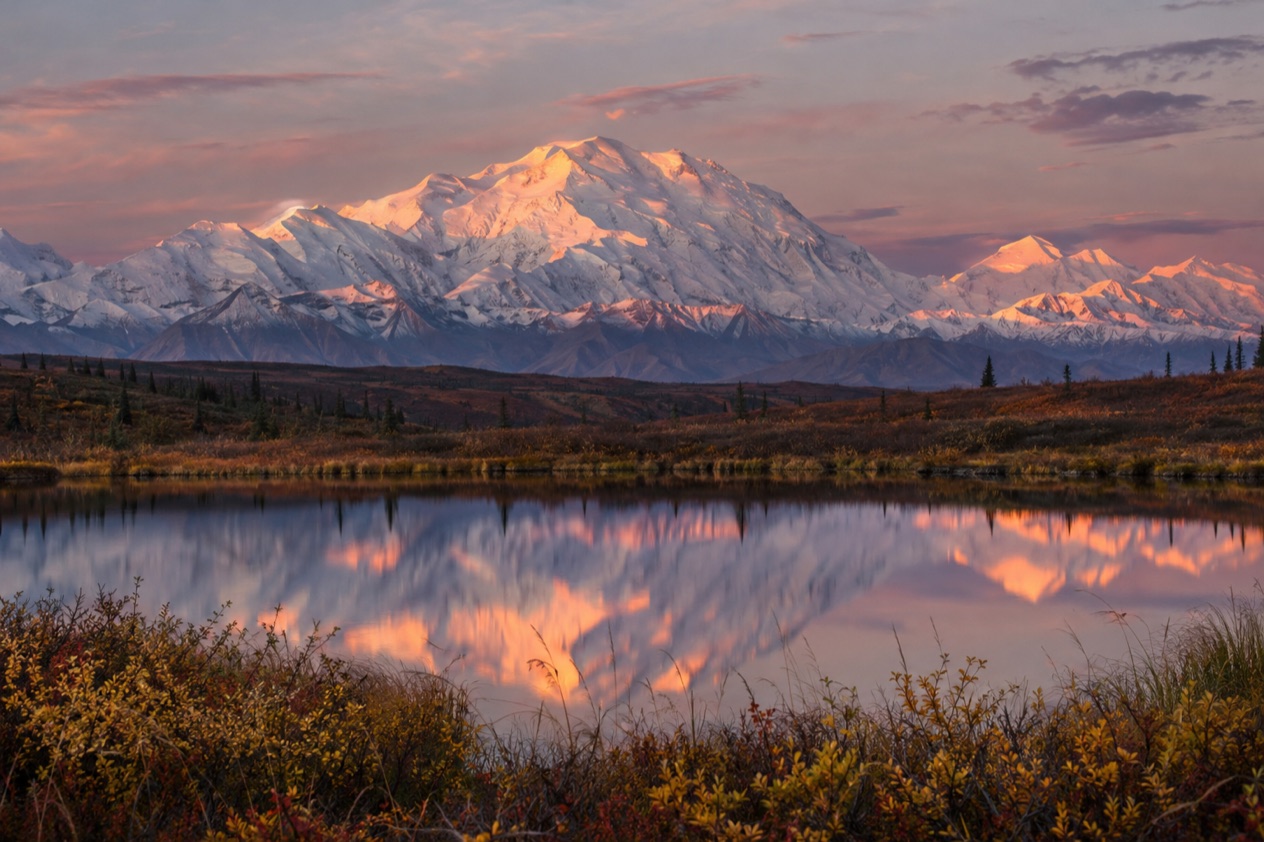
Denali is the highest peak in North America, rising to 20,310 feet, and the national park around it was established in 1917. The park is a huge piece of tundra, braided river and spruce, with the mountain appearing on clear days and hiding behind cloud on others. A lot of the pleasure is in that uncertainty, the moment the cloud lifts and the whole massif is simply there.
The Denali Park Road runs 92 miles, from the George Parks Highway to Kantishna. Private vehicles may drive only as far as Savage River Bridge. Past that point, the park interior is reached by shuttle or tour bus, which means you watch the tundra roll by from a window seat and look for caribou, Dall sheep and perhaps a bear on the slopes.
Snow closes the road past the park headquarters from October to April. The park itself stays open then for cross-country skiing, snowshoeing and dogsledding, so Denali is also a winter place with a very different, quiet character.
The northern lights around Fairbanks
Fairbanks sits far enough north that the aurora is a regular visitor, and the university’s aurora researchers say that on a clear night, after at least three nights in town, seeing it is highly likely. It is still a chance and never a promise, because clouds decide a good deal. The lights can look like a faint gray-green haze at first and then grow into moving bands that cross the whole sky.
The hours that matter are late. In interior Alaska in winter the window is typically from 9 p.m. to 3 a.m., and the stretch around midnight has the best odds of a spectacular show. Activity also tends to be stronger around the fall and spring equinoxes than at midsummer or midwinter. A full moon can wash out the dim features, though moonlight can also bring out colors.
People watch from places away from town lights, including Cleary Summit, Ester, Chena Lakes Recreation Area, Tanana Lakes Recreation Area, Haystack Mountain on the Elliot Highway, and turnouts along the Steese and Parks Highways. Wickersham and Murphy Domes, Nordale Road and the Ballaine Road turnout near the Goldstream Creek bridge are also on the recommended list.
Brown bears at Katmai
Katmai National Park and Preserve, on the Alaska Peninsula in southwest Alaska, is known for the Valley of Ten Thousand Smokes and for its brown bears. It protects the largest protected brown bear population in the world, estimated at about 2,200 animals. That is the reason it earns a place on the list, though seeing a bear on any given day is something you may or may not get.
The park is not on the road system. King Salmon, where the park headquarters stands, is the closest significant town, and the Alaska Peninsula Highway links it to Naknek Lake near the park entrance without connecting to the rest of Alaska’s roads.
The interior is reached by boat on Naknek Lake. From Brooks Camp a road runs to Three Forks, which overlooks the Valley of Ten Thousand Smokes, a landscape of ash and volcanic rock that feels like another planet.
Which experiences are best known?
Glaciers, the Iditarod and the Inside Passage join Denali, the aurora and Katmai’s bears on the shortlist that most Alaska plans are built around. They are very different in mood. One is calm and watery, one is a sled race across the frozen state, and one is a slow trip along a coast of mountains and small towns.
Glaciers at Mendenhall and Glacier Bay
Mendenhall Glacier lies about 12 miles from downtown Juneau and is about 13.6 miles long. It ends in a lake, and from the visitor center and the area around it you can look out over a calving glacier, one that sheds ice into the water below. The glacier and its surroundings are protected in the Mendenhall Glacier Recreation Area, part of the Tongass National Forest.
Photo Point Trail and Steep Creek Trail are described as easy and accessible, and both start near the visitor center, which the Forest Service runs with interpretive programs for children and adults. Elevated boardwalks over Steep Creek give you a chance to watch salmon and bears.
Glacier Bay National Park and Preserve lies west of Juneau and covers more than three million acres. No roads lead to it, so it is reached by air or sea. The Alaska Marine Highway ferry connects Juneau and Gustavus via Hoonah twice a week. The number of cruise ships allowed into the bay each day is limited by regulation. The park is part of a UNESCO World Heritage Site that was inscribed in 1979.
The Iditarod
The Iditarod begins with a ceremonial start in downtown Anchorage, at Fourth Avenue and D Street, where spectators line the street to watch the mushers leave. The official restart comes the next day in Willow, 80 miles north of Anchorage, and the trail then climbs through Rainy Pass in the Alaska Range, passes Skwentna, McGrath and Unalakleet, and follows the Bering Sea shore to Nome.
Teams start with 12 to 16 dogs, and at least five must be on the towline at the finish. The rules include a 24-hour layover, an 8-hour layover on the Yukon River and an 8-hour stop at White Mountain.
Spectators can fly to checkpoints such as Skwentna, a 40-minute flight from Anchorage. The finish is at the burled arch on Front Street in Nome, where a Widow’s Lamp burns until the last musher comes in.
The Inside Passage, fall color and winter play
The Inside Passage can be done without a cruise, as an itinerary that visits Juneau, Ketchikan, Skagway, Haines, Sitka, Hoonah and Glacier Bay. It is a way to see the coast town by town, at the pace of ferries and harbors rather than a ship’s schedule.
Other items fall into seasons. Fall color in Alaska runs from late August through September, and winter sports are best from November through March. Fishing trips target salmon, halibut, trout and grayling, so a line in the water can be added to nearly any part of the list.
How do you fit them into a trip?
You fit them in by matching each experience to its season and then grouping the ones that share a region. A single trip will rarely hold the whole list, and the seasons themselves pull the items apart: the aurora needs dark skies, while the Denali train and bus season belongs to the lighter months.
| Experience | Season |
|---|---|
| Aurora viewing in Fairbanks | August 21 to April 21 |
| Aurora season in Alaska | Late August through early April |
| Alaska Railroad Denali Star at the Denali depot | Mid-May to mid-September |
| Denali Park Road past the park headquarters | Closed by snow, October to April |
| Fall colors | Late August through September |
| Winter sports | November through March |
Late summer, when the seasons overlap
The stretch from late August to mid-September is the one moment when several items are available together. The Denali Star train still serves the Denali depot, the fall colors are turning, and in Fairbanks the sky has become dark enough again for the aurora. Between April 22 and August 20 it does not get dark enough there to see the lights, even in a spectacular display.
The train itself is part of the experience. The Denali Star runs between Anchorage and Fairbanks, 356 miles in 12 hours, with stops in Wasilla, Talkeetna and Denali National Park. On a clear day you can see Denali from the train.
The route unrolls in sequence. It crosses the Knik River with the Chugach Mountains behind, shows Denali above the Susitna River just south of Talkeetna, and runs over Hurricane Gulch on a 296-foot bridge through the roadless Hurricane area. Broad Pass opens views of the Alaska Range in every direction, and past the park the line follows Healy Canyon along the Nenana River.
A winter trip around Fairbanks and Denali
A winter trip puts the aurora at the center, with a stay of at least three nights in Fairbanks to give the clouds a chance to part. The days can then go to snow. Denali stays open for cross-country skiing, snowshoeing and dogsledding even while the park road is closed beyond the headquarters, and winter sports in general are best from November through March.
The equinox months, around fall and spring, are the ones when auroral activity tends to run stronger, with roughly twice the statistical likelihood of seeing it compared with midwinter or midsummer. The aurora was also expected to peak slightly after the last solar maximum, so activity can stay lively in the years that follow.
Southeast and southwest add-ons
The Southeast gathers glaciers, ferry towns and the Inside Passage in one region. Juneau gives you Mendenhall Glacier, Gustavus is the gateway to Glacier Bay, and the ferry between them calls at Hoonah. The towns of Ketchikan, Skagway, Haines and Sitka fill out the coast.
Katmai is a separate trip, about 290 miles southwest of Anchorage and reachable only without a road link to the rest of the state. It pairs with nothing else on the list, so plan it as its own chapter rather than a stop between two others.
Good to know before you go
The list rewards patience with seasons more than anything else. The Denali Park Road closes to snow past the park headquarters from October to April, while the train to the park depot runs only in the warmer months.
In Fairbanks, the sky is too light for the aurora in the middle of summer. Cloud cover can hide both the mountain and the lights, so build a spare day or two into any plan. For Katmai and Glacier Bay, getting there is part of the trip, since neither park has a road connection.
Sources
- Wikipedia, Denali National Park and Preserve (https://en.wikipedia.org/wiki/Denali_National_Park_and_Preserve), checked October 11, 2026
- University of Alaska Fairbanks Geophysical Institute, Aurora forecast (https://www.gi.alaska.edu/monitors/aurora-forecast), checked October 11, 2026
- Wikipedia, Katmai National Park and Preserve (https://en.wikipedia.org/wiki/Katmai_National_Park_and_Preserve), checked October 11, 2026
- Wikipedia, Glacier Bay National Park and Preserve (https://en.wikipedia.org/wiki/Glacier_Bay_National_Park_and_Preserve), checked October 11, 2026
- Wikipedia, Mendenhall Glacier (https://en.wikipedia.org/wiki/Mendenhall_Glacier), checked October 11, 2026
- White Pass and Yukon Route Railway, Skagway (https://www.wpyr.com/), checked October 11, 2026
- Alaska Railroad, Denali Star (https://www.alaskarailroad.com/ride-a-train/our-trains/denali-star), checked October 11, 2026
- Wikipedia, Iditarod Trail Sled Dog Race (https://en.wikipedia.org/wiki/Iditarod_Trail_Sled_Dog_Race), checked October 11, 2026
- Alaska.org, trip ideas (https://www.alaska.org/trip-ideas), checked October 11, 2026