
FOOD AND DRINK IN PORTUGAL · WHAT TO EAT · WHERE TO FIND IT
Salt cod, olive oil, pork, bread and Atlantic fish carry most of the Portuguese table. Portions are large, and the weekday lunch menu in an ordinary restaurant is where the cooking is at its most representative. What a week of eating costs is on the budget page.
This page is the eating map: the dishes worth planning around and when they are in season, what to drink, how to tell the rooms apart, and how the country handles dietary restrictions. Table manners, dinner hours, tipping and the coffee vocabulary belong to things to know before you go.
EATING AT A GLANCE · PORTUGAL
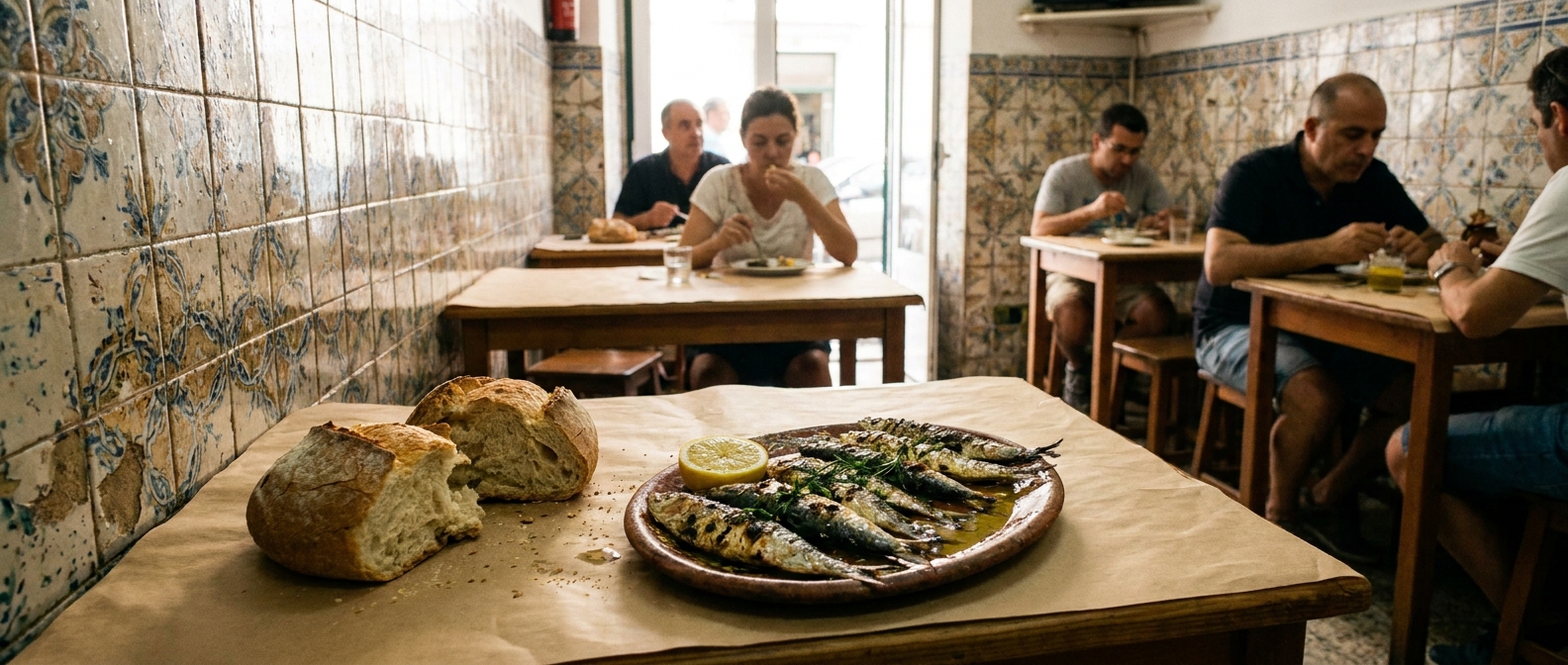
Eat lunch where the room is full at one o’clock, drink the house wine, and order the fish being grilled outside rather than the one printed largest on the menu.
SIGNATURE: BACALHAU · SWEET: PASTEL DE NATA · DRINK: VINHO VERDE
Go for: grilled fish at a beach shack, the lunch menu in a city tasca, a pastry from a busy counter, and one long dinner in the Alentejo.
Think twice before: ordering from a laminated menu with photographs on a tourist waterfront. Walking one street inland usually changes both the price and the fish.
Dishes, regions and wine categories: Turismo de Portugal, the regional wine commissions and the IVDP · no prices are printed · full sources at the end
On this page
- What do I have to eat?The dishes, and their seasons
- What do I drink?Wine and port
- Where do I eat it?The kinds of rooms
- I have restrictionsVegetarian, vegan, gluten and allergies
What to eat in Portugal: the dishes, and when they are in season
Bacalhau is the staple that defines the table. Salt cod, rehydrated and cooked in many ways, arrives baked with potatoes and olives, shredded with eggs and matchstick fries, or fried into fritters served as a snack. A local saying gives it a recipe for every day of the year, which says more about its place in the culture than about any count. Because it is preserved, it has no season.
The fish does have a season. Sardines are a summer and early-autumn food, with the Portuguese catch calendar running roughly June through October under annual fishing rules, and they are central to Lisbon’s June street festivals. Sea bass, bream and octopus run year-round, the last most famously as polvo à lagareiro, roasted with olive oil and garlic. Fish is often priced by weight, and the waiter will show you the catch before it is cooked.
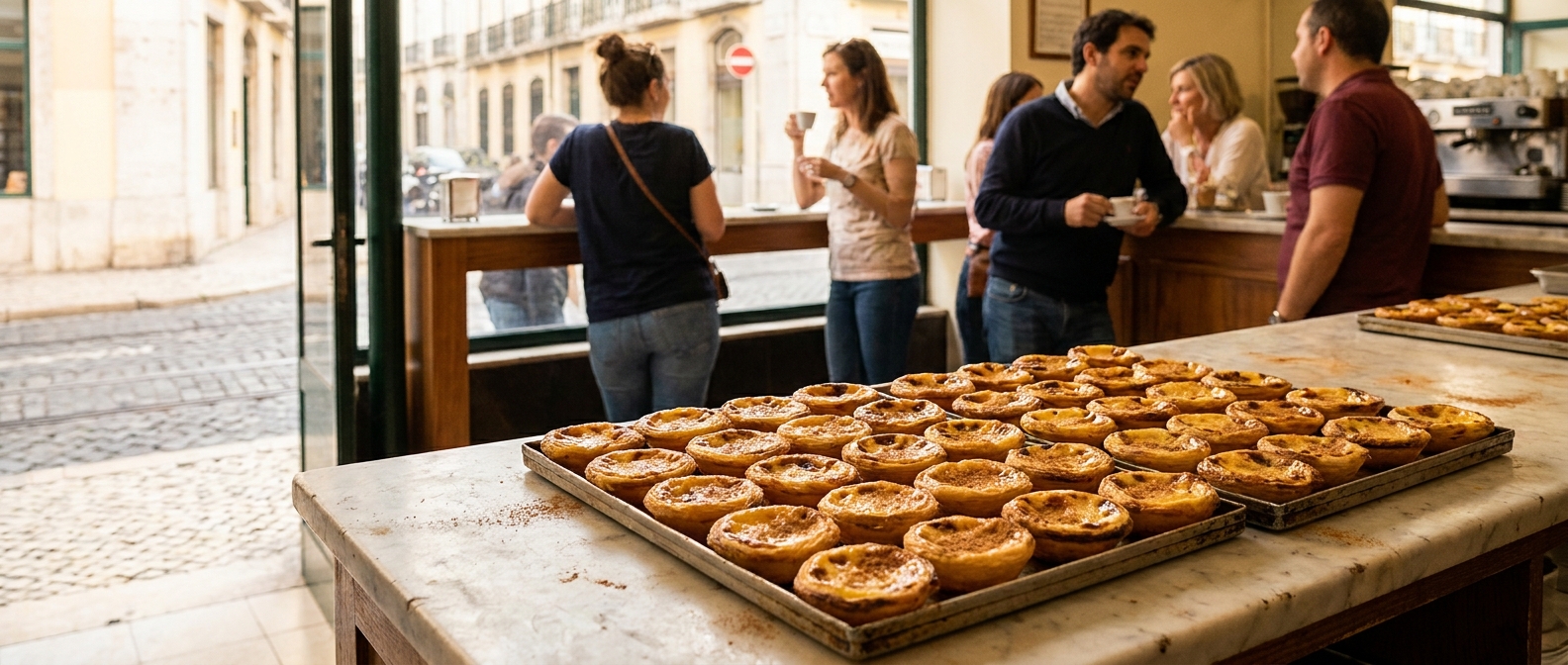
Then the pork, and the pastry. Roast suckling pig near Coimbra, Iberian black pork from the Alentejo, acorn-finished when it carries the montanheira label, and the bifana, a marinated pork sandwich sold at counters everywhere. Finish with a pastel de nata, best from a counter busy enough that the tray keeps being replaced.
The table below says what each name actually refers to. Several well-known Portuguese words name an ingredient, a serving format or a cooking vessel rather than one fixed recipe.
| Name | What it is | Type | Season | Where it belongs |
|---|---|---|---|---|
| Bacalhau | Salt cod, many preparations | Ingredient | All year, it is preserved | Everywhere |
| Sardinhas assadas | Grilled sardines, eaten off bread | Dish | Catch season, roughly June to October | Coastal, and Lisbon in June |
| Francesinha | Layered meat sandwich under cheese and sauce | Dish | All year, better cold weather | Porto |
| Cataplana | Hinged pan, and the dishes named after it | Utensil, and dish family | All year | The Algarve |
| Polvo à lagareiro | Octopus roasted with olive oil and garlic | Dish | All year | Everywhere |
| Porco preto | Iberian black pork, a breed rather than a diet | Meat product | Acorn-finished only under the montanheira regime | Alentejo |
| Petiscos | Small plates, often shared | Serving format | All year | Cities, evenings |
| Pastel de nata | Custard tart, cinnamon optional | Dish | All year | Every pastelaria |
Portuguese wine and port: what to order
House wine is poured by the carafe and costs very little (est.). In an ordinary restaurant it is generally sound, which makes ordering the cheapest wine on the list a reasonable move here rather than a risk.
Three names cover most lists. Vinho verde from the northwest, often young and lightly spritzy, though the region also makes still and aged bottles. Douro reds, dense and structured, from the same terraces as port. And Alentejo reds, rounder and warmer, poured widely across the country.
Port is aged in two places, not one. Producers mature it either in the Douro valley itself or in the lodges across the river from Porto, and both are visitable. The Porto guide covers the lodge visits, and the Douro guide covers the estates upstream.
Where to eat in Portugal: the types of restaurants
The room is a useful signal. A tasca is a small, usually family-run restaurant with a daily special written up somewhere, and this is where the weekday lunch menu tends to live. A marisqueira is built around shellfish and priced accordingly, and a cervejaria is a beer hall that also serves seafood, often late.
A churrasqueira grills chicken, much of it to take away. A pastelaria is the neighborhood counter that covers breakfast, mid-morning and the after-school hour, and it is where most Portuguese eat pastries standing at the bar.
Eating in Portugal with dietary restrictions
Vegetarians do better in the cities than inland. Lisbon and Porto have dedicated vegetarian and vegan restaurants and menus that mark their dishes. Portugal’s 2017 law also requires a daily option containing no animal products in public canteens, covering government services, the health service, care homes, schools, universities and prisons, with exemptions where demand is low. It does not apply to restaurants, and matters to a visitor only as a signal: asking for plant-based food here is an ordinary request. In a rural tasca the working answer is often a plate of vegetables, rice, bread and cheese, assembled on request rather than listed.
The hidden ingredient is pork. Soups, rice dishes and vegetable plates are frequently built on a pork or fish base, so a dish that reads as meat-free may not be. Asking directly is normal and gets a straight answer, and the phrase worth learning is sem carne e sem peixe, without meat and without fish.
Gluten and allergies are handled more formally. EU rules require restaurants to make information available about the fourteen listed allergens, which is not the same as guaranteeing a dish is safe. Bread is central to this cuisine, so travelers with celiac disease should ask about ingredients and cross-contact rather than rely on a menu mark, though supermarkets in any city carry gluten-free ranges. Halal and kosher options are concentrated in Lisbon and Porto, and worth verifying directly elsewhere.
Regional food in Portugal: north, coast and plain
The north cooks heavily. Porto and the Minho run to roast meats, tripe, broths and the francesinha, matched with vinho verde and, further inland, the reds of the Douro. The northwest is cold and wet in winter, which the regional guide covers.
On the coast, the default is fish on a grill with olive oil and salt, from Ericeira down to the Algarve. The Algarve adds the cataplana, named for the hinged pan it arrives in, most often filled with fish and shellfish.
Inland, in the Alentejo, the register changes again: bread soups, black pork, sheep’s cheese and game in season, over longer lunches. The plain’s own guide takes it from there.
The last word
Eating where the locals eat is easier here than in most of Western Europe, because the rooms that serve the best food are rarely the ones dressed for visitors, and prices are low enough that a wrong choice costs little.
Order the fish being grilled outside, drink what the house pours, and take the pastry from a counter with a queue. That covers most of the country, most of the time.
Sources & data for this guide
- Regional dishes, culinary regions and traditional recipes · Turismo de Portugal · checked Sep 3, 2026
- Vinho Verde styles, including still and aged bottles · Comissão de Viticultura da Região dos Vinhos Verdes · checked Sep 3, 2026
- Port ageing in the Douro or in the Vila Nova de Gaia lodges · Instituto dos Vinhos do Douro e do Porto · checked Sep 3, 2026
- Allergen information requirements, Regulation (EU) 1169/2011, Annex II · EUR-Lex · checked Sep 3, 2026
- Sardine fishing season and stock condition · IPMA and DGRM · checked Sep 3, 2026
- Vegan option required in Portuguese public canteens, Lei n.º 11/2017 · Diário da República, Lei n.º 11/2017 · checked Sep 3, 2026
- Editorial note: no prices are printed. Restaurant prices vary by room, city and season, and every comparison here is relative. Tipping, dinner hours, the couvert and the coffee vocabulary are covered on our know-before-you-go page rather than repeated here.
- Editorial note: dishes and wine regions are stable facts. This page is re-checked annually, unlike the flights guide, which is quarterly.