
BRAGA · THE MINHO · STAIRWAY AND FUNICULAR
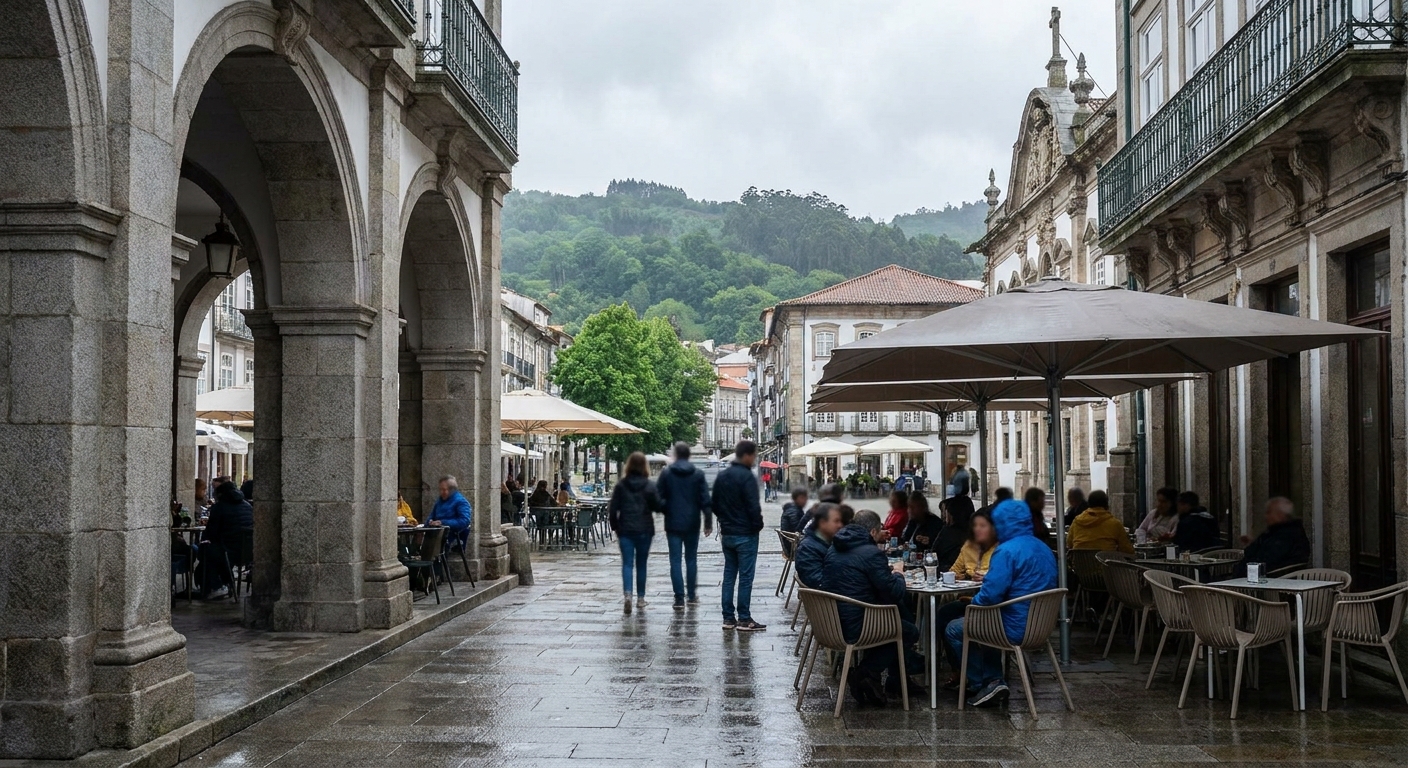
The bells start early in Braga and nobody in the cafés looks up. Portugal’s oldest see has been holding services here since before there was a Portugal, and the granite center was rebuilt in the baroque age to say so: gilded churches, an archbishops’ palace, a triumphal arch where the old gate stood. Then the University of Minho put several thousand students into the same streets. Ordering a coffee under the arcades on Praça da República near midnight is an ordinary thing to do in a cathedral town, and that combination is what people are unprepared for.
BRAGA IN BRIEF
Give the old center a morning and the hill a late afternoon, and expect a bill at dinner well under what the same meal costs in Porto.
THE MINHO · CATHEDRAL CITY · TRAIN FROM PORTO
Go for: the twin baroque organs inside the Sé, coffee under the arcades on Praça da República, the fountains of the Escadório dos Cinco Sentidos, and dinner at student prices.
Think twice before: arriving during Semana Santa without a room already held, or expecting a beach day. The Minho coast is a separate outing from here.
Sanctuary services and funicular hours change with the season and are posted on site · full sources at the end of this guide
On this page
- Things to do in Braga on footThe Sé, Praça da República, Jardim de Santa Bárbara
- Getting up to Bom Jesus do MonteThe stairway or the water funicular
- Holy Week in BragaWhat Semana Santa does to the old streets
- A day in Braga, morning to eveningCathedral first, hill last
- Where to stay in BragaHistoric center or the Bom Jesus hill
- Getting to Braga from PortoThe urban rail line, no car needed
- Braga or Guimarães for a night inlandOur Guimarães guide
What to see in Braga on foot: the Sé, Praça da República and the Jardim de Santa Bárbara
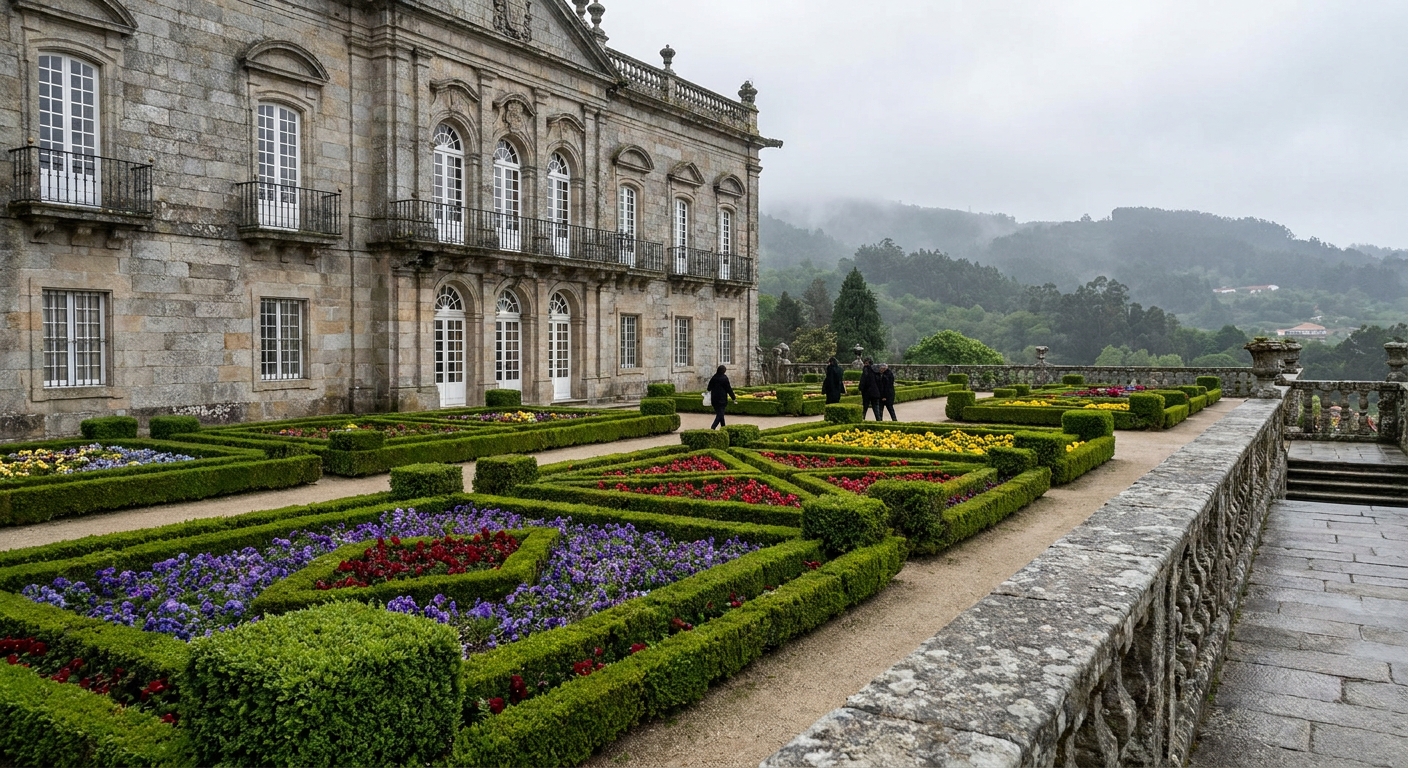
Start at the Sé. The country’s oldest cathedral has been altered so often that walking through it is a walk through successive rebuildings: a Romanesque shell, Gothic chapels, twin gilded organs facing each other above the choir, and a treasury museum reached from the cloister. Outside, the center is compact and flat. Rua do Souto runs from the Arco da Porta Nova to Praça da República, the Jardim de Santa Bárbara sets its box hedges and flowerbeds against the medieval wing of the archbishops’ palace, and the Palácio do Raio carries blue tile across its whole baroque front.
Evenings belong to the students. The University of Minho keeps its rectory at Largo do Paço, in the old episcopal quarters, with the main campus out at Gualtar, which is why term-time Braga has a café and bar life that startles visitors who booked for churches. The arcaded cafés on the Praça, Café Vianna among them, serve from breakfast until late. Prices run below Porto on rooms as much as on dinner, and we price the country’s tiers, sourced and dated, in our Portugal trip cost guide. Ask for a frigideira, the local puff-pastry pie.
Getting up to Bom Jesus do Monte: the baroque stairway and the water-counterweight funicular
Two routes go up the hill and they buy different things. On foot, the climb begins in woods and becomes the Escadório dos Cinco Sentidos, where each landing holds a fountain for one of the senses and the water runs down the stonework from one to the next. Above it comes the stairway of the Three Virtues. The switchbacks turn you around between flights so the city keeps reappearing below, chapels with painted scenes stand at the corners, and shade holds for most of the way. Climbing costs nothing and takes as long as your legs want.
The funicular does the same hill in a straight line. It has worked since the nineteenth century on a water counterweight: a tank beneath the upper car is filled until it outweighs the lower one, gravity handles the rest, and no engine takes part. Riding it is its own reason. The cars pass at the midpoint, the wooden interiors look their age, and the whole thing moves at walking pace. Hours shift with the season, so read the board at the lower station rather than a timetable found online. TUB city buses reach the foot of the hill from the center, and a road climbs to the top.
The sanctuary is a working church before it is a viewpoint. Mass is said, pilgrims climb the steps on their knees in religious weeks, and the interior asks for the voice you would use in any church. Behind the terrace the wooded park spreads out with paths, a lake and a handful of hotels, and higher along the ridge stands the Santuário do Sameiro, a second pilgrimage church with a wider sweep over the basin. For the Minho landscape all this belongs to, read our Porto and the North guide.
Holy Week in Braga: what Semana Santa closes and where the processions go
Semana Santa turns the city into the stage. The archdiocese and the brotherhoods run processions on successive nights through the old streets, balconies hang cloth, and the routes are lit by torches and candles instead of street lamps. The scene people carry home is the Ecce Homo procession, with barefoot farricocos in hooded robes carrying torches and the drums arriving before the column does. Shops keep late hours. Families who moved away come back for the week, so restaurant tables and hotel rooms go to whoever booked months in advance.
Easter moves, and the week moves with it, landing in March or April depending on the year. Either aim for it and book early, or check the date and stay clear, because the center closes to traffic in sections and the crowd stands several deep along the routes. Season and crowd shape are set out in our month-by-month guide, with the figures on the March and April pages.
June brings the other big one, the Festas de São João, with fairs, folk groups and the Dança do Rei David through the streets. Outside those weeks the calendar follows the university, which means a quiet August when the students go home and a busy November when they are all back. Nothing here is beach-shaped. The coast at Esposende and Viana do Castelo is a separate outing, and it needs its own half-day.
A day in Braga: cathedral in the morning, the hill in the late afternoon
| Time of day | Where | Why then | What goes wrong |
|---|---|---|---|
| Early morning | The Sé and its cloister | Services are on, the granite is still cool, tour groups have not arrived | Turning up expecting the treasury museum to keep café hours |
| Late morning | Rua do Souto, Praça da República, Mercado Municipal | The center is at its most ordinary and most local | Photographing squares and skipping the tiled front of the Palácio do Raio |
| Midday | Lunch in the old streets | Counter menus at student prices, frigideiras straight from the oven | Arriving after the university lunch rush has taken every table |
| Mid afternoon | Bus or taxi to the foot of Bom Jesus, then the stairway | Shade on the switchbacks and the fountains running the whole climb | Starting the climb with no water on a hot afternoon |
| Late afternoon | The terrace, the park behind it, the funicular down | Low light across the basin, and the ride is short enough to enjoy twice | Leaving the descent to the last car without checking the posted hours |
| Evening | Arcades on the Praça, Avenida da Liberdade, Theatro Circo | Terraces fill, dinner costs less than in Porto, the city stays out late in term time | Expecting the same nightlife in August, when the students are away |
Where to stay in Braga: the historic center or the Bom Jesus hill
The historic center is the default and in a city this size it covers almost everything: cathedral, arcades, market and restaurants inside a flat walk, with the station a short way west of the old streets. Rooms above Praça da República and along the student blocks take noise on term-time weekends. Move a street or two toward Campo das Hortas and the Arco da Porta Nova and the walk barely changes while the nights go quiet.
Up on the Bom Jesus hill the trade is plain: woods, cooler air, a terrace above the whole basin, and a commute for dinner. The funicular and the city bus make that commute easy in daylight and awkward late, so drivers get the most out of the hill. Country houses in the parishes around town suit them too. Zone thinking for the whole country is argued in our where-to-stay guide, and the base table on Porto and the North gives night counts for the region.
Getting to Braga by train from Porto, and how many nights to give it
Braga is the end of an urban rail line out of Porto, with trains from São Bento and Campanhã, which makes it one of the simplest places in the north to reach without a rental car. Long-distance services from Lisbon call here as well. Add the walk in from the station and you are among the old streets without touching a taxi. Ticket types and the rest of the rail mechanics: Getting Around Portugal handles those. Travelers keeping a room in the city should compare the lines out in our Porto day trips guide.
The other direction is worth planning. Guimarães is close enough to pair over two nights, though the direct link between the two towns is by coach and the rail route backtracks toward Porto. Peneda-Gerês, the granite country north of here, needs a car, and our car guide explains tolls and gearboxes. Pick the keys up on the morning you leave Braga, since the old center walks in minutes and parking inside it is a chore.
One night covers the Sé, the center and the hill at a decent pace. Two lets you take the stairway slowly, eat twice at local prices and give a morning to the market or the treasury museum. The price gap with Porto is what pays for the extra night, which is the argument for basing here and commuting rather than the reverse. Temperatures, rain days and the crowd curve for the Minho appear on the month-by-month guide and the individual month pages.
When to go. The month-by-month case for Braga — what the normals say, when the sea is warm enough to swim and which weeks fill up — sits on the best time to visit Braga.
The last word
Braga suits a particular traveler: someone who steps into churches without needing a reason, prefers granite and gold to sand, and likes a city where students outnumber visitors on a Tuesday night. Nobody should come for a beach or for a capital-city dinner scene. The city gives a scale you can hold in one day, an archdiocese that has been staging processions in these streets for centuries, and a bill at the end of dinner that reads lower than the same meal an hour down the line in Porto.
Give the hill your late afternoon and walk at least one direction of it. Halfway up the Escadório dos Cinco Sentidos there is a landing where the water leaves one stone mouth, crosses the step and enters the next, and it has been doing that since long before anyone built a funicular to spare people the climb. Sit there until a group of pilgrims goes past you on their way up. That is the Braga worth the train fare.
Sources & data for this guide
- City, cathedral, baroque center and sanctuary · visitportugal.com (Turismo de Portugal) plus ground observation · checked Sep 6, 2026
- Bom Jesus do Monte: stairway, water-counterweight funicular and religious services · sanctuary information published on site and at the lower station. We publish no hours or fares here because both change with the season · checked Sep 6, 2026
- Rail service on the Porto to Braga urban line and long-distance calls at Braga · CP Comboios de Portugal · checked Sep 6, 2026
- City buses to the foot of the Bom Jesus hill · TUB, Transportes Urbanos de Braga · checked Sep 6, 2026
- Semana Santa processions, routes and the date moving with Easter · Archdiocese of Braga and city tourist office announcements, published each year · checked Sep 6, 2026
- Editorial note: this page carries no prices, temperatures or timetables on purpose. Those numbers are held, sourced and dated, on the trip cost page, the month-by-month guide and the month pages. Street noise, café hours and the term-time rhythm are our own observations, not published data