
THE DOURO · HARVEST SEASON · THE 2026 VINDIMAS ARE UNDER WAY — AND 2027 IS BOOKABLE
For two or three weeks every fall, the world’s oldest demarcated wine region stops being a landscape and becomes a workplace. Picking crews thread the terraces at dawn, tractors queue at the weigh stations, the smell of crushed grapes hangs over the river towns, and after dark, in a handful of granite troughs, people still make port the way the Romans would recognize: barefoot, arm in arm, in rhythm.
This page is our almanac entry for the vindimas: when the harvest actually happens, what a visitor can do inside it, and how to book the real thing rather than the brochure version. We refresh it each season.
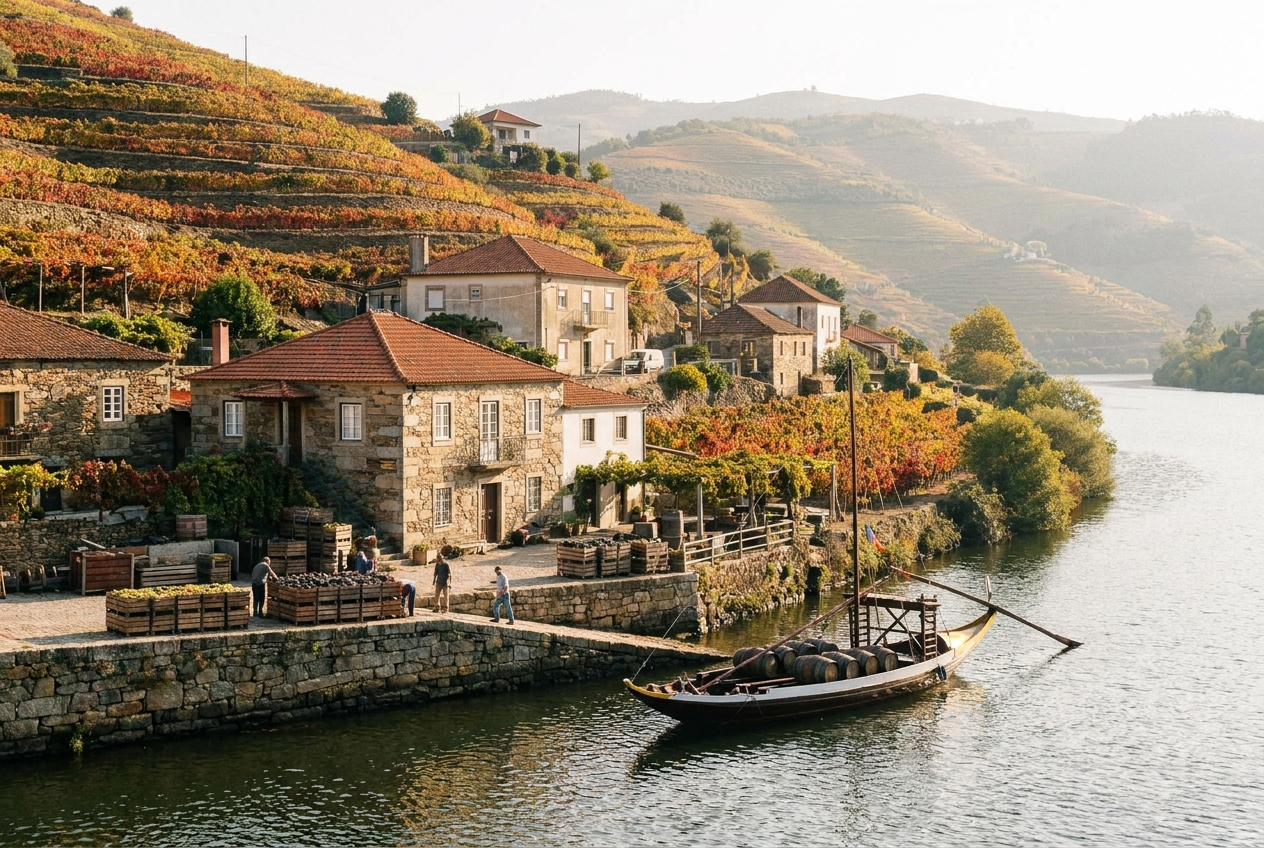
THE SEASON AT A GLANCE · DOURO VINDIMAS
Aim for mid-September to early October, sleep in the valley at least one night, and book a quinta harvest program weeks ahead: the picking, the lunch and the grape-treading are participatory, not spectator sports.
WINDOW: MID-SEP → EARLY OCT · BOOK WEEKS AHEAD · BASE: PINHÃO OR RÉGUA
Go for: the one European wine ritual you can still join with your own feet, in scenery that outranks the wine.
Think twice if: your dates are fixed in August or late October. The valley is beautiful then too, but the working season (the entire point of this page) will be over or not yet begun.
Season timing: regional wine-tourism calendars, reviewed each year · full sources at the end
On this page
- When exactly should I come?The 2026 and 2027 windows
- Picking, treading, tastingA harvest day at a quinta
- The barefoot thing — really?How the lagarada works
- How do I book it?Programs, prices, lead times
When is the Douro harvest? The 2026 and 2027 windows
The vindimas are a moving target with a reliable center of gravity. The picking generally opens in the first half of September and closes in early October, with the busiest fortnight in the second half of September, but the exact start belongs to the summer’s weather: a hot dry year pulls it earlier, a cool one pushes it back. The sweep is gradual too. Different sub-valleys and grape varieties come ripe in turn, so the season rolls across the region over several weeks rather than switching on at once. The visitor’s translation is simple: plan for September 15 to October 5 and you will land inside the working season almost regardless of the vintage’s mood, with the added bonus that early October tips into the copper light and thinning crowds of Portugal’s harvest month.
Reading this mid-season, or after? The 2026 vindimas are being picked as you read (through roughly October 5), and a late scramble can still land a program on the quieter weekdays. For everyone else, the planning horizon is already 2027: the window will sit in the same mid-September to early October band, estates generally open harvest bookings in the spring, and the valley’s small lodges are claimed by early summer. The right calendar entry is a March reminder that says “book the Douro.”
What a harvest day at a quinta looks like
The standard shape, offered by estates across the valley: you join a picking crew mid-morning with secateurs and a basket, work a couple of terrace rows (enough to earn the view, not enough to earn a wage), then sit down to a long harvest lunch of the feeding-the-crew kind, with the estate’s wines doing the pairing.
The afternoon brings the cellar: crushing, fermentation tanks, and at the quintas that keep the tradition, the granite lagares being loaded for the evening. It is gently staged, openly participatory and completely sincere. The grapes you pick genuinely go into the year’s wine, which is why the programs only exist while the harvest does.
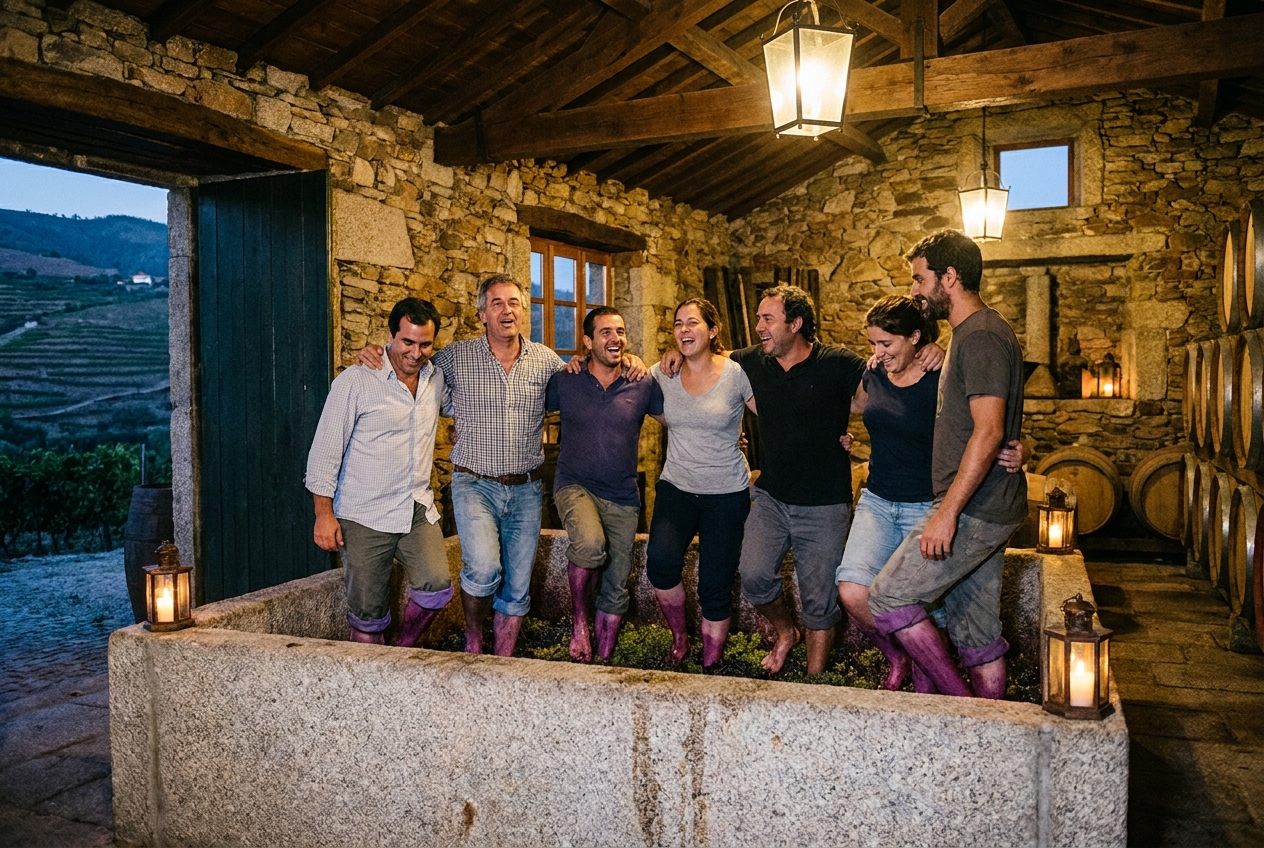
Grape stomping in the Douro: the lagarada
The image everyone carries into the valley is real, and it survives for a reason beyond folklore: for the finest vintage ports, several estates still hold that feet crush grapes more gently than any machine, breaking skins without bitter seeds. The ritual is called the lagarada.
After dinner, a line of treaders (workers, family, and visitors who booked ahead) steps into a thigh-deep granite trough called a lagar, links arms, and marches in called rhythm while the must climbs their calves. Estates in the Pinhão area with strong visitor traditions (Quinta da Pacheca and Quinta do Crasto among the best known) open their lagares to guests during the season.
Expect purple legs, borrowed shorts, music, and the rare feeling of being inside a postcard rather than in front of one.
The Douro harvest festival in Régua
Peso da Régua, the valley’s working capital, throws its harvest festival in mid-September: parades, grape-treading demonstrations, concerts and street food along the riverfront, with free entry and tens of thousands of visitors across the weekend. It is the communal, no-booking-required face of the season, and it pairs well with a quinta program on the adjacent days. If your dates hit mid-September, build around it.
How to book a Douro harvest experience
Book the program before the flight. Harvest experiences run only while the grapes do, capacity is a handful of guests per estate per day, and the best-known quintas fill weeks to months ahead. Expect roughly €80–200 per person (est., operator pricing varies with what’s included), picking-plus-lunch at the lower end, full days with the lagarada at the upper.
Book direct with the estate where possible: the valley’s quintas nearly all take reservations on their own sites, and direct guests get first claim when a vintage’s dates shift.
And sleep in the valley at least one night. The quinta lodges and Pinhão’s small hotels book out earliest of all, but the harvest’s best hour (the terraces at first light, before the day crews arrive) belongs only to people who woke up there. Our 10-day route treats that night as the trip’s single best upgrade.
Getting to the Douro for the harvest
The romantic arrival remains the right one: the Douro line from Porto’s São Bento station to Pinhão, with the final hour running beside the river below the terraces. It is also the practical choice in season, when narrow quinta lanes fill with tractors and the region’s roads reward a designated driver you may not want to be. The workable combination for most visitors: train in, one or two nights at a quinta or in Pinhão, taxis or estate transfers between visits, train out.
If you miss the harvest window
Gain: the terraces at maximum copper, new wine in the cellars, near-empty roads.
Lose: the picking, the lagarada, the working buzz.
Gain: almond blossom across the terraces, the valley’s other postcard.
Lose: everything green, and most tourist services hibernate midweek.
Gain: long days, green vines, boats running full schedules.
Lose: the harvest’s sense of occasion. It’s scenery then, not theater.
The last word
Most wine regions ask you to taste what they made last year. For three weeks each fall, the Douro lets you stand inside what it is making right now, purple to the knees, in the oldest appellation on earth. Book the program, take the train, sleep on the terraces. The postcard does the rest of the year; September is for the workplace.
Fold it into the 10-day route, see the whole month around it in Portugal in October, or weigh the season against the year in the 12-month verdict.
Sources & data for this guide
- Harvest window (~Sep 10 – Oct 5, peak second half of September) and year-to-year drift · regional wine-tourism calendars (Wine Tourism Portugal; visitportugal.com wine pages) · reviewed for the 2026 season, Sep 1, 2026
- Régua harvest festival, mid-September, free entry · municipal and regional event listings · checked Sep 1, 2026
- Quinta harvest programs and lagarada access (Quinta da Pacheca, Quinta do Crasto and others) · estate websites; availability and content change each vintage · verify when you book
- Program pricing ~€80–200 (est.) · operator listings, editorial range, varies with inclusions
- Douro line and driving context · CP (cp.pt) and our car guide
- This is an almanac page: dates are re-checked before each season, and the page carries the next vintage as soon as the current one is under way.