
ÉVORA · ALENTEJO · INSIDE THE WALLS
Évora fits inside its walls, and that shapes every visit. The Roman temple, the cathedral, the university and the bone chapel at São Francisco stand within a few minutes of one another, so nothing here is a drive. The question is only when. Morning and the hour before dinner belong to the streets. The middle of the afternoon belongs to whatever has a roof over it, and how hard that rule bites depends on the month, which our month-by-month guide handles.
ÉVORA AT A GLANCE · ALENTEJO
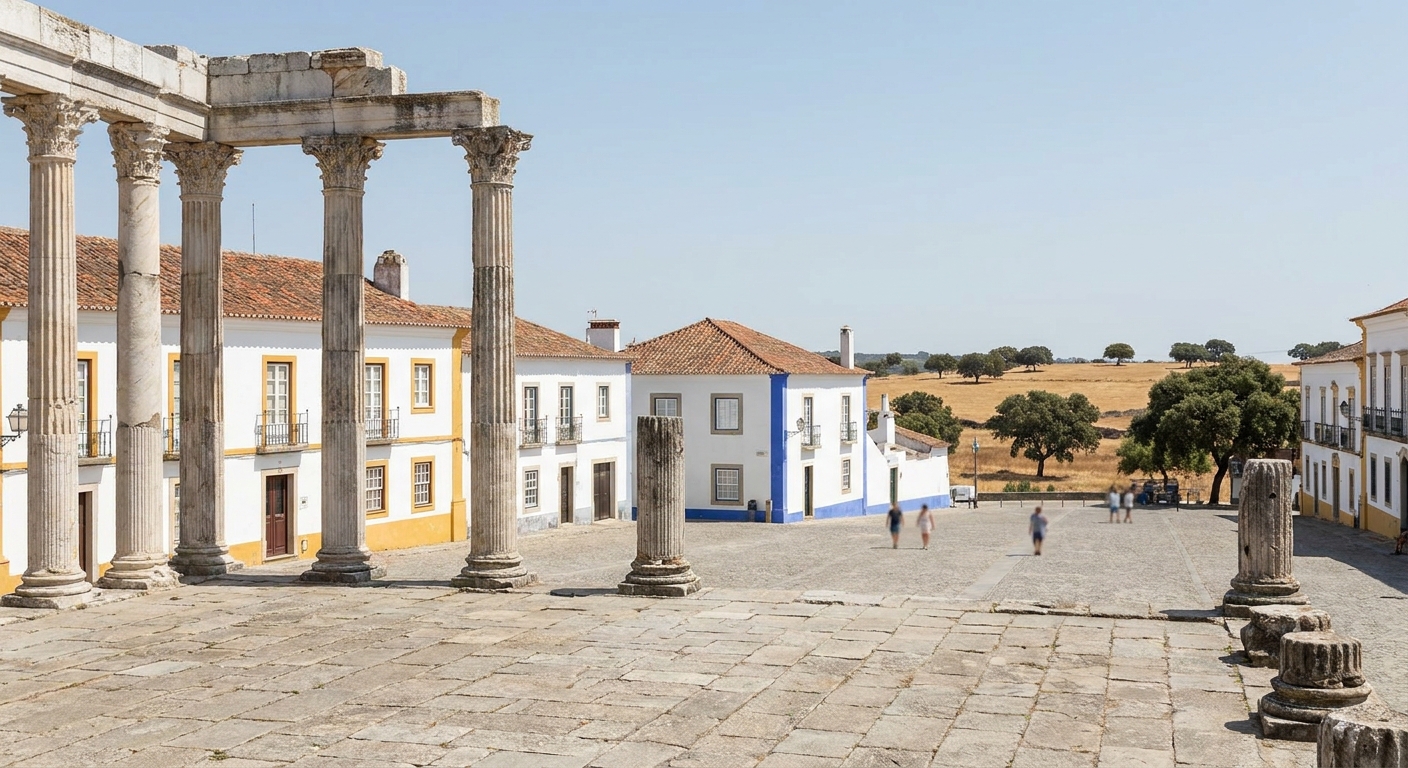
Walk the walled center early, keep the hot middle of the day for the cathedral, São Francisco and the university cloister, and leave Rua do Cano and the aqueduct for late afternoon.
ALENTEJO CAPITAL · UNESCO WALLED CENTER · TRAIN FROM LISBON
Go for: the temple esplanade once the day coaches have gone, the cathedral roof terrace early, the tiled classrooms of the Colégio do Espírito Santo, and Rua do Cano where houses sit under the aqueduct arches.
Think twice before: treating Évora as a day trip and skipping the evening, or planning a summer afternoon outdoors between granite walls.
Historic Centre of Évora: UNESCO · rail service: CP · opening hours and fares deliberately not published here · full sources at the end of this guide
On this page
- Things to do in Évora on footRoman temple, Sé roof terrace, Praça do Giraldo
- The Capela dos Ossos and the universitySão Francisco, the tiled classrooms, Rua do Cano
- Eating in ÉvoraLunch hours, meia dose, talha wine
- One day, around the afternoon heatMorning streets, indoor afternoon, evening walls
- Where to stay in ÉvoraInside the walls, outside the gates, or a herdade
- Getting to Évora from Lisbon by trainCP trains, and what still wants a car
- Day trips from ÉvoraAlmendres, Alqueva and the hill towns
What to see in Évora inside the walls: the Roman temple, the cathedral roof and Praça do Giraldo
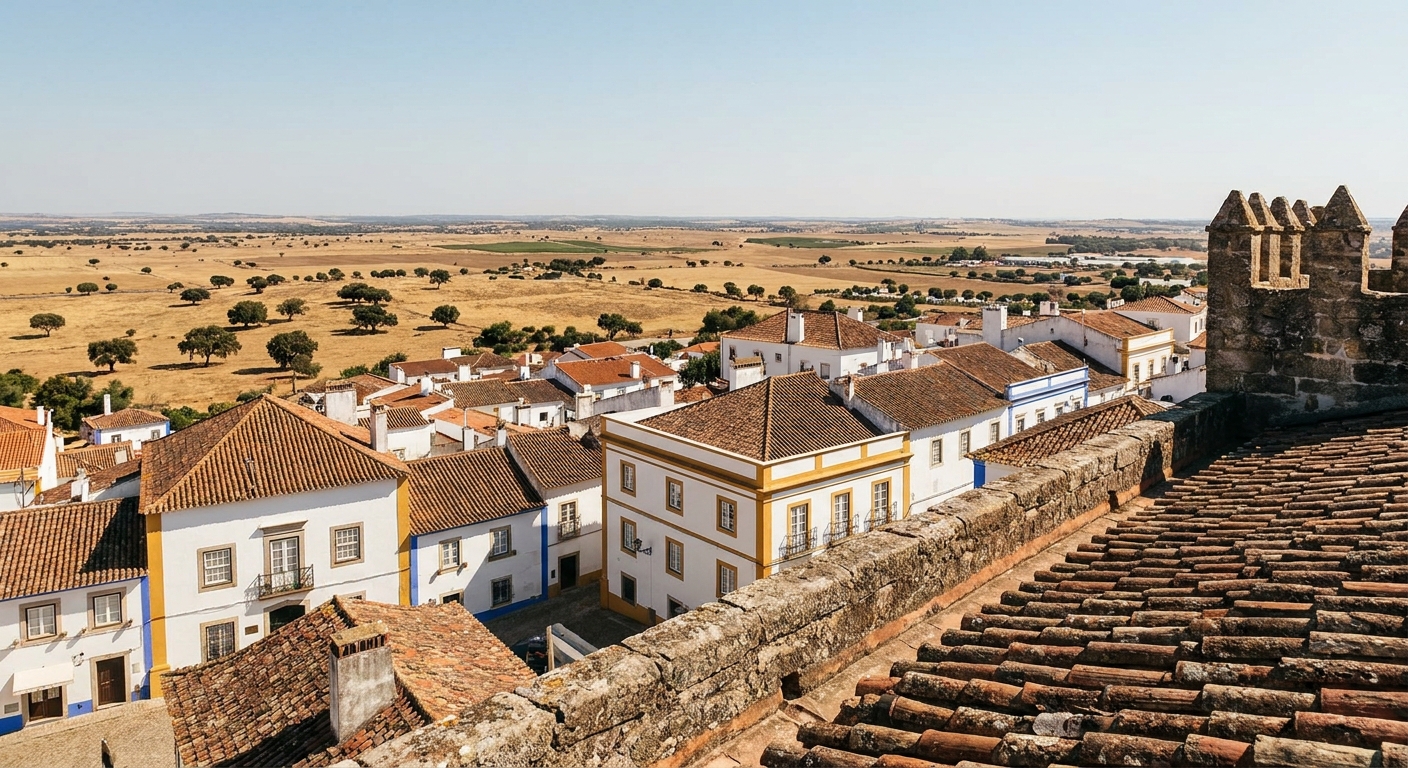
Start at the top of the hill, where the Roman temple stands on an open esplanade with the Museu de Évora on one side and the cathedral a few paces away. The columns are fenced, the square around them is not, so this is the town’s meeting point rather than a ruin behind a turnstile. The Sé is the other half of that space: granite, fortified, twin towers, a cloister, and a roof terrace above the nave. From up there the temple reads as a small rectangle of stone with the plain running off behind it.
Downhill, Praça do Giraldo is the flat center, with arcades along one side, a fountain at the top and the church of Santo Antão behind it. The cafés stay busy because the university is a working one. Rua 5 de Outubro climbs from the square back up to the cathedral and carries most of the souvenir trade, which means the better walking is one street either side, where the whitewash is trimmed in ochre yellow around doors and windows. East of the cathedral, Largo das Portas de Moura holds a Renaissance fountain shaped like a globe.
The Capela dos Ossos, the university’s tiled classrooms and the aqueduct on Rua do Cano
The Igreja de São Francisco, south of Praça do Giraldo beside the Jardim Público, holds the Capela dos Ossos. Its walls and pillars are lined with human bones and skulls, arranged by the friars who built the chapel as a meditation on death, and an inscription over the entrance addresses the visitor on behalf of the dead. The room is small, low and usually full, and walking through it takes a few minutes. Photography rules and the day’s hours are posted at the door. Worth telling children what is in there before you go in.
The Universidade de Évora opens its old college, the Colégio do Espírito Santo, to visitors: a two-story cloister of marble arcades, and classrooms lined floor to ceiling in blue and white azulejos, the panels illustrating the subject once taught in each room. These are still teaching rooms, so a door open in the morning can be shut in the afternoon with a class behind it. The cloister is also one of the coolest places to stand in town when the stone outside has been in the sun since noon.
The Água de Prata aqueduct walks in from the northwest, and along Rua do Cano its arches have been filled with houses, doorways and small shops, so that people live inside the arcade. That street costs nothing and works best late, when the light comes in sideways under the arches. The wall circuit picks up from there, and the Jardim Público below it keeps the Galeria das Damas of the Palácio de Dom Manuel among the trees.
Eating in Évora: lunch hours, portion sizes and vinho de talha
Alentejo cooking is bread-based, pork-heavy and slow, and Évora is the easiest place in the region to get to know it because there are enough kitchens here to compare one against another. Our food guide catalogues the dishes. What decides your day in town is the clock: lunch is the main meal, kitchens fill early and stop serving in the middle of the afternoon, and a dining room that looks closed at four is simply between services.
Portions were built for field work. Many places will serve a meia dose, a half portion, and asking for one is ordinary rather than apologetic. The bread, olives and cheese that arrive unordered are the couvert, they are charged for, and waving them away is equally ordinary. Ask what the day’s dish is before you open the printed menu, since the pot that took the whole morning is not always the one in print.
For wine, look for vinho de talha, fermented in clay amphorae and poured straight from the talha in a small number of bars and cellars in and around town, traditionally broached in November. Reguengos de Monsaraz, east of here, is the sub-region behind many of the reds on the list. Cellar visits, sub-regions and the etiquette of turning up at a working estate are covered on the Alentejo page.
A day in Évora: a one-day itinerary around the midday heat
| Time of day | Where | Why then | The trap |
|---|---|---|---|
| Early morning | Praça do Giraldo and the lanes north of it | Shops opening, delivery vans, shade still on one side of every street | Expecting ticket desks and monuments to be open this early |
| Mid morning | Roman temple, Sé and the roof terrace | The esplanade and the terrace are emptiest before the day coaches unload below the walls | Leaving the climb for the flat light of early afternoon |
| Midday | Igreja de São Francisco and the Capela dos Ossos | Indoors, with the Jardim Público next door for the shade afterwards | Turning up without reading the day’s hours posted at the door |
| Early afternoon | Lunch, then the Colégio do Espírito Santo | Kitchens serve early and stop, and the marble cloister holds the cool | Planning a late sit-down lunch and finding the kitchen shut |
| Late afternoon | Rua do Cano, the aqueduct arches, the wall circuit | The coaches pull out and the streets go back to residents | Saving the walk for after dark, when the arches are barely lit |
| Evening | The temple esplanade, then dinner | The columns are floodlit and the square is local again | Expecting late nightlife: this town dines and then goes quiet |
Where to stay in Évora: inside the walls, outside the gates, or a herdade in the country
Inside the walls is the default and it earns it. In Évora everything is a walk from everything else, and once the coaches have gone the loudest thing on a lane is a scooter on the cobbles. What you pay for that is parking. The streets inside the gates are narrow, one-way in stretches and partly restricted, and many places point guests at a public car park outside the walls. Settle where the car goes at the booking stage rather than at the gate.
Outside the gates, the modern town is cheaper, simpler to park in and a flat walk from the center, with a duller evening street. A herdade, the Alentejo farm estate turned guesthouse, gives you silence, a pool and an unlit sky, and it makes a car compulsory for dinner as well as for sightseeing. Zone-by-zone thinking for the country sits in our where-to-stay guide, and the regional base comparison is on the Alentejo page.
Getting to Évora by train from Lisbon, what still wants a car, and how many nights
Évora has a railway station, and CP runs trains to it from Lisbon. That is the detail most Alentejo planning misses, and it changes the trip: you can arrive, walk up into the walled center from the station, spend two days entirely on foot and leave the same way. Departures are spaced through the day rather than frequent, so pick your return before you plan the afternoon. Service-by-service mechanics are in our getting-around guide.
What is genuinely easier with a car is the country: the Cromeleque dos Almendres at the end of a dirt track west of town, the Anta Grande do Zambujeiro, the Alqueva shoreline, Monsaraz on its hill. Carless travelers are not confined to the walls, though. Estremoz is reachable by coach, and Reguengos de Monsaraz has scheduled services plus an on-demand rural service. Timetables are thin and change with the season, so confirm the day’s schedule before you build a morning on it. Tolls and rental rules are in the car guide.
On length of stay, the argument for a night is the late afternoon. The coaches leave, the ticket desks close, and the streets that were shoulder to shoulder at noon go back to the people who live in them. Évora also works as a long day out of the capital, and it appears on Lisbon’s day-trip list for good reason. If you want a second town of the same stamp, Coimbra is the other historic university city, and the nights count for the plain sits in the region’s base table.
When to go. The month-by-month case for Évora — what the normals say, when the sea is warm enough to swim and which weeks fill up — sits on the best time to visit Évora.
The last word
After the last coach pulls out from below the walls, Évora goes back to being a provincial capital with a university in it. Shutters open on the lanes off Rua 5 de Outubro. Swifts turn around the cathedral towers at roof height. Teenagers sit on the temple esplanade with their backs against the granite, under columns that are floodlit for nobody in particular. The wider case for the plain is made on the region page.
Walk Rua do Cano at that hour, with the aqueduct running over the doorways and somebody’s television audible through an arch, and the town stops being a set of monuments. Order a glass poured from the talha, eat late enough that the square has emptied, then climb back up to the columns before bed. A day trip gets you the temple. Sleeping inside the gates gets you the town it stands in.
Sources & data for this guide
- Historic Centre of Évora inscription · UNESCO World Heritage List · checked Sep 6, 2026
- Monuments inside the walls: Roman temple, Sé and roof terrace, Igreja de São Francisco and the Capela dos Ossos, Colégio do Espírito Santo, Água de Prata aqueduct · visitportugal.com (Turismo de Portugal) plus ground observation · checked Sep 6, 2026
- No opening hours, ticket prices or journey times are published on this page by design. Sites change hours by season and some close for lunch. Confirm at the door or with Évora’s municipal tourism office on the day · checked Sep 6, 2026
- Rail service between Lisbon and Évora · CP, Comboios de Portugal · checked Sep 6, 2026
- Coach and rural transport in the Évora district: Estremoz is served by coach and Reguengos de Monsaraz has scheduled services plus an on-demand service. Frequencies are limited and seasonal, so verify the day’s timetable with the operator before relying on it · checked Sep 6, 2026
- Almendres, Alqueva, Monsaraz and the wine sub-regions are covered on our Alentejo guide, dishes on the food and drink guide, climate figures on the month-by-month guide · checked Sep 6, 2026
- Editorial note: street character, the emptying of the town in the late afternoon and restaurant service hours are our own observations rather than published data