
PORTUGAL · SINTRA VS CASCAIS · 38.7° N
Two names come up every time a Lisbon trip has a spare day, and they pull in opposite directions: a wooded hill stacked with palaces, or a seafront town with sand, a marina and flat streets. Most travelers ask which one and get told “both,” which only helps if the spare day is secretly two.
What can be checked for each town is a short list: a set of 1991-2020 normals from the national weather service, a rain-day count at a stated threshold, and sunrise and sunset on the 15th of every month. Two of those three return the same figures for both places, and saying so out loud is worth more than dressing up a difference nobody measured.
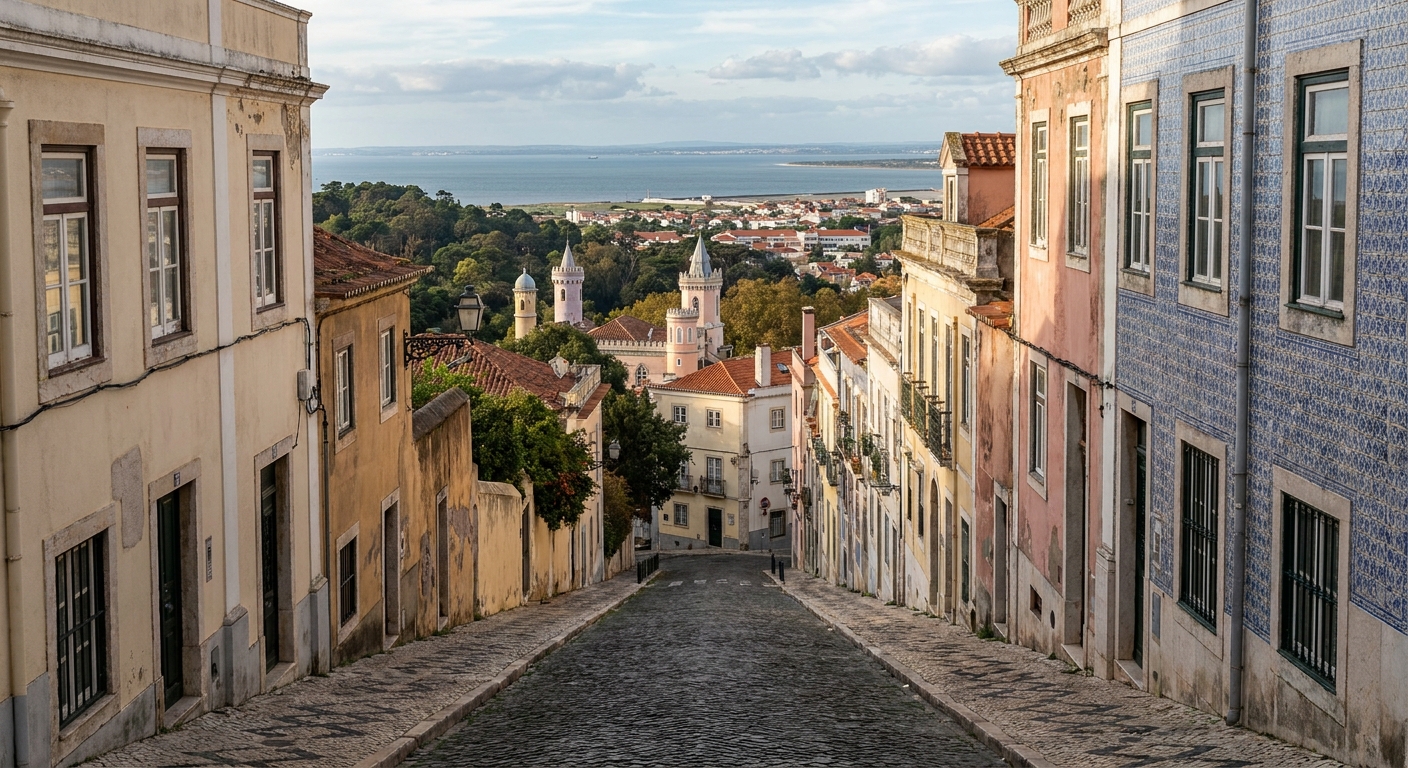
SIDE BY SIDE · SINTRA · CASCAIS
Take Sintra if the trip has one free day and you have never seen either, take Cascais if you want sea air, flat ground and a swim, and do not expect the weather tables to break the tie.
SAME WEATHER STATION FOR BOTH · NORMALS 1991-2020 · RAIN THRESHOLD 1 MM (0.04 IN)
Go for: Sintra when the plan is Pena, the Moorish walls and Quinta da Regaleira on foot, uphill, all day. Cascais when the plan is a beach, a harbor and no climbing.
Think twice before: booking either day in a month averaging 9.3 to 9.9 days at 1 mm (0.04 inch) or more, since both days happen outdoors.
Normals: IPMA station 579 · Daylight: sunrise-sunset.org · full sources at the end
On this page
- One free day out of Lisbon, one choiceSintra for a first visit, and the cases against it
- Temperature and rain month by monthThe 12-month table, 1991-2020
- Where the weather averages come fromStation 579, Lisbon airport, 103.9 m
- Daylight hours in Sintra and CascaisSunrise and sunset on the 15th
- Tourist tax and palace ticketsWhat we verified, and what we did not
- Palaces or beachesPena, Regaleira, Guincho, Boca do Inferno
- Sintra or Cascais in AugustThe month that pulls them apart
Each town has its own guide, Sintra and Cascais, with twelve month pages apiece. Anything compared below had to exist on both sides. Where it exists on one side only, that is stated rather than turned into a winner.
Sintra vs Cascais
Take Sintra. With one spare day and no previous visit to either, the hill of palaces is the thing people cross an ocean for, and the day fills itself without much planning. Cascais is a good town with real beaches and a working harbor. It is not, on a first visit, the one you will regret skipping.
Cascais is the right call for four named travelers. Anyone for whom stairs and steep cobbles are a problem, because Sintra’s sites sit uphill from the station and from one another. Families who want a swimming afternoon instead of a ticket queue. Anyone arriving in July or August, when the rain column reads 0.4 and 1.0 days and the coast is doing what a coast does. And second-time visitors who already have Pena in their camera roll.
Weather does not separate them, whatever the forums say. Both towns are served in our data by the same instrument, station 579 at Lisbon’s airport, so January reads 57.9°F high and 46.0°F low on each side, and August 84.2°F on each. Daylight matches to the minute, 9 hours 48 minutes on January 15 for both. Whether one is reliably sunnier than the other is not a question these normals can settle, and we have not found a station series that settles it.
Before committing, look up the rain-day count for your month, because both days are spent outdoors. January averages 9.9 days at 1 mm (0.04 inch) or more and 3.3 days at 10 mm (0.39 inch) or more. July averages 0.4 and 0.1. In a 9.9-day January, the odds that any given day records measurable rain sit at roughly one in three.
Sintra vs Cascais weather: temperature, rain and sea
| Month | Avg high | Avg low | Precipitation | Days ≥ 0.04 in (1 mm) |
|---|---|---|---|---|
| January | 57.9°F | 46.0°F | 3.78 in | 9.9 |
| February | 60.3°F | 47.1°F | 2.80 in | 7.8 |
| March | 65.1°F | 50.5°F | 2.63 in | 7.2 |
| April | 67.8°F | 53.2°F | 2.50 in | 7.7 |
| May | 73.0°F | 57.4°F | 2.00 in | 5.7 |
| June | 79.0°F | 61.7°F | 0.53 in | 2.0 |
| July | 82.9°F | 64.4°F | 0.11 in | 0.4 |
| August | 84.2°F | 65.3°F | 0.20 in | 1.0 |
| September | 80.2°F | 63.3°F | 1.41 in | 3.7 |
| October | 72.7°F | 58.8°F | 4.05 in | 8.3 |
| November | 63.7°F | 52.2°F | 4.51 in | 9.3 |
| December | 58.8°F | 47.7°F | 3.94 in | 9.7 |
Month by month, the figures published for Sintra and the figures published for Cascais are the same figures, because both series come from station 579 at Lisbon’s airport, 1991-2020 normals.
So the measured gap in temperature is zero, and the interesting part is what the weather service adds in words rather than degrees. Its caution for Sintra is that the hill makes its own cloud and sits several degrees colder and much mistier than the airport 20 km away. Its caution for Cascais is that the town faces the open Atlantic and runs cooler and windier than an inland thermometer 104 m up. Neither correction carries a number. The swing both towns do share is the airport’s own, from 57.9°F in January to 84.2°F in August.
For the sea, we found no water-temperature series for either coast in our sources, so no Atlantic number appears next to a beach plan here. The rain column is what a swimmer can lean on: July and August record 0.4 and 1.0 days at 1 mm or more, against 9.3 in November. A Cascais beach afternoon in high summer is dry far more often than not, and the water temperature remains a question for the Cascais guide to answer when we have a source for it.
Sintra and Cascais weather averages
Both columns come from IPMA station 579, Lisboa Gago Coutinho, a real thermometer at 103.9 m rather than a model grid cell. It sits inland of Cascais and about 20 km from Sintra, lower than the Sintra ridge and further from the surf than the Cascais seafront. That matters before anyone packs: a reading taken beside a runway is not a promise about a misty hillside trail, and the service says so itself.
A rain day in the table means a day recording at least 1 mm (0.04 inch), the national threshold, not the 0.10-inch cut most US tables use. Because that threshold is identical on both sides of this comparison, the rain column is the one that genuinely compares. The heavier count runs separately: 3.3 days at 10 mm (0.39 inch) or more in January, 3.9 in November, 0.1 in July.
How long are the days in Sintra and Cascais?
On January 15 the calculation returns 9 hours 48 minutes of daylight for Sintra and 9 hours 48 minutes for Cascais. June 15 gives 14 hours 55 minutes to each. March 15 lands on almost exactly twelve hours, and October 15 on 11 hours 14 minutes. The two towns sit close enough together that our source returns the same minute for both, so daylight is not a tiebreaker in either direction.
Converted to local time, which runs on UTC in winter and an hour ahead from late March to late October, that means a January 15 sunrise at 7:51 a.m. and sunset at 5:39 p.m. Mid-March opens at 6:45 a.m. and closes at 6:45 p.m. By June 15 the sun is up at 6:09 a.m. and gone at 9:04 p.m. December 15 is the tightest of the year in our table at 9 hours 31 minutes, with last light at 5:17 p.m.
Practically, a December visit to Sintra is one palace plus the town rather than three sites, and the last uphill walk needs to begin by early afternoon. A June day is generous enough to hold both: a morning on the hill and a late Cascais beach afternoon, with dinner outside afterward, since the two towns sit on the same side of Lisbon. Getting around Portugal covers the connection itself.
Tourist tax and ticket prices in Sintra and Cascais
| Item | Sintra | Cascais |
|---|---|---|
| Municipal tourist tax per night | Not in our verified data · ask the property | Not in our verified data · ask the property |
| Cap on the tax (number of nights) | Not verified here | Not verified here |
| Named ticketed monuments | Pena, Castelo dos Mouros, Quinta da Regaleira, Monserrate · prices not verified here | No equivalent ticketed monument appears in our data |
| Lodging rates | Not carried here | Not carried here |
| Where the detail lives | Sintra guide | Cascais guide |
Neither tourist tax gets a figure here. The amount per night and the number of nights it is capped at are the two halves that decide what a family actually pays, and neither half sits in the data behind this comparison. A municipal tax is also exactly the kind of number a council vote moves between one summer and the next, so ask the property at booking and check the town hall page rather than trusting a travel article, this one included.
On the ticket side, a Sintra day is a ticketed day several times over: Pena Palace, the Castelo dos Mouros walls, Quinta da Regaleira and Monserrate each charge their own admission. Current prices are not verified in Our sources, and reprinting unchecked numbers helps nobody at a ticket window. The Sintra guide carries them, and what a trip to Portugal costs puts the day in a budget.
Named plainly, four things are missing on both sides: nightly lodging rates, train fares from Lisbon, sea temperatures, and any tax or ticket amount. That is why no sentence here says one town is cheaper than the other. Nothing in the data supports a ranking, and inventing one would be the easiest way to be wrong in print.
Things to do in Sintra vs Cascais
Sintra’s list is a set of properties scattered across a wooded hillside: Pena Palace on the ridge in its yellows and reds, the Castelo dos Mouros walls running along the crest beside it, Quinta da Regaleira with its spiral initiation well, Monserrate further out in its gardens, and the Palácio Nacional in the old town under two conical chimneys. Almost all of it is uphill and outdoors, and the walking between sites is what fills the day rather than the rooms themselves.
Cascais answers with water and flat ground: a working fishing harbor beside the marina, the Boca do Inferno cliff cut a short walk west of town, sheltered beaches inside the bay, and Guincho’s open Atlantic surf strand beyond, where the wind that the weather service warns about is the entire point. For how to spend each day, the two guides carry the detail: Sintra and Cascais.
Sintra or Cascais by month
August pulls the two furthest apart, even though the numbers are shared: 84.2°F average high, 0.20 inch of rain and 1.0 day at 1 mm, which is a coast doing its best work and a hillside of stone staircases doing its hardest. November reverses it at 63.7°F, 4.51 inches and 9.3 rain days, when a ticketed property with rooms to shelter in reads better than a seafront. Both Sintra and Cascais carry twelve month pages for the rest.
The last word
Decide on what you want the day to feel like, not on a temperature chart that hands both towns the same row. Palaces and hill mist, or sand and wind off the Atlantic. One number is worth carrying away before you book either: the sharpest step in the whole rain column falls between September and October, from 3.7 days at 1 mm to 8.3, with precipitation nearly tripling from 1.41 to 4.05 inches. A trip straddling that turn is two different visits wearing one date range.
Sources & data for this guide
- 1991-2020 monthly normals used for both towns · IPMA, station 579 Lisboa Gago Coutinho, altitude 103.9 m · checked Sep 14, 2026
- The service’s own caveats: the Sintra hill makes its own cloud and runs several degrees colder and mistier than the airport 20 km away, while Cascais faces the open Atlantic and runs cooler and windier · same source · checked Sep 14, 2026
- Rain-day threshold of 1 mm (0.04 inch) and the separate 10 mm (0.39 inch) count, identical on both sides · IPMA · checked Sep 14, 2026
- Sunrise, sunset and daylight length on the 15th of each month · sunrise-sunset.org · checked Sep 14, 2026 · local times derived by us from the published UTC values
- Editorial admission: we hold no verified tourist-tax amount or cap, no monument ticket price, no lodging rate and no sea-temperature series for either town, which is why none appears above
- Monument and beach names are editorial; hours, closures and admission change · check operators when you book.