
ALBUFEIRA · THE ALGARVE · THREE TOWNS, ONE NAME
The taxi turns off the coast road, stops at a corner of white walls and a flight of steps, and the week is already half decided: what comes through the window at 1am is either a terrace winding down or a club warming up. Three separate places answer to the name Albufeira, and the reputation American visitors arrive with belongs to exactly one of them. What follows is a map of the other two, and of where the loud one begins and ends.
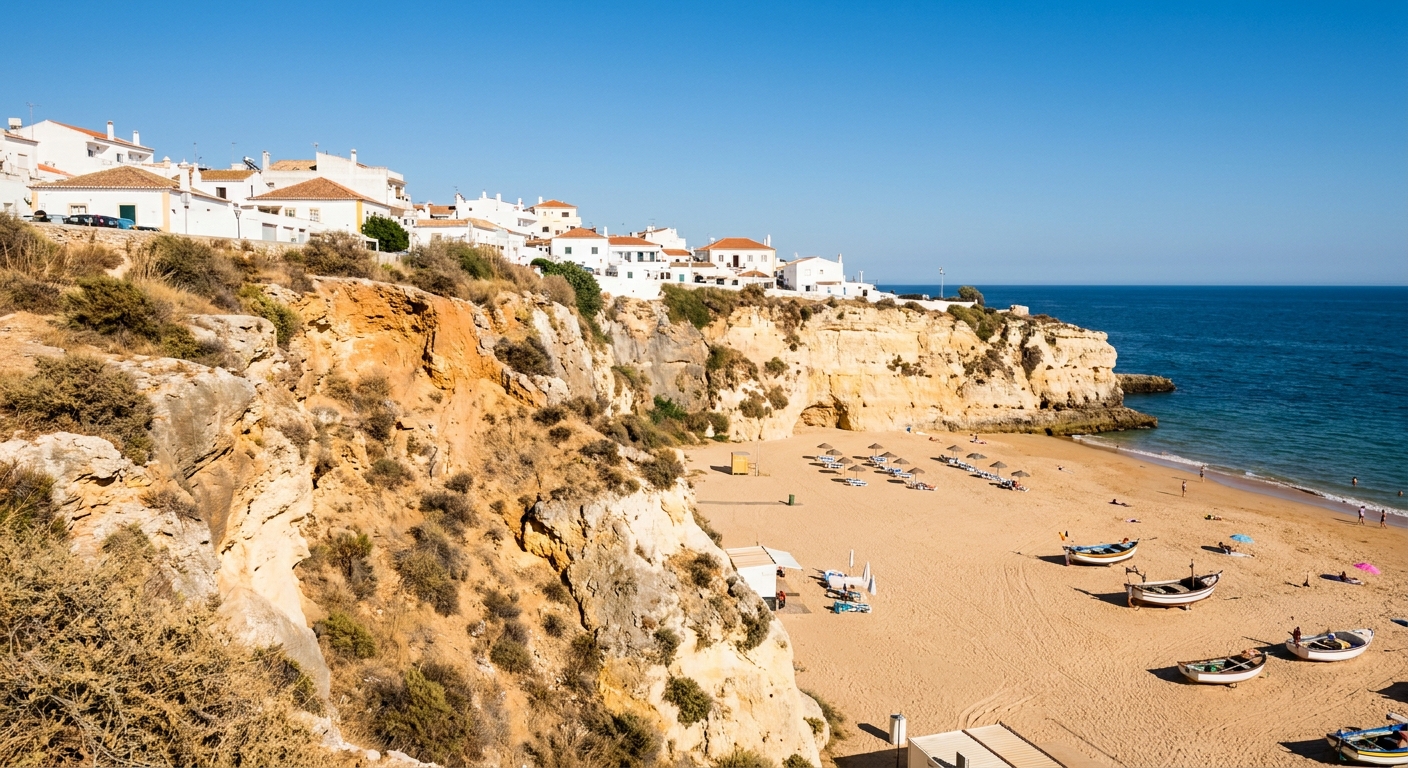
ALBUFEIRA AT A GLANCE
Albufeira works as well as your address does: the old town for the walkable version, Oura for pools and family calm, the strip only if the nightlife is the reason you came.
THREE ZONES, ONE NAME · CENTRAL SAND ON FOOT · WESTERN COVES NEED WHEELS
Go for: a hotel-easy week where the sand is at the bottom of the street, boat mornings west toward the caves, and grilled fish above Praia dos Pescadores once the beach crowd has gone to change.
Think twice before: booking a bargain apartment in Areias de São João in high summer without checking what operates downstairs, or hauling a suitcase up the old town’s steps at midnight.
Zone geography and beach access · municipal and regional tourism material · full sources at the end of this guide
On this page
- Which part of town to bookOld Town, the strip, Oura
- Beaches you can walk toPescadores, Peneco, Oura, Galé
- Arriving by train or carFerreiras station, parking, the hill
- Days that have nothing to do with barsMarket mornings, boats west, water parks
- Booking logic, zone by zoneThe zone table
Albufeira zones explained: Old Town, the strip and Oura
The Baixa, the old town. White lanes, calçada squares, a couple of churches and restaurant terraces stacked above Praia dos Pescadores. It is busy the way any popular Portuguese seaside town is busy: full tables, a guitarist, families eating late, a bar crowd that thins out rather than surges. This is where a first visit belongs, and the one zone where a rental car can sit unused for four days.
The strip, in Areias de São João and up toward Montechoro. The nightlife is concentrated here by design, in a few streets that run loud and late through the summer. Then come Oura and the spread-out hotel zones either side of it: apartment blocks, pools, low-rise resorts, quiet residential streets, and often a shuttle or a car between you and everything else. Two of the three Albufeiras are calm. The one that made the name is a handful of streets you can choose never to walk down.
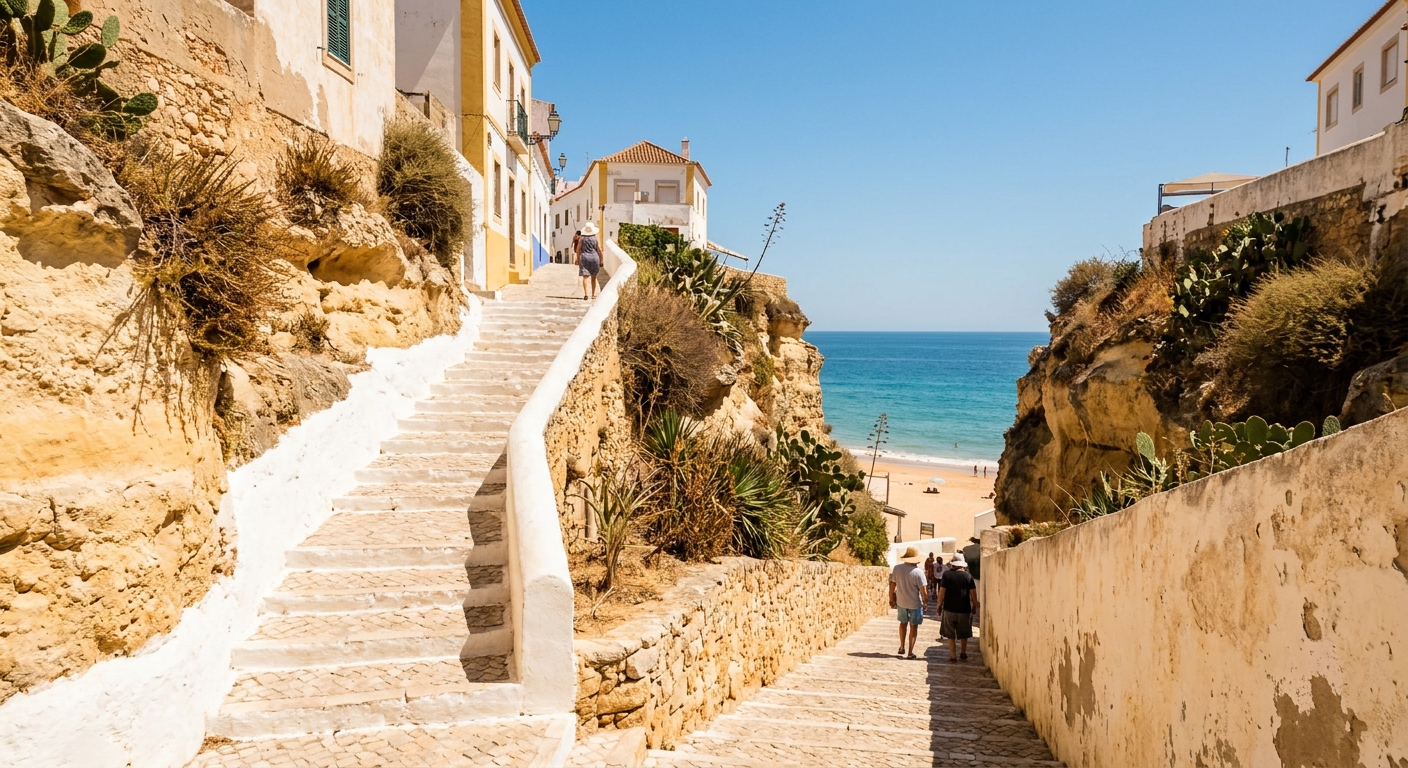
Albufeira beaches by zone: Pescadores and Peneco, Oura east, São Rafael and Galé west
Praia dos Pescadores and Praia do Peneco run together beneath the old town as one broad belt of sand with the cliff at its back. From the Baixa you get down by street, by steps, or through the tunnel cut into the rock, which is the flat route and the one to remember when you are carrying a cooler and a toddler. Sunbeds, cafés on the sand, lifeguards in season: this is the least complicated beach day on the coast.
East of the point the shore breaks into the resort beaches: Oura at the bottom of the strip’s hill, then Santa Eulália and the smaller bays beyond. Seafront walkways link some of them and give up at others, where a cliff staircase or a short detour inland takes over. Guests in Oura reach sand without thinking about it. Guests up on the strip walk down easily and back up considerably less so.
West is where the Algarve postcard starts. São Rafael, Praia da Coelha, Castelo and Galé are ochre-walled coves with small parking areas that fill early in summer, and none of them is a casual stroll from the center. Plan a taxi, a bus or the car covered in our rental guide, and treat the trip as an outing rather than a whim. The cliffs keep improving westward, toward Carvoeiro and the Benagil cave.
Arriving in Albufeira: Ferreiras station, parking and the old town hill
Trains marked for Albufeira stop at Albufeira-Ferreiras, inland among roundabouts and warehouses rather than anywhere near the sea. A local bus and a taxi rank cover the gap and both are routine, but plenty of visitors have stood on that platform with a suitcase expecting a beach. The same station governs day trips: Tavira and its warm lagoon water are the eastern contrast on the same line, while Carvoeiro and the coves west need a road. From Faro and the airport, road transfers are the simpler tool, as our getting-around guide sets out.
Driving into the Baixa is the other standard error. The old town is a pedestrian tangle on a slope, and the parking that works sits on the ridge above it or in the lots at its edge, from which you walk down. If the rental is only there for the western coves and an inland afternoon, park it once and leave it. Nothing in the center rewards wheels.
The gradient is the part nobody photographs. Streets in the old town climb in steps, the sand is at the bottom of all of them, and every return to the apartment is uphill in the heat. A public elevator and the rock tunnel behind Praia do Peneco exist precisely for that reason, and they are worth locating on the first evening rather than the third. Anyone traveling with a stroller, a bad knee or limited mobility should read the slope before choosing a street.
What to do in Albufeira besides the bars: market mornings, boats west, water parks
Boat trips leave from the marina west of the old town, next to the Porto de Abrigo where the working fleet ties up: cove-and-cave runs along the western cliffs, dolphin outings, sunset cruises and small-boat routes toward Benagil. Operators range from large catamarans to six-seat inflatables, and the difference between those two experiences matters more than the difference in price. For the same coastline at its most theatrical, the boats out of Lagos work Ponta da Piedade.
On land, market mornings are the town’s other face: fish counters, fruit, coffee, and nobody selling you an excursion. The inland strip around Guia carries the region’s water parks and the Zoomarine marine park, the reliable answer to too much energy or a gray sky, sketched alongside the other family options in Portugal with kids and on the Algarve guide.
Where to stay in Albufeira
| Zone | What it looks like | Best for | What you hear at night | Beach on foot |
|---|---|---|---|---|
| Baixa (old town) | White lanes and terraces stacked above Praia dos Pescadores | First visits, couples, anyone arriving without a car | Terrace talk, live covers, a late group heading home | Yes, the sand is at the bottom of the street |
| Areias de São João / Montechoro | Bar and club streets, signage, taxis all night in summer | Groups who came for the nightlife and want to walk back | Music and street noise until very late in season | Yes, downhill to Oura, uphill on the way back |
| Oura and the seafront belt | Hotel blocks, apartments, pools, promenade cafés | Families combining pool days with easy sand | Pool music by day, calmer on the inland rows | Yes for the front rows, a real walk for the rest |
| Santa Eulália east / Sesmarias and Galé west | Low-rise resorts and villas strung along the coast road | Repeat visitors, drivers, people wanting a quiet week | Air conditioning and cicadas | Sometimes. Often a shuttle or a short drive |
When to go. The month-by-month case for Albufeira — what the normals say, when the sea is warm enough to swim and which weeks fill up — sits on the best time to visit Albufeira.
The last word
A great many people have an excellent week here, and nearly all of them booked the right street. Old town for the fish grills and the downhill walk home, Oura for the pool-and-sand routine with children, the strip if the nightlife is the point rather than an unwanted extra. Get that one decision wrong and no amount of sunshine repairs 3am. Zone-by-zone booking sense for the rest of the country sits on our where-to-stay guide.
If none of the three sounds like your holiday, this coast has quieter answers close by, and the region page lays them out. If one of them does, pack flat shoes for the hill, take one boat west toward the caves, and eat late above Praia dos Pescadores, where the town still does what it did long before the bars arrived: sells fish, at night, beside the water it came out of.
Sources & data for this guide
- Zone geography, street layout and beach access · Câmara Municipal de Albufeira and Turismo do Algarve destination material, cross-checked against ground observation · checked Sep 3, 2026
- Old town gradient, the rock tunnel behind Praia do Peneco and the public elevator · operator and municipal signage plus editorial observation, described without figures because none are published · checked Sep 3, 2026
- Albufeira-Ferreiras station location and its regional line to Faro, Tavira and the west · CP Algarve regional services · checked Sep 3, 2026
- Boat departures, dolphin outings and cave routes from the marina west of the old town · operator listings, no single operator endorsed · checked Sep 3, 2026
- By design, no prices, temperatures, sea readings or journey times appear on this page: those live on the Algarve guide, the trip cost page and the month-by-month guide, where they are sourced and dated · checked Sep 3, 2026