
PORTUGAL · FEBRUARY · THE EMPTIEST MONTH, REGION BY REGION
February is the month Portugal keeps for itself. Lodging runs at roughly 35 percent of the August peak, so the trams have seats, the castle has no queue, and the Douro’s terraces stand bare and geometric above the water. It is also drier than January: seven rain days in Lisbon, five down in Faro. Cold, in Portuguese terms, means 49°F on a Lisbon night.
For an American week the arithmetic is unusual. Transatlantic fares sit near their yearly floor (est.), Lisbon’s 58°F afternoons beat almost anything north of Florida, and the things you flew for are open and empty at the same time. This page sorts February region by region, then sets the three cities against each other.
THE MONTH AT A GLANCE · PORTUGAL IN FEBRUARY
February is Portugal’s emptiest month and its city bargain: mild, drier than January, cities at about a third of their August pressure, and a coast built for walking rather than swimming.
MIXED MONTH NATIONALLY · BEST IN: THE CITIES · THIN IN: BEACH TOWNS
Go for: Lisbon and Porto without queues, negotiable off-season room rates (est.), almond blossom on the Douro slopes, and Carnaval in the towns that take it seriously.
Think twice before: building the week around beaches. The sea sits at 59°F, plenty of Algarve resort kitchens stay shut until spring (est.), and 44°F Porto nights call for a real coat.
Carnaval moves with Easter: February in most years, early March in others (est.). Confirm the dates with the town before you book flights around them.
Climate: 1991–2020 normals per city (ERA5) · Crowds: monthly lodging nights via our full-year verdict · sources at the end
See the full 12-month verdict →
On this page
- City days at 35% crowdsLisbon & the center
- The driest corner, 5 rain daysThe Algarve
- Almond blossom, port lodges, 103 mm of rainPorto, the Douro & the North
- Green plains and empty roadsThe Alentejo
Where to go in Portugal in February: the four Februaries
Lisbon & the center: 58°F days, 7 rain days
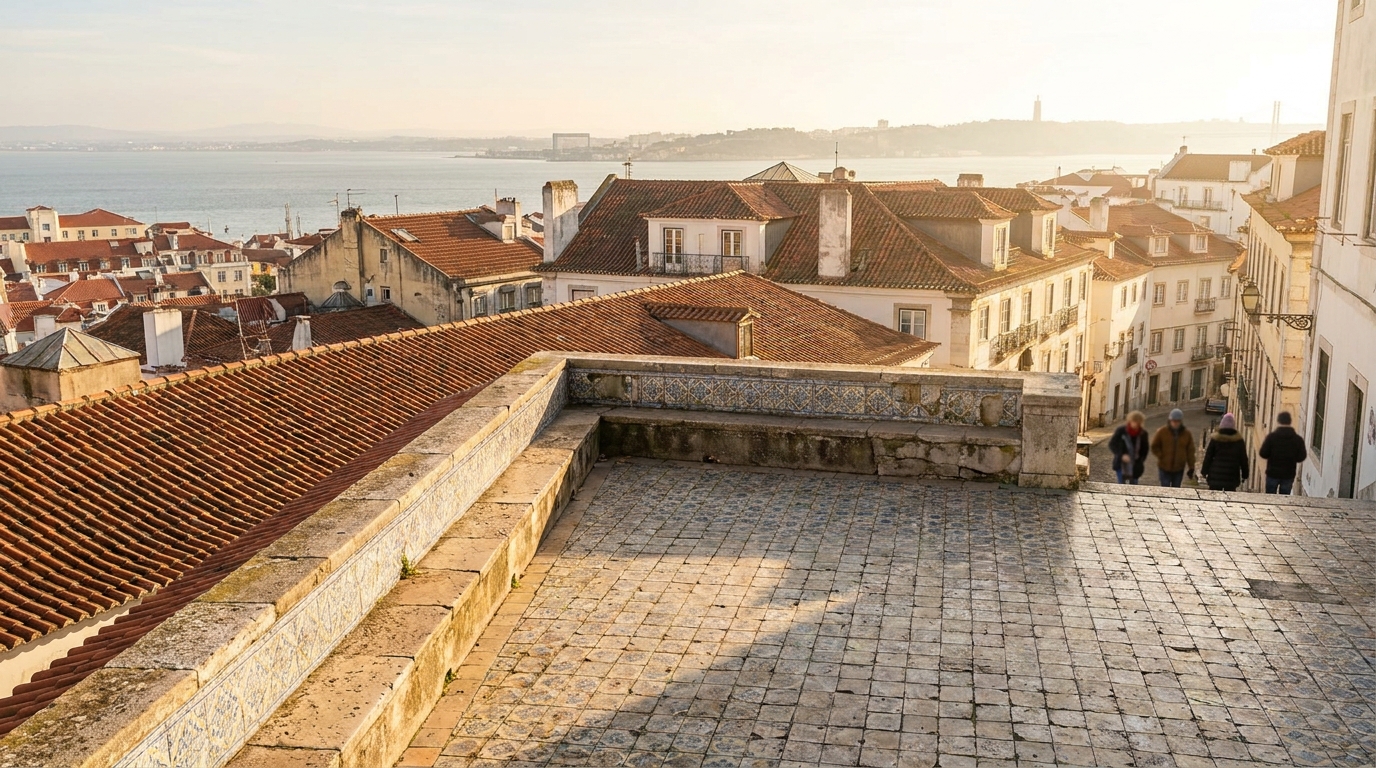
Afternoons at 58°F, nights at 49°F, and seven days that see rain, which is two fewer than the city gets in October. What February hands Lisbon is space: the castle, the tile museum and the Belém counters all move at winter speed, and the neighborhood gets its tables back. When an Atlantic band comes through, the indoor bench is deep. Sintra changes most of all this month, mist and no coach queue: see the day trips.
Verdict: Best · the city month · Rain: 7 days · For: museums, food halls, repeat visitors
The Algarve: the driest corner, at 5 rain days
Faro’s 60°F days and five rain days make this the mildest, driest slice of the country in February, which is why the walkers and golfers keep those flights full while everyone else stays home. A beach week it is not. The sea reads 59°F, and a fair share of resort-strip restaurants stay closed until March (est.). Point the week at cliff paths, the Ria Formosa’s winter birds and inland market towns instead: the Algarve, coast by coast.
Verdict: Mixed · warmest days, closed shutters · Rain: 5 days · For: walkers, golfers, birders
Porto, the Douro & the North: almond blossom and 103 mm of rain
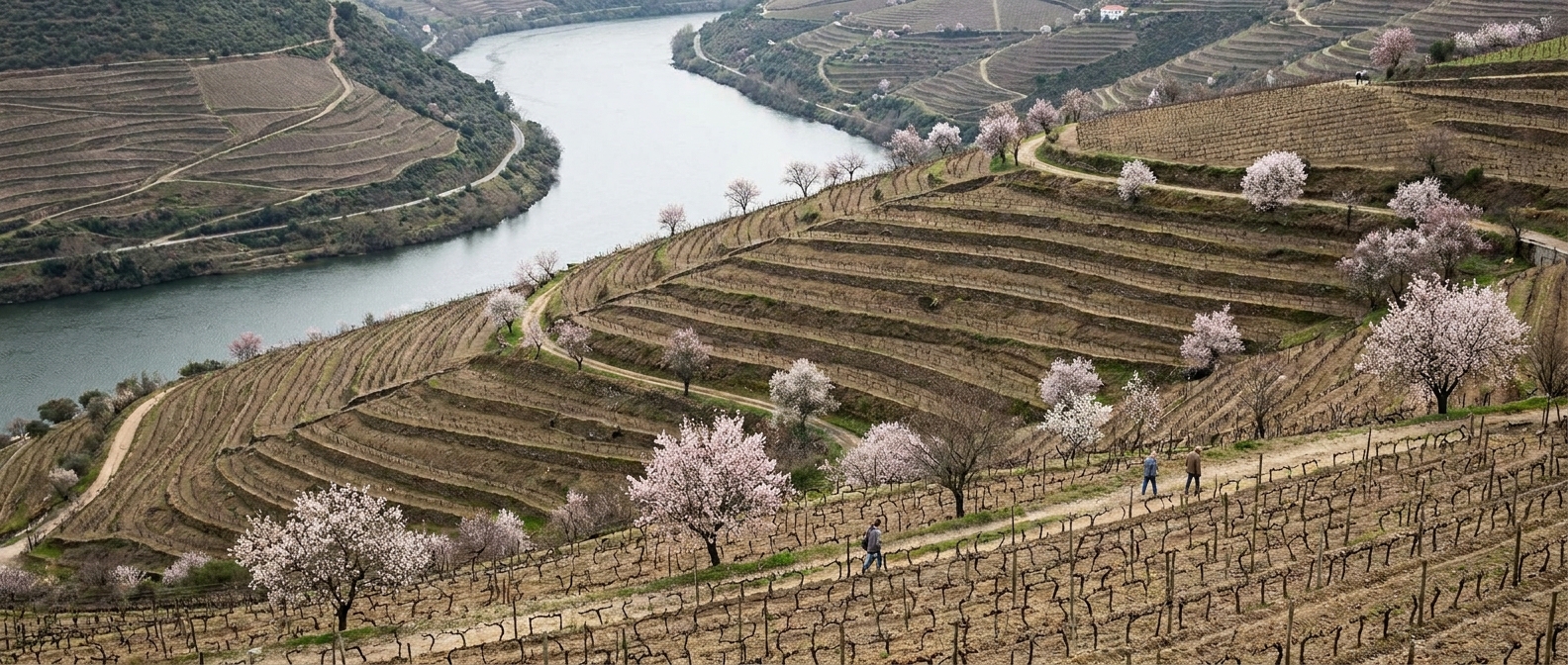
Porto pays for its beauty this month: 103 mm of rain across nine days, and nights down at 44°F, the coldest numbers on this page. Upriver the terraces are stripped back to their stonework and the almond trees flower, February’s quiet postcard. Gaia’s port lodges are indoors by design and the quintas that fill during picking season have room now. Our Douro harvest almanac covers the same slopes at the opposite end of the year.
Verdict: Mixed · blossom and 103 mm · Nights: 44°F · For: wine cellars, river light
The Alentejo: green plains and empty roads
This is the green version of the plains: pasture instead of stubble, cork oaks standing in wet fields, and long stretches of road with nobody on them. Daytime tracks Lisbon’s 58°F while nights run colder inland (est.), so book the pousada with a fireplace rather than the picnic. Distances here argue for a car over a timetable, and the rules that catch Americans out are in what renting in Portugal involves.
Verdict: Mixed · green, empty, cold after dark · For: road trips, wine towns, hearths
February weather in Portugal: the north, the capital and the Algarve
| Region (city) | Days | Nights | Rain | Sea | The trade |
|---|---|---|---|---|---|
| Lisbon | 58°F / 14°C | 49°F / 9°C | 7 days · 52 mm | 59°F | The winter reference week |
| Algarve (Faro) | 60°F / 16°C | 51°F / 11°C | 5 days · 49 mm | 59°F | Mildest and driest, half asleep |
| North (Porto) | 57°F / 14°C | 44°F / 6°C | 9 days · 103 mm | 59°F | Blossom season, real rain |
30-year averages (1991–2020) for the three reference cities. The sea figure is Portugal’s February national average, and the Alentejo interior tracks Lisbon by day with colder nights (est.). Crowd share comes from the same monthly lodging data behind the full-year verdict.
February in Portugal: Carnaval, almond blossom and 6:28pm sunsets
Carnaval, with a caveat. The dates follow Easter, which lands Portuguese Carnaval in February most years and in early March in others (est.). Torres Vedras is the parade locals send you to, Ovar runs one of the longest-established, and Loulé pulls the Algarve out of hibernation for a weekend. Routes and programs get published town by town each year, so any date you find months ahead is provisional until the municipality confirms it.
Almond blossom. White and pink across the Douro slopes and the southern interior, usually late in the month (est.). It is the first proof that a Portuguese winter is a short assignment, and those hillsides photograph better now than in August, when heat haze flattens everything.
The light, and when it goes. Sunset in Lisbon moves from 5:58pm at the start of the month to 6:28pm at the end, so a February afternoon here holds more usable daylight than one in Boston or Chicago. Set the viewpoint for six and dinner for eight, and dress for a ten to fifteen degree swing between a sunny lunch and a wet night: the packing list has the winter version.
Portugal in January, March or May instead
Gain: the same hollow streets with rates a notch lower still (est.). January in full.
Lose: February’s drier count and the almond blossom, which arrives too late for a January trip.
Gain: longer evenings once the clocks jump at the end of the month, and coastal kitchens reopening. March in full.
Lose: some of the 35 percent crowd figure, which starts climbing back toward spring.
Gain: terrace life, warm stone, a sea that no longer requires a wetsuit.
Lose: the empty castle, the negotiable winter room rate (est.), and the bare-terrace view of the Douro.
The last word
February rewards one shape of trip: two cities, a train between them, and no ambition to sit on sand. Lisbon and Porto run at full civic speed with roughly a third of the August crowd, which buys you the tile museum on a wet Tuesday, a fado room where the neighboring tables are local, and a Gaia port lodge with daylight left afterward. Walk up to a miradouro at 6:20 and watch the year’s shortest queue disappear into the light.
Compare the neighbors in January and March, line up all twelve in the full-year verdict, or settle the city question first with Lisbon vs Porto. What a winter week costs is broken down in trip cost, and the map starts at the Portugal playbook.
Sources & data for this guide
- Climate: 1991–2020 normals computed from ERA5 daily data for the Lisbon, Faro and Porto grid cells · Open-Meteo (ECMWF ERA5) · checked Sep 3, 2026
- Crowds (35% of the August peak) and the February sea average · our own twelve-month verdict, built on Eurostat monthly nights, Portugal · checked Sep 3, 2026
- Sunset times for Lisbon, first and last day of February · NOAA solar calculation · checked Sep 3, 2026
- Carnaval and seasonal closures: dates move with Easter and vary by town, and off-season room rates are our estimate, not a published figure. Both are marked (est.) in the text · Turismo de Portugal · checked Sep 3, 2026