
FARO · THE ALGARVE · THE CITY EVERYONE FLIES THROUGH
The rental counters at Faro airport empty fast. Within an hour of a flight landing, most of the plane is on the highway heading west toward the cliffs or east toward the lagoon towns, and the city up the road stays a name on the boarding pass. As a plan for a week of beach, that holds up. As a plan for the first night and the last one, it wastes the only place on this coast with a walled old town, storks on the roofline, boats leaving for uninhabited islands, and a dinner scene that does not shut down in February.
FARO AT A GLANCE
Give it the arrival night or the night before an early flight, spent inside the walls rather than on the airport road, and add a morning boat into the lagoon if the schedule allows.
AIRPORT CITY · ONE OR TWO NIGHTS · GATEWAY TO THE RIA FORMOSA
Go for: the cathedral bell tower at the end of the day, the Capela dos Ossos at Igreja do Carmo, and the first boat out to the islands before the day-trippers land.
Think twice before: booking Faro as a beach base. The sand is out on the barrier islands, and every trip to it starts with a boat or a bus.
City and park information · full sources at the end of this guide
On this page
- Late flight in, early flight outWhy the night works better in town
- One evening in the walled quarterArco da Vila, cathedral terrace, bone chapel
- Get out on the lagoonBoats to Deserta, Culatra and Farol
- On to the rest of the coastTrains east to Tavira, west toward Lagos
Why stay a night in Faro instead of an airport hotel
The case for the night is a timetable case. Most American routings still connect through Lisbon or another European hub and can put you on the ground at any hour, while United also runs a seasonal nonstop from Newark that arrives in the morning, as our flights guide sets out. A morning landing argues for taking the car and going. An evening landing, or a departure that wants you at the terminal before the cafés open, argues for one night in a city where dinner is a walk and not a drive.
The hotels along the airport road exist for exactly this, and they solve nothing that the center does not solve better. A room inside the old walls or on the marina side puts a real restaurant, a cathedral tower and a waterfront within a few minutes on foot, at the cost of a short bus or taxi ride at either end. The rental logic follows: collect the car on the way out rather than on the way in, and skip a night of paying for a parked vehicle. Our car guide covers counters, tolls and deposits.
The Cidade Velha: Arco da Vila, the cathedral terrace and the bone chapel
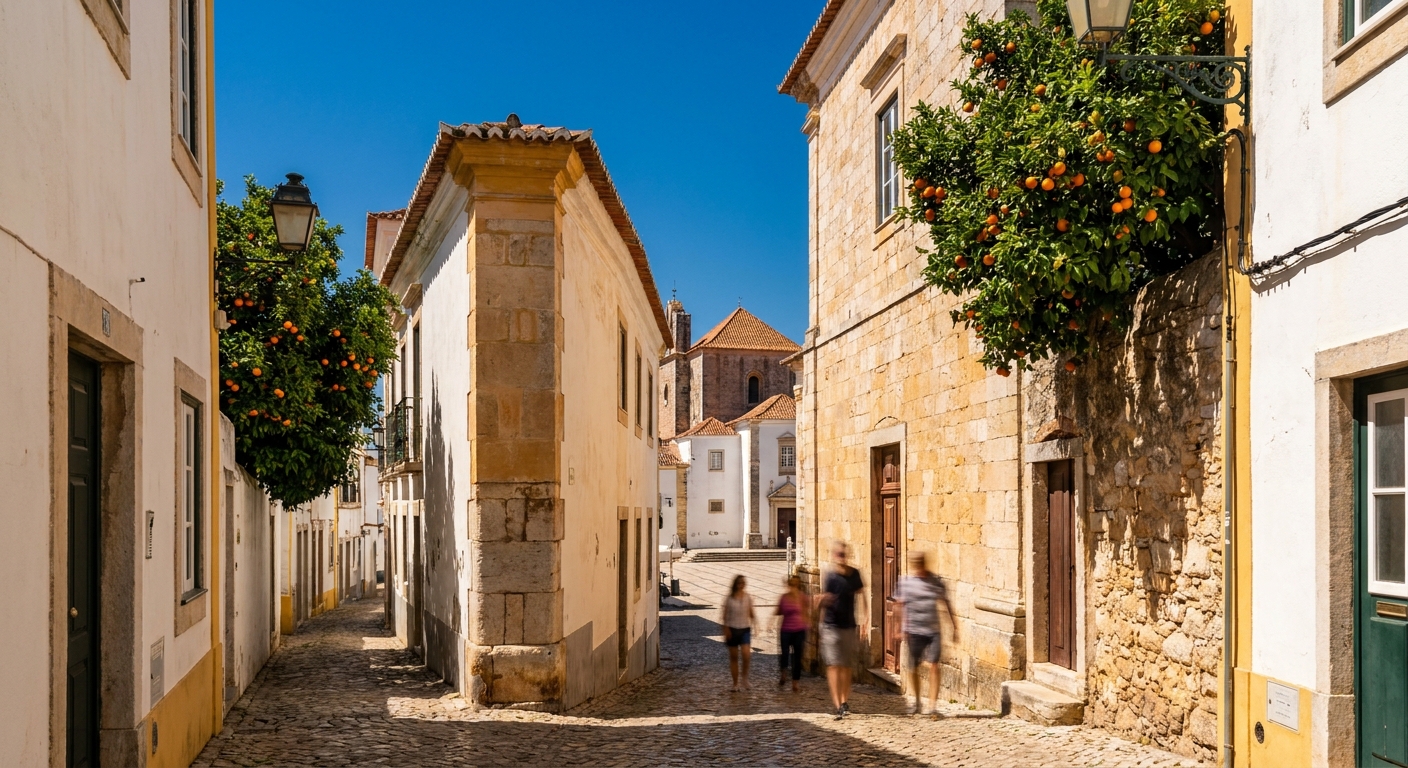
Walk in through the Arco da Vila, the pale neoclassical gate that usually has a stork nesting somewhere above it, and the traffic noise stops within a few steps. The Cidade Velha is a compact walled quarter of white houses, cobbles and orange trees, gathered around a square where the cathedral, the old bishop’s palace and a museum in a former convent all face one another. You can cross the whole thing in a few minutes, which is not the same as wanting to.
Two things inside the cathedral repay the ticket beyond the nave itself: the bell tower terrace, reached by a tight staircase, and the small bone chapel in the garden behind. From the top the plan of the place resolves at once, roof tiles, storks standing on their untidy nests, the marina, then the lagoon breaking into channels and sandbanks out toward the islands. Coach groups tend to move through in the middle of the day, and once they go the square belongs to whoever stayed the night.
Outside the walls, the Igreja do Carmo holds the Capela dos Ossos, a chapel lined with the bones of the church’s own dead. It is small, it is not staged for shock, and it asks for a few quiet minutes rather than a photograph. It also keeps church hours and closes long before dinner, so it belongs to the afternoon of an arrival day, not to the evening stroll.
Boats from Faro into the Ria Formosa: Deserta, Culatra, Farol
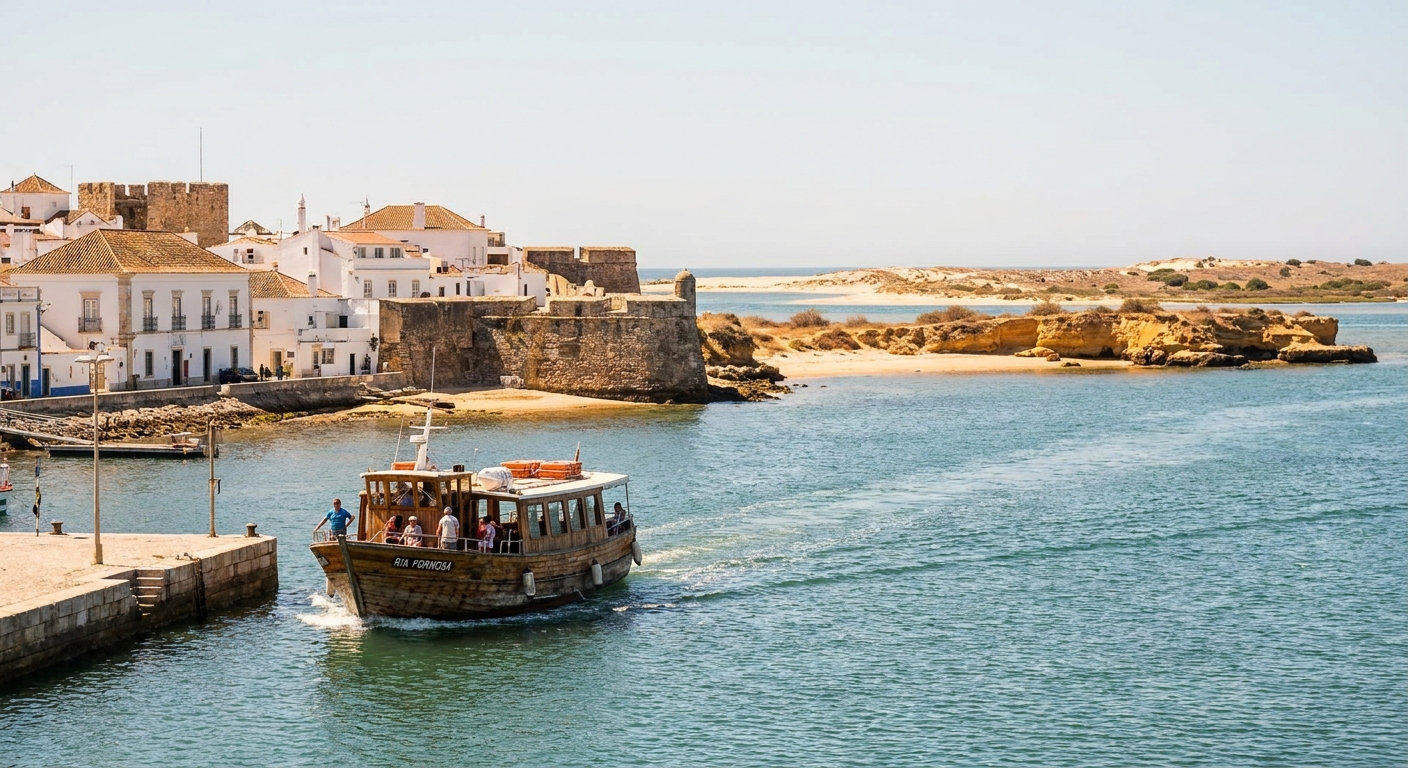
This is the reason to give Faro a full day rather than a bed. Departures leave from the quays along the waterfront garden, and they come in two flavors: a scheduled passenger ferry serving the inhabited islands, and small-boat operators selling island-hopping runs, birdwatching circuits through the channels and drop-offs on the sand. Our Algarve guide explains the lagoon and its barrier islands. What belongs here is the mechanics of getting onto the water from a city pier.
The contrast between the islands is the whole point of the trip. Culatra and Farol are lived in: a fishing community, a school, boats hauled up on the sand, a lighthouse at one end and no cars anywhere. Ilha Deserta, the outermost, has almost nothing built on it beyond a boardwalk over the dunes and a single place to eat, which is exactly what people come for. Pick one of each kind if the day is long enough.
Two practical points, and no invented numbers from us. Sailings thin out sharply outside the summer months, so check the board at the quay the evening before rather than trusting a screenshot. And the last boat back is the real timetable of your day: everything else on the island bends around it. If the water is not running your way, the city beach at Praia de Faro sits out on the sandspit near the airport, reachable by bus across the causeway.
Eating and evenings in a university town that stays open in winter
Faro carries a university, a hospital and a regional administration, which changes what an evening looks like. The resort towns along this coast run on a season, and plenty of their restaurants and bars close for months. Here the pedestrian streets between the marina and the Carmo church stay busy in November because students, nurses and office workers still need somewhere to eat, and the price of a table reflects a local clientele rather than a holiday one.
Order the way the coast orders: grilled fish, clams, whatever the cataplana holds that night, and the almond and fig sweets that follow it. Our food and drink guide handles the dishes and the drinking in full. The one local habit worth copying is geographic. The marina terraces catch the view and the arriving crowd, the lanes one or two blocks inland catch the residents, and the difference shows up on the plate more than on the bill.
One day and one night in Faro, hour by hour
| Moment | Where | Why | The trap |
|---|---|---|---|
| Arrival, any hour | Straight to the old town or the marina side | Everything you need sits inside a few walled blocks | Collecting the rental car on landing, then paying to park it all night |
| Late afternoon | Igreja do Carmo and the Capela dos Ossos | The chapel wants quiet, and it gets it before closing | Saving it for after dinner, when it is shut |
| Golden hour | The cathedral bell tower terrace | Roof tiles, stork nests, the lagoon splitting into channels | Turning up as the last ticket of the day is sold |
| Evening | Pedestrian lanes inland from the marina | A university town keeps its kitchens open off-season | Assuming the waterfront terrace is the local option |
| Next morning, early | The quays by the waterfront garden | First departures beat the day-trip arrivals from the resorts | Expecting summer frequencies on a winter morning |
| Midday | Ilha Deserta, or Culatra and Farol | One island is a fishing village, the other is sand and dunes | Losing track of the last boat back to the city |
| Departure day | Breakfast in town, then the airport | The terminal sits close in, on the lagoon edge | Cutting it fine on a summer morning when check-in fills |
Leaving Faro: trains east to Tavira, west toward Lagos, and the buses
The Algarve line runs through Faro and distributes the region in both directions. Eastward it reaches Tavira and the lagoon side. Westward it works through stations set back from the water, Albufeira-Ferreiras among them, on its way to Lagos. That inland alignment matters when you plan: several stations sit some distance from the town and the beach that share their name, Albufeira included, and a local bus or taxi covers the gap.
Buses pick up what the rails miss. Regional coaches leave from the Faro terminal and from the airport for the bigger resort towns, and they are the tool for anywhere the line does not serve. Carvoeiro and Sagres both need that last leg by bus or by car, which is why people heading to either usually take the keys at the airport instead.
Driving remains the flexible answer for cove-hopping and for the western capes, and Faro is where nearly every Algarve rental begins and ends. Our getting-around guide compares trains, buses and the road across the country. What the city adds is a soft landing at both ends of that arrangement: arrive without a car, leave with one, or the reverse.
When to go. The month-by-month case for Faro — what the normals say, when the sea is warm enough to swim and which weeks fill up — sits on the best time to visit Faro.
The last word
The traveler who walks off the plane and straight into a parking space has a fine week and one specific blind spot. They never stand under the Arco da Vila with a stork clattering overhead, never climb the bell tower at the hour when the lagoon turns to metal, never sit in the Capela dos Ossos for the two minutes it asks for, and never watch a working ferry load school bags and shopping for an island with no cars on it.
So give the city the arrival night or the one before the early flight, and spend it inside the walls. Faro pays that back with a terrace over the roofs, a pier a short walk from your bed, and a table served by people who live here in February. Nobody regrets that night. The regret runs the other way, and it tends to arrive on the drive back to the terminal, when the old walls slide past the window and it is too late to go in.
Sources & data for this guide
- Cidade Velha layout, Arco da Vila, cathedral and bell tower, Igreja do Carmo and its Capela dos Ossos · visitportugal.com (Turismo de Portugal) and Câmara Municipal de Faro visitor information · checked Sep 3, 2026
- Ria Formosa barrier islands (Deserta, Culatra, Farol), quays on the Faro waterfront and the seasonal thinning of sailings · Parque Natural da Ria Formosa (ICNF) and operator listings · checked Sep 3, 2026
- Algarve railway stations east to Tavira and west via inland stops including Albufeira-Ferreiras toward Lagos · CP regional network · checked Sep 3, 2026
- US routings, including the seasonal Newark nonstop and its morning arrival · airline schedules, summarized on our flights page · checked Sep 3, 2026
- Editorial note: no ferry times, ticket prices or transfer durations appear on this page. They move by operator and season, and the board at the quay beats anything we could print here.
- Evening life, the university effect and the marina-versus-backstreet split · ground observation, offered as editorial judgment rather than data · checked Sep 3, 2026