
COIMBRA · CENTRAL PORTUGAL · THE UNIVERSITY HILL
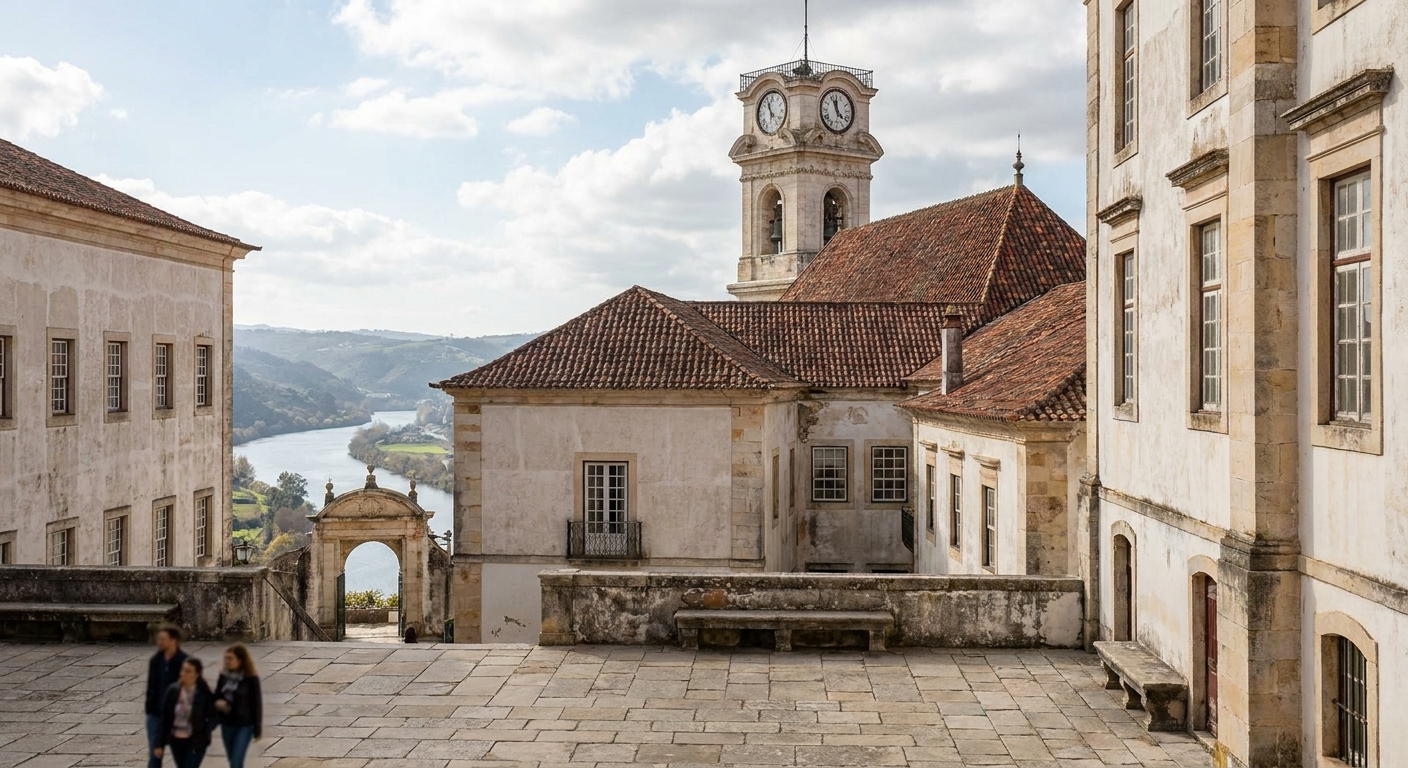
Most travelers meet Coimbra through a window. Trains between Lisbon and Porto run the Mondego valley, the hill with the clock tower on top slides past, and the doors close again. Stepping off costs almost nothing, because the line is busy and the town begins at the platform. Above that platform sit one of Europe’s oldest universities still in session, a baroque library entered at a fixed hour, and a fado sung by men in black capes that shares a name with Lisbon’s and very little else.
COIMBRA IN BRIEF
Coimbra repays a night rather than a connection: secure the Joanina library slot first, make the climb once in real shoes, and keep the evening for a fado session where the room coughs instead of clapping.
CENTRAL PORTUGAL · ON THE LINHA DO NORTE · UNIVERSITY CITY
Go for: the Paço das Escolas courtyard with the river flat below it, the Escadas de Quebra-Costas at dusk, and the low sound of a guitarra de Coimbra in a small room.
Think twice before: getting out at Coimbra-B and assuming you are in town, or reaching the library in high summer without a slot already in hand.
Library entry runs on timed slots and we publish no hours or fares · full sources at the end of this guide
On this page
- Things to do in CoimbraThe courtyard, the tower and the Joanina library
- The climb from the riverUpper town, lower town and the public lifts
- Fado de CoimbraHow it differs from Lisbon fado, and how to respond
- A day in CoimbraMorning in the Baixa to fado at night
- Where to stay in CoimbraBaixa, the hill, or across the Mondego
- Getting to Coimbra by trainThe two stations, and the run to Conímbriga
The University of Coimbra on the hill: the Paço das Escolas, the tower, São Miguel and the Joanina library
The university occupies the summit of the old city, in the buildings of a royal palace that stopped being royal when the crown moved south. You walk into the Paço das Escolas, an open courtyard with the Via Latina colonnade along one side and the whole Mondego plain dropping away on the other. The Torre da Universidade is climbable and narrow. The Capela de São Miguel keeps a gilded baroque organ that still gets played, and the university’s ceremonial hall is part of the same ticket family sold at the visitors’ desk in the courtyard.
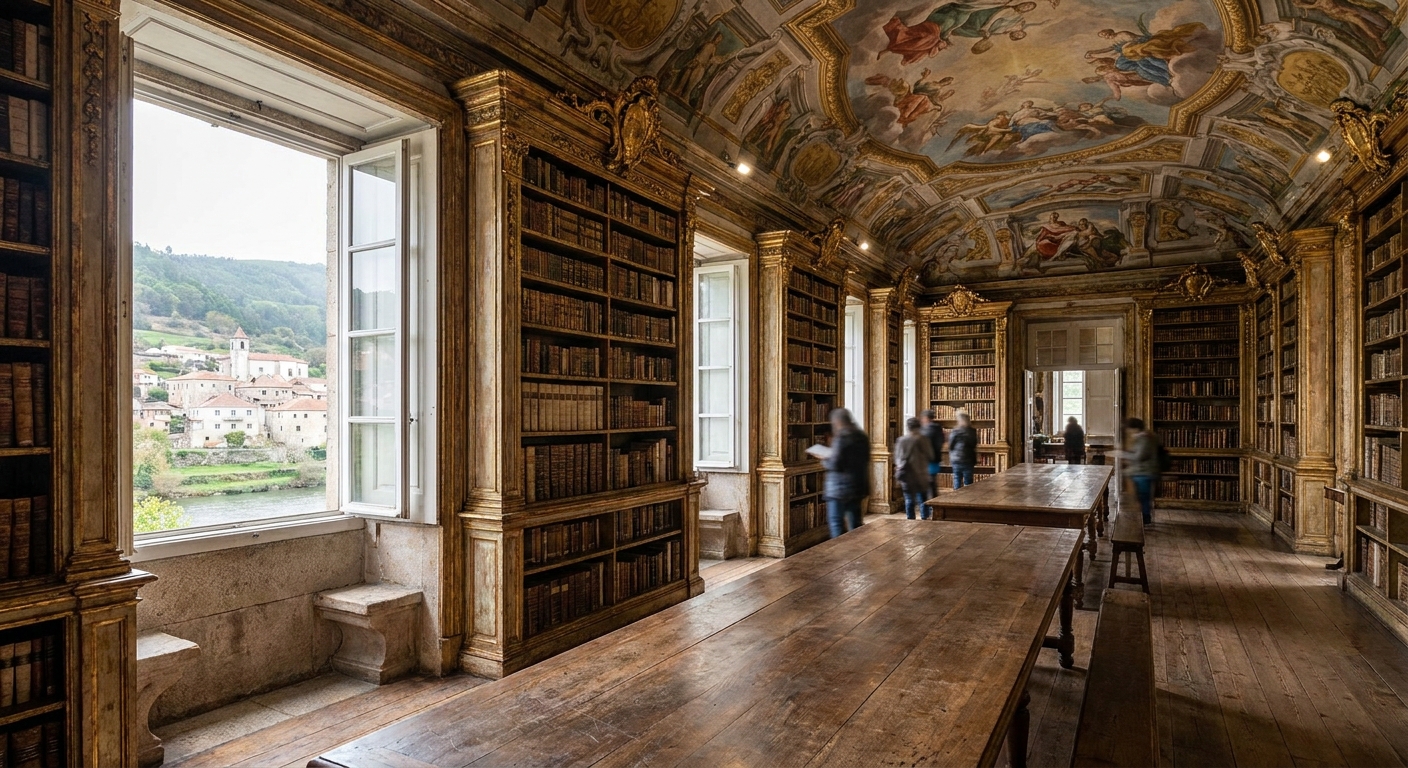
The Biblioteca Joanina is the reason the courtyard has a queue. Behind its heavy door are gilded shelving, painted ceilings and a working colony of bats that comes out at night to eat the insects that would otherwise eat the books, which is why the reading tables get covered before closing. Entry runs on timed slots in small groups, and this is the one part of the hill that saturates in season. In high summer the next free slot can fall well after the moment you ask for it, so buy ahead or arrive early.
Coimbra upper town and lower town: the climb from the Mondego, the stairs and the public lifts
Coimbra is vertical, and the day’s real work is the difference in height between the river and the courtyard. The Baixa is the flat part: Rua Ferreira Borges, the Praça 8 de Maio, and the church of Santa Cruz, which holds the tombs of Portugal’s first two kings from the years when this was the capital. From there the city tips upward. The classic way in is the Arco de Almedina, the old gate in the medieval wall, and then the Escadas de Quebra-Costas, a stairway whose name translates as back-breaker and was not chosen ironically.
Residents do not climb it every time. Public lifts and mechanical stairs cut the worst of the gradient, the Elevador do Mercado among them, rising from the municipal market to the streets under the university, and locals ride it the way they would ride a bus. The Sé Velha, squat and fortress-like, sits halfway up as a natural breather. Bring shoes with grip: the paving is polished limestone and it turns slick in rain, a point argued in our packing list.
Downhill has its own set of places. The university’s Jardim Botânico lies below the hill beside the arches of the São Sebastião aqueduct, and it is the shaded half of any afternoon. Cross the Parque Verde and the Ponte Pedro e Inês footbridge to the left bank for Santa Clara-a-Velha, the Gothic monastery the Mondego flooded and buried for centuries, dug out and now shown with an interpretation centre. Portugal dos Pequenitos, the miniature-Portugal park, stands nearby and appears in our family guide.
Fado de Coimbra: how it differs from Lisbon fado, and how the room responds
Two Portuguese cities sing fado and the two traditions barely overlap. Coimbra’s is a men’s repertoire tied to the university: performers wear the student capa e batina, the black cape and gown, and the accompanying instrument is the guitarra de Coimbra, tuned lower than its Lisbon cousin and built with its own headstock. The songs are serenades and student laments rather than the tavern narratives of Alfama. Nobody dresses in a shawl, and the singer usually stays seated.
The response is the detail that catches visitors out. In the traditional setting the audience does not clap. Approval arrives as a dry cough, a collective clearing of the throat that runs around the room after the last chord, a habit inherited from serenades sung outdoors at night where applause would have been noise. Commercial rooms are relaxed about it and some crowds clap anyway. Wait a beat before you commit, and follow whatever the locals in the row ahead do.
Small venues in the lower town and on the hill run nightly sessions for visitors, and student groups sing on their own terms outside them. The largest occasion is the Queima das Fitas in May, the ribbon-burning festival that opens with a serenade on the steps of the Sé Velha in the small hours, sung to a silent crowd. Beds and streets both get scarce that week, which our May guide covers for the country as a whole.
A day in Coimbra, from the Baixa to the hilltop and back
| Time of day | Where | Why then | Where it goes wrong |
|---|---|---|---|
| Early morning | Baixa: Santa Cruz, the market streets | Flat walking, cafés working for students rather than tour groups | Spending the fresh hours on the shopping street and climbing at noon |
| Mid morning | Arco de Almedina and the Quebra-Costas stairs, or the Elevador do Mercado | One climb, done once, with the Sé Velha as the pause | Dragging a wheeled suitcase up the steps to a hilltop room |
| Midday | Paço das Escolas: courtyard, tower, Capela de São Miguel | The whole river plain from the parapet, and the tower before the legs give out | Arriving at the courtyard with no library slot booked |
| Early afternoon | Biblioteca Joanina | Entry is by timed slot in small groups, so the room is never a scrum | Assuming a walk-up works in July or August |
| Late afternoon | Jardim Botânico, then Parque Verde and the Ponte Pedro e Inês | Downhill, shaded, and the hill looks best from the far bank | Leaving the garden so late that it closes on you |
| Evening | A fado session, then dinner in the lower town | The repertoire is written for this hour, and the Baixa eats late | Clapping into the silence when the room is about to cough |
Where to stay in Coimbra: the Baixa, the university side, or across the Mondego
The Baixa is the default and the flattest option: guesthouses among the shops, the central station a short walk along the river, restaurants that stay open after the fado ends. It is also the loudest, especially in term time. Praça da República, on the eastern shoulder of the hill, is the student bar square, so a room on it buys convenience and a soundtrack. Anyone travelling with a suitcase should check how many steps stand between the taxi and the door before booking on the upper streets.
The university side puts the courtyard, the Sé Velha and the museums within a few minutes of breakfast, and turns every dinner into a return climb. Across the water, the Santa Clara bank trades atmosphere for the view: the whole lit hill from your window and a footbridge walk back from dinner. We compare neighborhoods across the country in the where-to-stay guide, and our trip-cost page sets the price tiers that a university town undercuts.
Getting to Coimbra by train from Lisbon or Porto, the two stations, and how many nights
Coimbra sits on the Linha do Norte roughly midway between the two big cities, which is what makes it the natural break in a journey people usually take in one go. Fast services call at Coimbra-B, which stands outside the centre, and a short connecting train runs from there into the central station down by the river. Read the station name on your ticket before you book a room. Ticket types and the difference between the services are explained in Getting Around Portugal, and the city at each end of the line gets weighed in Lisbon vs Porto.
South of the city, Conímbriga is the largest excavated Roman town in Portugal, with its mosaic floors, the House of the Fountains and a site museum beside the ruins, close to Condeixa-a-Nova. No railway reaches it. You go by car or by regional bus, and the bus timetable rules the visit rather than the other way round. Our car guide deals with tolls and the automatic-transmission booking trap if you drive down.
One night is the answer for almost everyone. A three-hour halt between trains buys the courtyard and possibly the library, and it hands back the two things that separate this city from a monument: the climb taken slowly, and a fado session at an hour when the last train has gone. Add it to a week that already includes both big cities, as sketched in the seven-day route. Which month you pick changes the student calendar as much as the weather, and the month-by-month guide holds those curves.
When to go. The month-by-month case for Coimbra — what the normals say, when the sea is warm enough to swim and which weeks fill up — sits on the best time to visit Coimbra.
The last word
The image that survives the trip is usually small and indoors. A man in a black cape, seated, a guitarra tuned low, and then a room answering the last note with a cough rather than applause. Students will tell you the tears in a cape’s hem each stand for something, and no two of them tell you the same thing. Nothing about that scene is staged for the platform crowd, which is the argument for staying past dinner in a place the standard Portugal route treats as a corridor.
Coimbra asks for one honest effort, the haul from the Mondego up to the Paço das Escolas, and pays it back in a courtyard that looks over the river the trains follow. Take the bags off your shoulders before you climb, keep the library slot for the middle of the day, and let the botanical garden take the heat out of the afternoon. Come morning, the hill goes past your window again, and this time you have been up there.
Sources & data for this guide
- University of Coimbra visits: Paço das Escolas, Torre da Universidade, Capela de São Miguel and the Biblioteca Joanina, with library entry on timed slots · University of Coimbra visitor information · we publish no opening hours or fares here because both change by season · checked Sep 6, 2026
- Old town fabric: Santa Cruz and the royal tombs, Sé Velha, Arco de Almedina, the Quebra-Costas stairs and the public lifts · visitportugal.com (Turismo de Portugal) and Coimbra municipal tourism, plus ground observation · checked Sep 6, 2026
- Santa Clara-a-Velha, its repeated flooding by the Mondego, the excavation and the interpretation centre · Portuguese heritage service site information · checked Sep 6, 2026
- Conímbriga Roman town and site museum near Condeixa-a-Nova · Museus e Monumentos de Portugal · access is by car or regional bus, with no rail service to the site · checked Sep 6, 2026
- Linha do Norte services and the two Coimbra stations, including the connection from Coimbra-B into the central station · CP timetables. Check the station printed on your ticket before booking a room · checked Sep 6, 2026
- Editorial note: the applause convention at fado sessions, the crowding at the library door and the night noise around Praça da República are our own observations rather than published figures. No venue is named because programming and ownership change.