
ERICEIRA · PORTUGAL’S SURF COAST · THE RESERVE
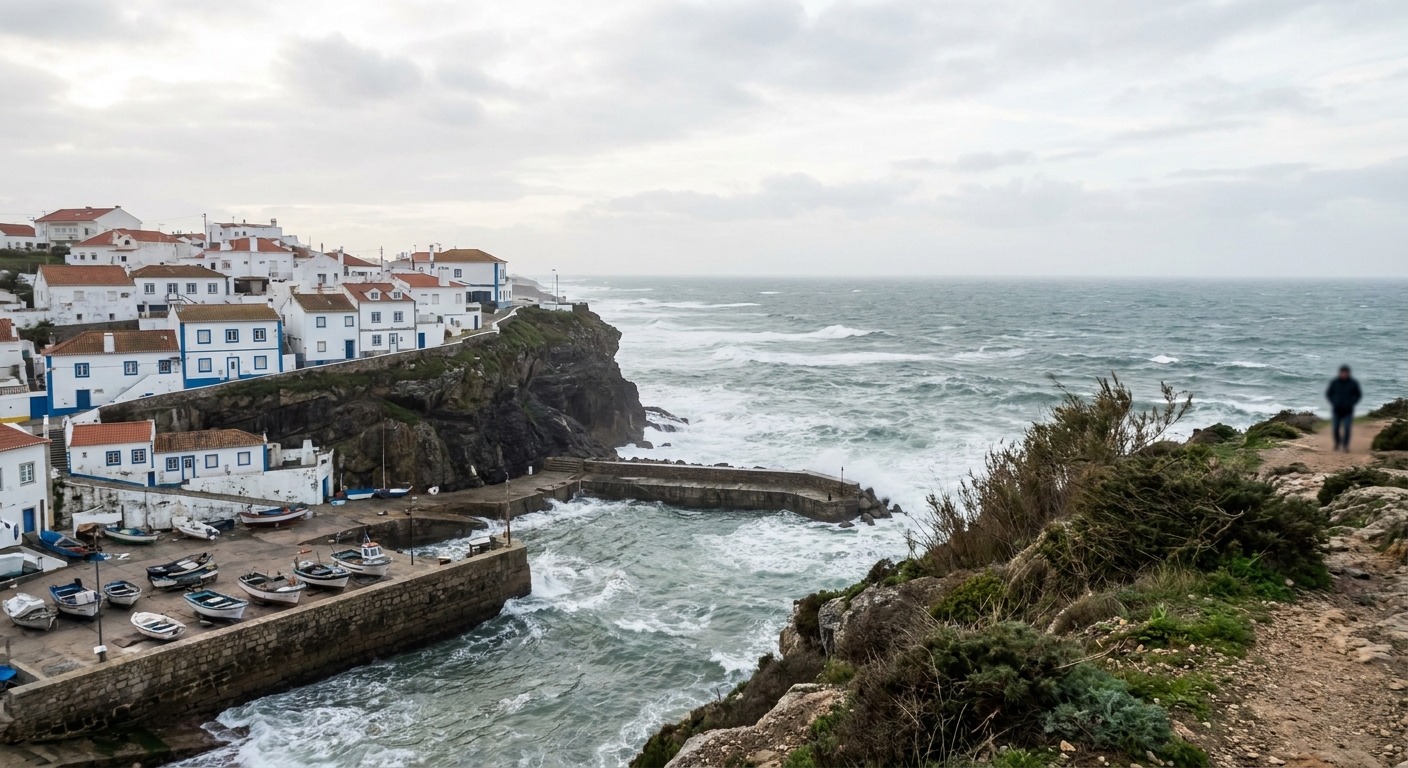
Ericeira does not open with a beach. It opens with a wall: a whitewashed village standing on a cliff above the Atlantic, with steps down to a cove that the ocean takes back at high tide. What fixed the place in its present shape was a designation. The coast running north from the village was recognised as Europe’s first World Surfing Reserve, and the surfers stayed. Fish restaurants, board racks, vans parked nose-out at the clifftop, rooms rented by the month: the village runs on the water, whether or not you go in.
ERICEIRA AT A GLANCE
The sheltered sand under the village is for swimming and first lessons, the reef spots north are for people who already surf, and the water is cold in every month of the year.
WORLD SURFING RESERVE · NORTHWEST OF LISBON · NO RAILWAY STATION
Go for: the morning swell check on the clifftop wall, percebes off the rocks below it, and a wide beginner beach at Foz do Lizandro that is nothing like the reef north of town.
Think twice before: treating this as a warm swimming coast, or letting a beginner paddle out anywhere in the reserve. The bottom there is rock, not sand.
Reserve status and boundaries: Save The Waves Coalition · full sources at the end of this guide
On this page
- What the Ericeira surf reserve isEurope’s first World Surfing Reserve, and what it changed
- Ericeira beaches by levelTown sand, then the reef spots north
- Learning to surf in EriceiraWhich beach to start on, and the wetsuit
- A day in EriceiraMorning check, midday village, fish dinner
- Things to do in Ericeira villagePraça da República, the port, the winter closures
- Getting to Ericeira from Lisbon and where to stayBus or car, and three zones to sleep in
What Europe’s first World Surfing Reserve means in Ericeira, including for people who never surf
The reserve is a designation, not a gate. The Save The Waves Coalition, which runs the World Surfing Reserve programme, recognised the coast running north from the village, with a string of named waves inside it: Empa, Pedra Branca, Reef, Ribeira d’Ilhas, Cave, Crazy Left and Coxos, out toward São Lourenço. Ericeira was the first in Europe, and North Devon in England has since been designated too, so the continent now holds two. Nothing about it costs money or needs a permit. What it defends is water quality, public access and the seabed that makes those waves break as they do.
For a visitor who never puts on a wetsuit, the effect shows in the village rather than in the ocean. A protected coast holds a permanent population of instructors, shapers, camp staff and remote workers who arrived for a season and renewed the lease. That population keeps cafés opening early in February and fills the clifftop wall every morning with people reading the swell before breakfast. It also sorts the beaches for you. The sheltered sand under the village stays the swimming beach, because the surfers have somewhere better to be.
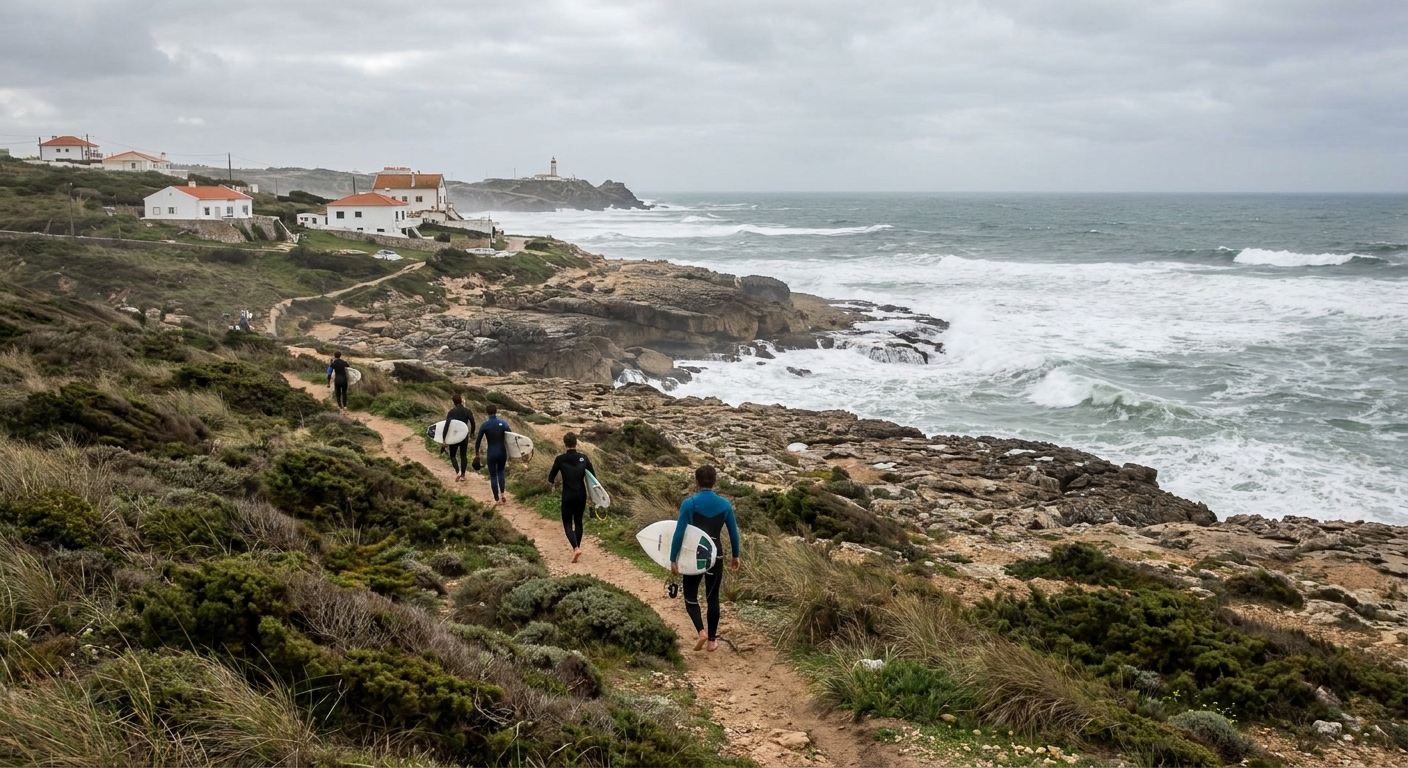
Ericeira beaches by level: Praia dos Pescadores and Praia do Sul in town, Ribeira d’Ilhas and Coxos north
Praia dos Pescadores lies directly below the village, beside the fishing port, with rock arms taking the edge off the shorebreak. This is the swimming beach, narrow at high tide and packed with families in August. Praia do Sul, a walk south along the clifftop, gives more sand and more room for a towel. North of the centre, Praia de São Sebastião and the small cove at Matadouro are prettier and rockier. None of them is calm in the Mediterranean sense. The Atlantic has weight here even on a flat day.
The reserve spots are another matter. Ribeira d’Ilhas, the wide bay north of town, is the competition venue and the easiest to find, a long right-hander with a car park and a café on the slope above it. Coxos, further north again, breaks fast over stone. Between them sit Reef, Cave, Crazy Left and Pedra Branca, all shallow and all over rock. Booties are ordinary equipment here. Sea urchins are ordinary too. Up the coast, Nazaré turns big surf into a spectator event, while the reserve is somewhere people paddle out.
Cold water is the constant. Atlantic upwelling keeps this coast chilly straight through the summer, which is why the rental racks in the village never empty in July, and why Portugal’s warm, shallow swimming happens elsewhere: in the lagoon behind Tavira and along the Algarve. Rip currents are the serious hazard, the flags are the instruction, and lifeguard cover runs only in the bathing season. Our safety guide sets out the flag system. A red flag on this coast is not an opinion.
Learning to surf in Ericeira: which beach beginners are taken to, and why the wetsuit is not seasonal
Schools work out of shopfronts in the village and out of vans at the beach car parks, and the sorting happens by beach rather than by brochure. First-timers go to sand: Foz do Lizandro, the river-mouth beach just south, or São Julião further down the coast toward Sintra, both wide enough to hold a class without anyone drifting onto rock. Praia do Sul does the job when the swell is small. A school offering a beginner Ribeira d’Ilhas on day one is selling the name of the wave.
The wetsuit is not optional and it is not a winter item. August water on this coast asks for one, and lesson rates normally include the rental, so the thing to confirm when you book is thickness rather than whether. The second question is wind. The nortada, the north wind that gets up on summer afternoons, chops the surface and turns a pleasant lesson into a wrestling match. Morning slots fill first for that reason.
Winter is when the reserve earns its designation, with the biggest swell of the year and empty car parks, and it is also when daylight is short and the lifeguards have gone home. Camps run right through it, and the standard in the water climbs with the swell. Families weighing a first lesson against a straightforward swimming holiday will find the trade-off argued in our Portugal with kids guide, and the seasons themselves live on the month-by-month guide.
A day in Ericeira: a one-day surf-and-town itinerary
| Time or season | Where | Why then | The trap |
|---|---|---|---|
| Early morning | The clifftop wall above Praia dos Pescadores | The wind is usually lightest at dawn, and you can read the swell before committing to anything | Booking a summer lesson for the afternoon without asking about the nortada |
| Mid morning | Foz do Lizandro, or Praia do Sul when it is small | Sand bottom, room for a class, lifeguards in season | Assuming a beginner beach means gentle water |
| Midday | Praça da República and the lanes behind it | Shops and cafés are open, and the terraces sit in shade | Expecting a big-town lunch service out of season |
| Afternoon | Ribeira d’Ilhas, from the café above the bay | You can watch competent surfing over a reef without going in | Walking down to the rocks in flip-flops at low water |
| Evening | The fishing port below the cliff, then dinner | Boats on the slipway, percebes and grilled fish on the menus | Turning up late in high season without a table booked |
| Winter | The reserve spots north | Biggest swell, empty car parks, the village back to its residents | Closed restaurants, closed rental shops, no lifeguard cover |
Ericeira village: Praça da República, the fishing port and what closes out of season
The old centre is a grid of narrow lanes in whitewash with blue and yellow trim, running back from the cliff edge to Praça da República, where the terraces sit under trees and the buses pull in. Walk to the edge and the layout explains itself: the cove below, the slipway, the small boats winched up above the tide line. A monument on that clifftop marks the departure of Manuel II, the last king of Portugal, who left the country from this cove. Percebes, the goose barnacles prised off these rocks, turn up on the menus underneath it.
The season is short and the village makes no secret of it. Summer brings Lisbon weekenders, camps at capacity and cars circling for a space; out of season a share of the restaurants and rental shops shut, and the ones that stay open feed the people who live here. Rain sends the day inland to Mafra, where the Palácio Nacional de Mafra keeps its basilica and its library a short drive from the coast. What Portuguese seafood cooking is doing with all this sits in our food and drink guide.
Getting to Ericeira from Lisbon by bus or car, and where to stay in the village
There is no railway station in Ericeira and no line reaches it. The link from Lisbon is the bus out of Campo Grande, on a route long operated by Mafrense and now signed under the Carris Metropolitana network. Timetables shift with the season and with the day of the week, which is why we publish none here: read the operator’s current one. Our getting-around guide explains how Portugal’s regional bus networks fit together with the trains.
Driving is the other answer, in on the coast road through Mafra, and it is the practical way to reach the reserve spots north of town with boards on the roof. Parking in the centre in high summer is the price of that freedom. Tolls, fuel and the rest are covered in the car-rental guide. From the capital the village also works as a day out, alongside the options in our Lisbon day trips guide, though it repays a night better than a bus ride home.
The old centre puts you within a walk of the cove, the buses and dinner, with late terrace noise as the trade-off. The cliff south, toward Praia do Sul, holds quieter apartments and family rooms. North, toward Ribeira d’Ilhas, is camp and villa territory that needs wheels. High-season rates here have climbed to capital levels, a shift our trip-cost guide puts in context, and the zone logic for the whole country is in the where-to-stay guide. A night is enough to see the village. Learning takes several mornings, because the ocean does not deliver a beginner’s day to order. Wider planning starts at our Portugal hub.
When to go. The month-by-month case for Ericeira — what the normals say, when the sea is warm enough to swim and which weeks fill up — sits on the best time to visit Ericeira.
The last word
For anyone who never gets in, Ericeira pays out on the wall above Praia dos Pescadores. The morning check is a village event: cars pull in nose-out, engines stay running, nobody says much, and then people either drive north or go for coffee. Below, the boats sit on their trailers above the slipway and someone is always scraping a hull. Add the barnacles off those rocks, the cliff path south, and a swimming beach that sits under the restaurant terraces rather than a bus ride away.
Take the wetsuit warning seriously in August, and take the flags more seriously than the wetsuit. Then give the evening to the clifftop, when the nortada drops, the light goes flat and orange on the whitewash, and the last class of the day comes up the steps with foam boards under their arms. A working surf coast is a strange thing to sit above and watch, and Ericeira lets you do it with a plate of fish in front of you.
Sources & data for this guide
- World Surfing Reserve designation and programme · Save The Waves Coalition. Ericeira was the first reserve designated in Europe; North Devon in the United Kingdom was designated later, so Europe currently holds two · checked Sep 6, 2026
- Reserve stretch and the named waves (Empa, Pedra Branca, Reef, Ribeira d’Ilhas, Cave, Crazy Left, Coxos, toward São Lourenço) · reserve documentation plus ground observation · checked Sep 6, 2026
- Beach flags, bathing season and lifeguard cover · Autoridade Marítima Nacional flag system, summarised on our Portugal safety page · checked Sep 6, 2026
- Bus links from Lisbon (Campo Grande) to Ericeira, route long operated by Mafrense and now within the Carris Metropolitana network. We publish no times or fares: both change with the season and the operator · checked Sep 6, 2026
- Water temperature and wetsuit thickness · deliberately not given here as figures; Atlantic upwelling on this coast is a documented year-round pattern and local rental shops set thickness by month · checked Sep 6, 2026
- Palácio Nacional de Mafra, inland from Ericeira · visitportugal.com (Turismo de Portugal) · checked Sep 6, 2026
- Editorial note: which restaurants close out of season, parking difficulty in the old centre, the monument to the departure of Manuel II and the character of each sleeping zone are our own observations, not published data