
THE AZORES · PORTUGAL · THE ISLAND GUIDE
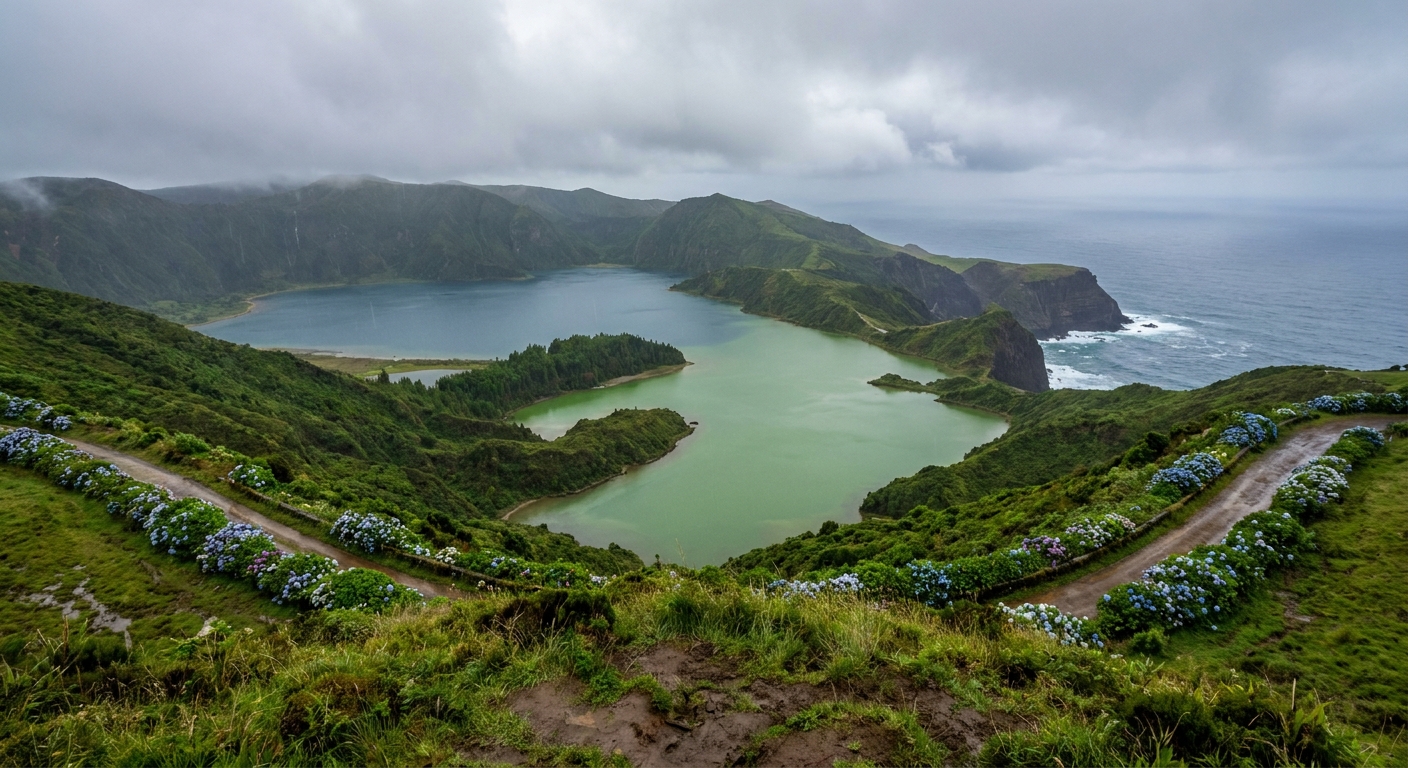
São Miguel does its introductions in green. Pasture walls climb from the sea to a crater rim, the rim drops away, and at the bottom sits a lake the color of bottle glass. The largest island of the archipelago is built on that vertical logic: cattle up top, hot water underneath, tea somewhere in between, and cloud arriving to referee the whole arrangement.
What makes the Azores unusual for an American planner is how flat the calendar runs. At the thermometer in Ponta Delgada, the coolest month averages a 63.3°F high and the warmest 78.8°F. Nothing here is ever cold and nothing is ever hot. Rain is the variable that moves: 1.02 inches in an average July against 6.02 inches in December.
THE ISLANDS AT A GLANCE · THE AZORES
Come for cetaceans, crater rims and thermal water, plan around rain rather than cold, and read every temperature here as Ponta Delgada at sea level rather than the mountain above it.
DRIEST MONTHS: JUNE AND JULY · WHALE TRIPS RUN ALL YEAR · NORMALS FROM ONE STATION, PONTA DELGADA
Go for: crater lakes at Sete Cidades and Lagoa do Fogo, cetaceans in every month of the year, thermal bathing at Furnas, and tea grown at Gorreana since 1883.
Think twice before: booking a beach fortnight. The sea reaches 77.0°F only in August, October records 13.7 days of rain, and the high ground writes its own forecast.
Normals: IPMA station 513 · Whales and sights: Visit Azores · Sea: Open-Meteo Marine · full sources at the end
On this page
- Best time to visit the AzoresThe twelve months, side by side
- Azores temperature and rainfall averagesStation 513, Ponta Delgada, 35.0 m
- Whale watching months by speciesBlue whales in late winter, dolphins all year
- Things to do on São MiguelCrater lakes, Furnas springs, two tea plantations
- How big is São Miguel62.1 km long, 1,105 m at Pico da Vara
- Tourist tax in Ponta DelgadaEUR 2 a night, capped at 3 nights
- Are the Azores worth visiting?Worth it for walkers and whales, not for a lounger week
Every temperature and rain figure quoted below was measured at a single instrument: station 513, Ponta Delgada Observatório, 35.0 m above the sea on the south coast of São Miguel. High ground across the archipelago runs colder and far wetter, and the north coast of the same island often has a different day going on.
Best time to visit the Azores: weather month by month
| Month | Avg high / low | Rain | Days ≥ 1 mm | Sea |
|---|---|---|---|---|
| January | 63.5°F / 54.9°F | 4.02 in | 13.0 | 63.3°F |
| February | 63.3°F / 53.8°F | 3.43 in | 10.8 | 62.7°F |
| March | 64.2°F / 54.7°F | 3.82 in | 11.7 | 61.9°F |
| April | 65.8°F / 55.9°F | 3.13 in | 10.2 | 63.0°F |
| May | 68.4°F / 58.3°F | 2.40 in | 8.7 | 65.9°F |
| June | 72.3°F / 62.2°F | 1.75 in | 6.6 | 69.5°F |
| July | 76.5°F / 66.0°F | 1.02 in | 4.8 | 73.1°F |
| August | 78.8°F / 67.8°F | 1.80 in | 6.5 | 77.0°F |
| September | 77.0°F / 66.4°F | 3.08 in | 9.4 | 75.3°F |
| October | 72.7°F / 62.8°F | 4.65 in | 13.7 | 72.3°F |
| November | 67.8°F / 58.8°F | 3.75 in | 11.8 | 68.4°F |
| December | 64.9°F / 56.1°F | 6.02 in | 15.0 | 65.4°F |
The Azorean year is narrow at both ends. February averages a 63.3°F high, August 78.8°F, a spread of fifteen degrees across an entire calendar. Rain does the moving instead: 1.02 inches over 4.8 wet days in July against 6.02 inches over 15.0 days in December. The sea lags the air by roughly two months, bottoming at 61.9°F in March and peaking at 77.0°F in August, those water figures being averages of daily maxima from 2015 to 2024.
July and August win on paper: 4.8 and 6.5 wet days, water at 73.1°F then 77.0°F, and 14 hours 34 minutes of daylight on July 15. June is the quieter twin, 1.75 inches spread over 6.6 days, with the longest light of the year at 14 hours 49 minutes on the 15th. September holds the warm water at 75.3°F and gives back two hours of daylight.
December costs walkers the most: 15.0 rain days, 6.02 inches, and 9 hours 37 minutes of light on the 15th leave little room for a rim trail. October reads worse than its temperature suggests, with 13.7 wet days behind a 72.7°F average high. Neither month is a loss for a whale watcher or for anyone whose plan is a thermal pool in the drizzle, and February, at 10.8 wet days, is the drier of the two winter halves.
For a first trip the shape is simple. June and July are the driest months at this thermometer, late winter is the blue whale window, and the wet-day counts above use the Portuguese service’s 1 mm threshold (0.04 inch), a lower bar than the 0.10-inch line most US tables apply. The two sets of counts are not interchangeable, and a table showing fewer Azorean rain days than ours is probably measuring something else.
Azores weather: temperature and rainfall averages
The normals come from IPMA, the Portuguese national weather service, covering 1991 to 2020 at station 513, Ponta Delgada Observatório, 35.0 m above sea level on the south coast of São Miguel. That is a real instrument in a real town, not a model grid cell smeared across an ocean. Its rain is counted at two thresholds: July records 4.8 days reaching 1 mm and only 0.6 day reaching 10 mm (0.39 inch), so most damp July days barely qualify.
One coastal town cannot describe an archipelago. Pico da Vara rises to 1,105 m on the same island, colder and far wetter than the harbor below it, and the north coast can sit under cloud while Ponta Delgada stays bright. Pack accordingly: a rain shell and a warm layer earn their place in the bag even in a 78.8°F August, and our Portugal packing guide handles the rest of the list.
Whale watching in the Azores: which whales, which months
Common dolphins and common bottlenose dolphins are resident, so any month of the year puts something in the water, and swimming with them is permitted. Blue whales are the late-winter headline, easily spotted at the end of the season. Summer brings the heavyweights: sperm whales, sei whales and other baleen whales, with spotted dolphins alongside them. The boats run all twelve months, and the month decides the cast rather than whether you go out at all.
A trip lasts about three hours. Visit Azores puts the recommended minimum age at five, and the reasoning holds up at sea: a swell an adult calls calm can be a long morning for a small child. Families traveling with younger children should ask the operator directly rather than assume a policy, and plan the day so nobody is committed to three hours they cannot leave. Our Portugal with kids guide takes the same line on long boat days.
These waters count as one of the largest whale sanctuaries anywhere, and the figure behind that phrase is worth keeping: more than 20 cetacean species can be seen here, roughly a third of all species that exist. No single morning delivers anything like that range. Which of the twenty shows up on your particular boat is nobody’s decision to make.
Things to do on São Miguel: crater lakes, hot springs and tea
The island’s set pieces are craters. Sete Cidades holds twin lakes, one green and one blue, and the named lookout over them is Vista do Rei. Lagoa do Fogo sits higher and wilder, with no village on its shore. Both are hostage to cloud in the same way: a rim can be clear at nine and gone by ten, so the viewpoint goes early in the day and the backup plan goes in your pocket.
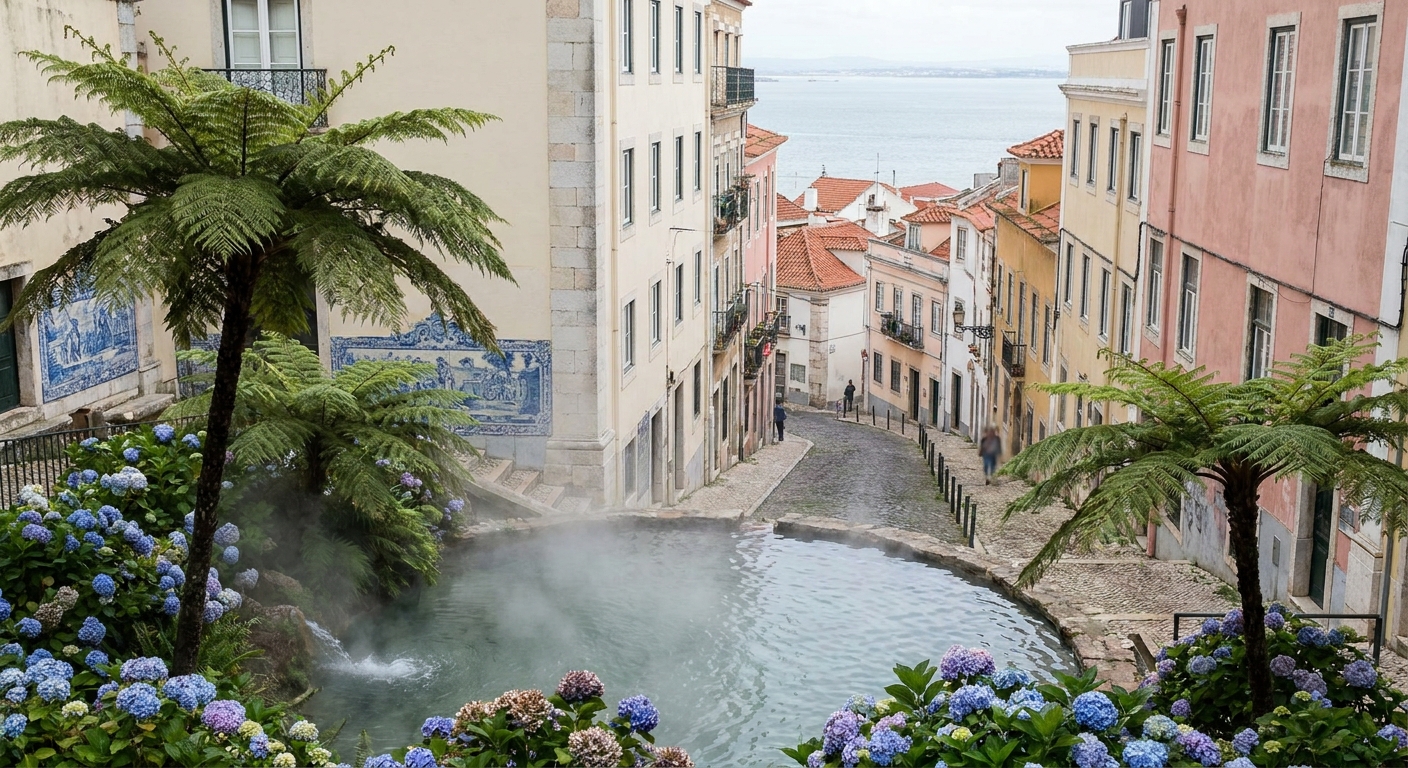
The Furnas Valley carries dozens of thermal springs, fumaroles and carbonated water. Poça da Beija is a bathing spot of clear water and ferrous mud. The Caldeiras of Ribeira Grande pair a thermal building dating from 1811 with trees and steam vents. Terra Nostra Park, a thermal pool inside a botanical garden, prices visitors and residents differently, around EUR 16 for a visiting adult against about EUR 12.80 for a resident, under-6s free. Those two figures resisted verification, so confirm them at the gate.
Gorreana and Porto Formoso grow tea, uniquely in Europe, and both run museum-factories open to visitors. Gorreana has worked its slopes since 1883 and claims the title of the continent’s oldest plantation. The rows run down toward the north coast road in long green corduroy, and the factory tour, with its belt-driven machinery, earns its place on a gray morning far better than a viewpoint would.
The calendar hits those three unevenly. The lakes want dry air, which points at June and July with their 6.6 and 4.8 wet days. Thermal bathing is indifferent to weather: December’s 15.0 rain days are an argument for Furnas rather than against it, and warm water in cool air is the better version anyway. Tea is indoor work in any month, and it survives an October of 13.7 rain days intact.
How big is São Miguel: island size in km and highest point
São Miguel measures 62.1 km end to end and 15.8 km at its widest, covering 744.7 square kilometers. Pico da Vara tops it at 1,105 m. Those are modest numbers for an island that feels far larger from behind a windshield, because the roads climb, drop and switchback rather than run straight. We have no drive time we trust enough to print here, but a single base can reach both ends, so changing hotels midway is a preference and not a requirement.
More than half of all Azoreans live on this one island: 137,856 people at the 2011 census. Ponta Delgada has been the capital since 1546, a role it inherited from Vila Franca do Campo after an earthquake destroyed that town in 1522. The capital is also the place where the municipal tourist tax applies, which matters more to a booking than it sounds.
Azores travel costs: the Ponta Delgada tourist tax
Ponta Delgada has charged a municipal tourist tax since January 2025, and the cap is the part that decides what a stay costs. Press reports and host guides put it at EUR 2 per person per night from age 13, stopping after 3 consecutive nights, so roughly EUR 6 a head. Porto charges EUR 3 a night up to 7 nights (EUR 21), Funchal EUR 2 up to 7 (EUR 14). The city’s own platform confirms the tax but keeps its rate leaflet behind a login, so treat the amounts as unconfirmed.
What we cannot put a number on, by name: a hotel night on São Miguel in any month, a flight from the US East Coast, a week of car rental, a seat on a whale boat, and Terra Nostra’s entry beyond the order of magnitude above. None of it sits in a source we can verify for the archipelago. The figures in our Portugal trip cost guide are national and drawn from the mainland, and no monthly price series exists here, so no month gets called the cheapest of the year.
The property is the one to ask for the tax in writing, with the nights it covers and the exemptions spelled out: under-13s, medical stays, disability of 60 percent or more, and Azorean residents. Whale operators answer the other two questions, trip length and their own rule on children under five, usually by email within a day. At Terra Nostra, ask at the ticket desk before you plan the afternoon, since visitor and resident rates differ.
Are the Azores worth visiting?
Yes, for walkers, whale watchers and anyone who enjoys negotiating with cloud. The reward is a landscape of craters and steam that nowhere else in Portugal offers, plus more than 20 cetacean species within a three-hour boat ride. No, for a sun-lounger fortnight. The sea touches 77.0°F in one month of twelve, August still records 6.5 wet days, and a week here can hand you four gray afternoons without apologizing.
Match the month to the reason. Whales first sends you to February, when blue whales pass and the station logs 10.8 wet days against October’s 13.7. Walking first sends you to July, 1.02 inches over 4.8 days with 14 hours 34 minutes of light on the 15th. Swimming first means August or September, water at 77.0°F then 75.3°F, and our national calendar puts that against the mainland.
The last word
Take the rim early and the hot water late, and let the middle of the day sort itself out. Even December, the wettest month on the record, logs 15.0 days reaching 1 mm and only 4.5 reaching 10 mm: most Azorean rain is a shower with somewhere else to be. Stand at Vista do Rei long enough and the cloud usually opens once. That is the whole discipline of the place, and it is why the twelve month pages exist.
Sources & data for this guide
- Monthly normals 1991-2020, temperature, precipitation, days at 1 mm and 10 mm · IPMA, station 513 Ponta Delgada Observatório, altitude 35.0 m · checked Sep 13, 2026
- Sea surface temperature, mean of daily maxima 2015-2024 · Open-Meteo Marine API · checked Sep 13, 2026
- Daylight length and sun times on the 15th of each month · sunrise-sunset.org · checked Sep 13, 2026
- Whale seasons by species, three-hour trips, recommended minimum age five, more than 20 cetacean species · Visit Azores (official regional tourism) · checked Sep 13, 2026
- São Miguel dimensions, Pico da Vara, 2011 census population, capital since 1546 · Visit Azores, São Miguel page · checked Sep 13, 2026
- Furnas thermal spots, Caldeiras of Ribeira Grande (1811), Gorreana since 1883 and Porto Formoso · Visit Azores and Gorreana official site · checked Sep 13, 2026
- Ponta Delgada municipal tourist tax · taxaturistica.cm-pontadelgada.pt confirms the tax exists, the rate leaflet is behind a login; amounts relayed by Jornal de Notícias and Correio dos Açores · checked Sep 13, 2026
- Terra Nostra Park rates · we could not read them at source (park pages returned 404, regional portal returned 403), so the EUR 16 / EUR 12.80 figures are an order of magnitude only · attempted Sep 8, 2026
- We publish no Azorean hotel, flight or car rental figure, because we found none we could verify · descriptions of sights are editorial, and hours and prices change.