
THE ALGARVE · PORTUGAL’S SOUTH COAST · 37.0° N
The Algarve is where Portugal turns Mediterranean in mood without ever touching the Mediterranean: a hundred miles of gold-ochre cliffs, sea caves and lagoon islands along the Atlantic’s warmest, calmest Portuguese stretch. Europe knows it well — the British have been wintering here for decades — but for Americans it’s still a discovery: the beach chapter that turns a Lisbon city trip into a full Portuguese story.
THE REGION AT A GLANCE · ALGARVE
Come May–June or September–October for warm days without the July–August squeeze — and know that the two halves of this coast offer two different vacations.
BEST: MAY–JUNE & SEPTEMBER · PEAK: JULY–AUGUST · SUNNIEST REGION IN PORTUGAL
Go for: cliff-cove beaches and boat trips out of Lagos, the lagoon islands off Tavira, golf-green winters, and the wild surf coast around Sagres.
Think twice if: bathtub-warm water is the point — even in September the sea tops out in the low-to-mid 70s°F on the warmest stretch.
July gets essentially zero rain — the Algarve summer is the driest in mainland Portugal, part of its 3,000-hours-of-sun reputation.
Climate normals 1991–2020 (ERA5, Faro) · Seasonality: Turismo de Portugal / INE · full sources at the end of this guide
Two coasts in one region
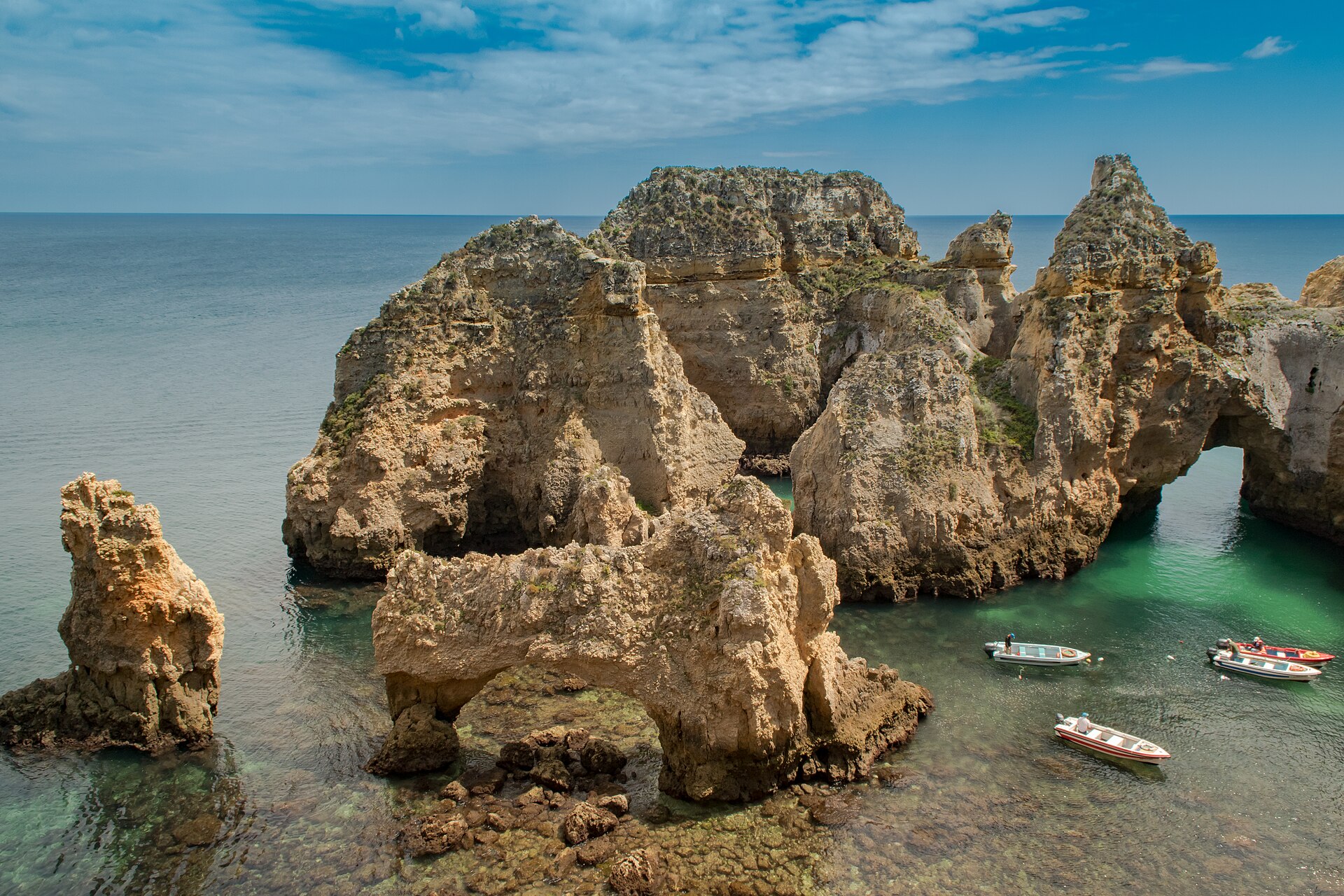
The Barlavento (west): the postcard. From Lagos to Albufeira, this is the Algarve of the photographs — golden limestone cliffs, sea stacks and grottoes, cove beaches like Praia Dona Ana and Praia do Camilo wedged between rock walls. Boat tours out of Lagos thread the caves at Ponta da Piedade. The sea here is a touch cooler and livelier.
The Sotavento (east): the lagoon. From Faro to Tavira and beyond, the Ria Formosa natural park lines the coast with barrier islands — Ilha de Tavira, Armona, Culatra — reached by little ferries. The water is the warmest and calmest in Portugal, the sand runs in huge shallow-water sweeps, and the whole thing suits families and long lazy days. Warmer, calmer, quieter: the east is the connoisseur’s Algarve.
And then the wild card: the west-facing coast. Beyond Sagres and Cabo de São Vicente — mainland Europe’s southwestern tip, all sixty-meter cliffs and lighthouse drama — the coast bends north into the Costa Vicentina: undeveloped surf beaches like Amado (an international competition venue), Arrifana and Monte Clérigo, laced together by the Rota Vicentina hiking trails. Cooler water, bigger waves, almost no resorts. It’s a different planet, twenty minutes from the sunbeds.
Where to base yourself
Lagos — the best all-rounder: walkable historic town with Age-of-Discoveries bones, the cliff beaches at its doorstep, good restaurants, boat trips. Tavira — the charmer of the east: traditional Portuguese architecture, a castle, and the lagoon-island beach a ferry ride away. Albufeira — the resort engine: biggest beach scene, biggest nightlife; choose it knowingly. Faro — underrated for a night or two: a real working city with a walled old town, the gateway to the Ria Formosa, ten minutes from the airport. Sagres — for surfers and wind-lovers who want the end-of-the-world feeling to come with dinner.
What to actually do here
Get on the water. The signature Algarve experience is a small-boat trip through the grottoes — from Lagos to the arches of Ponta da Piedade, or from Benagil beach to the famous domed sea cave with its skylight (kayak and SUP tours land you inside it; swimmers should respect the boat traffic). Dolphin-watching trips run out of Lagos and Albufeira all season.
Walk the cliff tops. The Seven Hanging Valleys trail between Carvoeiro and Marinha — repeatedly named among Europe’s best coastal walks — strings together clifftop views, sinkholes and cove after cove. Out west, day-hike sections of the Rota Vicentina give you the wild-coast version with barely a soul.
Go inland for an afternoon. Silves, the red-stone former Moorish capital, has the region’s best castle and orange groves at its feet. The Monchique hills add altitude, cork forests and a viewpoint over the whole coast at Fóia. Saturday morning, the Loulé market is the region’s pantry on display.
With kids. The lagoon beaches of the Ria Formosa (calm, shallow, warm) are the family default; the region’s water parks and the Zoomarine marine park around Albufeira/Guia soak up an energy-heavy day.
In winter. This is one of Europe’s classic golf coasts — mild 60°F days from November to February built the Algarve’s off-season economy — and hiking weather stays open all winter.
The Algarve for…
Families → the Sotavento: Tavira or the Faro-area islands, shallow warm water, ferry rides as entertainment. Couples and photographers → Lagos and Carvoeiro, for the cliffs, coves and golden light. Surfers and the crowd-averse → Sagres and the Costa Vicentina. Nightlife → Albufeira, knowingly. Golfers and snowbirds → anywhere along the center in winter, when tee times and hotel rates both fall. Not for: anyone whose trip stands or falls on 80°F water — that’s the Caribbean’s job.
What it costs
The Algarve runs cheaper than comparable coasts in Spain, France or Italy — outside the July–August squeeze. Rule of thumb: a simple beach-town guesthouse and grilled-fish dinners keep a couple comfortable on a lean budget; sea-view four-stars with pool sit in the middle; the clifftop resorts and golf hotels form the high end, still shy of Riviera pricing. The one lever that beats every haggle: dates. The same room can cost half as much in late May or late September as in the first week of August. (Editorial orders of magnitude; season moves everything.)
The year on this coast
| Month | Days | Rain | Sea (open coast) | The short version |
|---|---|---|---|---|
| Jan–Feb | 59–60°F | ~7–9 days/mo | 61°F | Mild, green, golf season, empty |
| Mar–Apr | 63–65°F | 6–8 days | 61–63°F | Spring hiking on the Rota Vicentina |
| May | 70°F | 4 days | 64°F | Season opens, still roomy |
| Jun | 75°F | 1 day | 67°F | Early-summer sweet spot |
| Jul–Aug | 80°F | ~0 | 68–72°F+ | Peak crowds, peak prices, bone-dry |
| Sep | 76°F | 3 days | 66–77°F by coast | Warmest sea, crowds fading |
| Oct | 71°F | 7 days | 68°F | Still swimmable for the brave, quiet |
| Nov–Dec | 61–65°F | 8–9 days | 63–64°F | Soft winter light, lowest prices |
Numbers are 30-year averages for Faro; the sheltered eastern lagoons run warmer than the open-coast figures, the west coast cooler. The crowd calendar follows the international school year: July–August is the continental holiday crush (the UK alone accounts for more Algarve nights than any other country), September keeps summer’s weather with a fraction of the pressure, and the region stays pleasantly alive — unlike some Mediterranean islands — straight through winter.
Getting there and around
Faro airport (FAO) is the region’s gateway, ten minutes from Faro itself. Onward without a car: the Vamus Aerobus route 56 runs direct to Albufeira, Portimão and Lagos; city buses (lines 14/16) connect to Faro’s center and train station, where the regional line strings together Faro–Albufeira–Portimão–Lagos and Faro–Tavira. With a car — the better tool for cove-hopping and the west coast — the A22 highway spans the region, with the boothless-toll caveat covered in our Portugal car rental guide. From Lisbon, it’s roughly a three-hour drive or train ride south.
Sources & data for this guide
- Climate normals 1991–2020 computed from ERA5 daily data, Faro grid cell — Open-Meteo (ECMWF ERA5) — checked Aug 31, 2026. Model reanalysis; the IPMA station at Faro reads slightly warmer in summer.
- Sea temperatures — Open-Meteo Marine multi-year averages + IPMA-based coastal ranges (Barlavento 70–73°F, Sotavento 72–77°F late summer) — checked Aug 31, 2026
- Seasonality and markets — Travel BI by Turismo de Portugal (20.8M nights 2025; UK first market; July peak) — checked Aug 31, 2026
- Region character and beaches — visitportugal.com (Turismo de Portugal) — checked Aug 31, 2026
- Airport connections — ANA / Faro Airport official — checked Aug 31, 2026