
On the Na Pali Coast, the morning light slides down green cliffs while a boat rocks gently below. Over on Oahu, surfers paddle out at dawn off Waikiki and a pot of coffee is brewing on the Kona slopes. Hawaii is a chain of volcanic islands in the middle of the Pacific, each with its own mood, and this is where an American vacation without a passport leads to rain forest, lava fields, whales and trade-wind beaches.
Where is Hawaii and what is it like?
Hawaii is a U.S. state, a string of volcanic islands far out in the central Pacific, reached from the mainland by air. Six islands receive visitors: Oahu, Maui, the Big Island, Kauai, and the quiet pair of Lanai and Molokai. No passport or visa is needed.
The character changes from island to island and even from coast to coast. Oahu is the city and the surf, Maui the resort beaches and the volcano summit, Kauai the green and slow one, the Big Island the youngest and wildest.
The trade winds drop their rain on windward coasts and mountain slopes, which stay lush and wet, while leeward shores stay sunny and dry. Much of the land is sacred to Native Hawaiians, and sea turtles, monk seals and the reef deserve distance and care.
Where to go in Hawaii
Oahu: Honolulu, Waikiki and the North Shore
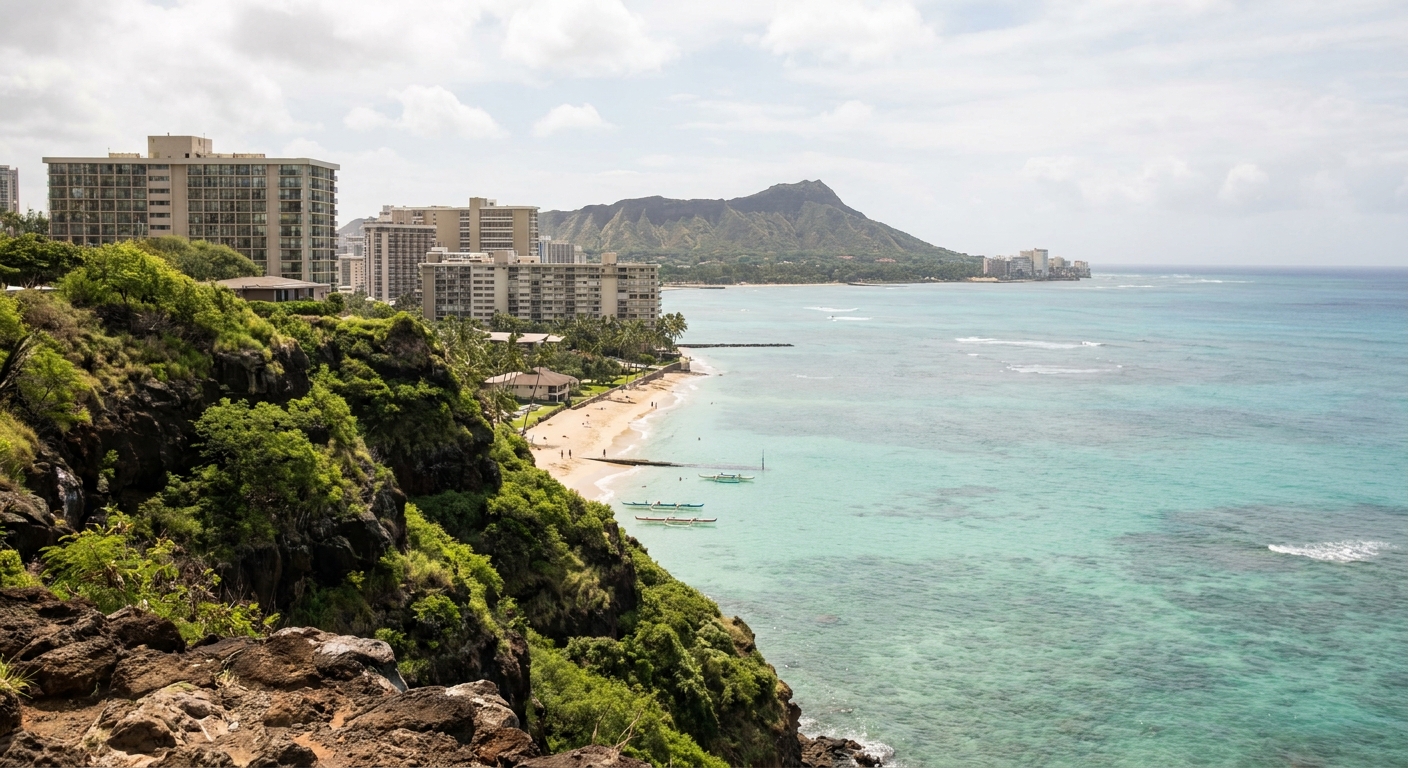
Oahu is the busiest island and the one with real city life. Waikiki puts the beach, the hotels and the restaurants within a walk of each other, and Honolulu has markets, museums and plate lunches. The volcanic crater of Diamond Head rises at the eastern end of the beach, and Pearl Harbor, a place of remembrance, lies west of town. The North Shore, with its surf towns and shrimp trucks, has a slower beat.
It suits first-time visitors, families and anyone who wants to mix a city with the sea. In winter the big swells build on north-facing shores, so the North Shore is for watching waves, while summer brings its calmer days. South shores flip the pattern. The lifeguards and beach signs decide whether to swim. Oahu is a short hop by air from the other islands.
Maui: Haleakala, Hana and the resort coast
Maui pairs two very different faces. On the dry leeward side, Kaanapali and Wailea offer long resort beaches and sunny afternoons. On the other side, the Road to Hana winds along a wet windward coast of waterfalls, banana bread stands and black sand at Waianapanapa. Above it all, the summit of Haleakala draws visitors before dawn for a sunrise above the clouds.
Maui suits couples, families and snorkelers, with boat trips toward Molokini, a crescent islet off the southwest coast. In Lahaina, rebuilding continues after the 2023 fire, and Front Street has reopened to vehicles. Give the Hana drive a full day: the road is narrow and slow, and it rewards patience more than speed.
Kauai: the green island
Kauai is quieter and more rural, known for the Na Pali Coast cliffs and Waimea Canyon. Poipu on the sunnier south shore is the place for beach days, while Princeville and Hanalei on the wetter north side sit among taro fields and mountains that seem to drip with green.
There is no road along the Na Pali Coast, so you see it on foot from Haena, from a boat or from the air. It is the island for hikers, honeymooners and people who want a slower pace. In September 2026, Hurricane Lowell passed just west of Kauai and damaged roads, trails and parks. For current state park status, check the Hawaii state parks notices page before planning.
The Big Island: volcanoes, Kona and Hilo
The Big Island is large enough to hold several climates. Hawaii Volcanoes National Park, around Kilauea, is a landscape of steam vents, crater rims and lava fields, cool and often rainy at the crater edge. The Kona coast on the west is sunny, with coffee farms on its slopes and calm mornings for snorkeling. Hilo, on the windward side, is rainy and green, with waterfalls like Akaka Falls close to town.
The summit of Mauna Kea, a sacred mountain, is a stargazing destination for prepared visitors with the right vehicle. This island suits road-trippers, hikers and anyone who likes contrasts. Distances between Kona and Hilo are long, so most visitors base themselves on one side and make a day of the other.
Lanai and Molokai: the quiet islands
Lanai and Molokai have few hotels, little traffic and no city. They draw a small share of the visitors who come to Hawaii, and that is exactly the appeal: empty roads, small towns and a sense of how the islands felt before resorts. They suit travelers who prefer solitude to sightseeing lists and who are happy to slow right down.
Things to do in Hawaii
Beaches, surf and snorkeling
The beach is the center of most vacations here, from Waikiki’s surf lessons to Kee Beach on Kauai and the coves of Maui and Kona. The sea follows the season: winter swells hit north-facing shores, summer swells reach the south. Snorkeling is best on calmer mornings, and Molokini off Maui is a protected marine area where fishing and feeding fish are prohibited and landing on the islet is not allowed.
Hanauma Bay on Oahu has its own routine: a short education video before you reach the sand, and a reservation for non-residents. Always check the lifeguard and the beach signs before getting in the water.
Volcanoes and summits
Two national parks anchor the volcano experience. Haleakala on Maui is famous for its summit sunrise, which is cold, windy and sometimes wet, so dress warmly. Hawaii Volcanoes on the Big Island is the place for crater walks and steam vents. Both are covered by the same annual tri-park pass option if you plan to visit more than once.
Diamond Head on Oahu is a shorter outing: a steep, sunny, partly stepped trail through a lighted tunnel to a summit with views over Waikiki and the south shore. Out-of-state visitors need a reservation for it.
Whales in winter
From about November through May, humpback whales fill the shallow waters around the main islands to breed and nurse their calves, with the peak usually from January through March. Tens of thousands of visitors have watched them from boats and from shore.
It is illegal to approach within 100 yards of a humpback, so a good pair of binoculars on a headland is a fine alternative. On the last Saturday of January, February and March, volunteers count whales from shore on Oahu, the Big Island and Kauai.
History, culture and food
Pearl Harbor National Memorial is a place of quiet reflection, with the USS Arizona Memorial standing over the sunken battleship. Elsewhere, heiau, historic parks and the story of the Hawaiian monarchy tell a deeper history than the beaches suggest. Do not climb on temple stones, and stay on marked paths.
Food is part of every day: poke from a market counter, plate lunches, shave ice, fresh fruit from roadside stands and coffee from Kona farms. A luau is a classic evening out, and Lei Day on May 1 brings flower garlands and music across the islands.
When to visit Hawaii
Hawaii has two seasons: a drier, hotter summer from May to October and a wetter, cooler winter from October to April. Temperatures barely move, so the question is less about warmth than about which side of an island you want. Leeward coasts such as Kona, Waikiki, Wailea and Poipu are sunny nearly every month. Windward spots such as Hilo are rainy in any season, and there it rains on most summer days too.
| Place | Jan high (°F) | Jan rain days | Aug high (°F) | Aug rain days |
|---|---|---|---|---|
| Honolulu | 80.5 | 3.3 | 88.8 | 1.2 |
| Maui | 82.2 | 4.0 | 89.9 | 1.3 |
| Kauai | 78.6 | 4.4 | 85.2 | 5.3 |
| Kona | 81.4 | 1.8 | 87.3 | 1.4 |
| Hilo | 78.7 | 9.6 | 82.9 | 18.2 |
Winter is whale season and brings big surf to north shores. Trade winds can pause for days when fronts and Kona storms pass, which means a gray, humid spell is possible even on a sunny coast. The Haleakala summit is far colder than the beach year-round.
The Central Pacific hurricane season runs from June 1 to November 30. Hawaii is rarely hit, but Hurricane Iniki struck Kauai in September 1992, and Hurricane Lowell passed just west of Kauai in September 2026. The busiest months are summer and the year-end holidays, while September is noticeably quieter.
Getting around Hawaii
Short inter-island flights link the islands, and there is no car ferry between them, so each island means its own rental car. Flights from the mainland arrive mostly at Honolulu, with direct service to the other main islands as well.
On Oahu, you can manage Waikiki and Honolulu without a car, using TheBus, which charges per boarding with a daily cap on a HOLO card. Pearl Harbor is about a 45-minute drive from Waikiki, and rideshare and taxis drop off at the visitor center.
Elsewhere a car is the norm, though the Hana Highway demands slow driving, with hundreds of curves and one-lane bridges. Pull over to let local traffic pass, and park only where it is legal. Above the visitor station on Mauna Kea you need a dependable four-wheel-drive vehicle, and there is no gas on the mountain.
Good to know before you go
Prices are in dollars, as on the mainland, and the state accommodations tax applies to hotel stays. Many popular sites need advance reservations, including Diamond Head, Hanauma Bay, the Haleakala sunrise, the USS Arizona Memorial and Waianapanapa, so plan these early. Respect the reef, keep your distance from turtles and seals, and treat sacred places with care.
| Fee | Amount | Who pays |
|---|---|---|
| State transient accommodations tax | 11% | Guests in hotels and other lodging, plus cruise fares |
| Haleakala National Park entrance | $30 per vehicle, three days | Visitors entering by private vehicle |
| Haleakala sunrise reservation | $1 per vehicle | Vehicles entering between 3 and 7 a.m. |
| Diamond Head entry and parking | $5 per person, $10 per vehicle | Non-residents |
Sources
- NWS Honolulu (HFO), « Climate of Hawaii » summary, weather.gov/hfo/climate_summary, checked September 24, 2026
- NWS Honolulu / Central Pacific Hurricane Center, « 2026 Central Pacific Hurricane Season Outlook », weather.gov/hfo/hurricaneOutlook2026, checked September 24, 2026
- NOAA/NWS, Natural Disaster Survey Report « Hurricane Iniki, September 6-13, 1992 », April 1993, weather.gov/media/publications/assessments/iniki1.pdf, checked September 24, 2026
- NOAA/NWS, Natural Disaster Survey Report « Hurricane Iniki », April 1993, Finding 1.1 and Executive Summary, checked September 24, 2026
- Hawaiian Islands Humpback Whale National Marine Sanctuary (NOAA), pages « Boating Guide » and « About the Sanctuary », hawaiihumpbackwhale.noaa.gov, checked September 24, 2026
- NOAA National Ocean Service, « Hawaiian Islands Humpback Whale National Marine Sanctuary », oceanservice.noaa.gov, checked September 24, 2026
- Hawaiian Islands Humpback Whale NMS (NOAA), « Boating Guide », checked September 24, 2026
- Hawaiian Islands Humpback Whale NMS (NOAA), « About the Sanctuary », checked September 24, 2026
- Hawaiian Islands Humpback Whale NMS (NOAA), « Sanctuary Ocean Count », checked September 24, 2026
- National Park Service, state « Hawaii », nps.gov/state/hi, checked September 24, 2026
- National Park Service, nps.gov/state/hi, checked September 24, 2026
- National Park Service, Haleakala « Fees & Passes », nps.gov/hale/planyourvisit/fees.htm, checked September 24, 2026
- National Park Service, Hawaii Volcanoes « Fees & Passes », nps.gov/havo/planyourvisit/fees.htm, checked September 24, 2026
- National Park Service, Pearl Harbor « Fees & Passes », nps.gov/perl/planyourvisit/fees.htm, checked September 24, 2026
- Hawaii DLNR Division of State Parks, « Diamond Head State Monument », dlnr.hawaii.gov/dsp, checked September 24, 2026
- Hawaii Department of Taxation, Announcement No. 2025-03 (June 9, 2025), files.hawaii.gov/tax/news/announce/ann25-03.pdf, checked September 24, 2026
- DBEDT (Hawaii Department of Business, Economic Development & Tourism), press release « Visitor Spending Increased in December 2025 », dbedt.hawaii.gov/blog/26-04, checked September 24, 2026
- DBEDT, press release December 2025, dbedt.hawaii.gov/blog/26-04, checked September 24, 2026
- DBEDT, press releases monthly July (blog/25-34), September (blog/25-42) and December 2025 (blog/26-04), checked September 24, 2026
- NOAA NCEI, monthly normals 1991-2020, station USW00022521, checked September 8, 2026
- NOAA NCEI, monthly normals 1991-2020, station USW00022516, checked September 8, 2026
- NOAA NCEI, monthly normals 1991-2020, station USW00022536, checked September 8, 2026
- NOAA NCEI, monthly normals 1991-2020, station USW00021510, checked September 8, 2026
- NOAA NCEI, monthly normals 1991-2020, station USW00021504, checked September 8, 2026
- NOAA NCEI, monthly normals 1991-2020, station USC00511004, checked September 8, 2026
- City and County of Honolulu, DPR, honolulu.gov/dpr/hanauma-bay-nature-preserve, checked September 25, 2026
- Hawaii DLNR Division of State Parks ; gostateparks.hawaii.gov/diamondhead, checked September 25, 2026
- National Park Service, nps.gov/perl, checked September 25, 2026
- TheBus, thebus.org/Fare/TheBusFares20240701.asp, checked September 25, 2026
- National Park Service, nps.gov/hale/planyourvisit/sunrise.htm and fees.htm, checked September 25, 2026
- Hawaii DLNR Division of State Parks ; gostateparks.hawaii.gov/waianapanapa, checked September 25, 2026
- Hawaii DLNR Division of Aquatic Resources, checked September 25, 2026
- Hawaii DOT, Final EA Hana Highway Bridge Improvements (Sept. 2024), checked September 25, 2026
- County of Maui, notice of July 17, 2026, checked September 25, 2026
- Hawaii DLNR Division of State Parks, haena-state-park, checked September 25, 2026
- DLNR news release Sept. 16, 2026 ; DLNR State Parks announcements (9/23/26), checked September 25, 2026
- Center for Maunakea Stewardship, hilo.hawaii.edu/maunakea, checked September 25, 2026
- Hawaii DLNR Division of State Parks, akaka-falls-state-park, checked September 25, 2026
- National Park Service, « USS Arizona Memorial Programs », nps.gov/perl/uss-arizona-memorial-programs.htm (last updated May 7, 2026), checked September 25, 2026
- National Park Service news release « Advanced Reservations for USS Arizona Memorial Boat Tours Resume Nov. 1 », nps.gov/perl/learn/news, checked September 25, 2026
- Hawaii DLNR Division of State Parks, dlnr.hawaii.gov/dsp/parks/oahu/diamond-head-state-monument, checked September 25, 2026
- gostateparks.hawaii.gov/diamondhead/faq ; DLNR news release NR22-055, April 25, 2022, checked September 25, 2026
- gostateparks.hawaii.gov/diamondhead/about, checked September 25, 2026
- gostateparks.hawaii.gov/diamondhead/faq and /about, checked September 25, 2026
- City and County of Honolulu, DPR news release, June 29, 2021, checked September 25, 2026
- City and County of Honolulu, DPR news release « New concession aims to improve access to Hanauma Bay », October 30, 2025, checked September 25, 2026
- National Park Service, sunrise reservations FAQ, nps.gov/hale/planyourvisit/haleakala-sunrise-reservations-faq.htm, checked September 25, 2026
- National Park Service, nps.gov/hale/planyourvisit/fees.htm, checked September 25, 2026
- NOAA NCEI, normals 1991-2020, station USC00511004, checked September 25, 2026
- sunrise-sunset.org (UTC converted to HST, UTC-10), checked September 25, 2026
- DLNR news release, September 16, 2026, via governor.hawaii.gov/newsroom, checked September 25, 2026
- DLNR Division of State Parks, announcements (9/23/26), dlnr.hawaii.gov/dsp/announcements, checked September 25, 2026
- Go Haena, park conditions, gohaena.com/conditions (notice of 9/9/26), checked September 25, 2026
- Hawaii DLNR Division of State Parks, dlnr.hawaii.gov/dsp/parks/kauai/haena-state-park, checked September 25, 2026
- Hawaii DOT, Final Environmental Assessment « Hana Highway Bridge Improvements Project » (Sept. 2024), files.hawaii.gov/dbedt/erp, checked September 25, 2026
- Hawaii DLNR Division of State Parks, dlnr.hawaii.gov/dsp/parks/maui/waianapanapa-state-park, checked September 25, 2026
- gostateparks.hawaii.gov/waianapanapa/about, checked September 25, 2026
- Hawaii DLNR Division of State Parks, waianapanapa-state-park, checked September 25, 2026
- National Park Service, nps.gov/hale/planyourvisit/kipahulu.htm, checked September 25, 2026
- villes.json (hawaii/hana, portee_climat) ; NOAA NCEI station USC00511125
- Center for Maunakea Stewardship, « Visiting Maunakea Safely and Responsibly », hilo.hawaii.edu/maunakea/visitor-information/public-safety, checked September 25, 2026
- Center for Maunakea Stewardship, public-safety and « Important Things to Know », checked September 25, 2026
- Center for Maunakea Stewardship, public-safety and visitor information pages, checked September 25, 2026
- Center for Maunakea Stewardship, « Important Things to Know », checked September 25, 2026
- Center for Maunakea Stewardship, visitor information, checked September 25, 2026
- Center for Maunakea Stewardship, « Geology and Climate », hilo.hawaii.edu/maunakea/environment/geology-climate, checked September 25, 2026
All our pages
When to go
- Best Time to Visit Hawaii: Seasons, Weather by Island, Whales and Crowds
- Hawaii in January: Humpback Whales, Island-by-Island Weather and What to Do
- Hawaii in February: Humpback Whales, Weather by Island and Where to Go
- Hawaii in March: Weather by Island, Humpback Whales and What to Do
- Hawaii in April: Weather by Island, Whales, Merrie Monarch and Where to Go
- Hawaii in May: Weather by Island, Lei Day, Whales and What to Do
- Hawaii in June: Island Weather, Kamehameha Day and Where to Go
- Hawaii in July: Island Weather, Summer Surf, Festivals and Where to Go
- Hawaii in August: Weather by Island, Summer Surf, Crowds and What to Do
- Hawaii in September: Weather by Island, Where to Go and What to Do
- Hawaii in October: Weather by Island, Ironman Week in Kona and What to Do
- Hawaii in November: Weather by Island, Early Whales, Surf and Where to Go
- Hawaii in December: Weather, Whales, Winter Surf and Where to Go
- Hawaii Hurricane Season: Dates, Odds, the 2026 Outlook and What to Do if a Storm Threatens
- Hawaii Whale Watching Season: When to Go, Best Islands, Shore Viewing and How Close You Can Get
Things to do
- Things to Do in Hawaii: Volcano Sunrises, Snorkeling Bays, Pearl Harbor and What to Eat
- 10 Days in Hawaii: Itinerary for Oahu, Maui and Kauai with Diamond Head, Haleakala Sunrise and Na Pali
- 2 Weeks in Hawaii: Itinerary Across Oahu, Maui, the Big Island and Kauai
- 7 Days in Hawaii: Itinerary Across Oahu, Maui and the Big Island
- Akaka Falls State Park: Rainforest Loop, 442-Foot Waterfall, Hours and Fees
- Hawaii Food and Drink: Poke, Plate Lunch, Shave Ice, Spam Musubi and Kona Coffee
- Hawaii Honeymoon: Best Island, Getting Married, Haleakala Sunrise and Budget
- Manoa Falls Trail: Rainforest Walk, Getting There and When to Go
- Molokini Crater: Snorkeling the Crescent, Marine Life Rules and When to Go
- Hawaii National Parks: Haleakala and Volcanoes Fees, Sunrise Reservations and Pearl Harbor
- Oahu Travel Guide: Waikiki, the North Shore, Pearl Harbor and Where to Stay
- Renting a Car in Hawaii: Which Islands Need One, Rental Tax, Car Seats and Mountain Drives
- Hawaii with Kids: Car Seats, Ocean Safety, TheBus and Family Days Out
Where to stay
Getting there
- Getting Around Hawaii: Interisland Flights, TheBus and Skyline, Rental Cars and Taxi Fares
- Hawaii Airport Transfers: Honolulu to Waikiki, TheBus, Skyline and Taxis from Maui, Kona and Kauai
- Flights to Hawaii: Airports, West and East Coast Routes, and Landing Day
- What to Pack for Hawaii: Reef-Safe Sunscreen, Haleakala Layers, Rain Gear and Luggage Rules
- Which Hawaiian Island to Visit: First Trip, Weather, Volcanoes and Crowds
Practical
- Know Before You Go to Hawaii: Agriculture Form, Sunscreen Law, Reservations and Taxes
- Is Hawaii Safe? Ocean Safety, Winter Surf, Driving and Haleakala Cold
- Hawaii Trip Cost: Daily Spending, Hotel Taxes, Rental Cars and Park Fees
Places
- Honolulu Travel Guide: Waikiki, Diamond Head, Pearl Harbor and the Windward Coast
- Maui Travel Guide: Haleakala Sunrise, the Road to Hana, Beaches and When to Go
- Kauai Travel Guide: Napali Coast, Waimea Canyon, Hanalei and When to Go
- Haleakala Travel Guide: Sunrise Reservations, Summit Crater, Kipahulu and When to Go
- Hawaii Volcanoes National Park Travel Guide: Kilauea Glow, Lava Tubes, Crater Hikes and Where to Stay
- Hilo Travel Guide: Rainbow Falls, Volcanoes Day Trips, Maunakea and Rain
- Kona Travel Guide: Beaches, Coffee Farms, Kealakekua Bay and Where to Stay
- Waikiki Travel Guide: Surf Lessons, Diamond Head, Where to Stay and When to Go
- Hana Travel Guide: Black Sand Beaches, the Road to Hana and Kipahulu
- Kaanapali Travel Guide: Black Rock, Beachfront Resorts, Whale Season and When to Go
- Kailua Travel Guide: Beaches, Kayaking to the Mokulua Islets, Windward Gardens and When to Go
- Ko Olina Travel Guide: Lagoons, Leeward Sunshine, Whales and Where to Stay
- Lanai Travel Guide: Pine-Scented Highlands, Hulopoe Bay, the Ferry from Maui and When to Go
- Molokai Travel Guide: Kalaupapa, Palaau State Park, Weather and Getting Around
- The North Shore Travel Guide: Big-Wave Surf, Haleiwa, Turtles and Garlic Shrimp
- Princeville Travel Guide: Hanalei Bay Views, North Shore Beaches, Haena and Where to Stay
- Punaluu Travel Guide: Black Sand, Sea Turtles and the Road to Volcanoes
- Waikoloa Travel Guide: Kohala Coast Beaches, Petroglyphs, Maunakea Stargazing and When to Go
- Wailea Travel Guide: Beaches, Golf, Snorkeling at Molokini and the Best Months to Visit
- Waimea Canyon Travel Guide: Kokee Lookouts, Rim Trails, Weather and Getting There
- The Big Island Travel Guide: Volcanoes, Kona Coast, Maunakea and Hilo Waterfalls
- Pearl Harbor: USS Arizona Memorial, Visitor Center, Tickets and Getting There
- Diamond Head Hike: Crater Trail, Summit Views, Reservations and Best Times
- Hanauma Bay: Snorkeling the Reef, Reservations, Hours and Getting There
- Visiting Lahaina: Front Street, the Harbor, Royal History and Respectful Travel
- Mauna Kea Summit: Sunset Above the Clouds, Stargazing, Sacred Lake Waiau and Getting Up the Mountain
- Na Pali Coast: Haena State Park, the Kalalau Trail and Seeing the Cliffs by Land, Sea or Air
- Poipu Travel Guide: Beaches, Monk Seals, Spouting Horn and When to Go
- Road to Hana: Waterfalls, Black Sand at Waianapanapa and the Drive to Kipahulu