
Early in the morning in Hilo, mist drifts off the Wailuku River, farmers set out their tables of papayas and orchids downtown, and a rainbow often hangs in the spray of the falls just up the hill. This is the wet, green, unhurried side of the Big Island, an old town facing Hilo Bay with a volcano at its back door. It suits travelers who like waterfalls, markets and a real working town more than resort pools.
Where is Hilo and what is it like?
Hilo sits on the east, windward coast of the Big Island, curled around a wide bay with Mauna Kea and Mauna Loa rising behind it and Hawaii Volcanoes National Park to the southwest. It is the island’s main town on this side, a place of older wooden storefronts, rain gardens and a harbor that has seen more than one tsunami.
The pace is slow and the mood is local. There are no resort strips here, and the beaches are mostly rocky or black sand, so the draw is waterfalls, tropical gardens and the volcano. Rain is part of the deal, which is exactly why everything is so lush. Travelers who want guaranteed sun and a long sandy beach will be happier on the Kona side.
The tsunami of May 22, 1960 hit Hilo hard, and the town rebuilt its bayfront afterward. You still feel that history in the open green spaces along the water.
What is there to do in Hilo?
Waterfalls close to town
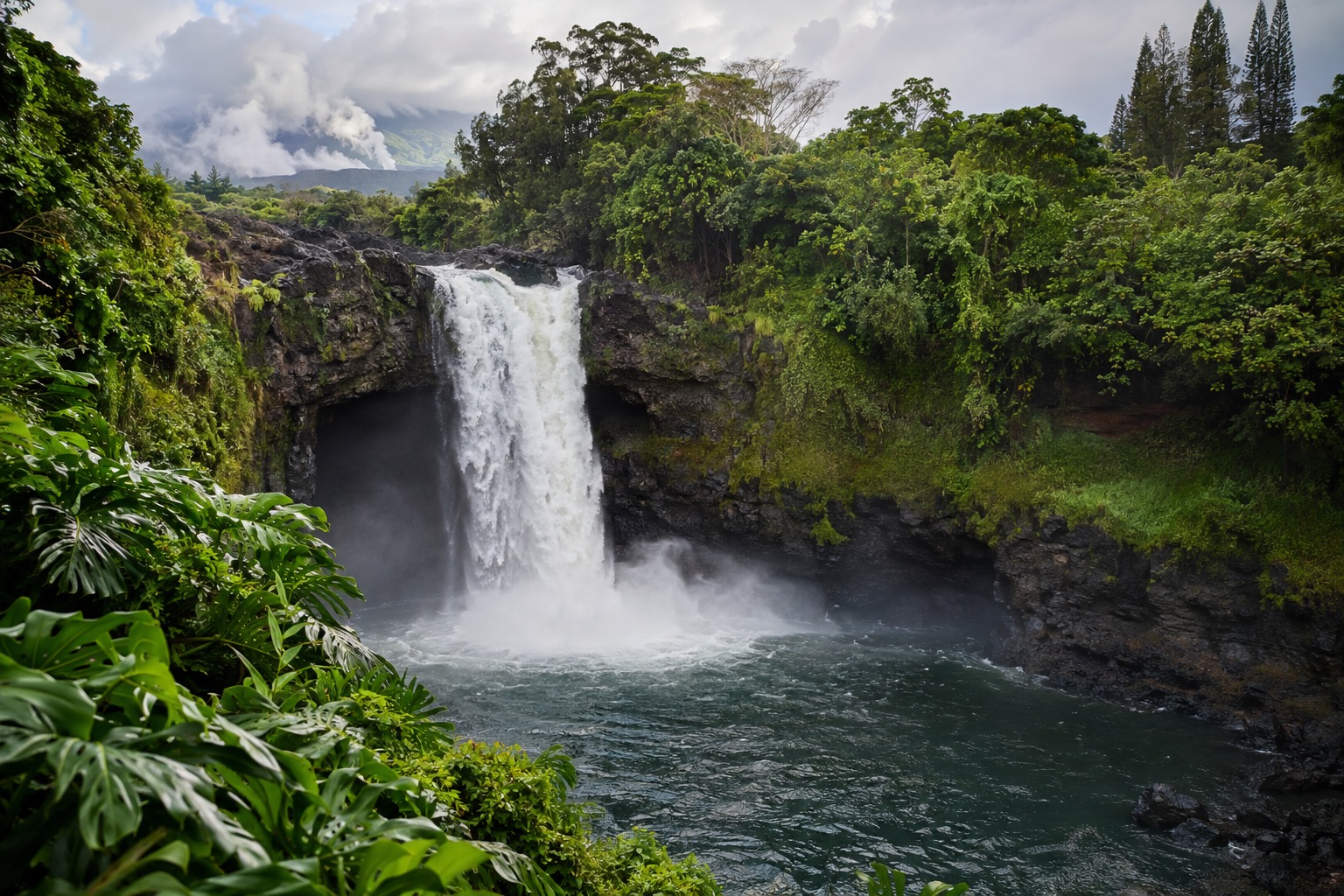
Rainbow Falls drops 80 feet into a pool just minutes from downtown, in Wailuku River State Park. Mornings are the time to go, because the sun catches the mist and often draws a rainbow. The nearby Boiling Pots are a short stop on the same visit, a series of churning basins in the river.
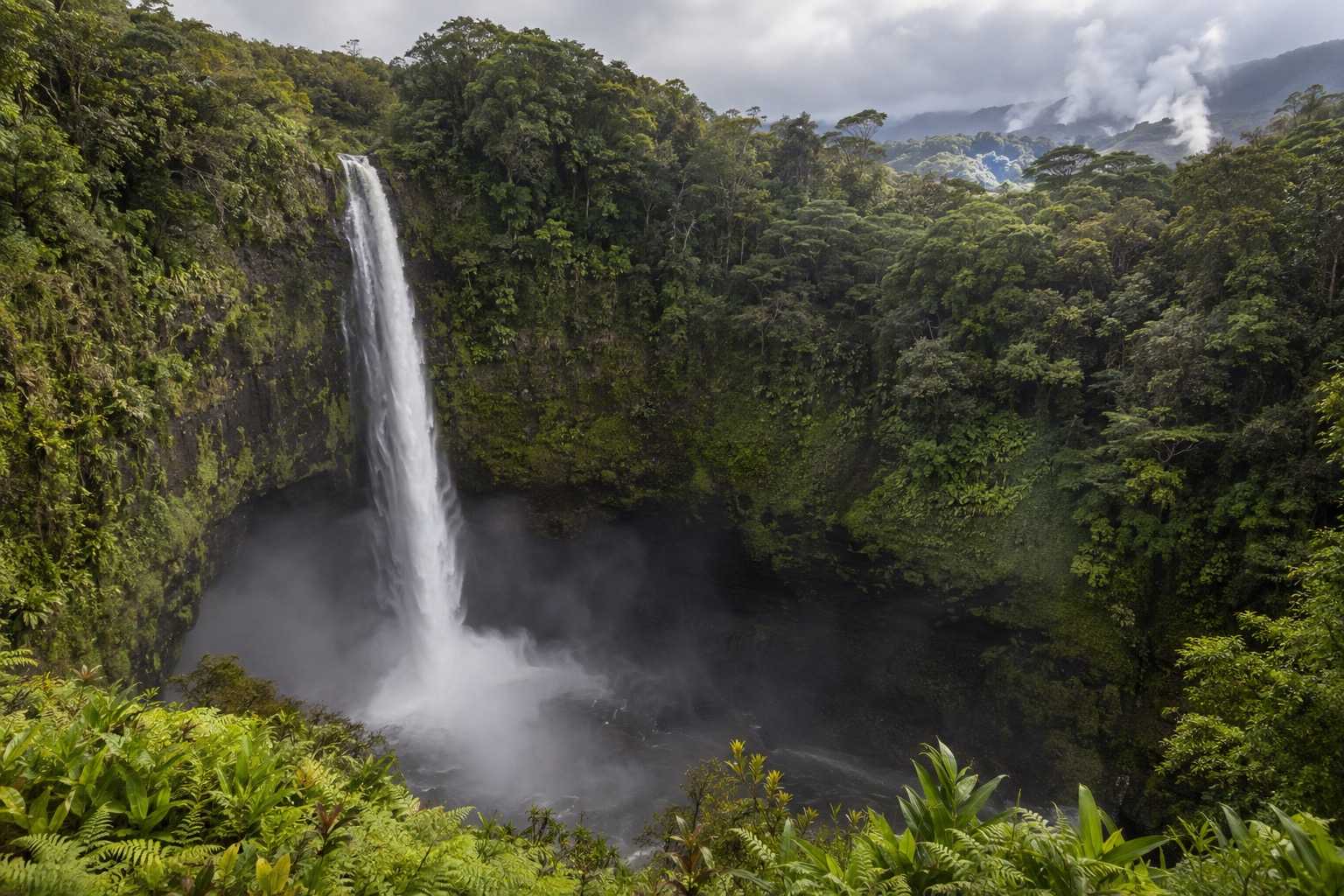
Farther up the coast, Akaka Falls plunges 442 feet into a gorge, reached by a short loop walk through bamboo, ferns and wild ginger. It is an easy outing for most visitors and pairs well with a slow drive along the Hamakua coast. Both parks charge out-of-state visitors.
| Site | Entry (per person) | Parking (per vehicle) |
|---|---|---|
| Rainbow Falls and Boiling Pots (Wailuku River State Park) | $5.00 | $10.00 |
| Akaka Falls State Park | $5.00 | $10.00 |
Hawaii Volcanoes National Park
The park is a 30-mile drive southwest on Highway 11 from town, about 45 minutes, which makes Hilo the closest big base for it. You come for the crater rim of Kilauea, steam vents, lava tube walks and the odd landscapes of a volcano that keeps reshaping the island.
The park sits high and is cooler and rainier than the coast, so bring a layer. A vehicle pass costs $30 and covers the passholder plus up to 14 passengers. Give it a full day if you can, and plan to stay for the glow after dark when conditions allow.
Maunakea and the Saddle Road
The Daniel K. Inouye Highway, the Saddle Road, starts on the outskirts of Hilo and climbs nearly 5,500 feet through the gap between Mauna Loa and Mauna Kea. It is a well-improved road and a scenic drive in itself, with lava fields and cloud giving way to open sky.
The Visitor Information Station sits at 9,200 feet and is open daily from 9:00 a.m. to 9:00 p.m. Stopping there for at least half an hour helps your body adjust and gives you a current weather report. Beyond it, four-wheel drive is required, since two-wheel-drive vehicles are not permitted. The summit reaches 13,796 feet, so it is cold and the air is thin.
Culture, markets and a planetarium
Downtown Hilo is best on foot, with farmers’ stalls, old storefronts and cafés within a few blocks of the bay. Plan a morning for the market stalls, where you find tropical fruit, flowers and local crafts, then wander the bayfront gardens, where the park paths run along the water and the views reach toward Mauna Kea on clear days.
On a rainy afternoon, Imiloa Astronomy Center is a good indoor stop. It is part of the University of Hawaii at Hilo, with exhibits and a planetarium that tie Hawaiian navigation to modern astronomy. It is open Tuesday through Sunday from 9:00 a.m. to 4:30 p.m. and closed Mondays, so plan around that. It suits families and anyone curious about the mountain they have been looking at.
How many days do you need in Hilo?
Three days is a comfortable stay, and a long weekend covers the essentials. One day goes to downtown, the market and the falls near town, another to the volcano, and a third to the Hamakua coast and Akaka Falls.
With a week, you can add a Maunakea evening, slower mornings at the gardens, and a day crossing the island on the Saddle Road toward the Kona side. Keep a rainy day free, since the weather here sets the rhythm more than any schedule.
Where to stay in Hilo
Most visitors stay along the bayfront and in the downtown area, where small hotels and inns put you within walking distance of cafés, the market and the waterfront. It suits those who like a town atmosphere over a resort.
Another option is to stay near Volcanoes National Park, which cuts the early drive and gives you the cool, misty highlands. Whichever you choose, lodging carries state and county accommodation taxes that are added to the rate.
How do you get to Hilo and get around?
Hilo International Airport (ITO) is the gateway, a small-hub airport that handles inter-island and mainland connections. From Kailua-Kona, the drive across to the park side runs roughly 2 to 3 hours depending on the route, either along the south or through Waimea.
Downtown is walkable, but the falls, the volcano and the Hamakua coast all call for a car. A rental car is the practical way to reach the sights outside town, and Highway 11 and the Saddle Road are the main roads out.
When is the best time to visit Hilo?
Hilo is warm all year, with afternoon highs between the high 70s and low 80s, and rain falls in every month. January and February are the least rainy, with about ten or eleven rain days, though they sit in the cooler, wetter season of the islands. May and June bring warmer days and a bit more sun overall.
July, August and October are the warmest, with highs in the low 80s, but rain days still run high, and rain here usually comes as passing showers that clear for sunny stretches. The wettest feel comes in spring and fall, with more than half the days showing some rain.
The Merrie Monarch hula festival fills the town the week after Easter, so book early for that stretch. The Central Pacific hurricane season runs from June 1 to November 30.
Good to know before you go
Bring a rain jacket in any month, and a warm layer for the volcano and Maunakea. Hilo’s history with tsunamis means paying attention to local warning signs and sirens. Hotel stays carry the state and county accommodation taxes, which the table lays out.
| Tax | Rate | Who pays |
|---|---|---|
| State Transient Accommodations Tax | 11.00% | Guests staying in lodging |
| County of Hawaii Transient Accommodations Tax | 3% | Guests staying in lodging |
| General Excise Tax pass-on (County of Hawaii) | Up to 4.7120% | Customers of businesses that pass it on |
Sources
- Hawaii Department of Taxation, Tax Announcement No. 2025-03 (Transient Accommodations Tax Law Changes from 2025 Legislative Session), files.hawaii.gov/tax/news/announce/ann25-03.pdf, checked September 24, 2026
- County of Hawaii, Department of Finance, Transient Accommodations Tax (TAT) page, hawaiicounty.gov/departments/finance/transient-accommodations-tax-tat (live returned HTTP 403 on request, read via Internet Archive Wayback Machine snapshot dated August 14, 2026, same official content), checked September 25, 2026
- Hawaii Department of Taxation, County Surcharge on General Excise and Use Tax page, tax.hawaii.gov/geninfo/countysurcharge/, checked September 25, 2026
- Federal Aviation Administration, CY2024 Commercial Service Enplanements (xlsx), faa.gov/airports/planning_capacity/passenger_allcargo_stats/passenger/arp-cy2024-commercial-service-enplanements.xlsx, checked September 24, 2026
- Hawaiʻi Department of Land and Natural Resources, Division of State Parks, "Wailuku River State Park", dlnr.hawaii.gov/dsp/parks/hawaii/wailuku-river-state-park/, read September 25, 2026
- Hawaiʻi Department of Land and Natural Resources, Division of State Parks, "ʻAkaka Falls State Park", dlnr.hawaii.gov/dsp/parks/hawaii/akaka-falls-state-park/, read September 25, 2026
- University of Hawaiʻi at Hilo, Center for Maunakea Stewardship, "Important Things to Know", hilo.hawaii.edu/maunakea/visitor-information/important-things-to-know, read September 25, 2026
- University of Hawaiʻi at Hilo, Center for Maunakea Stewardship, "Maunakea Visitor Information Station", hilo.hawaii.edu/maunakea/visitor-information/station, read September 25, 2026
- National Park Service, "Fees & Passes", nps.gov/havo/planyourvisit/fees.htm, read September 25, 2026
- Imiloa Astronomy Center, University of Hawaii at Hilo, About Imiloa, https://imiloahawaii.org/aboutimiloa, checked September 25, 2026
- Imiloa Astronomy Center, University of Hawaii at Hilo, homepage, https://imiloahawaii.org/, checked September 25, 2026
- NOAA National Centers for Environmental Information, Recent/Significant Tsunami Events, https://www.ncei.noaa.gov/products/natural-hazards/tsunamis-earthquakes-volcanoes/tsunamis/recent-significant-events, checked September 25, 2026
- National Weather Service, International Tsunami Information Center, Hawaii Tsunamis, https://weather.gov/itic-car/hawaii_tsunamis, checked September 25, 2026
- USGS, November 27-December 10, 2022 Eruption of Mauna Loa, https://www.usgs.gov/volcanoes/mauna-loa/science/november-27-december-10-2022-eruption-mauna-loa, checked September 25, 2026
- NPS, Directions, https://www.nps.gov/havo/planyourvisit/directions.htm, checked September 25, 2026
- Hawaii Department of Transportation, New phase of Daniel K. Inouye Highway opens Oct. 10 2017, https://hidot.hawaii.gov/highways/new-phase-of-daniel-k-inouye-highway-opens-oct-10-2017/, checked September 25, 2026
- NOAA NCEI, monthly normals 1991-2020, station USW00021504
- NOAA NCEI, monthly normals 1991-2020, station USW00021510
- NOAA NCEI, monthly normals 1991-2020, station USC00511303
- NWS Honolulu / Central Pacific Hurricane Center, « 2026 Central Pacific Hurricane Season Outlook », weather.gov/hfo/hurricaneOutlook2026, checked September 24, 2026
All our pages
When to go
- Best Time to Visit Hilo: Weather by Month, Crowds, Swimming and Festivals
- Hilo in January: Weather, Sea Conditions, Rainforest Outings and a Two-Day Plan
- Hilo in February: Weather, Rain, Waterfalls and What to Do
- Hilo in March: Rain, Waterfalls, Merrie Monarch Season and What to Do
- Hilo in April: Weather, Swimming, Things to Do and a Two-Day Plan
- Hilo in May: Weather, Waterfalls, Farmers Markets and What to Do
- Hilo in June: Rainy-Side Weather, Waterfalls, Farmers Markets and Two Days of Plans
- Hilo in July: Weather, Swimming, Waterfalls and a Two-Day Plan
- Hilo in August: Weather, Swimming, Things to Do and a Two-Day Plan
- Hilo in September: Weather, Rain, Swimming and What to Do
- Hilo in October: Weather, Rainforest Waterfalls and What to Do
- Hilo in November: Weather, Rain, Swimming and What to Do
- Hilo in December: Weather, Rain, Sea and What to Do