
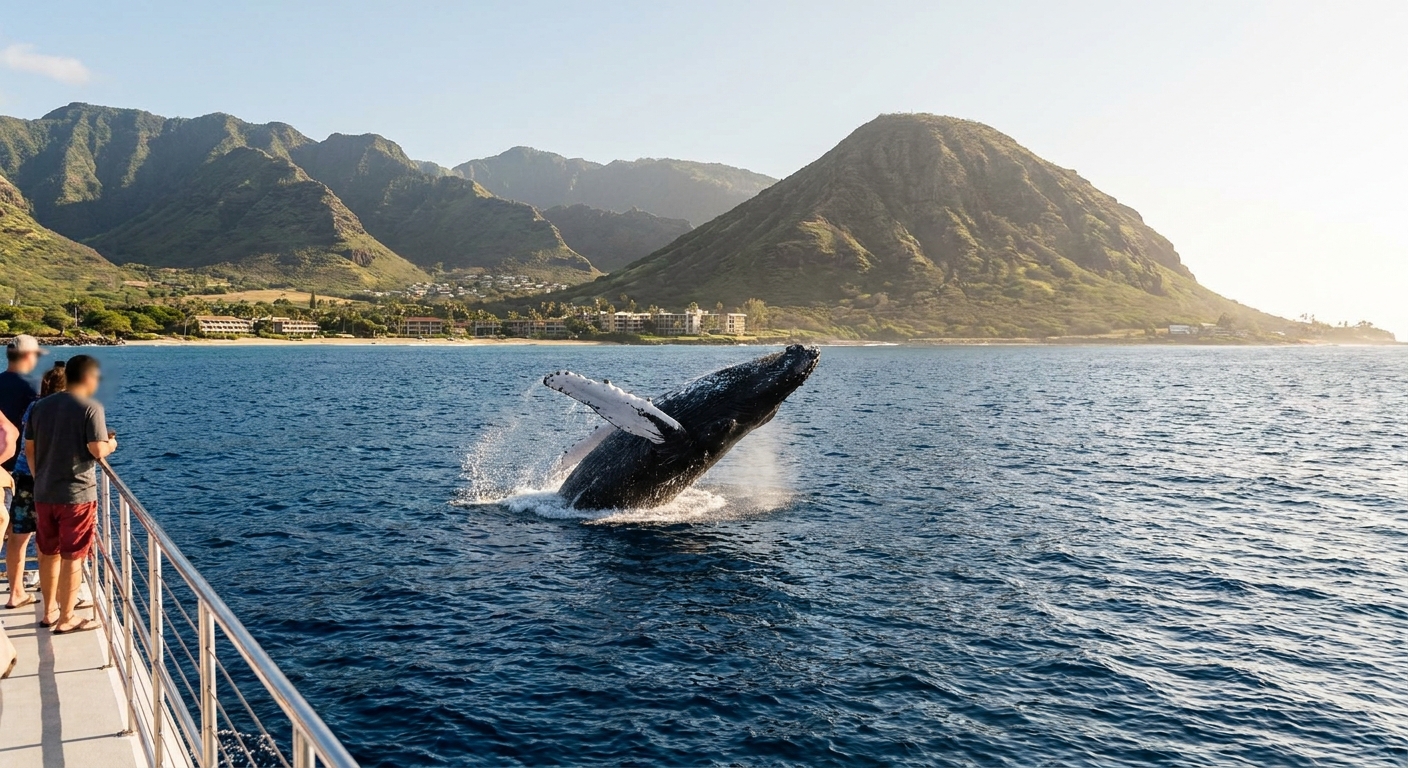
A humpback breaches off the coast of Maui, rising almost fully out of the water before it crashes back in a burst of white, and every head on the lanai turns at once. Between the late-autumn arrival of the first whales and the last lingering mothers with calves in spring, the waters around the main islands become a nursery. Here is when the whales arrive in Hawaii, which island and month suit you, and how close you may go.
When is whale season in Hawaii?
Humpback whales are in Hawaiian waters from November through May, and the first sightings often come while the beaches still feel like autumn. The sanctuary itself describes the season as November through April, so the edges are soft: early and late visitors may see a lone whale, while the middle of winter brings the crowds of animals.
They come to breed, give birth and nurse their young, and this is why so many are here. Up to 12,000 humpbacks, more than half of the North Pacific population, spend the winter and spring in these warm shallows after feeding in colder northern waters.
Arriving in October, as the calendar turns, you are a little early. The season picks up through November and December, so a trip around the winter holidays already has a fair chance of a spout on the horizon.
What is the best month for whale watching in Hawaii?
The best months are January through March, when the whales are most abundant. Sightings in those weeks are frequent enough that a quiet look at the sea from a restaurant table can turn into a show.
Midwinter, when the water is busiest
In January and February, competitive groups of males chase a female, mothers teach newborns to surface, and tail slaps carry across the bay. Boats see breaches, pectoral fin waves and the long dives where a tail rises before a whale sinks out of sight.
This is also the time of big surf on north-facing shores, so the calmer south and west coasts are where most people stay on the water. The weather is mild, though it is the prime time of year for visitors, so plan boat trips and rooms ahead.
The edges of the season
November and December bring the first arrivals, and April and May bring the stragglers, often mothers with calves that stay close to shore until they are strong enough for the long swim north. You see fewer whales, but you also share the water with fewer boats. If you want a quieter trip and are happy with a few good sightings rather than a dozen, the shoulders of the season are a gentle alternative.
Where is the best whale watching in Hawaii?
Maui is the island most people name first, though whales are found around every main island. Humpbacks gather in waters less than 600 feet deep, and the sanctuary protects the waters around Penguin Bank, the Maui Nui region (Maui, Lanai, Molokai and Kahoolawe), Kauai and Niihau, Hawaii Island and Oahu.
Maui and the Maui Nui waters
The shallow, sheltered channels between Maui, Lanai and Molokai are a favorite whale nursery. From the resort beaches of Kaanapali and Wailea on the dry side, whales often appear close enough to follow from a beach chair or a seaside lanai.
Boats leave from the west and south shores, and the sea off Maui in January is about 77.6°F. Maui suits families, couples and anyone who wants whales as a backdrop to a beach vacation.
Oahu, Kauai and the Big Island
Oahu offers whale watching close to the city, with boats leaving from the south and west coasts and sightings from the southeast shoreline. It is the busiest island, so it is easy to combine whales with Honolulu, Waikiki and Diamond Head.
Kauai is greener and quieter, with whales spotted from the cliffs of the south shore near Poipu and from the Na Pali coast by boat. On the Big Island, the sunny Kona coast has the calmest conditions and a good number of sightings, while rainy Hilo sees much less of the sunshine that makes spotting easy.
Can you see whales from shore in Hawaii?
Yes, and it is one of the pleasures of a Hawaii winter: whales are often visible from beaches, lookouts, lighthouses and hotel balconies. You look for a puff of mist, a dark back, then a tail or a splash, usually within a short distance of land because the animals favor shallow water.
Early morning is a good moment, when the sea is flatter and the glare is low. Polarized sunglasses and a pair of binoculars make a big difference, and a cliff or high vantage point shows the most.
On Oahu, Hawaii Island and Kauai, volunteers do precisely this through the Sanctuary Ocean Count on the last Saturday in January, February and March, between 8:00 a.m. and 12:15 p.m. Locals and visitors join to count whales from land, with sign-up through oceancount.org.
How close can you get to whales in Hawaii?
The law says you must stay 100 yards away from a humpback whale. That applies to boats, swimmers and kayakers, and it is meant to give mothers and calves room to rest.
Boat captains follow the guidance of NOAA: a top speed of 15 knots while transiting in whale season, and 6 knots within 400 yards of a whale. Sometimes a curious whale comes to the boat on its own, and that is the moment passengers talk about for years.
For a closer look, a good camera with a long lens will do more than any approach. Tour operators with experienced naturalists help you read the animals’ behavior and keep your distance without losing the view.
Hawaii weather during whale season
Winter is the wetter, cooler half of the year, yet it stays warm enough for the beach. Honolulu in January reaches the low 80s by day, with only a few showery days, and the sea off the city is in the upper 70s.
The side of the island matters. Dry coasts such as Kona, Wailea and Kaanapali get little rain and plenty of sun, while Hilo on the windward side sees showers on many days in January and March. Kauai is greener and has a wetter March than the other dry-side spots.
Winter also builds big surf on north shores like Oahu’s North Shore, and the calmer water moves to south and west-facing beaches. Before getting in the water, residents read the posted advisories that come with that day’s surf and currents, and they only swim beside a lifeguard where one is stationed, and remember that boats frequently depart from an island’s calmer side.
Good to know before you go
Winter is a popular time, and the year-end holidays fill rooms and boats on every island, so reserve early. The hurricane season runs from June 1 to November 30, so those who arrive in November overlap with its final weeks, while the core whale months of January to March fall outside it.
Sources
- Hawaiian Islands Humpback Whale National Marine Sanctuary (NOAA), pages « Boating Guide » and « About the Sanctuary », hawaiihumpbackwhale.noaa.gov, checked September 24, 2026
- NOAA National Ocean Service, « Hawaiian Islands Humpback Whale National Marine Sanctuary », oceanservice.noaa.gov, checked September 24, 2026
- Hawaiian Islands Humpback Whale NMS (NOAA), « Boating Guide », checked September 24, 2026
- Hawaiian Islands Humpback Whale NMS (NOAA), « About the Sanctuary », checked September 24, 2026
- Hawaiian Islands Humpback Whale NMS (NOAA), « Sanctuary Ocean Count », checked September 24, 2026
- DBEDT (Hawaii Department of Business, Economic Development & Tourism), press release « Visitor Spending Increased in December 2025 », dbedt.hawaii.gov/blog/26-04, checked September 24, 2026
- DBEDT, press release December 2025, dbedt.hawaii.gov/blog/26-04, checked September 24, 2026
- DBEDT, press releases monthly July (blog/25-34), September (blog/25-42) and December 2025 (blog/26-04), checked September 24, 2026
- NOAA NCEI, monthly normals 1991-2020, station USW00022521, checked September 8, 2026
- NOAA NCEI, monthly normals 1991-2020, station USW00022516, checked September 8, 2026
- NOAA NCEI, monthly normals 1991-2020, station USW00022536, checked September 8, 2026
- NOAA NCEI, monthly normals 1991-2020, station USW00021510, checked September 8, 2026
- NOAA NCEI, monthly normals 1991-2020, station USW00021504, checked September 8, 2026
- Open-Meteo Marine API, average 2015-2024, checked September 8, 2026
- NWS Honolulu / Central Pacific Hurricane Center, « 2026 Central Pacific Hurricane Season Outlook », weather.gov/hfo/hurricaneOutlook2026, checked September 24, 2026
To plan your stay
- Things to Do in Hawaii: Volcano Sunrises, Snorkeling Bays, Pearl Harbor and What to Eat
- Where to Stay in Hawaii: Choosing an Island, Oahu to Kauai Bases and the Hotel Tax
- Getting Around Hawaii: Interisland Flights, TheBus and Skyline, Rental Cars and Taxi Fares
- Know Before You Go to Hawaii: Agriculture Form, Sunscreen Law, Reservations and Taxes