
The little paper form that gets passed down the aisle before landing, the bottle of sunscreen picked up at a Waikiki ABC Store, the sunrise slot booked weeks ahead for a summit above the clouds: a Hawaii trip comes with small rules that are easy to meet when you know them. Most are about protecting islands that are fragile and far from everything. A few minutes of preparation covers them all.
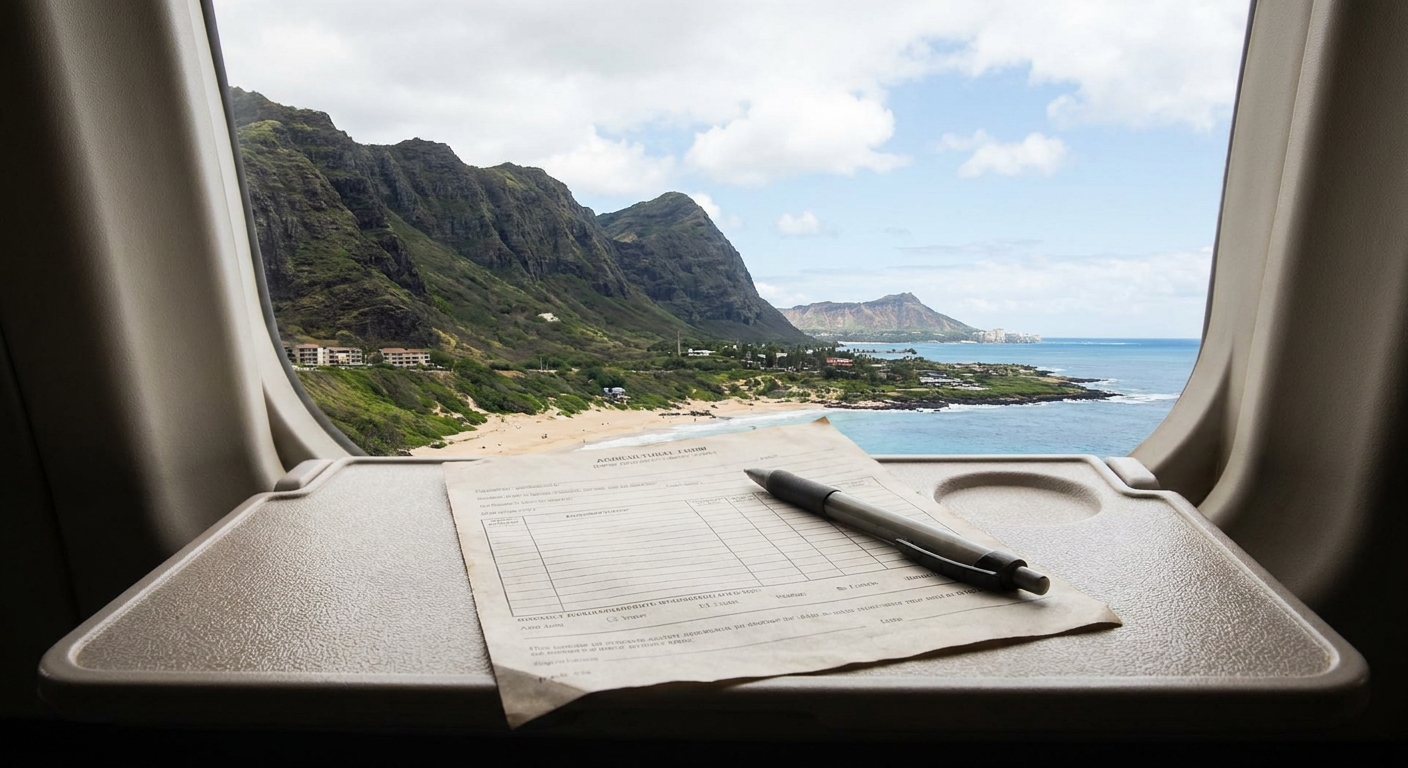
Hawaii agriculture declaration form
Anything agricultural you bring from the mainland goes on the Plants and Animals Declaration Form, and that includes the snack fruit in your daypack. Flight attendants hand the form out and collect it before landing. Afterward, you show it at the Agricultural Inspection Counter, right by the exits from baggage claim.
Plant material has to be free of soil, pests and disease. A handful of items can enter only with advance permits or after treatment: bromeliads, taro, seeds or fruit, passion fruit, coconut plants, corn including corn on the cob, banana plants, and pineapple plants. Root vegetables such as radish, turnip and daikon are on the list too, and so is citrus from Florida and Puerto Rico.
A digital version called Akamai Arrival was piloted on select mainland flights starting March 1, 2025, so you may be offered a screen instead of paper. Whichever you get, answer honestly: the point of the whole exercise is keeping new pests off the islands.
Can you bring fruit back from Hawaii?
Not freely. Every bag leaving Hawaii for the mainland, checked or carry-on, passes through a U.S. Department of Agriculture pre-flight inspection before you board.
The checks aim at fruit flies and other pests, so fruits, plants and live snails get the closest look. That is the reason a bag of roadside lychee or a potted plant from a farm stand can be stopped at the airport. Pack any produce with that inspection in mind, and leave extra time at the airport for the screening line.
Packaged treats such as macadamia nuts, coffee, jams and chocolate are the usual souvenirs that travel without drama. Farms and shops that sell fresh fruit to visitors are familiar with the process and can often tell you what will clear inspection.
Hawaii attractions that require reservations
Several of the best-known places on the islands ask you to reserve ahead, and the list is worth sorting out before you fly. The rules differ by site, so they are gathered here.
| Site | Reservation | Cost |
|---|---|---|
| Haleakala sunrise (Maui) | recreation.gov, released up to 60 days ahead at 7:00 a.m. HST, with a portion released 2 days ahead | Park pass of $30 per private vehicle, paid on top |
| Diamond Head State Monument (Oahu) | Entry and parking reservations for non-residents, open 6:00 a.m. to 6:00 p.m., last entry 4:30 p.m. for the 4:00 p.m. slot | $5 per person and $10 per vehicle |
Haleakala at sunrise
The sunrise reservation covers entry to the summit district between 3:00 and 7:00 a.m., and you get one per three-day period. There is no refund or exchange for weather, which matters on a mountain that sits in cloud more often than people expect.
The park pass is separate, valid three days and good for both the Summit and Kipahulu districts. Payment at the entrance stations is by card only. Dress warmly, since the summit is cold well before the sun comes up.
Diamond Head and Hanauma Bay
Both Oahu sites are booked online, and both reward an early start. At Diamond Head, Hawaii residents with ID are free, and the trail itself is steep and strenuous, so bring water and take it slowly.
At Hanauma Bay the City keeps daily attendance near 1,400 people, and every visitor watches a 10-minute educational video before heading to the water. Since November 2025, packages sold a month ahead add a round-trip electric bus from Ala Moana and Waikiki, while admission-only tickets had been bookable 48 hours ahead.
Pearl Harbor and the volcano
Pearl Harbor National Memorial, home of the USS Arizona Memorial, charges no admission, though parking costs $7 per day, paid by mobile app. It is a place for a quiet, unhurried morning rather than a quick stop.
Hawai’i Volcanoes National Park on the Big Island charges $30 per private vehicle, which covers the passholder and up to 14 passengers. Splitting the cost across a carload makes it one of the more modest entrance fees for a landscape this dramatic, and the crater rim is cool and often wet, so a rain layer helps.
Hawaii sunscreen law
Since January 1, 2021, it has been unlawful to sell, offer for sale or distribute for sale in Hawaii any sunscreen containing oxybenzone or octinoxate, or both, without a prescription from a licensed healthcare provider. The rule is Act 104 of 2018, and it targets the sale of the products, which is why shelves in island stores look different from the ones at home.
Ingredient lists can be tricky. Oxybenzone may also appear as benzophenone-3, and octinoxate as ethylhexyl methoxycinnamate or octyl methoxycinnamate. Reading the back of the bottle takes a few seconds and saves a return trip to the store.
Mineral sunscreens based on zinc oxide or titanium dioxide are the usual reef-conscious choice. That is a personal choice rather than a legal one, but it fits the spirit of snorkeling over living coral.
Hawaii hotel tax and rental car surcharge
Both add a visible layer to the final bill, so the numbers are worth knowing when you compare rates. The state Transient Accommodations Tax (TAT) rose from 10.25% to 11% on January 1, 2026, and it applies to hotel rooms, vacation rentals and resort time share units.
What a room is taxed
Since 2021 each county may add its own TAT of up to 3%. On Oahu, the City and County of Honolulu charges the full 3%, so a room there carries 11% state TAT plus 3% county TAT.
Hotels and rental operators also owe the General Excise Tax: 4%, plus a county surcharge where the county applies one (0.5% in the Department of Taxation’s own examples). Mandatory fees, such as cleaning, management and resort fees, are part of the taxed price.
Separate charges for meals, laundry or phone calls are not. Since January 1, 2026, the TAT also applies to cruise fares, prorated by the share of the voyage the ship spends docked in Hawaii ports.
The rental car surcharge
Starting January 1, 2026, Hawaii’s rental motor vehicle surcharge tax comes to $7.50 for each day or any part of one. It falls on the rental company, peer-to-peer car sharing included, and rental companies commonly show it as a line on the bill.
Whether you need a car depends on the island. Honolulu and Waikiki work without one thanks to TheBus and Skyline. Maui, the Big Island and Kauai have attractions scattered widely, county bus service is thin, and as a result most visitors rent.
Hawaii driving laws for visitors
Drivers in Hawaii follow a few rules that catch visitors off guard, mostly about children and phones. They apply to a rental car just as they do to your own.
Child seats and seat belts
The child passenger law covers every child under 10. Under 2, a rear-facing seat with harness is required. From 2 to under 4, a rear- or forward-facing seat with harness. From 4 to under 10, a harness seat or booster seat.
From 7 to under 10, a child may use the lap and shoulder belt instead of a booster, but only if the child is over four feet nine inches tall. The law exempts operators of emergency, commercial and mass transit vehicles, so the rule rests on the driver of a private car, including a rental. A first offense carries a fine of up to $100, a child passenger safety class of up to four hours ordered by the court, and a $50 driver education assessment.
Every other occupant must be belted, front seat and back seat alike. Children under 10 are covered by the child seat law instead.
Phones behind the wheel
Hawaii law bars anyone from driving while using a mobile electronic device. A 911 emergency call is a defense. Drivers under 18 may not use even a hands-free device.
On winding roads such as the Road to Hana, where the curves come one after another, it makes sense to set up navigation and music before the engine starts. A passenger can handle directions while the driver keeps both hands and eyes on the road.
Good to know before you go
The Central Pacific hurricane season runs from June 1 to November 30, so a trip in those months deserves flexible plans and a glance at the forecast. Trips to Hawaii need no passport or visa, and you pay in dollars like at home. Before you head into the water, the signs posted at the beach entrance give you the facts you need, so look at that day’s surf and currents and swim near a lifeguard only at spots where one is on duty.
Sources
- Hawaii Department of Agriculture and Biosecurity, Plant Quarantine Branch, « Traveling and Shipping from the U.S. Mainland to Hawai'i », dab.hawaii.gov, checked September 25, 2026
- Hawaii Department of Transportation, Airports Division, « Agriculture Inspection » at l'aeroport Daniel K. Inouye International (HNL), airports.hawaii.gov, checked September 25, 2026
- National Park Service, Haleakala National Park, pages « Fees & Passes » and « Sunrise », nps.gov/hale, checked September 25, 2026
- National Park Service, Hawai'i Volcanoes National Park, « Fees & Passes », nps.gov/havo, checked September 25, 2026
- National Park Service, Pearl Harbor National Memorial, « Fees & Passes », nps.gov/valr, checked September 25, 2026
- Hawaii DLNR, Division of State Parks, « Diamond Head State Monument », dlnr.hawaii.gov/dsp, checked September 25, 2026
- City and County of Honolulu, Department of Parks and Recreation, press releases of June 26, 2023 (« No reservation required for kama'aina entry ») and of October 30, 2025 (« New concession aims to improve access to Hanauma Bay »), honolulu.gov/dpr, checked September 25, 2026
- Hawaii Revised Statutes §342D-21 « Sale and distribution of sunscreen containing oxybenzone or octinoxate », capitol.hawaii.gov (blocked by Cloudflare, read via the web.archive.org capture of February 5, 2025), checked September 25, 2026
- Hawaii Department of Taxation, Announcement No. 2025-03 (June 9, 2025) and « Outline of the Hawaii Tax System as of July 1, 2025 », files.hawaii.gov, checked September 25, 2026
- City and County of Honolulu, Department of Budget and Fiscal Services, « Oahu Transient Accommodations Tax FAQ » (revision of January 2026), honolulu.gov, checked September 25, 2026
- Hawaii Department of Taxation, Tax Facts 96-2 « Transient Accommodations Tax » (revised May 2025), files.hawaii.gov, checked September 25, 2026
- Hawaii Department of Taxation, Form RV-3 Instructions (Rev. 2025), Rental Motor Vehicle, Tour Vehicle and Car-Sharing Vehicle Surcharge Tax, files.hawaii.gov, checked September 25, 2026
- Hawaii Revised Statutes §291-11.5 « Child passenger restraints », capitol.hawaii.gov (blocked by Cloudflare, read via the web.archive.org capture of April 18, 2025), checked September 25, 2026
- Hawaii Revised Statutes §291-11.6 « Mandatory use of seat belts », capitol.hawaii.gov (blocked by Cloudflare, read via the web.archive.org capture of August 24, 2025), checked September 25, 2026
- Hawaii Revised Statutes §291C-137 « Mobile electronic devices », capitol.hawaii.gov (blocked by Cloudflare, read via the web.archive.org capture of August 22, 2025), checked September 25, 2026
- NWS Honolulu / Central Pacific Hurricane Center, « 2026 Central Pacific Hurricane Season Outlook », weather.gov/hfo/hurricaneOutlook2026, checked September 24, 2026
To plan your stay
- Best Time to Visit Hawaii: Seasons, Weather by Island, Whales and Crowds
- Things to Do in Hawaii: Volcano Sunrises, Snorkeling Bays, Pearl Harbor and What to Eat
- Where to Stay in Hawaii: Choosing an Island, Oahu to Kauai Bases and the Hotel Tax
- Getting Around Hawaii: Interisland Flights, TheBus and Skyline, Rental Cars and Taxi Fares