
Early in the morning at a Hilo diner, a plate of loco moco arrives under a blanket of brown gravy, and by noon the line at a roadside stand is waiting for chicken off the turning spit. Eating in Hawaii means moving between fish counters, convenience stores, shave ice windows and coffee farms. These are the dishes and drinks that shape a vacation across the islands, and the labels worth reading before you buy a bag of beans.
Hawaiian food to try
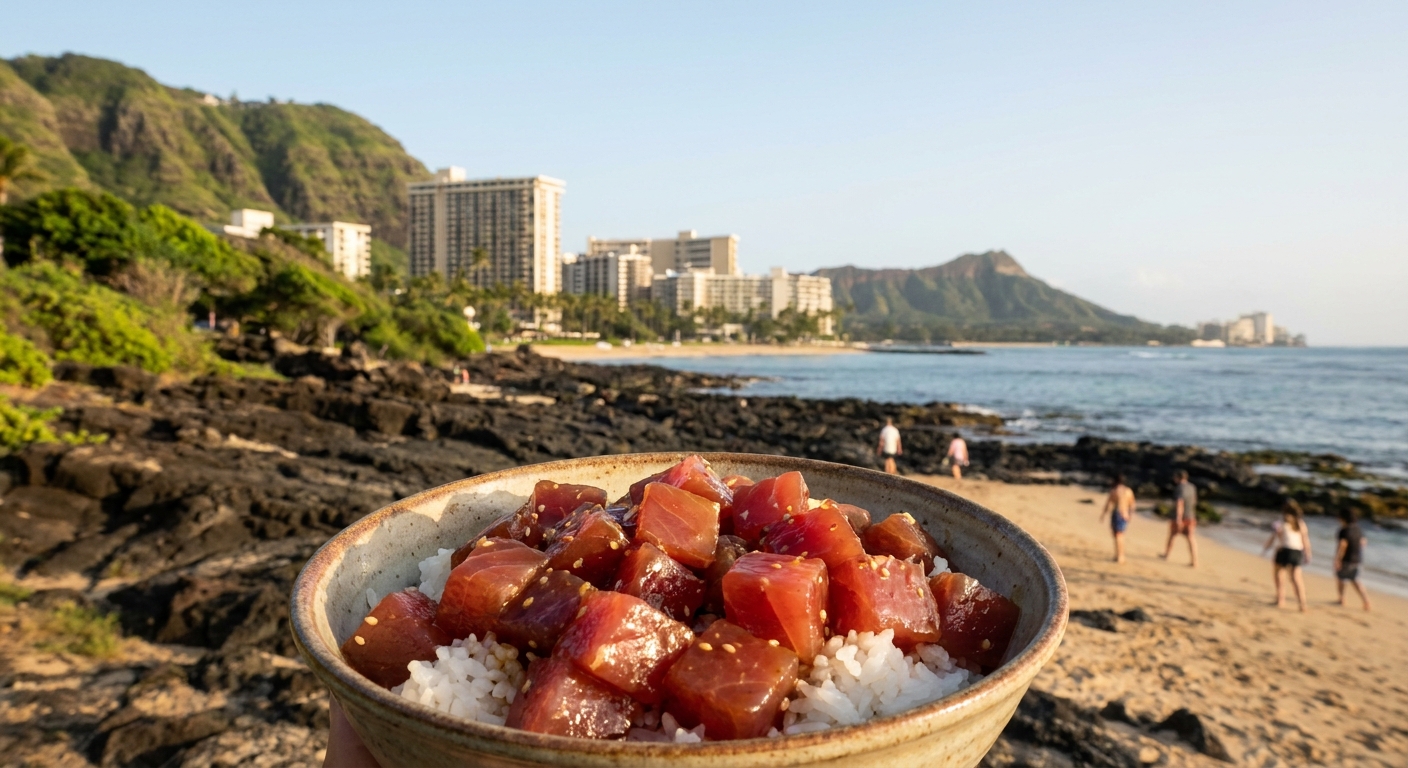
The essential Hawaiian meals are poke, the plate lunch, loco moco and the dishes of a luau, and most of them cost little and come from counters rather than white tablecloths. Start with poke, cubed raw fish, most often ahi tuna, dressed with soy sauce, sesame oil, onion and seaweed. Supermarkets and fish markets sell it by the pound at the deli counter, so a picnic on the beach can begin in the grocery aisle.
The plate lunch and loco moco
The plate lunch is the everyday meal of the islands: a main such as teriyaki beef, chicken katsu or kalua pork, with two scoops of rice and a scoop of macaroni salad. It comes in a takeout box, it is filling, and you eat it on a tailgate, a park bench or a seawall. Locals argue over which stand does the best gravy and the crispiest katsu, which is reason enough to try several.
Loco moco is the breakfast version of the same spirit. Rice is topped with a hamburger patty, a fried egg and brown gravy, a diner dish born in Hilo. It suits a big morning before a hike or a long drive, and it is not a dish for a light appetite.
Luau dishes and roadside chicken
A luau table rests on three old foods. Kalua pig is pork cooked slowly in an underground oven, the imu, then shredded until it falls into smoky strands. Beside it come laulau, a parcel steamed in leaves, and poi, a soft purple paste of pounded taro that tastes mild and a little sour. Poi is easiest to appreciate as a cool counterpoint to the salty pork.
Huli huli chicken is the other smell of Hawaiian weekends. The chicken turns on a spit over the coals, basted with a sweet soy glaze, and it is often sold at roadside fundraisers. If you see smoke and a row of cars pulled onto the shoulder, that is the stop to make.
Shave ice and malasadas
Shave ice and malasadas are the two sweets of the islands, one icy and one fried, and both are best eaten the minute they are handed over. Shave ice is ice shaved as fine as snow, then soaked in fruit syrups until the colors run together. Many stands put a scoop of ice cream underneath or a spoonful of sweet azuki beans in the bottom of the cup.
Malasadas are Portuguese-style fried doughnuts rolled in sugar, tender inside and a little crisp outside. They are a reminder that Hawaiian cooking absorbed the plantation communities that arrived over the years. Eat one warm with a coffee in the morning, or split a shave ice on a hot afternoon after the beach.
Both treats are easy to share, which makes them a good fit for children and for anyone who wants a taste without a full meal. Napkins are not optional with either one.
Spam musubi in Hawaii
Spam musubi is a real local snack, not a joke, and you will find it in convenience stores across the islands. It is a slice of grilled Spam on a block of rice, wrapped in a band of nori. Spam is part of local food here, and the musubi turns it into something between a sandwich and a sushi roll.
It sits by the register in a plastic wrap, usually still a little warm, and it makes a cheap breakfast or a trailhead snack. The salty, sweet-glazed meat against plain rice is the point. Try one before deciding what you think of it, since many visitors end up buying a second for the road.
Kona coffee blend
A Kona coffee blend is a bag that carries the Kona name but is not all Kona coffee, and the label tells you how much is. Under Hawaii’s coffee labeling law, a package may name a Hawaii origin such as Kona on a blend containing as little as 10% coffee from that origin until June 30, 2027. From July 1, 2027 the minimum rises to 51%.
The law requires a blend to state the percentage of the named Hawaii coffee followed by the words Coffee Blend, all in the same type size. Look for that line before you pay. Coffee that is entirely from one Hawaii origin may be labeled with that origin and 100%, and that is the bag to choose if you want the real thing.
A cheaper blend is not a bad purchase for a morning pot, as long as you know what is inside. Beans from a farm stand or a roaster near the Kona coast are a natural gift to bring home, and the label makes the comparison easy.
Can you bring food back from Hawaii?
On the way out, all baggage, checked and carry-on, is inspected by the U.S. Department of Agriculture, because fruit flies and other pests must stay on the islands.
Packaged coffee, sealed snacks and jars of sauce are the easy souvenirs. Going the other way, to the islands, the state asks you to declare agricultural items, and pineapple, passion fruit, taro, coconut plants and banana plants cannot enter without prior permits or treatment. Ask at the agricultural inspection before buying a box from a roadside stand, and let the stand tell you whether it is already inspected for travel. A sealed bag of Kona beans or a box of cookies is a far simpler gift than anything that grew in the ground.
Good to know before you go
Much of the best eating is cheap and casual, from the deli counter to the convenience store, so a vacation here does not need a restaurant for every meal. The Central Pacific hurricane season runs from June 1 to November 30, and food stands and farms can close on short notice when weather turns.
Sources
- Hawaii Revised Statutes §486-120.6 « Hawaii-grown and Hawaii-processed coffee; labeling or advertising requirements », capitol.hawaii.gov (blocked by Cloudflare, read via the web.archive.org capture of April 25, 2025), checked September 25, 2026
- Hawaii Department of Agriculture and Biosecurity, Plant Quarantine Branch, « Traveling and Shipping from the U.S. Mainland to Hawai'i », dab.hawaii.gov, checked September 25, 2026
- Hawaii Department of Transportation, Airports Division, « Agriculture Inspection » at l'aeroport Daniel K. Inouye International (HNL), airports.hawaii.gov, checked September 25, 2026
- NWS Honolulu / Central Pacific Hurricane Center, « 2026 Central Pacific Hurricane Season Outlook », weather.gov/hfo/hurricaneOutlook2026, checked September 24, 2026
To plan your stay
- Best Time to Visit Hawaii: Seasons, Weather by Island, Whales and Crowds
- Where to Stay in Hawaii: Choosing an Island, Oahu to Kauai Bases and the Hotel Tax
- Getting Around Hawaii: Interisland Flights, TheBus and Skyline, Rental Cars and Taxi Fares
- Know Before You Go to Hawaii: Agriculture Form, Sunscreen Law, Reservations and Taxes