
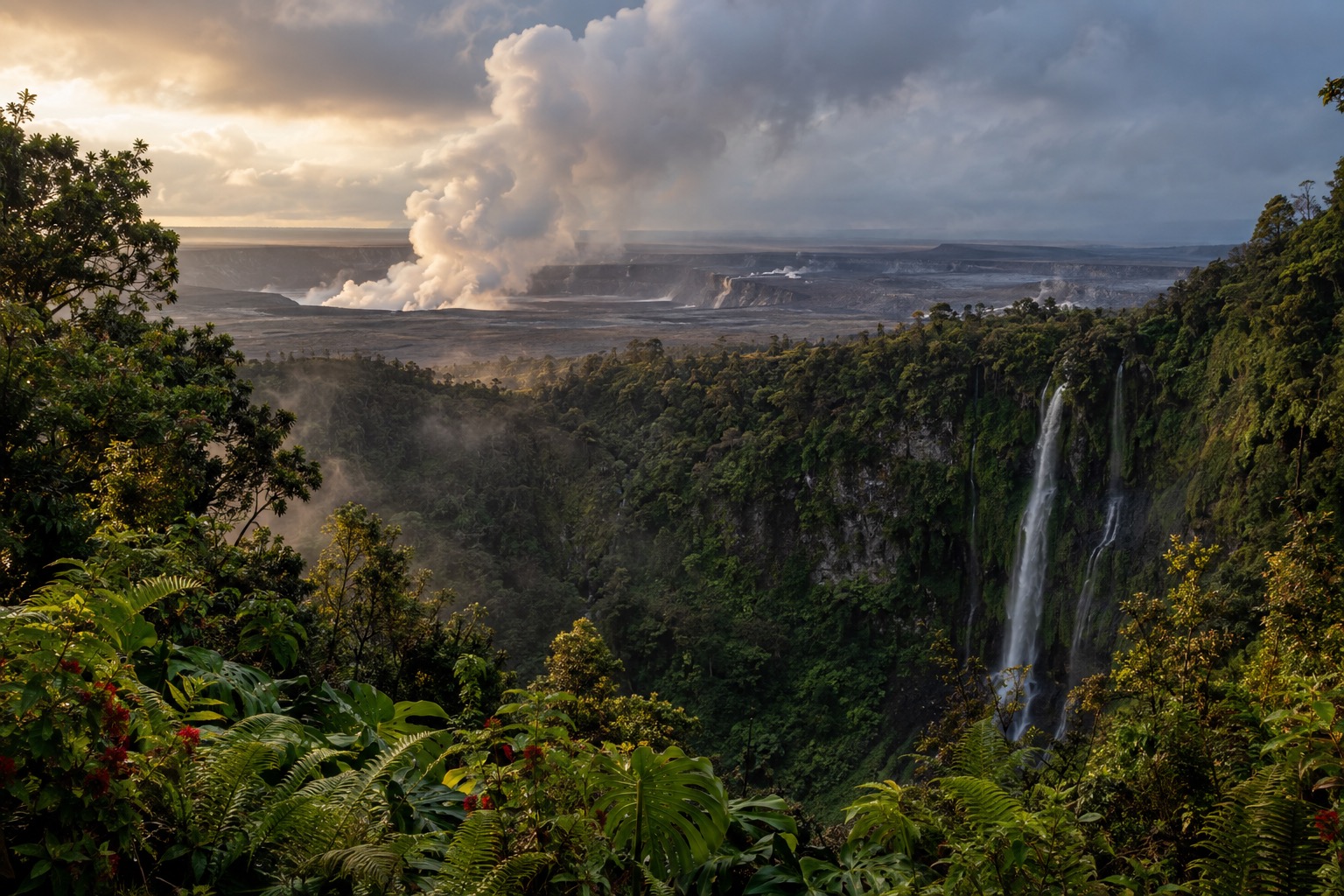
After dark, the sky above the Kilauea crater turns a deep orange, and the steam vents along the rim breathe white clouds into the cool air. People stand quietly at the overlooks, wrapped in fleece, watching the glow pulse. This is Hawaii Volcanoes National Park, a high, wild corner of the Big Island for travelers who want to see a living landscape rather than lie on a beach.
Where is Hawaii Volcanoes National Park and what is it like?
Hawaii Volcanoes National Park sits on the southeastern flank of the Big Island, between Hilo on the wet east side and the long, dry Kona coast on the west. The park climbs from the sea to the summits of two giants, Kilauea and Mauna Loa, and the small village of Volcano sits just outside the entrance.
The mood here is nothing like the resort coasts. The air is cool and often misty, ohia trees and giant ferns crowd the rainforest, and the ground steams in places. The pace is slow and outdoorsy, with early starts, damp jackets and long looks into the crater.
It suits hikers, geology fans and families with curious kids. It suits less well anyone who wants sunshine and sand every hour of the day, since the weather at this elevation changes quickly and the summit area is still working through repairs and closures.
What is there to do in Hawaii Volcanoes National Park?
Watch Kilauea from the rim
Kilauea is the main reason people come. The volcano is currently at a WATCH alert level, with strong glow and intermittent spatter from its vents, so the crater overlooks around the summit are the places to be at dusk and after dark. The glow is most striking once the light fades.
The park is open around the clock, which makes a night visit easy to plan. The old Jaggar Museum is gone, and a stone outline now marks where it stood. Because a summit construction project is under way, expect some closures and delays, and bring a warm layer even on a sunny afternoon.
Walk the Kilauea Iki Trail and Nahuku
Kilauea Iki is the classic hike, a loop that drops through rainforest onto a crater floor of hardened lava, where steam still rises from cracks. It is rated moderate to challenging because the descent and climb back are steep and rocky. The loop from the overlook takes about two to three hours.
Nahuku, the Thurston Lava Tube, is the easier outing, a short walk through fern forest and into a tunnel left by draining lava. The tube is lit during the day and evening. Parking fills quickly, so go early in the morning or toward evening when the tour buses have moved on.
Drive Chain of Craters Road
This road drops from the summit area toward the coast, passing old craters and black lava fields that run out to the sea. The drive is 18.8 miles one way, and the scenery changes from cool forest to hot, open lava flats with wide Pacific views.
Two stops reward the detour. Puuloa holds around 23,000 petroglyphs, many seen from a boardwalk, on a walk of an hour or so. Holei Sea Arch is a tall natural arch carved into the sea cliffs by waves, a windy, dramatic place to end the drive. Bring water and sun protection, because there is little shade down at the coast.
Kahuku, the quiet side
Kahuku is a separate unit of the park on the slopes of Mauna Loa, with ranch-era relics, old lava flows and open pasture views. A ranger-led walk called People and Land of Kahuku covers the history of the land and its people.
It is a good choice for travelers who want less company than the summit crowds. It keeps limited days, and the drive from the main entrance is about 50 minutes, so it works best as part of a loop south along the highway.
| Site | Open | Admission |
|---|---|---|
| Main park (Kilauea summit, Chain of Craters Road) | 24 hours a day, 7 days a week | $30 per private vehicle (up to 14 passengers), $15 per person on foot or bicycle (age 16 and older), $25 per motorcycle |
| Kahuku Unit | Thursday to Sunday, 8 a.m. to 4 p.m. | Free |
| Nahuku (Thurston Lava Tube) | Lit 8 a.m. to 8 p.m. daily | Included with park entry |
How many days do you need in Hawaii Volcanoes National Park?
One long day covers the highlights, and an overnight stay is better. A full day lets you see the crater rim, walk through the lava tube, drive Chain of Craters Road and return for the glow after dark.
With two days you can add the Kilauea Iki hike without rushing, linger at the petroglyphs and sea arch, and see the summit both in daylight and at night. A third day makes room for Kahuku, the village of Volcano, and a slower pace in the rain forest.
Many visitors combine the park with Hilo on the east side, with its waterfalls and farmers market, or with a drive down toward the southern coast. Anyone staying on the Kona side should plan for a long day of driving each way.
Where to stay in Hawaii Volcanoes National Park
The most atmospheric choice is Volcano House, a historic lodge on the crater rim with 33 guest rooms, a dining room, a snack bar and a lounge. The village of Volcano, just outside the gate, offers a quieter, cozier alternative with bed-and-breakfasts and cottages tucked among ferns.
Campers have two options inside the park area. Namakanipaio Campground has drive-in sites and refurbished camper cabins, while Kulanaokuaiki is a simple first-come site with no water and no fires. Both sit at cool elevations, so nights are chilly.
| Campground | Cost per night | Notes |
|---|---|---|
| Namakanipaio | $15 per site | Restrooms, water, picnic tables, barbecue pits, 7-night maximum |
| Kulanaokuaiki | $10 per site ($5 with a senior or access pass) | Nine first-come sites, no water, no fires |
How do you get to Hawaii Volcanoes National Park and get around?
Most visitors fly into Hilo or Kona, then drive. From Hilo, the park is about 45 minutes southwest on Highway 11. From Kailua-Kona, the drive is roughly two to two and a half hours along the southern route, or a bit longer through Waimea and Hilo.
Inside the park, a car is the practical way to move between the summit, the overlooks, the trailheads and the coast. Distances are long, and stops like Chain of Craters Road are far apart. Walking covers the short trails near the summit once you are parked.
When is the best time to visit Hawaii Volcanoes National Park?
The drier, warmer stretch from May to October is the easiest time for hiking, and August and September bring a bit less rain than the rest of the year. Even then, showers come through on about a dozen days a month, so a rain jacket belongs in the daypack.
March and April are the wettest months here, with rain on most days, and winter brings cool, damp weather. At this elevation the afternoons stay mild year-round and nights are always cool, which is part of the charm after dark when the crater glows.
Crowds follow the school calendar, with busy weeks around the winter holidays, spring break and the middle of summer. The Central Pacific hurricane season runs from June 1 to November 30, and the crater itself is most memorable on clear evenings whatever the month.
Good to know before you go
Volcanic gases can drift over the park, and people with heart or breathing problems, infants, children and pregnant women should check the air quality alert before they go and keep watching it. The Kilauea Visitor Center is closed for renovations, so plan on the overlooks and trailheads rather than a stop inside. Lodging in the county carries the state and county accommodations taxes, which are added to the room rate at checkout.
| Tax | Rate | Who pays |
|---|---|---|
| State Transient Accommodations Tax | 11.00% | Guests on lodging |
| County of Hawaii Transient Accommodations Tax | 3% | Guests on lodging |
Sources
- Hawaii Department of Taxation, Tax Announcement No. 2025-03 (Transient Accommodations Tax Law Changes from 2025 Legislative Session), files.hawaii.gov/tax/news/announce/ann25-03.pdf, checked September 24, 2026
- County of Hawaii, Department of Finance, Transient Accommodations Tax (TAT) page, hawaiicounty.gov/departments/finance/transient-accommodations-tax-tat (live returned HTTP 403 on request, read via Internet Archive Wayback Machine snapshot dated August 14, 2026, same official content), checked September 25, 2026
- Hawaii Department of Taxation, County Surcharge on General Excise and Use Tax page, tax.hawaii.gov/geninfo/countysurcharge/, checked September 25, 2026
- Federal Aviation Administration, CY2024 Commercial Service Enplanements (xlsx), faa.gov/airports/planning_capacity/passenger_allcargo_stats/passenger/arp-cy2024-commercial-service-enplanements.xlsx, checked September 24, 2026
- National Park Service, "Fees & Passes", nps.gov/havo/planyourvisit/fees.htm, read September 25, 2026
- National Park Service, "NPS Geodiversity Atlas – Hawaiʻi Volcanoes National Park", nps.gov/articles/nps-geodiversity-atlas-hawai-i-volcanoes-national-park-hawai-i.htm, read September 25, 2026
- National Park Service, "Drive Chain of Craters Road", nps.gov/havo/planyourvisit/ccr_tour.htm, read September 25, 2026
- National Park Service, "Operating Hours & Seasons", nps.gov/havo/planyourvisit/hours.htm, read September 25, 2026
- National Park Service, "Current Conditions", nps.gov/havo/planyourvisit/conditions.htm, read September 25, 2026
- National Park Service, "Kīlauea Visitor Center", nps.gov/havo/planyourvisit/kvc.htm, read September 25, 2026
- U.S. Geological Survey, Hawaiian Volcano Observatory, "Kīlauea Volcano Updates", usgs.gov/volcanoes/kilauea/volcano-updates, read September 24, 2026
- USGS Hawaiian Volcano Observatory, Volcano Notice, https://volcanoes.usgs.gov/hans-public/notice/DOI-USGS-HVO-2026-09-11T16:16:02+00:00, checked September 25, 2026
- NPS, Lodging, https://www.nps.gov/havo/planyourvisit/lodging.htm, checked September 25, 2026
- NPS, News Release on Uekahuna Reopening, https://www.nps.gov/havo/learn/news/20250528-nr-uekahuna-reopens.htm, checked September 25, 2026
- NPS, Day Hike Nahuku (Thurston Lava Tube), https://www.nps.gov/havo/planyourvisit/day-hike-nahuku.htm, checked September 25, 2026
- NPS, Day Hike Kilauea Iki Trail, https://www.nps.gov/havo/planyourvisit/hike_day_kilauea-iki.htm, checked September 25, 2026
- NPS, Day Hike Puuloa Petroglyphs, https://www.nps.gov/havo/planyourvisit/hike_day_puuloa.htm, checked September 25, 2026
- NPS, Puuloa Petroglyphs, https://www.nps.gov/havo/learn/historyculture/puuloa.htm, checked September 25, 2026
- NPS, Holei Sea Arch, https://home.nps.gov/places/holei-sea-arch.htm, checked September 25, 2026
- NPS, Hawaii Volcanoes National Park expands hours and increases access to Kahuku Unit, https://www.nps.gov/havo/learn/news/20220523-nr-kahuku-hrs.htm, checked September 25, 2026
- NPS, Hike and Explore the Park's Kahuku Unit in Kau, https://www.nps.gov/havo/learn/news/hike-and-explore-kahuku.htm, checked September 25, 2026
- NPS, Camping, https://www.nps.gov/havo/planyourvisit/camp.htm, checked September 25, 2026
- NPS, Safety, https://www.nps.gov/havo/planyourvisit/safety.htm, checked September 25, 2026
- NPS, Directions, https://www.nps.gov/havo/planyourvisit/directions.htm, checked September 25, 2026
- USGS, November 27-December 10, 2022 Eruption of Mauna Loa, https://www.usgs.gov/volcanoes/mauna-loa/science/november-27-december-10-2022-eruption-mauna-loa, checked September 25, 2026
- NOAA NCEI, monthly normals 1991-2020, station USC00511303
- NWS Honolulu / Central Pacific Hurricane Center, « 2026 Central Pacific Hurricane Season Outlook », weather.gov/hfo/hurricaneOutlook2026, checked September 24, 2026
All our pages
When to go
- Best Time to Visit Hawaii Volcanoes National Park: Weather, Crowds, Rain and Seasonal Events
- Hawaii Volcanoes National Park in January: Cool Crater Rims, Rain Showers and a Two-Day Plan
- Hawaii Volcanoes National Park in February: Weather, Kilauea Hikes, Night Skies and a Two-Day Plan
- Hawaii Volcanoes National Park in March: Weather, Crater Rim Walks and Two Days Around Kilauea
- Hawaii Volcanoes National Park in April: Cool Crater Rims, Showers and Steam Vents
- Hawaii Volcanoes National Park in May: Weather, Crater Walks and a Two-Day Plan
- Hawaii Volcanoes National Park in June: Weather, Crater Walks and a Two-Day Plan
- Hawaii Volcanoes National Park in July: Weather, Crater Walks and a Two-Day Plan
- Hawaii Volcanoes National Park in August: Weather at the Crater Rim, Things to Do and a Two-Day Plan
- Hawaii Volcanoes National Park in September: Weather, Crater Walks and Two Days Around Kilauea
- Hawaii Volcanoes National Park in October: Weather, Kilauea Crater Walks and a Two-Day Plan
- Hawaii Volcanoes National Park in November: Weather, Kilauea Crater Walks and a Two-Day Plan
- Hawaii Volcanoes National Park in December: Weather, Kilauea Glow and What to Do