
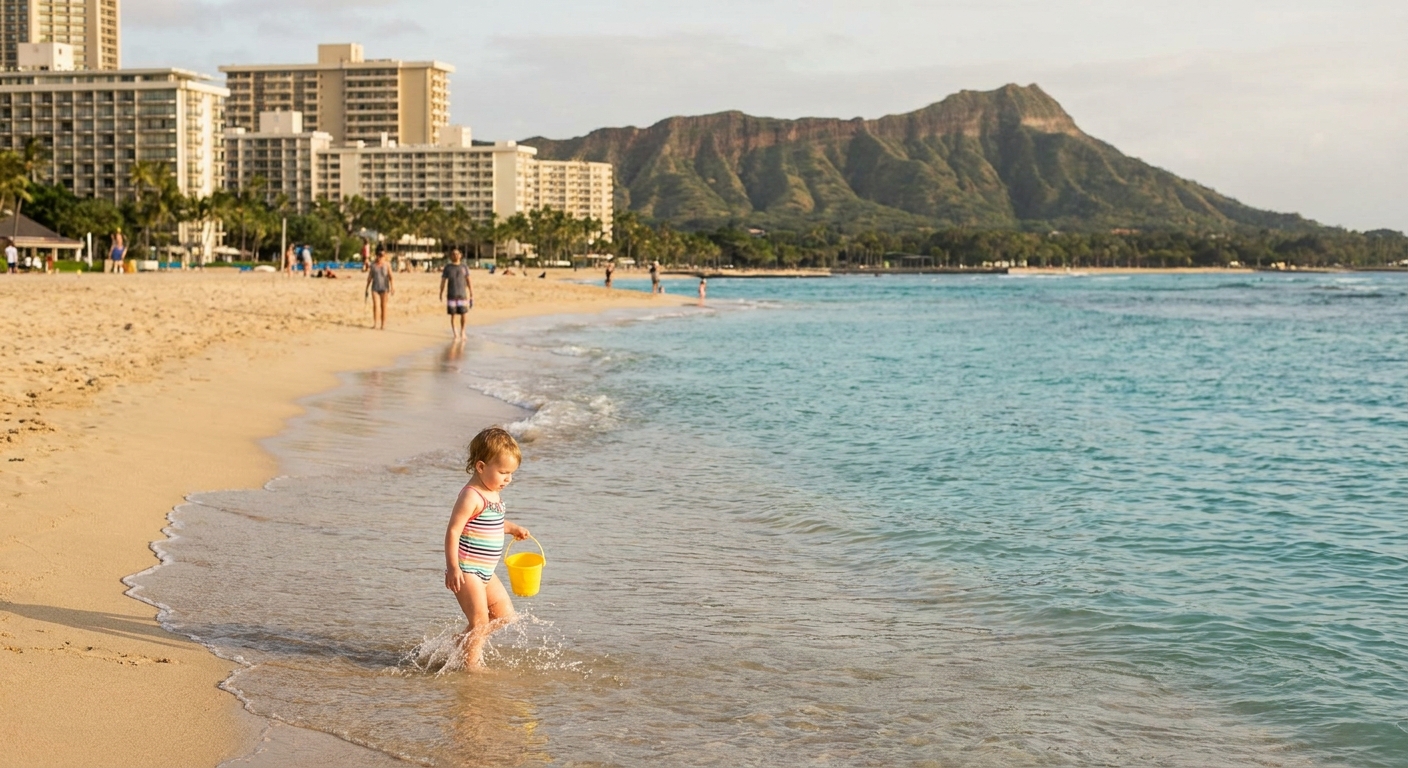
Small hands pressed against the window of a rental car, a wet towel draped over a booster seat, and the smell of sunscreen and shave ice drifting across the back row: a family day in Hawaii runs on rhythms like these. Children find the islands easy to love, from the tide pools to the crater trails to the open-air buses. This is Hawaii for families, with the practical pieces that keep a trip with kids relaxed.
Hawaii car seat law
Every child under 10 has to be buckled into something made for their size, and the duty sits on whoever is driving, even in a rental. The rule shapes the first stop after the airport, so it is worth settling the seats before the keys are in your hand.
Which seat for which age
The law steps up with age. A baby under 2 rides rear-facing in a harness seat. From 2 up to 4, the seat may face either way, still with a harness. Between 4 and 10, a harness seat or a booster both qualify.
There is one way out of the booster. A child from 7 to under 10 may use the regular lap and shoulder belt, but only if taller than four feet nine inches. Stand your child against a wall before you decide, because many kids of 8 or 9 are still shorter than that.
What a mistake costs
A first offense can mean a fine as high as $100, a court-ordered child passenger safety class lasting as long as four hours, plus a $50 driver education assessment. Older passengers fall under the general seat belt rule, which applies in the front and the back. Drivers should also keep phones out of hand, since Hawaii bars using a mobile device behind the wheel.
Ocean safety for kids in Hawaii
The ocean is the best part of a family trip and the part that needs the closest watching, because visitors are the majority of drowning victims in the state. Non-residents account for 53% of those victims, and their rate of deadly ocean drowning is roughly eight times that of residents.
Snorkeling with children
More visitors drown while snorkeling than in any other activity. The Department of Health advises snorkeling only for experienced ocean swimmers who know high surf, strong currents and waves that break in shallow water. A first-time child is not that swimmer, however confident the mask makes them feel.
A protected bay like Hanauma Bay, set in an old volcanic crater, is the gentler classroom. Splashing at the edge, with a parent within arm’s reach, is a fine start and often all a young child wants anyway.
Reading the surf
When winter arrives, swells from the North Pacific hammer the north shores, and that draws surfers and onlookers to the North Shore of Oahu. In summer the pattern tips and the south shores catch the swell. The National Weather Service in Honolulu posts High Surf Advisories shore by shore, starting at 15 feet on north-facing coasts and 10 feet on south- and east-facing ones.
Those are full wave faces, taller than they look from the sand. On any beach, with children, check the posted warnings plus that day’s surf and currents before anyone steps into the water, and swim only near a lifeguard tower that is staffed, the finest habit you can hand down. When in doubt, stay out and build a sandcastle.
The islands do not carry the same risk. Signs at the beach entrance tell you to review the warnings plus that day’s surf and currents before entering the water, and over a decade the islands have ranked like this for fatal drowning rates per 100,000 people: Kauai highest, then Maui, the Big Island and Oahu, so swimming near a lifeguard matters, especially on the neighbor islands.
Riding TheBus with kids in Honolulu
Honolulu’s buses are friendly to families, and small children ride along for nothing: one child aged 5 or under travels free with a fare-paying rider, provided the child is not taking a seat. Kids love the big windows, the bell cord and the rail line that glides above the streets.
Older kids from 6 to 17 pay the youth fare. Cash fares are paid at every boarding, with no change given, so keep small bills and coins in a pocket. A HOLO card is the smoother route for a few days of riding, since it caps what you spend in a day.
| Rider | Cash fare | HOLO card |
|---|---|---|
| Adult | $3.25 per ride | $3.00 two-hour pass, $7.50 daily cap |
| Youth, 6 to 17 | $1.75 per ride | $1.50 two-hour pass, $3.75 daily cap |
| Child 5 and under | Free with a paying rider, no seat | Free with a paying rider, no seat |
Skyline trains run from early morning until late evening, with a train every few minutes through most of the day. Riding them takes a HOLO card, and moving between train and bus within two hours of the first tap costs nothing extra. Children tend to remember the elevated ride longer than the sights it takes them to.
Things to do in Hawaii with kids
Families do best with a few big outings spaced between easy beach days, and Oahu offers three of the classics within a short ride of Waikiki.
Diamond Head and Hanauma Bay
Diamond Head is the crater you see on Waikiki’s skyline. The route to the summit is brief but steep and demanding, so it works well for school-age children who enjoy a challenge, not for toddlers. Go early, when the air is cooler, and let children set the pace on the stairs and tunnels.
Hanauma Bay is the reef-filled bay for first looks at tropical fish. Before going down, everyone watches a brief educational video, and the size of the daily crowd is capped, so families should schedule their trip on the days it is open.
| Site | Open | Admission |
|---|---|---|
| Diamond Head State Monument | 6:00 a.m. to 6:00 p.m., last entry 4:30 p.m. for the 4:00 p.m. slot | $5 per person and $10 per vehicle for non-residents |
Pearl Harbor and volcano country
For older kids who are ready for history, Pearl Harbor National Memorial, which houses the USS Arizona Memorial, makes for a peaceful excursion. You can enter the park for free, while parking is $7 a day and you pay through a mobile app. Explain beforehand that it is a place of remembrance, so voices stay low.
On the Big Island, Hawaii Volcanoes National Park charges $30 per private vehicle, covering everyone in the car up to 14 passengers. Because the crater’s rim is cool and rain is frequent, children should wear a layer. Steam vents and the vast crater floor tend to hold their attention without any help.
Haleakala and the scenic drives
Haleakala on Maui is a sunrise outing that asks a lot of small ones. Sunrise needs a reservation on recreation.gov, and the park entry of $30 per vehicle is paid on top. At the top it is much colder than the beach, so pack jackets and let the little ones doze in the car while you drive up.
Along Maui’s rainy east coast, the Road to Hana twists and turns, while Kauai’s Na Pali Coast is a roadless cliff coast, usually glimpsed from the water or the air. Both reward patience. Curves tend to upset young stomachs, so plan stops and keep the day loose.
What to pack for kids in Hawaii
Pack light for the beach and warm for the mountains, because Hawaii’s weather changes with altitude and with the side of the island. Honolulu is warm in every season, with highs near 80 in January and in the upper 80s in July.
- Swimsuits, rash guards and hats, which do double duty against the sun.
- A fleece or sweatshirt for the Haleakala summit, where January highs stay in the low 60s even partway up.
- A rain jacket for Volcanoes National Park and the uplands of Kauai, where the air is cool and the showers frequent.
- Water shoes for rocky tide pools and lava trails.
- Mineral sunscreen, since a Hawaii law bars selling sunscreens with oxybenzone or octinoxate without a prescription.
Ingredient lists sometimes use other names, such as benzophenone-3 for oxybenzone. Mineral formulas made with zinc oxide or titanium dioxide are typically the reef-friendly choice, but they are optional and not legally required.
Good to know before you go
Families fly in from the mainland with nothing to exchange and nothing to declare, and a card works nearly everywhere, though the Haleakala entrance stations take cards only. The Central Pacific hurricane season runs from June 1 to November 30, so check the forecast for the weeks you travel. Fix the car seats and the beach routine on the first day and the rest of the trip tends to take care of itself.
Sources
- Hawaii Revised Statutes §291-11.5 « Child passenger restraints », capitol.hawaii.gov (blocked by Cloudflare, read via the web.archive.org capture of April 18, 2025), checked September 25, 2026
- Hawaii Revised Statutes §291-11.6 « Mandatory use of seat belts », capitol.hawaii.gov (blocked by Cloudflare, read via the web.archive.org capture of August 24, 2025), checked September 25, 2026
- Hawaii Revised Statutes §291C-137 « Mobile electronic devices », capitol.hawaii.gov (blocked by Cloudflare, read via the web.archive.org capture of August 22, 2025), checked September 25, 2026
- Hawaii State Department of Health, Injury Prevention Systems Section, « Drowning Prevention Information », health.hawaii.gov/injuryprevention, checked September 25, 2026
- National Weather Service, Weather Forecast Office Honolulu, « High Surf Advisory/Warning Information », weather.gov/hfo/highsurfinfo, checked September 25, 2026
- TheBus (City and County of Honolulu), « Fares and Passes », thebus.org, checked September 25, 2026
- Hawaii Department of Transportation, Airports Division, « The Bus and Skyline » at Daniel K. Inouye International Airport, airports.hawaii.gov/hnl, checked September 25, 2026
- National Park Service, Haleakala National Park, pages « Fees & Passes » and « Sunrise », nps.gov/hale, checked September 25, 2026
- National Park Service, Hawai'i Volcanoes National Park, « Fees & Passes », nps.gov/havo, checked September 25, 2026
- National Park Service, Pearl Harbor National Memorial, « Fees & Passes », nps.gov/valr, checked September 25, 2026
- Hawaii DLNR, Division of State Parks, « Diamond Head State Monument », dlnr.hawaii.gov/dsp, checked September 25, 2026
- City and County of Honolulu, Department of Parks and Recreation, press releases of June 26, 2023 (« No reservation required for kama'aina entry ») and of October 30, 2025 (« New concession aims to improve access to Hanauma Bay »), honolulu.gov/dpr, checked September 25, 2026
- NOAA NCEI, monthly normals 1991-2020, station USW00022521
- Open-Meteo Marine API, average 2015-2024
- NOAA NCEI, monthly normals 1991-2020, station USC00511004
- NOAA NCEI, monthly normals 1991-2020, station USC00511303
- NOAA NCEI, monthly normals 1991-2020, station USC00513099
- Hawaii Revised Statutes §342D-21 « Sale and distribution of sunscreen containing oxybenzone or octinoxate », capitol.hawaii.gov (blocked by Cloudflare, read via the web.archive.org capture of February 5, 2025), checked September 25, 2026
- NWS Honolulu / Central Pacific Hurricane Center, « 2026 Central Pacific Hurricane Season Outlook », weather.gov/hfo/hurricaneOutlook2026, checked September 24, 2026
To plan your stay
- Best Time to Visit Hawaii: Seasons, Weather by Island, Whales and Crowds
- Where to Stay in Hawaii: Choosing an Island, Oahu to Kauai Bases and the Hotel Tax
- Getting Around Hawaii: Interisland Flights, TheBus and Skyline, Rental Cars and Taxi Fares
- Know Before You Go to Hawaii: Agriculture Form, Sunscreen Law, Reservations and Taxes