
The line at the Honolulu airport curb moves fast, and somewhere in it a traveler is wondering whether the fleece is really necessary. It is, if the plan includes a volcano summit at dawn. For the rest of the trip, Hawaii asks for very little: swimsuits, light clothes, a good sunscreen and one warm layer for the mountains.
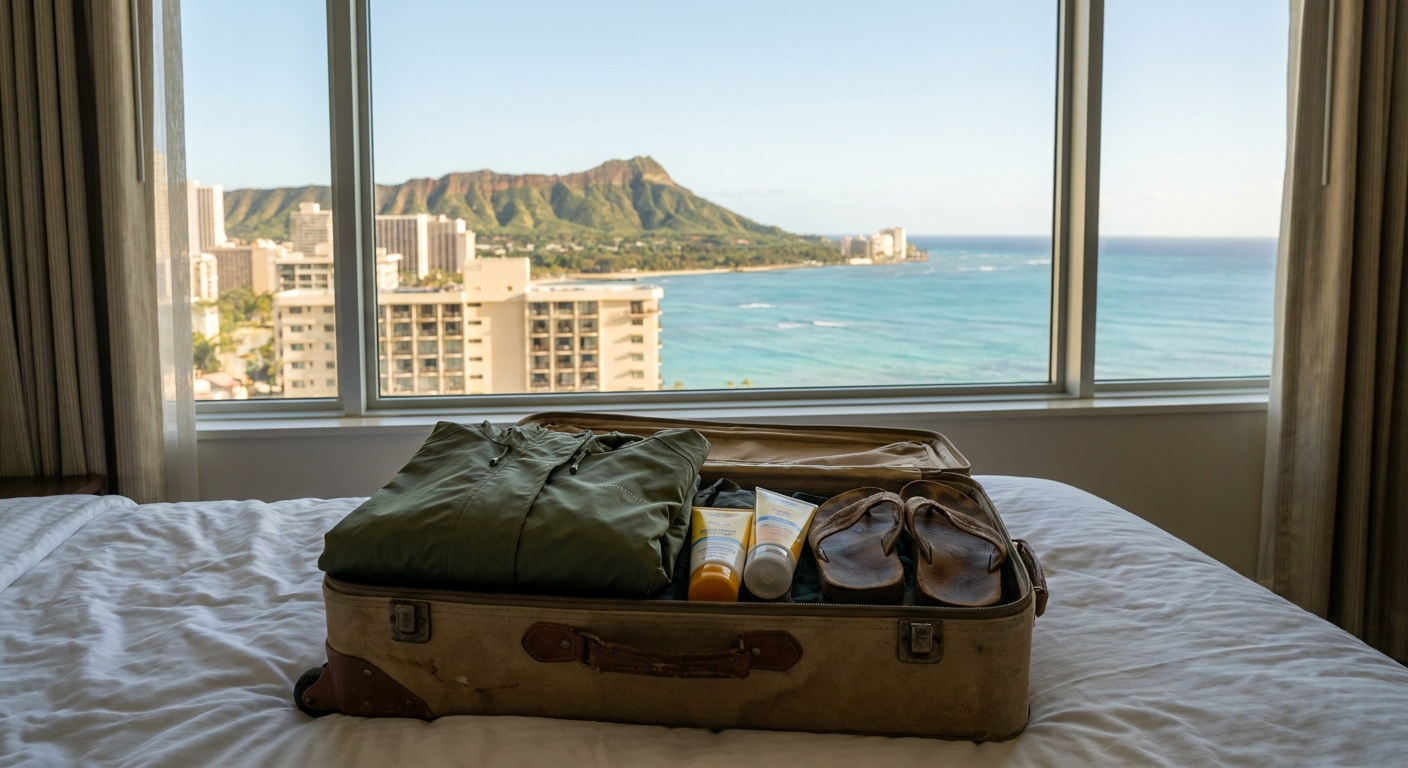
Reef-safe sunscreen in Hawaii
You need to think about it before you leave, because Hawaii has a law on which sunscreens can be sold. Starting January 1, 2021, stores are barred from selling, or distributing for sale, sunscreen that contains oxybenzone or octinoxate, or both, unless the customer holds a prescription from a licensed healthcare provider. The rule is Act 104 of 2018.
The easiest habit is to read the back of the bottle before packing it. Sometimes oxybenzone is listed as benzophenone-3, while octinoxate can show up as ethylhexyl methoxycinnamate or octyl methoxycinnamate. If either name is on the list, leave that bottle at home and buy a different one.
The reef-conscious option people usually choose is a mineral sunscreen made with zinc oxide or titanium dioxide. No law demands it, so the decision is personal, yet most visitors pick it when they intend to swim or snorkel above a living reef. Stand on sand rather than on coral, and let the sunscreen go on well before you step into the water.
What to wear in Hawaii
Light, breathable clothes and a swimsuit cover almost every day, with one warm layer for the higher ground. Along the leeward coast, Honolulu runs from the low 80s in winter to the high 80s in summer, and nights stay mild year-round. Shorts, linen shirts, sundresses and sandals are what most people live in.
At the beach and on the coast
Pack two swimsuits so one can dry while you wear the other, plus a rash guard or light long-sleeve shirt for long snorkeling sessions. A wide-brimmed hat and sunglasses matter more than most people expect, since the trade winds can hide how strong the sun is.
Rubber sandals (slippers, as locals say) are fine for the beach and for town. Add a pair of shoes with real grip if you want to walk a muddy trail or a lava field, where sandals are a poor idea.
Up in the mountains and at dinner
The high country is a different climate. Kokee above Waimea Canyon on Kauai is noticeably cooler and wetter than the coast, and the headquarters area of Hawaii Volcanoes National Park is cool and rainy at the crater rim. A fleece or light sweater and long pants make those days comfortable.
Evenings are relaxed almost everywhere. An aloha shirt or a simple dress is as dressed up as most restaurants require, and a light layer helps on a breezy lanai after sunset.
| Place | Month | Average high (°F) | Average low (°F) | Rain (inches) |
|---|---|---|---|---|
| Honolulu | January | 80.5 | 66.8 | 1.84 |
| Honolulu | July | 88.1 | 75.1 | 0.52 |
| Hawaii Volcanoes headquarters | January | 68.3 | 49.4 | 8.77 |
| Kokee, Kauai | January | 64.7 | 47.5 | 7.86 |
What to wear to Haleakala sunrise
Dress as if you were going to a winter morning in the mountains, because the summit is far colder than the beach you left a few hours earlier. You wait in the dark for the light to arrive, often standing still, and the wind makes it feel colder.
The ranger station around 7,000 feet sees January highs near 61°F and lows near 44°F. The peak where people watch the sunrise rises to 10,023 feet and is colder yet. Think of a warm jacket, long pants, a hat, gloves and closed shoes, with a blanket or extra layer for the wait.
A good system is a base layer, a fleece and a windproof shell, all of which you can take off once the sun rises and the air warms. Bring a thermos of something hot if you have one, and keep your swimsuit and sandals for the afternoon back down at the coast.
Do you need a rain jacket in Hawaii?
Yes, a light packable one is worth having, though not for the places most people stay. Honolulu and the other leeward coasts are dry and sunny, with little rain in summer and only a modest amount in winter. Showers there tend to be short and pass quickly.
The windward sides and the mountains are another story. Hilo, Hana and the Kauai uplands get frequent rain, and the crater rim of Hawaii Volcanoes National Park can be wet and chilly at once. Kokee gets a similar mix of drizzle and cool air on a winter day.
A thin waterproof shell weighs almost nothing and doubles as a windbreaker on a summit or a boat. An umbrella is less useful, since the trade winds tend to turn it inside out.
Hawaii luggage restrictions
The restrictions that matter most are about plants and fruit, and they apply in both directions. Flying in from the mainland, every agricultural item must be declared on the Plants and Animals Declaration Form, which flight attendants hand out and collect before landing. Next, stop at the Agricultural Inspection Counter by the baggage claim exits and show it there. Plant matter has to be clean, with no dirt, pests, or disease.
Akamai Arrival, an electronic version of the form, was tested on some flights from the mainland beginning March 1, 2025. The state agency is now known as the Department of Agriculture and Biosecurity.
What cannot come in
Some items cannot enter without prior permits or treatment. On the list you’ll find bromeliads, passion fruit, radish, turnip, daikon, and root vegetables like them, plus corn, including corn on the cob, taro, coconut plants, banana plants, and pineapple plants, seeds or fruit. Citrus from Florida and Puerto Rico makes the list too.
Leave the garden cuttings and the fruit basket behind. Packaged snacks are a simpler way to bring a taste of home.
Flying home and riding the bus
When you return to the mainland, every bag, checked or carry-on, must go through a pre-flight inspection by the U.S. Department of Agriculture. Department of Agriculture pre-flight inspection. To prevent fruit flies and other pests from spreading, limits are enforced on live snails, fruits and plants, so your best choice is a pineapple souvenir that has already been inspected and packed.
Your luggage can go underneath or ahead of your seat, down between your feet, or on your lap, but it must not block the aisle or occupy a seat. Skyline trains have dedicated luggage racks.
Good to know before you go
There is no passport or visa to pack, and everything is paid in dollars. The Central Pacific hurricane season runs from June 1 to November 30, so a trip in those months deserves a flexible plan and a look at the forecast. Beyond that, a refillable water bottle, a small dry bag for the beach and a reef-safe bottle of sunscreen are the three things that earn their place in the suitcase.
Sources
- Hawaii Revised Statutes §342D-21 « Sale and distribution of sunscreen containing oxybenzone or octinoxate », capitol.hawaii.gov (blocked by Cloudflare, read via the web.archive.org capture of February 5, 2025), checked September 25, 2026
- NOAA NCEI, monthly normals 1991-2020, station USW00022521
- Open-Meteo Marine API, average 2015-2024
- NOAA NCEI, monthly normals 1991-2020, station USC00511004
- NOAA NCEI, monthly normals 1991-2020, station USC00511303
- NOAA NCEI, monthly normals 1991-2020, station USC00513099
- Hawaii Department of Agriculture and Biosecurity, Plant Quarantine Branch, « Traveling and Shipping from the U.S. Mainland to Hawai'i », dab.hawaii.gov, checked September 25, 2026
- Hawaii Department of Transportation, Airports Division, « Agriculture Inspection » at l'aeroport Daniel K. Inouye International (HNL), airports.hawaii.gov, checked September 25, 2026
- Hawaii Department of Transportation, Airports Division, « The Bus and Skyline » at Daniel K. Inouye International Airport, airports.hawaii.gov/hnl, checked September 25, 2026
- Hawaii Department of Transportation, Airports Division, « Taxicab » at l'aeroport Daniel K. Inouye International (HNL), airports.hawaii.gov, checked September 25, 2026
- TheBus, « Rules, Regulations and Rider Tips » (Baggage Rules), thebus.org, and Honolulu DTS, Skyline « Rules, Regulations, and Rider Tips », honolulu.gov, checked September 25, 2026
- NWS Honolulu / Central Pacific Hurricane Center, « 2026 Central Pacific Hurricane Season Outlook », weather.gov/hfo/hurricaneOutlook2026, checked September 24, 2026
To plan your stay
- Best Time to Visit Hawaii: Seasons, Weather by Island, Whales and Crowds
- Things to Do in Hawaii: Volcano Sunrises, Snorkeling Bays, Pearl Harbor and What to Eat
- Where to Stay in Hawaii: Choosing an Island, Oahu to Kauai Bases and the Hotel Tax
- Know Before You Go to Hawaii: Agriculture Form, Sunscreen Law, Reservations and Taxes