
PORTUGAL · THE COMPLETE FIRST-TIMER’S GUIDE · 38.7° N
Portugal is the Europe trip that over-delivers. It’s compact enough to mix a capital, a wine valley and an ocean coast in one week; it’s the continent’s west-facing balcony, so every evening ends in Atlantic light; and it still costs noticeably less than its famous neighbors. Americans have caught on — Portugal keeps climbing the charts of favorite European destinations — but the country absorbs it with grace, mostly because there’s far more of it than the postcard suggests.
THE ESSENTIALS · PORTUGAL FOR US TRAVELERS
A week gives you Lisbon plus one other Portugal — the Douro, the Algarve or Porto. Ten days gives you two. The country rewards the traveler who picks fewer bases and stays longer at each.
BEST MONTHS: MAY–JUNE & SEPTEMBER–OCTOBER · CURRENCY: EURO · LANGUAGE: PORTUGUESE (ENGLISH WIDESPREAD IN TOURISM)
Go for: walkable historic cities, the world’s oldest demarcated wine region, cliff-backed beaches, and the best value-for-money in Western Europe.
Think twice if: you want a warm-ocean swimming vacation — that’s the Caribbean’s job, not the Atlantic’s.
Entry: State Dept & EU rules · Advisory: travel.state.gov · full sources at the end of this guide
The five Portugals, and which is yours
Lisbon and its day-trip belt. The capital earns three or four days on its own — Alfama’s lanes, Belém’s monuments, the miradouro circuit — and then multiplies: Sintra’s hilltop palaces, the beach towns of Cascais and Estoril, and the Arrábida coast are all within an hour. Start here. Our month-by-month Lisbon guides and neighborhood guide go deeper.
Porto and the North. Portugal’s second city is grittier, cheaper and, many visitors whisper, more charming: the Ribeira riverfront, the port-wine lodges of Vila Nova de Gaia across the bridge, and azulejo-covered churches at every turn. It’s greener and wetter up here — the price of those hills.
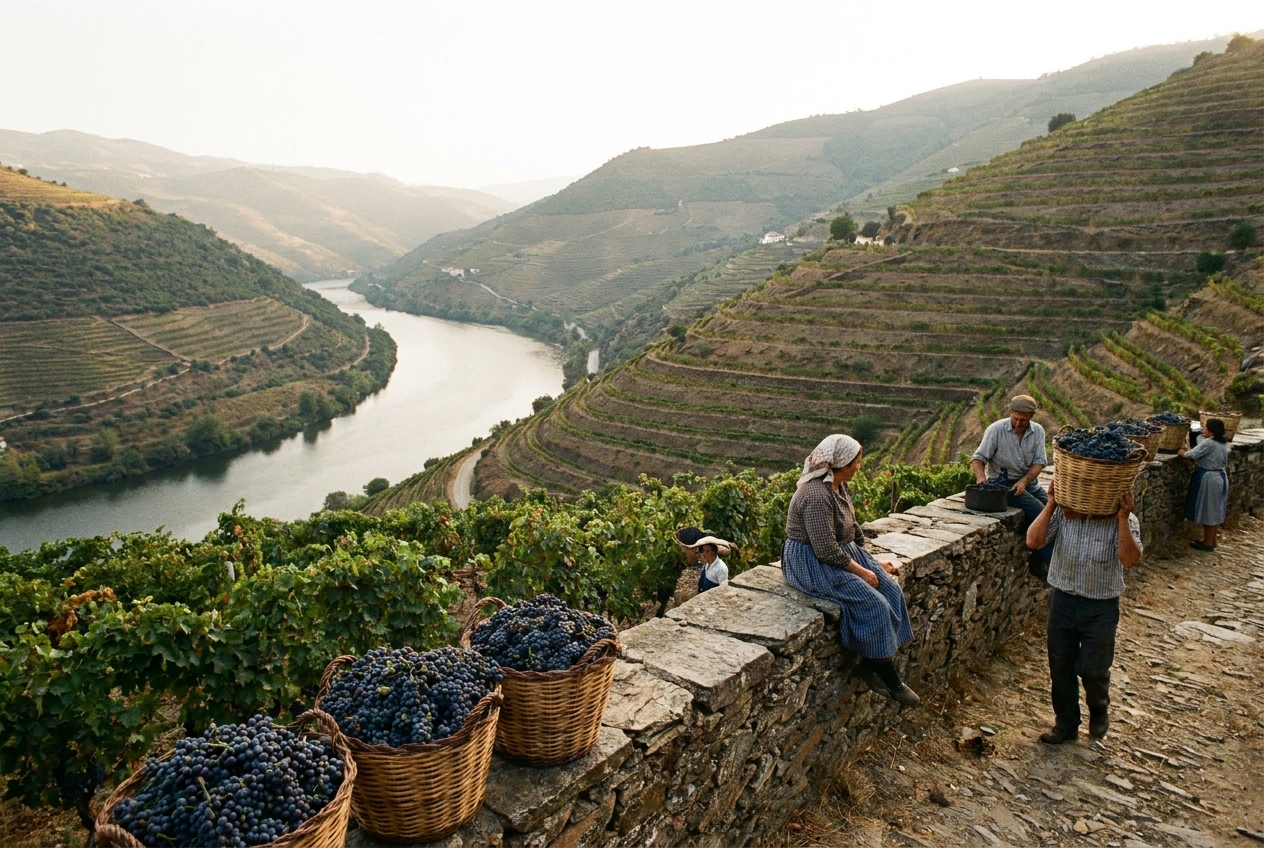
The Douro Valley. Ninety minutes inland from Porto, the world’s oldest demarcated wine region (1756) — terraced vineyards stacked above a winding river, quintas that host tastings and harvest visits in September–October. Doable as a Porto day trip; better as an overnight.
The Algarve. The southern coast: golden cliffs and sea caves around Lagos, the lagoon islands of the Ria Formosa in the east, surf beaches on the wild west coast. The warmest sea and the most sunshine in the country. Full region guide: The Algarve.
The Alentejo. The empty quarter between Lisbon and the Algarve — cork-oak plains, whitewashed hill towns like Évora and Monsaraz, serious wine, few tourists. Portugal’s best road-trip country; see renting a car in Portugal.
(Madeira and the Azores are Portugal too — Atlantic islands with their own climates and flight logistics. They deserve their own trip, and their own guides.)
When to come
The short version: May, June, September and early October hit the sweet spot of summer weather without August’s crowds and prices — and fall adds the grape harvest. August is peak everything (12.6 million lodging nights nationally); winter runs at a third of that, mild and rainy, with the almond blossom lighting up the Douro in February. The full month-by-month matrix, with temperatures, rain days and the real crowd curve: Best Time to Visit Portugal.
Getting in, getting around
Entry is simple: US citizens travel visa-free under the Schengen rules — up to 90 days in any 180-day window — with a passport valid at least three months beyond your departure from the Schengen area. Portugal sits at Level 1, the lowest tier of the State Department’s advisory scale.
Between cities, take the train: Lisbon–Porto runs in about three hours on the Alfa Pendular, city center to city center. For the Douro, the Alentejo and the Algarve’s corners, rent a car — Portugal’s highways are excellent and empty, your US license works for tourist stays, and the one genuine trap (boothless electronic tolls) is solved with a transponder from the rental desk. The full rulebook, including why you must reserve an automatic explicitly: Renting a Car in Portugal as an American.
Within Lisbon and Porto, walk and ride: both metros are clean and simple, and Lisbon’s Vermelha line runs direct from the airport into town.
Money, language, and the small print
Portugal uses the euro. Cards are the norm in cities and tourist areas; keep some cash for small cafés and country markets. Tipping is modest — rounding up or a euro or two at a restaurant reads as generous, not stingy. English is widely spoken in the tourism economy, and the Portuguese switch to it graciously; a bom dia and obrigado still open doors. One heads-up for drivers staying central: Lisbon’s downtown runs a low-emission zone and near-impossible parking — collect the rental when you leave the city, not when you land.
Portugal for…
Couples. Lisbon’s miradouro sunsets and fado cellars, a Douro quinta with a river view, and the cliff coves west of Lagos. If the trip is an anniversary, spend the splurge night in the Douro, not the capital — it’s where Portugal slows down.
Families. Lisbon works surprisingly well (the Oceanário in Parque das Nações is one of Europe’s great aquariums, trams are a ride in themselves), then head south: the Ria Formosa’s shallow, warm lagoon beaches off Tavira are the country’s most child-friendly sand.
Food-first travelers. Come hungry: pastéis de nata eaten warm in Belém, grilled sardines in Alfama in summer, bacalhau in its proverbial 365 preparations, Porto’s gloriously excessive francesinha, percebes and clams down south, and two wine cultures (port in Gaia’s lodges, crisp vinho verde up north) for less than half the price of their French equivalents. The Time Out Market in Lisbon is the efficient sampler; the tascas around it are the real course.
Outdoors people. The Rota Vicentina’s coastal trails in the southwest, surf from Ericeira to Sagres, granite peaks and stone villages in the Peneda-Gerês national park up north — Portugal packs four terrains into a country smaller than Indiana.
Budget travelers. Portugal remains Western Europe’s best value: excellent meals under €15, espresso under €1.50 outside the tourist core, and the €1.85 metro fare. You’ll feel the difference from France or Italy at every till.
What things cost, honestly
Think in three tiers. Lean (hostels or simple guesthouses, tascas, transit): comfortable on roughly €60–90 a day per person. Middle (boutique hotels, one nice restaurant a day, a rental car split two ways): €150–250. High (five-star Avenida da Liberdade, Douro wine hotels, tasting menus): Portugal’s ceiling is real but still ~30% below Paris prices for the equivalent room. The big seasonal swing is lodging: August rooms in the Algarve can run double their May price — one more argument for the shoulder months. (Ranges are editorial orders of magnitude, not quotes; they move with season and city.)
The mistakes first-timers make
Overpacking the itinerary. Lisbon + Porto + Douro + Algarve in one week means living in transit. Pick two. Driving into old Lisbon. The center is a low-emission zone with near-zero parking — collect the car on your way out (our car guide explains the toll trap too). Skipping reservations for the famous fado houses and Belém’s big sights in summer. Treating the Atlantic like the Mediterranean. The waves and currents are real; swim on flagged beaches. And underestimating the hills — Lisbon is a workout in cute disguise; pack actual walking shoes, not just sandals.
A first-timer’s week, sketched
Days 1–3: Lisbon — one day for Alfama and the castle hill, one for Belém and the riverfront, one for the Baixa–Chiado–Príncipe Real axis. Day 4: Sintra. Day 5: train to Porto, evening on the Ribeira. Day 6: port lodges in Gaia, azulejos and bookshops. Day 7: Douro day trip, or fly home from Porto. Swap the northern half for an Algarve wind-down if the trip is about coast: three nights around Lagos or Tavira instead. Either way — fly into one city, out of the other, and skip the backtrack.
Sources & data for this guide
- Entry rules for US citizens — Schengen 90/180 and passport validity — europa.eu and travel.state.gov — checked Aug 31, 2026
- Travel advisory Level 1 — State Department advisories — checked Aug 31, 2026
- Crowd seasonality — Eurostat monthly nights, Portugal — checked Aug 31, 2026
- Driving and license rules — US Embassy Portugal — checked Aug 31, 2026
- Douro demarcation (1756), harvest tourism — Turismo de Portugal — checked Aug 31, 2026