
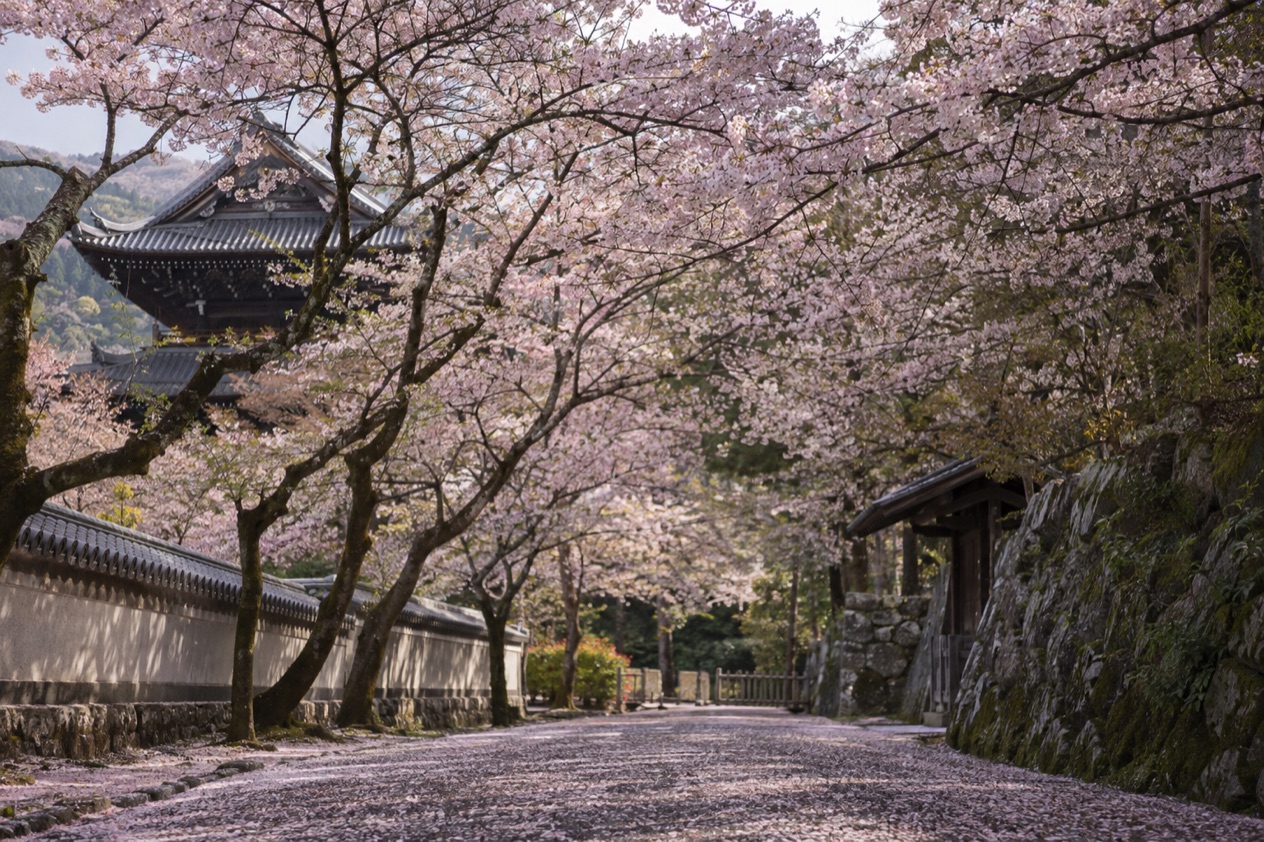
Under a row of Somei-Yoshino trees, office workers spread blue tarps, open bento boxes and pass around cups of tea, a gathering known as hanami, or flower viewing. The question that comes up long before anyone sits down is when the petals will actually open. Blossom in Japan arrives in late March in the big southern and central cities, then travels north into May.
When do the cherry blossoms bloom in Japan?
In Tokyo, Kyoto and Osaka the cherry blossoms usually open in the last week of March and reach full bloom in the first days of April. Those are the usual dates for each city, and from one spring to the next the real dates slide earlier or later by a week or two.
Two words come up in every forecast. Kaika is the first bloom, recorded by the Japan Meteorological Agency as the first day on which five or six or more flowers are open on a sample tree.
Mankai is full bloom, the first day on which about 80 percent or more of the buds are open. The tree observed is mainly the Somei-Yoshino. Where it does not grow, the agency watches the Hikan-zakura in Okinawa and Amami and the Ezo-yamazakura in Hokkaido.
Usual dates in the three most visited cities
Tokyo usually sees its first flowers around March 24 and full bloom around March 31. Kyoto follows a little behind, with first bloom around March 26 and full bloom around April 4. Osaka is almost the same as Kyoto, opening around March 27 and peaking around April 4.
In recent years Tokyo’s full bloom has landed anywhere from late March to early April, and Kyoto’s has ranged from the last week of March to the first days of April. A trip planned around a single date is a bet, while a trip that spans the last days of March and the first week of April covers the usual window in all three cities.
Other cities in the same window
Nagoya, Yokohama, Kobe, Nara and Hiroshima all fall in the same stretch. Nagoya usually reaches full bloom around April 2 and Yokohama around April 1. Kobe and Hiroshima come around April 3 to 5, and Nara matches Kyoto and Osaka at about April 4. A traveler who bases themselves in one of these cities and takes day trips to the others rarely has to choose between blossom and sightseeing.
| City | First bloom (usual date) | Full bloom (usual date) |
|---|---|---|
| Tokyo | March 24 | March 31 |
| Yokohama | March 25 | April 1 |
| Nagoya | March 24 | April 2 |
| Kyoto | March 26 | April 4 |
| Osaka | March 27 | April 4 |
| Nara | March 28 | April 4 |
| Kobe | March 27 | April 5 |
| Hiroshima | March 25 | April 3 |
How does the bloom move across the country?
The bloom travels from south to north, starting in Okinawa and Amami around mid-January and ending in eastern Hokkaido in mid-May. The Hikan-zakura open first in the far south. The Somei-Yoshino then reach Kyushu, Chugoku, Shikoku, Kinki, Tokai and Kanto in late March, Hokuriku and the southern Tohoku region around April 10, and move on through northern Tohoku.
That slow march gives a patient traveler a long season. Someone who misses the trees in Kyoto can still find them days or weeks later farther north, and someone arriving early can start in the south and follow the flowers up the map.
Kyushu and western Honshu
Fukuoka is among the first big cities to flower, with first bloom usually around March 22 and full bloom around March 31. Kagoshima opens around March 26 and peaks around April 5. Hiroshima peaks around April 3.
The Japan Sea side and the mountains
Kanazawa usually sees first bloom around April 3 and full bloom around April 8, a few days after Kyoto and Osaka are past their best. Nagano comes later still, with first flowers around April 11 and full bloom around April 16. A trip that starts in Tokyo or Kyoto and moves inland or up the coast can stretch the season by a week or more.
Tohoku and Hokkaido
Sendai usually reaches full bloom around April 13. Aomori follows, with first flowers around April 22 and full bloom around April 26. Hakodate is next, opening around April 28 and peaking around May 2.
Sapporo comes last of the big cities, with first bloom around May 1 and full bloom around May 6. In Hokkaido the trees are the Ezo-yamazakura, not the Somei-Yoshino, so the blossom feels like a different season from the one in Tokyo, arriving as the north shakes off winter.
| City | First bloom (usual date) | Full bloom (usual date) |
|---|---|---|
| Fukuoka | March 22 | March 31 |
| Kagoshima | March 26 | April 5 |
| Kanazawa | April 3 | April 8 |
| Nagano | April 11 | April 16 |
| Sendai | April 8 | April 13 |
| Aomori | April 22 | April 26 |
| Hakodate | April 28 | May 2 |
| Sapporo | May 1 | May 6 |
How do you plan around it?
Plan around a window, not a date, and pick the city whose usual full bloom matches the days you have. For the big central cities that means the last days of March into the first week of April, and for the north it means mid-April to early May.
Choosing a route
A classic first trip links Tokyo, Kyoto and Osaka, whose usual full blooms fall within about four days of each other. The spread in recent years, from late March to the first days of April in each city, means that one of the three may be early or late. Adding Nara, Kobe or Nagoya gives extra chances to catch a city at its peak.
For a longer trip, work with the map. Begin in Fukuoka or Hiroshima in the last week of March, move to Kyoto and Tokyo as the first days of April arrive, then continue to Kanazawa, Sendai or Nagano after the central cities fade. A traveler with a full two weeks can follow the flowers well into the third week of April.
Reading the season as it unfolds
Blossom forecasts are published in Japan in the weeks before the season, and the first-bloom announcement for each city is the signal that the clock has started. Full bloom usually follows within about a week of first bloom in the central cities, which is why the two dates in the tables sit so close together. Petals fall soon after, and a stretch of rain or wind can shorten the show.
A good habit is to leave a day or two of slack in the itinerary so that a change in the forecast does not wreck the plan. If the trees in one city are early, a day trip to another city often catches them at a different stage.
What to do under the trees
Hanami is the heart of it. Picnics beneath the branches, food stalls selling grilled skewers and sweet dumplings, seasonal drinks and sweets in cherry pink, and evening strolls under trees lit after dark all belong to the season. People simply walk along a river or a castle moat and let the petals drift down.
Good to know before you go
Spring days in Japan can swing from warm sun to a cool, wet evening, so a light layer is useful when sitting outdoors after dark. Rain can arrive during the blossom weeks and shortens the display, which is one more reason to leave a spare day in the plan. Carrying some yen for food stalls and small shops keeps hanami picnics simple.
Sources
- Japan Meteorological Agency, cherry blossom first-bloom dates 2021-2026 and 1991-2020 normal (https://www.data.jma.go.jp/sakura/data/sakura003_07.html), checked October 11, 2026
- Japan Meteorological Agency, cherry blossom full-bloom dates 2021-2026 and 1991-2020 normal (https://www.data.jma.go.jp/sakura/data/sakura004_07.html), checked October 11, 2026
- Japan Meteorological Agency, sakura2020.pdf (https://www.data.jma.go.jp/sakura/data/sakura2020.pdf), checked October 11, 2026
To plan your stay
- Japan Rainy Season (Tsuyu): Dates, Regions and How to Plan Your Trip
- Seasons in Japan: Blossoms, Fall Color, Snow Festivals and Summer Matsuri
- Typhoon Season in Japan: When It Hits, Which Regions Take the Brunt and How the Warning Alerts Work
- Autumn Leaves Dates by City: Usual Maple Dates, 2025 Results and How Much They Shift