
In Kyoto in spring, the talk at breakfast tables and in hotel lobbies turns to one question: are the trees open yet? People walk out with a thermos and a plastic sheet, looking for a patch of ground beneath the branches. For most visitors the answer starts at Maruyama Park, beside Yasaka Shrine in Gion, and continues at Daigo-ji, a temple in the Fushimi district with a garden of national standing.
Where are the best cherry blossom spots in Kyoto?
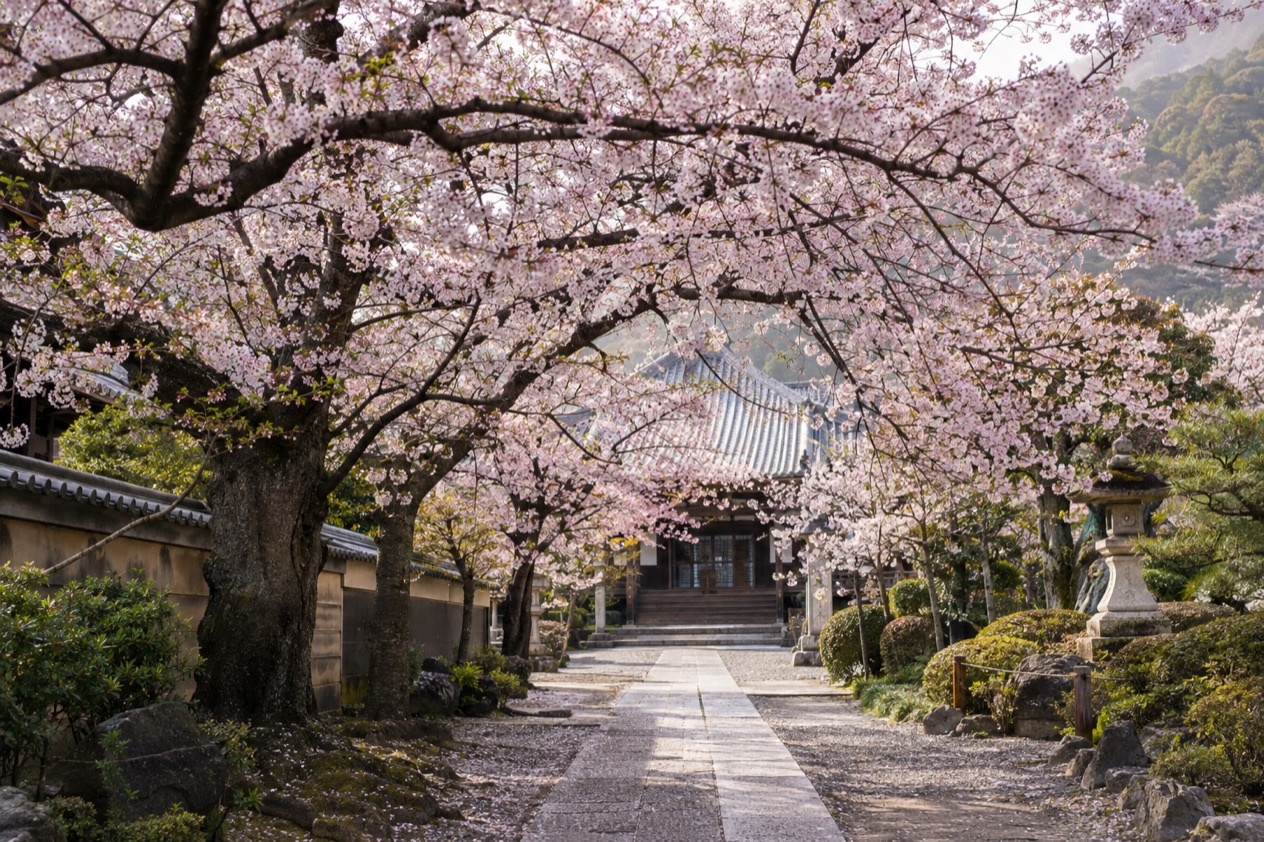
The best-placed spots for cherry blossoms in Kyoto are Maruyama Park, noted as the main center for blossom viewing in the city, and the temple grounds of Daigo-ji, together with the temples that line the foot of the eastern hills. Kyoto is a city of gardens, shrines and temple courtyards, so the blossoms are often found inside a larger visit rather than in a place built only for them.
The custom is called hanami, literally flower viewing. People gather under the trees to eat, talk and simply look up at the petals. A cherry tree in bloom is a short event, which is why the whole country follows it with such attention each year, and why a plan built around one or two places works better than a long checklist.
Maruyama Park and the Gion side of town
Maruyama Park is a nationally designated Place of Scenic Beauty, and it is the place most visitors have in mind when they say they want to see Kyoto’s cherry blossoms. You reach it through Yasaka Shrine, which sits at the eastern end of Shijo Street in the Gion District. That means a blossom walk can begin among the shrine’s buildings and lanterns before the path opens into the park.
The star of the park is a weeping cherry, a shidarezakura, whose long branches fall like a curtain. After dark it is lit up, and the pale pink of the petals glows against the black trees around it. Groups settle nearby, and the whole park takes on the mood of an open-air party that is also a quiet moment of admiration.
The park suits anyone who wants blossoms, a shrine and the streets of Gion in a single outing. It is also the spot where you should expect a crowd in April, since it can get extremely crowded then.
Chion-in and Shoren-in, next door
Directly to the north of Maruyama Park stands the vast temple of Chion-in, followed by the smaller temple of Shoren-in. Together with the park they make a chain of places to move through on foot, each with its own character: the park for open ground and the lit weeping cherry, Chion-in for scale, Shoren-in for a more intimate temple setting.
Because these sit one after another, you can treat them as one outing and let the day set its own rhythm. Pause under the trees, step inside a temple, then return to the park as evening comes and the lights come on around the weeping cherry.
Daigo-ji in Fushimi-ku
Daigo-ji is a Buddhist temple in Fushimi-ku and the head temple of the Shingon-shu Daigo-ha sect. It is one of the component parts of the UNESCO World Heritage Site Historic Monuments of Ancient Kyoto, a listing that covers Kyoto, Uji and Otsu. The Sambo-in garden here is designated by the Japanese government as both a Special Historic Site and a Special Place of Scenic Beauty.
The grounds hold a Five-Story Pagoda and a main hall, the Kondo, where a seated Yakushi Nyorai, the Buddha of healing, is the principal image. In spring the temple is a place to walk slowly among trees and buildings. In autumn the bright colors of the maple leaves bring visitors back to the same paths, so the same walk is worth making in two seasons.
Which are best known?
Maruyama Park is the one the sources single out, described as the main center for cherry blossom viewing in Kyoto, and its lit weeping cherry is its star attraction.
Why Maruyama Park comes first
The park’s position is part of the appeal. The entrance through Yasaka Shrine places you immediately in Gion, so the approach is already atmospheric before you see a single petal. From there the path leads to the weeping cherry, the tree that people photograph and talk about afterward.
The same tree also tells you something about the park after dark. Lighting turns it into an evening destination as well as a daytime one, and the lit branches give the park a second personality. The park is also busy at New Year’s Eve with festivals, so it plays a role in the city’s calendar well beyond the cherry season.
Daigo-ji for a temple-centered visit
Daigo-ji is a different kind of experience. It is a large temple complex, with separate parts that each have their own character. The Sambo-in and its garden, the museum, Shimo-Daigo and the higher area of Kami-Daigo each have a place in a visit, and the Kami-Daigo area, centered around the Kaisan-do and Nyoirin-do, sits well up the hillside.
A temple event is held at Oku-no-in, the inner sanctum, on the first Sunday in March. It comes before the usual blossom season, but it shows that Daigo-ji keeps a calendar of its own. For a traveler who prefers architecture and gardens to open lawns and picnics, this is a good fit.
Two ways to spend a blossom day
- A Gion day: enter through Yasaka Shrine, spend time in Maruyama Park, then continue north to Chion-in and Shoren-in.
- A temple day: head to Fushimi-ku and give Daigo-ji its own day, moving between the Sambo-in garden, the pagoda and the hall of the Kondo at your own pace.
What should you know before you go?
The main thing to know is that cherry blossoms follow the weather rather than the calendar, so the dates that matter are averages, not promises. Japan’s weather agency tracks two moments: first bloom, called kaika, and full bloom, called mankai. Both are measured on a sample tree, mainly of the Somei-Yoshino variety.
What first bloom and full bloom mean
First bloom is the first day on which five or six or more flowers are open on the sample tree. Full bloom is the first day on which about 80 percent or more of the buds are open. The two are not the same moment, and the gap between them is the stretch in which a tree goes from a few flowers to a full canopy.
For the wider region, the Somei-Yoshino reach Kyushu, Chugoku, Shikoku, Kinki, Tokai and Kanto in late March. Kyoto lies within Kinki, so late March is the broad landmark for the season there. How the blossoms actually fall from one spring to the next varies, so it makes sense to treat that timing as a starting point for planning rather than a fixed date.
Crowds at Maruyama Park
Maruyama Park can get extremely crowded in April. If your plans center on the park and the weeping cherry, expect to share the paths and the open ground with many other people, and treat the visit as a lively event rather than a solitary stroll.
The park is also a place that fills at other moments of the year, notably during the New Year’s Eve festivals. Knowing that the park has a busy calendar helps you see why it can feel so full when the trees are in flower.
Admission at Daigo-ji
At Daigo-ji, entering different parts of the temple requires separate admission. Entering Sambo-in proper, the museum and Shimo-Daigo share combined ticketing, while Kami-Daigo is separate. Because of this, it helps to decide which parts you want to see before you arrive, so the layout of the grounds shapes the order of your visit.
| Part of Daigo-ji | Ticketing |
|---|---|
| Sambo-in | Combined with the museum and Shimo-Daigo |
| Museum | Combined with Sambo-in and Shimo-Daigo |
| Shimo-Daigo | Combined with Sambo-in and the museum |
| Kami-Daigo | Separate admission |
Other blooms across Japan
Where the Somei-Yoshino does not grow, the weather agency watches other trees instead. In Okinawa and Amami the Hikan-zakura begins to bloom around mid-January, and in Hokkaido the Ezo-yamazakura takes its place.
Farther along, the Somei-Yoshino reach Hokuriku and the southern Tohoku region around April 10, then move through northern Tohoku and arrive in northern and eastern Hokkaido in mid-May. The wave of blossoms crosses the country over many weeks, which is why Kyoto’s moment is one stop on a longer journey.
Good to know before you go
Plan around the trees, not the date on the calendar. Both work well on foot and with a bag for a picnic, and both reward a return visit in another season, with Daigo-ji known for its maple leaves in autumn.
Sources
- Japan Meteorological Agency, sakura2020.pdf (https://www.data.jma.go.jp/sakura/data/sakura2020.pdf), checked October 11, 2026
- Wikipedia, Daigo-ji (https://en.wikipedia.org/wiki/Daigo-ji), checked October 11, 2026
- Wikipedia, Maruyama Park (https://en.wikipedia.org/wiki/Maruyama_Park), checked October 11, 2026
To plan your stay
- Japan Rainy Season (Tsuyu): Dates, Regions and How to Plan Your Trip
- Seasons in Japan: Blossoms, Fall Color, Snow Festivals and Summer Matsuri
- Typhoon Season in Japan: When It Hits, Which Regions Take the Brunt and How the Warning Alerts Work
- Autumn Leaves Dates by City: Usual Maple Dates, 2025 Results and How Much They Shift