
On the first warm afternoon of spring, blue tarps appear under the cherry trees in Japan’s parks, and office groups, families and friends settle in with food and drinks beneath the petals. That custom, hanami, is why people build whole trips around a flower that stays on the branch only briefly. The itinerary that works follows the sakura front as it travels up the archipelago, so you choose the region and the stretch of spring first, and the city second.
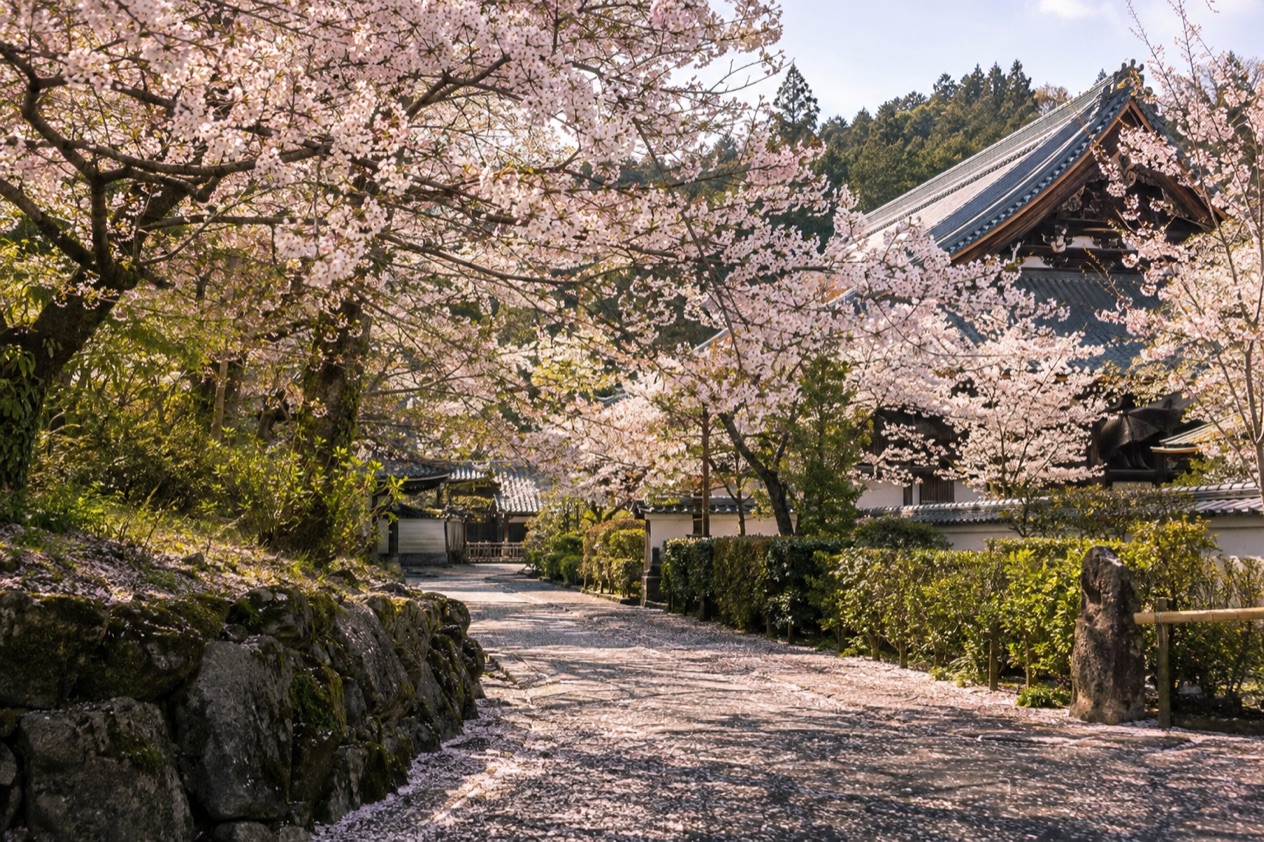
How do you plan a cherry blossom trip?
You plan it by following the bloom front: pick the region where the trees will be open when you arrive, and keep your dates loose enough to shift with the weather. The cherry blossom is the national flower of Japan and the heart of hanami, so the whole country watches the same question each spring, which is when the first flowers will open and when they will be at their fullest.
The Japan Meteorological Agency and the public track this movement as the sakura zensen, the cherry blossom front. It rides the arrival of warmer weather and slides north along the islands, which means a trip is really a decision about where on that line you want to stand.
What first bloom and full bloom mean
The forecasts you read use two terms. Kaika, first bloom, is the day the first flowers open on a sample tree that the agency watches. Mankai, full bloom, is the first day on which about 80 percent or more of the buds are open, and that is the moment travelers are chasing.
The tree being watched is mainly the Somei-Yoshino. Where it does not grow, the agency observes other kinds: the Hikan-zakura in Okinawa and Amami, and the Ezo-yamazakura in Hokkaido. A Yoshino cherry usually drops its petals within a week of flowering, before the leaves come out, so full bloom is a short window and worth aiming at squarely.
How the front moves across the country
| Region | When the blossoms usually arrive |
|---|---|
| Okinawa and Amami (Hikan-zakura) | Around mid-January |
| Kyushu, Chugoku, Shikoku, Kinki, Tokai and Kanto (Somei-Yoshino) | Late March |
| Hokuriku and southern Tohoku (Somei-Yoshino) | Around April 10 |
| Northern and eastern Hokkaido (Somei-Yoshino) | Mid-May |
Between the Hokuriku and Hokkaido stages, the blossoms pass through northern Tohoku, so the north is not a single date but a slow handover over several weeks. These are usual dates, not promises, and a spring that runs warm or cool will nudge them either way from one year to the next.
For planning, the useful habit is to treat the table as a starting point. Choose a region, aim for the middle of its usual window, and then watch the agency’s forecasts as your departure approaches so you can slide your days a little earlier or later.
Blossoms outside the main season
The main event is not the only one. The Kawazu cherry blooms from late February to early March, well ahead of the Somei-Yoshino. Some trees, called fuyuzakura, bloom between October and December, so a few flowers can turn up in the autumn months, though they are a curiosity and not the great spring show.
If you arrive after the petals have fallen, spring still has other flowers to offer. Japan’s tourism board points to tulips, wisteria and nemophila among the spring displays, which makes a useful fallback if the weather moves the bloom away from your dates.
Which cities fit the bloom?
Kyoto and Tokyo fit the bloom best for most trips, because cherry blossoms typically reach both at the beginning of April, and recent years have trended toward earlier flowerings near the end of March. They share a window, so one pair of weeks can cover the temple gardens of one and the parks of the other.
Tokyo and Kyoto in early April
With both cities blooming at about the same time, you can plan a single stretch of days and split them between the two. Tokyo’s parks and riverbanks fill with hanami groups once the trees open, and Kyoto’s temple grounds and canal-side paths take on the same soft pink. Each city rewards a slow walk under the branches more than a checklist of sights.
Because the trend is toward the end of March, a trip that starts in the last days of that month has a real chance of catching the opening, while one that starts a little later in April may find the petals already falling.
If you can only fix your dates far ahead, lean toward the turn of March into April and keep a day or two of slack so you can reorder which city you visit first once the forecasts firm up.
Earlier blossoms: Okinawa and the Kawazu cherries
Okinawa is where the Japanese cherry season begins, with the Hikan-zakura blooming from January. These are a different tree from the Somei-Yoshino, and a trip in the winter months is a way to see sakura when the rest of the country is still waiting.
Another early option is the Kawazu cherry, which blooms from late February to early March. It fills the gap between winter and the main season, and it suits a traveler who wants blossoms without waiting for the front to reach the big cities. You can then see the main display later in the season if your plans stretch that far.
Later blossoms: Hokuriku, Tohoku and Hokkaido
If you miss the bloom in Kyoto and Tokyo, the front is still moving. Hokuriku and the southern Tohoku region come around April 10, and the front then passes through northern Tohoku before it reaches northern and eastern Hokkaido in mid-May. The cherry blossom front arrives in Hokkaido a few weeks after Kyoto and Tokyo.
This is the answer for a traveler whose dates are fixed later in spring. Heading north lets you meet the blossoms where they are just opening, and in Hokkaido the observed tree is the Ezo-yamazakura, not the Somei-Yoshino.
Other spring flowers can fill the days around it. Hitachi Seaside Park is praised for its blue nemophila against sea and sky, Grinpa has a sea of tulips with Mount Fuji behind, and Tonami Tulip Park in Toyama has a vast spread of colors. Kawachi Fujien Wisteria Garden has tunnels of purple, blue and white wisteria.
How many days do you need?
You need enough days to stay in one region through its blooming window, with a couple of spare days in case the weather shifts the flowers. A tree is open only briefly, so the length of the trip matters less than whether your days sit on top of the bloom.
Think in terms of how much of the front you want to cross. A trip that stays in one place needs the fewest days. A trip that moves with the front needs more, because you are stretching your time along the same line the blossoms follow over several weeks.
A single-region stay
The simplest plan is to choose Kyoto and Tokyo, or any region in the late March group, and stay through the stretch when the trees are open. Because the Yoshino flowers fall within a week, even a short window gives you the chance to see the buds, the full bloom and the first petals drifting down.
A few extra days on either side give you a margin. If the flowers come early, you are already there, and if they run late, you have time to wait without cutting the rest of your trip. Parks are the setting for hanami, so build in unhurried afternoons, not a schedule of sights packed back to back.
Two regions in one trip
A second option is to pair the main bloom with a region that blooms either earlier or later. You might start in Kyoto and Tokyo around the end of March or the start of April, then move north to Hokuriku or southern Tohoku, where the blossoms usually arrive around April 10. This gives you a second chance if your first stop is early or late.
It also lets you see how the front changes the look of spring. A city just past its peak has petals on the ground and leaves coming out, while one farther along the line is just opening. A trip with two stops therefore gives two different moods of the same flower.
Following the front north
The most ambitious itinerary follows the front from the main islands up to Hokkaido, which takes several weeks because the blossoms reach northern and eastern Hokkaido only in mid-May. It is the plan for someone with a long stretch of time and an interest in seeing the whole movement, from Kanto and Kinki in late March up through Tohoku.
Even a shorter version works. Pick a start in Kyoto or Tokyo, then continue to a later-blooming region as your days allow. In the spring months, the countryside has other flowers, too: the tulips, wisteria and nemophila mentioned earlier can bridge the gaps between one bloom and the next.
Good to know before you go
Hanami is a centuries-old habit of eating and drinking beneath blooming trees, so the pleasure of the season lies in the sitting as much as in the looking. Because the bloom depends on the weather, the usual dates in this itinerary are a guide, and the best preparation is to leave a day or two of slack. If you travel in autumn, a handful of fuyuzakura may flower from October to December, and in October the Tonami Yumenotaira field in Toyama shows its cosmos flowers.
Sources
- Japan Meteorological Agency, sakura2020.pdf (https://www.data.jma.go.jp/sakura/data/sakura2020.pdf), checked October 11, 2026
- Japan National Tourism Organization, flowers by season: cherry blossom, plum, wisteria, hydrangea, where and when (https://www.japan.travel/en/see-and-do/flowers/), checked October 11, 2026
- Wikipedia, Cherry blossom (https://en.wikipedia.org/wiki/Cherry_blossom), checked October 11, 2026
To plan your stay
- Japan Rainy Season (Tsuyu): Dates, Regions and How to Plan Your Trip
- Seasons in Japan: Blossoms, Fall Color, Snow Festivals and Summer Matsuri
- Typhoon Season in Japan: When It Hits, Which Regions Take the Brunt and How the Warning Alerts Work
- Autumn Leaves Dates by City: Usual Maple Dates, 2025 Results and How Much They Shift