
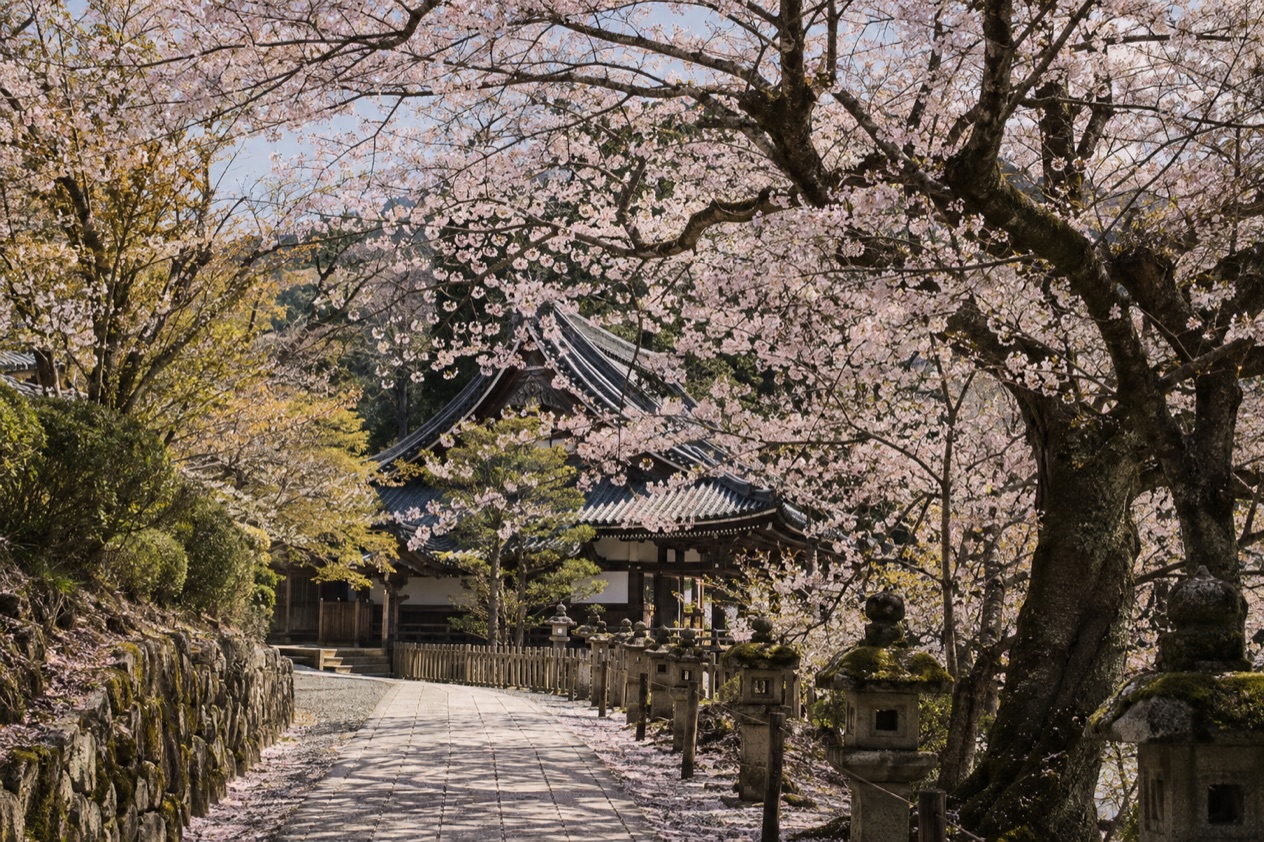
Pale petals drift onto the water of the old moat, and people stop on the stone bridges just to watch them turn slowly in the current. In Kanazawa, spring has a particular look, with cherry branches hanging over castle walls, garden ponds and tiled rooftops of a city that was once a great center of art and craft. A visit built around the blossoms depends on timing, and the dates here run from late March into early April.
When do the cherry blossoms bloom in Kanazawa?
In recent years the whole show has sometimes started in the last week of March, so the window is wide enough that a trip planned for one fixed weekend is a gamble.
| Stage | Usual date | Range in recent years |
|---|---|---|
| First bloom (kaika) | April 3 | March 23 to April 1 |
| Full bloom (mankai) | April 8 | March 29 to April 8 |
First bloom and full bloom
Japanese forecasts use two markers. Kaika, first bloom, is the day the first flowers open on the reference trees. Mankai, full bloom, is when most of the blossoms on those trees are open, and that is the moment people usually have in mind when they say the cherry blossoms are out.
Between them the branches go from a scattering of flowers to a pale cloud, so even a short stay can catch trees in very different states. People like the in-between days too, when buds and open flowers share the same branch.
How much the dates move from one spring to the next
The range in the table tells the real story. First bloom has arrived as early as the last week of March, and full bloom has landed anywhere from the end of March to the second week of April. A warm early spring pulls everything forward, and a cool one holds the trees back.
For planning, that means thinking in terms of a window rather than a date. A trip that spans the turn from March to April gives you the best chance of meeting the trees at some stage of bloom. Local forecasts, published through the spring, narrow the picture as the season approaches.
After full bloom: the petal snow
Once the flowers pass their peak, petals begin to fall in drifts. The Japanese call this hanafubuki, a blizzard of petals, and it collects on paths, covers pond surfaces and sticks to the shoulders of passersby. Some travelers think this stage is as beautiful as the bloom itself.
Floating petals are especially striking on water, and Kanazawa has plenty of it, from garden ponds to the moats around the castle grounds and the rivers that run through the city. If you arrive a little after the full bloom, expect this kind of scene rather than a disappointment.
Where can you see them in Kanazawa?
The best-known places to look for blossoms in Kanazawa are Kenrokuen Garden and Kanazawa Castle Park, which sit side by side as the city’s central green space, with the rivers and older quarters offering quieter looks at spring. Kenrokuen is one of Japan’s most iconic landscape gardens, and spring is a natural moment to walk its paths.
Kenrokuen Garden
Kenrokuen is a stroll garden, designed to reveal itself as you walk: ponds, stone lanterns, bridges, hills, tea houses and carefully shaped pines with ropes fanning out from their trunks. Cherry trees add soft color to this composition, and when they are in bloom the garden’s reflections in the water turn pale pink.
Free admission is offered to Kenrokuen Garden, which makes it easy to fit into a day without planning around a ticket. It is a garden worth slowing down in. Pause at the ponds, follow the paths past the tea houses and let the blossoms frame the view rather than chasing a single photo spot.
Kanazawa Castle Park
Kanazawa Castle Park spreads out around the reconstructed castle buildings, with white-plastered walls, stone foundations, wide lawns and broad open spaces that suit a leisurely picnic under the trees. The grounds are large enough to wander for a good while, and the contrast of pink branches against pale walls and dark roof tiles is what many photographs of Kanazawa in spring capture.
Kanazawa Castle Park and Kenrokuen Garden are both illuminated at night, as promoted by the Kanazawa Tourist Information Guide. That gives you a second way to see the blossoms: after dark, with lit branches glowing against the sky, a very different mood from daytime.
Rivers, old quarters and the rest of the city
Away from the garden and castle, spring in Kanazawa is a matter of small discoveries. Cherry trees lean over the banks of the Sai and Asano rivers, and the old teahouse districts, with their lattice-fronted wooden houses and quiet lanes, are a gentle backdrop for the flowers. Walking with no fixed destination is a good way to find them.
Kanazawa was one of the most important cultural and artistic centers in Japan during the Edo period, and it still rewards visitors interested in art and culture. Between blossom walks you can step into museums, craft workshops and tea rooms. They offer a place to rest when you have had enough of the outdoors.
What should you know before you go?
The most useful thing to know is that the blossoms keep their own schedule, so build flexibility into the trip and look for the forecast as spring gets closer. Beyond that, getting to Kanazawa is straightforward, and a few habits of cherry blossom viewing will make the visit smoother.
Getting to Kanazawa
Kanazawa is the capital of Ishikawa Prefecture, on a narrow strip of land along the Sea of Japan on Honshu, Japan’s main island. The Hokuriku Shinkansen serves the city and shortens the trip from Tokyo to around two and a half hours, which puts Kanazawa within reach of a first visit to Japan.
The nearest airport is Komatsu Airport, in the city of Komatsu. If you are flying in rather than taking the train, it is the airport that serves Kanazawa, so look for it when you compare itineraries.
Planning around an unpredictable bloom
Because first bloom has ranged across more than a week in recent years, staying a few nights gives you more chances than a single day trip. A longer stay lets you shift your garden and castle visits to match what the trees are doing, and keep the museums and old quarters for the days when petals have not yet opened or have already fallen.
If you are pairing Kanazawa with other cities, remember that blossom dates differ from place to place. Do not assume the stage you saw in one city holds for the next. Treat each stop as having its own spring.
Hanami habits
Hanami, the custom of gathering under blooming trees, is part of the season. People spread out sheets on the grass, share seasonal snacks and drinks, and linger as the light changes. Picnics under the trees are a gentle ritual, so bring a relaxed pace and take your time rather than ticking off sights.
A few habits keep things pleasant for everyone: take your rubbish with you, keep to the paths and lawns where people are sitting, and avoid touching or shaking the branches. Cherry blossoms last only days, and the trees are there for everyone to enjoy.
Other seasons in the same places
If the blossoms do not line up with your dates, the same gardens and streets have their own autumn moment. Maple leaves in Kanazawa usually change color in late November, and the garden’s ponds and lanterns suit that season just as well as they suit spring. It is a different palette, with reds and golds in place of pink.
Good to know before you go
Spring days in Kanazawa can swing between sun and cloud, so a light layer in the bag is a sensible habit for long hours outdoors. Carry some yen for small purchases along the garden paths and at tea houses, and keep an eye out for the city’s illuminations when you plan an evening. Cherry blossom season is a short one, so give yourself room to change the plan from day to day.
Sources
- Japan Meteorological Agency, cherry blossom first-bloom dates 2021-2026 and 1991-2020 normal (https://www.data.jma.go.jp/sakura/data/sakura003_07.html), checked October 11, 2026
- Japan Meteorological Agency, cherry blossom full-bloom dates 2021-2026 and 1991-2020 normal (https://www.data.jma.go.jp/sakura/data/sakura004_07.html), checked October 11, 2026
- Japan National Tourism Organization, Kanazawa (https://www.japan.travel/en/destinations/hokuriku-shinetsu/ishikawa/kanazawa-and-around/), checked October 11, 2026
- Kanazawa Tourist Information Guide (https://www.kanazawa-tourism.com/), checked October 11, 2026
- Wikipedia, Kanazawa, Ishikawa (https://en.wikipedia.org/wiki/Kanazawa,_Ishikawa), checked October 11, 2026
- Japan Meteorological Agency, maple color-change dates 2025-2026 with difference from the 1991-2020 normal (https://www.data.jma.go.jp/sakura/data/phn_014.html), checked October 11, 2026
To plan your stay
- Japan Rainy Season (Tsuyu): Dates, Regions and How to Plan Your Trip
- Seasons in Japan: Blossoms, Fall Color, Snow Festivals and Summer Matsuri
- Typhoon Season in Japan: When It Hits, Which Regions Take the Brunt and How the Warning Alerts Work
- Autumn Leaves Dates by City: Usual Maple Dates, 2025 Results and How Much They Shift