
On a spring evening in Osaka, office workers spread plastic sheets under the trees, passing around boxes of takoyaki and cans of something cold while petals drift onto the sheets. The ritual is called hanami, flower viewing, and the city treats it as a seasonal appointment. Osaka’s cherry trees usually open at the very end of March and reach full bloom in the first days of April.
When do the cherry blossoms bloom in Osaka?
Osaka’s cherry blossoms usually begin to open in the last days of March, and full bloom follows about a week later, in the first days of April.
| Stage | Usual date | Range in recent springs |
|---|---|---|
| First bloom (kaika) | March 27 | March 19 to March 30 |
| Full bloom (mankai) | April 4 | March 27 to April 6 |
Kaika is the day the first blossoms open on the reference tree, and mankai is the day most of the blossoms on it are open. Those two words are the ones you will hear on Japanese weather broadcasts and see on bloom forecast maps, so they are worth recognizing.
How much the dates move
The dates shift from one spring to the next. In recent years first bloom has come as early as the third week of March and as late as the final days of the month, and full bloom has landed anywhere from the very end of March to the first week of April.
So think of the usual dates as the center of a window rather than an appointment. A trip planned around the turn of March into April sits inside that window in most years, and the first days of April are the usual moment for the trees to be fully open.
What the weeks around full bloom feel like
Hanami is a social season as much as a botanical one. People gather under the trees with bento boxes, snacks and drinks, and shops fill with pink packaging and sakura-flavored sweets, from mochi wrapped in a salted cherry leaf to seasonal lattes and soft serve. Convenience stores and department store food halls lean into the theme for weeks.
Osaka is a city known for its food, entertainment and nightlife, and that shapes the way spring is spent here. A day of walking under blossoms slides easily into an evening of okonomiyaki, kushikatsu or a few rounds of takoyaki, and the mood is relaxed and chatty rather than formal.
After the petals fall
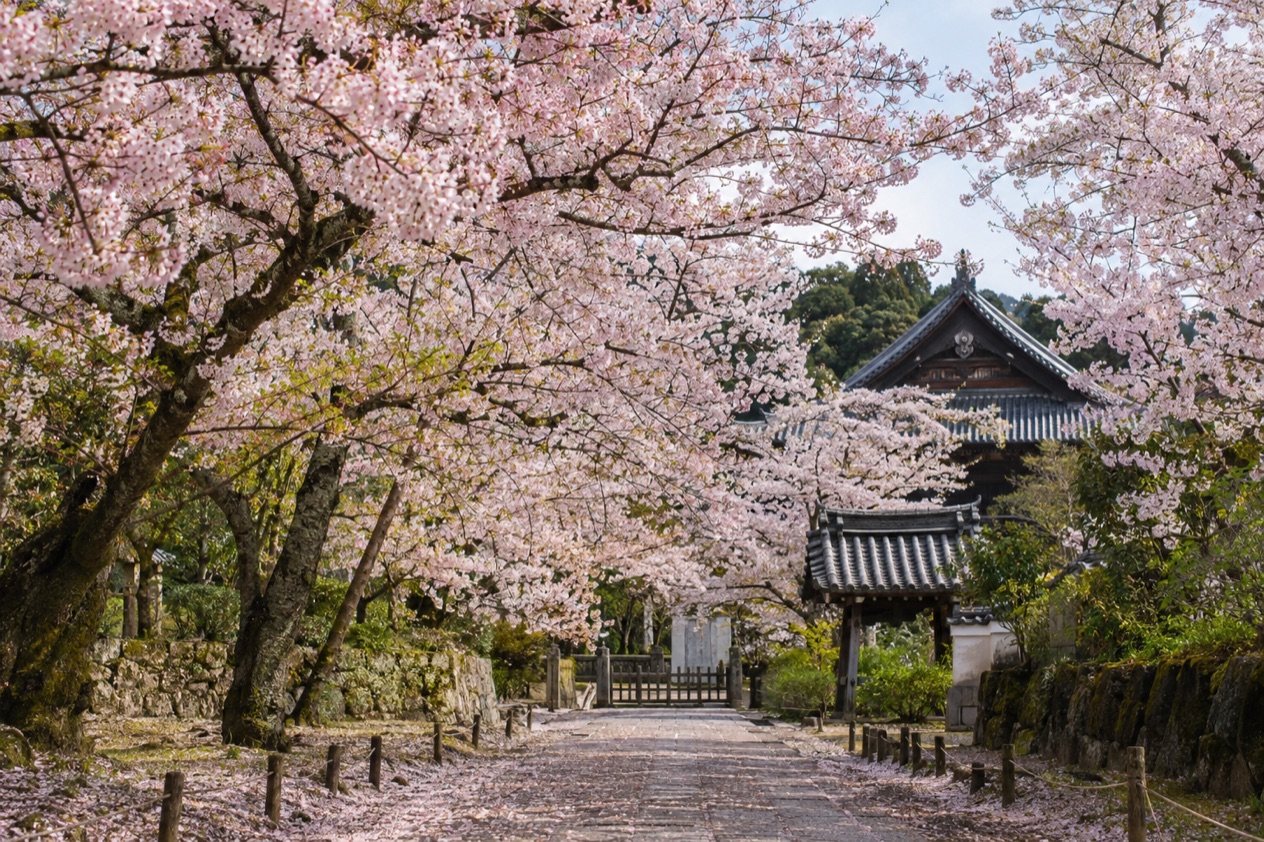
When the petals come down, they pile at the edges of paths and float on moats and rivers in pale drifts, a moment the Japanese call hanafubuki, a blossom blizzard. It is a fleeting scene and a favorite with photographers.
Where can you see them in Osaka?
You find cherry trees across Osaka in castle grounds, along riverbanks and in city parks, and the usual way to build a day is to pair a blossom walk with one of the city’s districts. Specific trees and viewing hours vary from one park to the next, so this is a guide to the kinds of places that suit hanami and to the districts that fit around them.
Parks, castle grounds and riverbanks
Osaka Castle Park is the name travelers associate with spring blossoms in the city. The castle keep rises above a wide park with moats and stone walls, and cherry trees are part of its seasonal picture. Under them you see the classic hanami scene, with groups on sheets, bento boxes open and the keep in the background.
Riverbanks are the other setting to look for. The Okawa riverside around Sakuranomiya, whose name literally refers to cherry blossoms, is a place where Osaka residents walk along the water under rows of trees. The Mint Bureau’s garden walkway nearby is also known for its blossoms. Rivers give a different feel from the castle, more of a stroll and less of a picnic ground.
If rain falls on the day you planned, the blossoms can still be worth a walk, since wet petals on dark branches make a different picture.
Dotonbori and Shinsaibashi after a day of blossoms
Dotonbori and Shinsaibashi are districts in Osaka, and they make a natural evening after a day among the trees. Dotonbori is the neon-lit canal-side stretch of food stalls and restaurants, and Shinsaibashi is the shopping area beside it. Come here for the street food and the lights rather than for the blossoms themselves.
From Osaka or Umeda Station, the Midosuji Line runs to Shinsaibashi Station, which puts you in both Shinsaibashi and Dotonbori. You can also stay on the Midosuji Line until Namba Station to reach Dotonbori. A crab sign, a giant octopus lantern and a row of takoyaki stands are the kind of sights you meet along the canal.
Osaka Bay for a change of scene
Osaka Bay lies in Osaka, a major port city in the Kansai region. It is reached from Osaka or Umeda stations via the JR Loop Line and the Chuo subway line. The bay area is the part of the city where Universal Studios Japan stands, home to attractions such as the Wizarding World of Harry Potter.
It suits a day when you want something other than blossoms, perhaps with children or a group that wants a theme park. It also makes a contrast with the old castle grounds, since the harbor side is built for amusement rather than for flower viewing.
What should you know before you go?
The main thing to know is that bloom timing decides the trip, so aim for the turn of March into April and stay flexible about the exact days. Beyond that, getting into the city and moving between districts is straightforward to plan from the rail routes below.
Reaching Osaka by train
From Tokyo, the Tokaido-Sanyo shinkansen runs to Shin-Osaka Station, and the journey takes about two and a half hours. For travelers this is the leg that links a Tokyo stay to a Kansai spring, with a window seat for the countryside in between.
From Shin-Osaka Station, you take the JR local line to Osaka Station. Osaka Station and Umeda Station are where the Midosuji Line, the JR Loop Line and the Chuo subway line connect you to the districts described above, so this is the junction around which most days are built.
Planning around the bloom
Because first bloom has fallen anywhere from the third week of March to the end of the month, and full bloom anywhere from the end of March to the first week of April, a stay of several days gives you more chances to catch the trees open. A short visit on a single date is a bet, while a longer one lets you adjust to the weather.
Watching the bloom forecasts in the weeks before departure helps. Japanese media report kaika and mankai city by city as spring unfolds, and those reports tell you whether the trees are running early or late in a given year.
Building a day around hanami
A hanami day works well as a loose sequence. Start with a walk under trees at a castle park or along a river, pick up seasonal snacks from a shop or a stall, and let the afternoon stretch as the groups around you do. Evening then moves naturally to the food districts.
Osaka’s reputation as a relaxed, charming city fits this rhythm. There is some history and culture to discover between meals, and the blossoms simply add a seasonal layer to a city that is already built around eating and going out.
Good to know before you go
Spring in Osaka rewards flexibility, since the trees follow the weather rather than the calendar, and a few open days in the plan let you chase the bloom. Bring a light layer for evenings under the trees and keep some room in your schedule for a rainy afternoon. Seasonal sweets and picnic food are part of the fun, so leave some appetite for them.
Sources
- Japan Meteorological Agency, cherry blossom first-bloom dates 2021-2026 and 1991-2020 normal (https://www.data.jma.go.jp/sakura/data/sakura003_07.html), checked October 11, 2026
- Japan Meteorological Agency, cherry blossom full-bloom dates 2021-2026 and 1991-2020 normal (https://www.data.jma.go.jp/sakura/data/sakura004_07.html), checked October 11, 2026
- Japan National Tourism Organization, Osaka (https://www.japan.travel/en/destinations/kansai/osaka/), checked October 11, 2026
- Japan Meteorological Agency, maple color-change dates 2025-2026 with difference from the 1991-2020 normal (https://www.data.jma.go.jp/sakura/data/phn_014.html), checked October 11, 2026
To plan your stay
- Japan Rainy Season (Tsuyu): Dates, Regions and How to Plan Your Trip
- Seasons in Japan: Blossoms, Fall Color, Snow Festivals and Summer Matsuri
- Typhoon Season in Japan: When It Hits, Which Regions Take the Brunt and How the Warning Alerts Work
- Autumn Leaves Dates by City: Usual Maple Dates, 2025 Results and How Much They Shift