
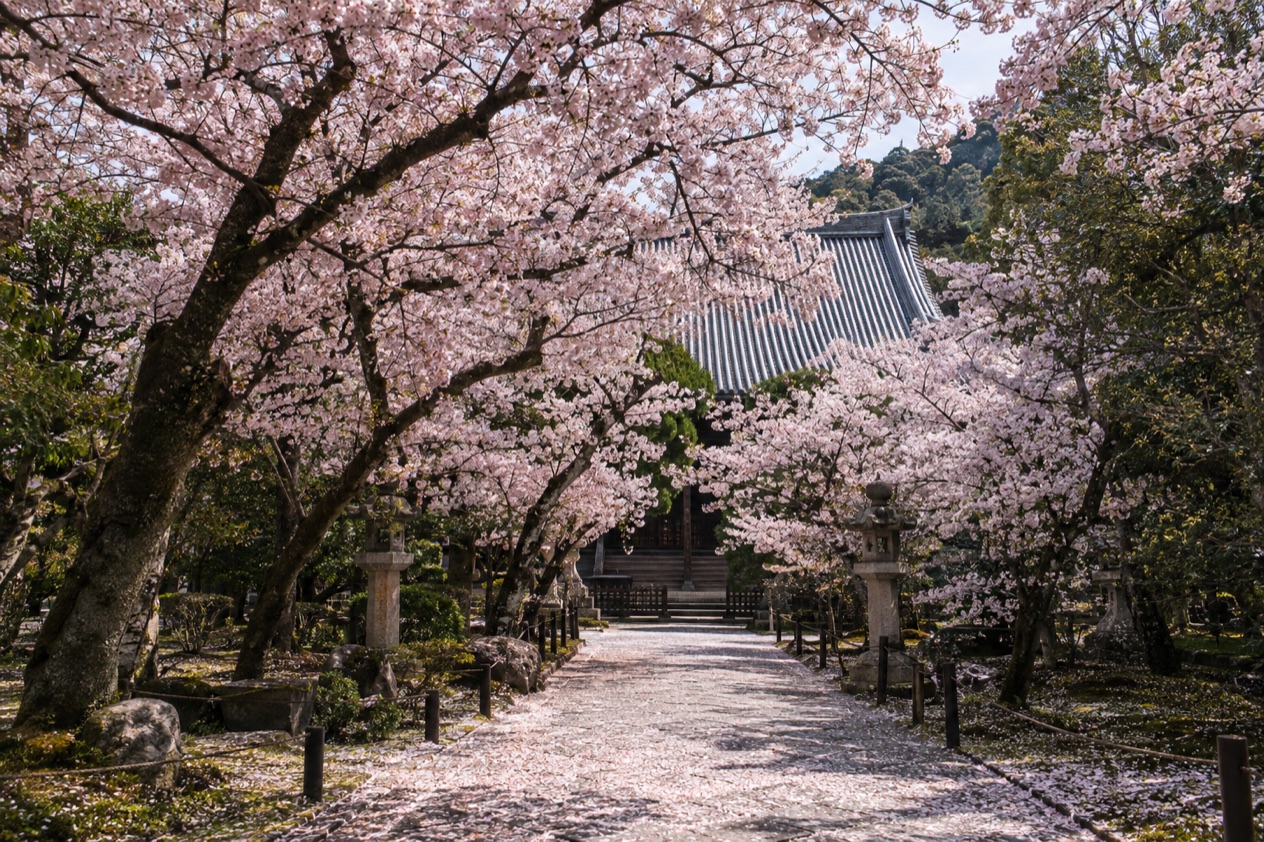
Under the trees at the foot of Mount Wakakusa, families spread picnic sheets on the grass while a deer wanders past, nose raised toward someone’s rice ball. Petals drift onto the sheets, the paths and the backs of the animals.
When do the cherry blossoms bloom in Nara?
The cherry blossoms in Nara usually begin to open at the very end of March and reach full bloom in the first days of April. The Japan Meteorological Agency tracks both moments for Nara, the first flowers (kaika) and the full bloom (mankai), and the dates below are the usual ones for the city.
| Stage | Usual date | Range in recent springs |
|---|---|---|
| First bloom (kaika) | March 28 | March 20 to March 31 |
| Full bloom (mankai) | April 4 | March 27 to April 8 |
The second column is the date that anchors most plans. The third is a reminder that spring in Nara does not keep a calendar. A warm stretch in March pulls everything forward, a cold one holds the buds back.
How a bloom unfolds in Nara
Kaika is declared when the first blossoms open on the reference trees, and at that point the branches still look mostly bare, dotted with pale pink. Over the following days the trees fill in until mankai, when the flowers cover most of the branches and the whole park turns a soft white and pink. It is the stretch around full bloom that people mean when they say they want to see the cherry blossoms.
Then comes hanafubuki, the petal storm. When the flowers start to fall, a breeze is enough to send them swirling across lawns and paths, and the ground takes on its own pink carpet. Many Japanese travelers love this moment as much as the full bloom, so a visit that lands a little after the peak is not a lost one.
Planning around a moving date
Because the range between an early and a late spring is wide, a trip built around one fixed day is a gamble. A stay that straddles the turn from March to April gives you the best odds of catching the trees in flower, since both the usual first bloom and the usual full bloom fall within a week of that turn. Forecasts of the bloom, published in Japan every spring, tighten the picture in the weeks before you travel.
Nara also has a second color season. The maples here usually turn around the third week of November, so the city is worth a thought in autumn too, with red leaves taking the place of pink petals along the same kind of park paths.
Where can you see them in Nara?
The place to start is Nara Park, which sits at the foot of Mount Wakakusa and is reached from both Nara Station and Kintetsu Nara Station. It is the city’s open green heart, a wide landscape of lawns, ponds, old trees and temple grounds, and in spring it is where people go to walk beneath the flowers.
Nara Park and its deer
What sets a Nara hanami apart is the company. The park is home to tame deer that visitors can approach and feed with crackers sold along the roadside. In blossom season you see them stepping across fallen petals, lying in the grass beside picnickers and looking up whenever a paper bag rustles. It makes for photographs you will not get in Kyoto or Tokyo.
The setting also matters. Mount Wakakusa rises behind the park as a smooth, grassy backdrop, and the pink of the trees plays against the dark wood of the temple and shrine buildings that stand among the lawns. Plan to wander without a fixed route, following whichever path looks the prettiest, and let the park set your pace.
Naramachi, the old merchant quarter
Naramachi is also reached from Nara Station and Kintetsu Nara Station, and it makes a change of mood from the open park. It is an old townscape of lanes, wooden houses and small shops, the kind of place where you drift in and out of craft stores and cafés rather than follow a list of sights.
Pair the two in one day. Spend a stretch of the day among the trees and the deer at Nara Park, then walk into Naramachi for lunch and a slow afternoon. In spring, sakura sweets are the seasonal treat to look for, such as sakura mochi (a pink rice cake wrapped in a salted cherry leaf) and tea or lattes flavored with blossom.
How to hanami the Japanese way
Hanami simply means flower viewing, and in practice it is a picnic. In a park with deer, the habit is to keep food packed away and close to you, since the animals know exactly what a bag of crackers looks like.
If a picnic is not your style, the season has other ways in. You can simply stroll, stop for a seasonal sweet, or sit with a coffee and watch the petals fall. The trees are the main event, and any unhurried way of being near them counts as hanami.
What should you know before you go?
Nara is in the Kansai region, east of Osaka and south of Kyoto, and it is reached by train from both cities. That position makes it a natural pairing with a Kyoto or Osaka stay, though a night in Nara itself lets you see the park when the day trippers have gone.
Getting to Nara by train
Nara has two main stations, JR Nara Station and Kintetsu Nara Station. From Osaka, the JR Yamatoji rapid train serves JR Nara Station directly. From Osaka-Namba Station, the Kintetsu limited express reaches Kintetsu Nara Station in 35 minutes and costs 520 yen more than the regular express, which takes 5 minutes longer.
Which station you choose shapes your first steps. Both Nara Park and Naramachi are accessible from Nara Station and Kintetsu Nara Station, so either arrival puts you on the way to the blossoms.
Arriving from the airport
The closest airports to Nara are Osaka International Airport (Itami) and Kansai International Airport, both in Osaka Prefecture. Each is about one hour and fifteen minutes away by bus and train. Since both sit in the Osaka area, travelers arriving for the blossom season pass through Osaka first and continue to Nara by one of the rail routes above.
A flight that lands in the afternoon still leaves room for an evening in the city, and a first night in Nara or Osaka sets you up for a full day among the trees the next morning.
Timing the trip around the blossoms
The practical question is how to be in Nara when the trees are in flower. The usual dates sit at the end of March and the start of April, but the range across recent springs runs from the third week of March into the second week of April.
A flexible plan helps in another way. If you reach Nara a little before the full bloom, you see the trees filling in, and if you arrive a little after, you see the petal storm. Either version of the park has its own charm, and both come with the deer.
Good to know before you go
Blossom dates shift from one spring to the next, so treat the usual dates as a guide and keep your days in Nara loose. The deer in the park are tame, but they are still animals and they have a keen interest in the crackers sold along the roadside, so hold them with some care. A day that mixes the park, Naramachi and a seasonal sweet or two is a full spring day in Nara.
Sources
- Japan Meteorological Agency, cherry blossom first-bloom dates 2021-2026 and 1991-2020 normal (https://www.data.jma.go.jp/sakura/data/sakura003_07.html), checked October 11, 2026
- Japan Meteorological Agency, cherry blossom full-bloom dates 2021-2026 and 1991-2020 normal (https://www.data.jma.go.jp/sakura/data/sakura004_07.html), checked October 11, 2026
- Japan National Tourism Organization, Nara (https://www.japan.travel/en/destinations/kansai/nara/), checked October 11, 2026
- Japan Meteorological Agency, maple color-change dates 2025-2026 with difference from the 1991-2020 normal (https://www.data.jma.go.jp/sakura/data/phn_014.html), checked October 11, 2026
To plan your stay
- Japan Rainy Season (Tsuyu): Dates, Regions and How to Plan Your Trip
- Seasons in Japan: Blossoms, Fall Color, Snow Festivals and Summer Matsuri
- Typhoon Season in Japan: When It Hits, Which Regions Take the Brunt and How the Warning Alerts Work
- Autumn Leaves Dates by City: Usual Maple Dates, 2025 Results and How Much They Shift