
On a clear spring morning, a pink branch hangs in the foreground and a snow-capped cone fills the frame behind it. That picture is why so travelers ask when to come. The blossoms around Mount Fuji arrive in the last days of March and the first days of April, and the dates shift from one spring to the next.
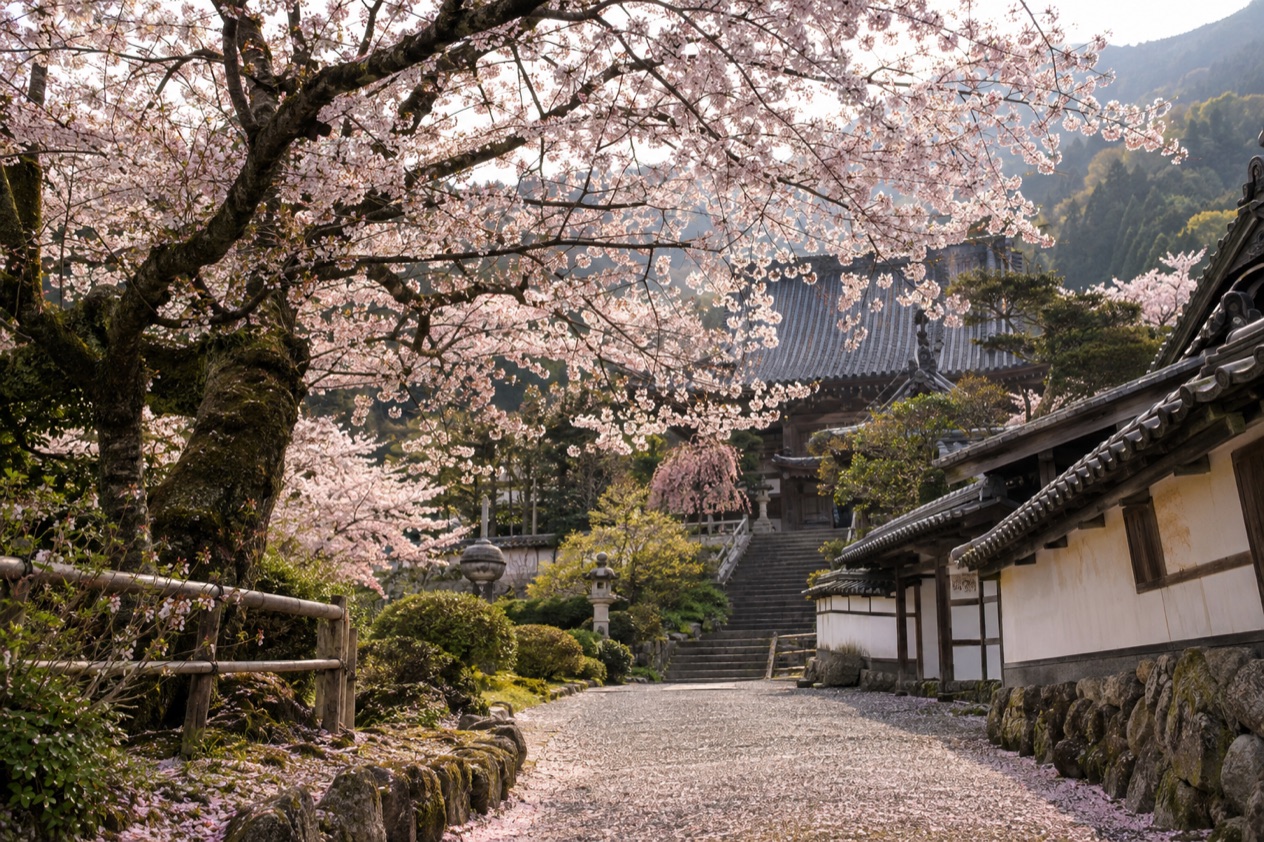
When do the cherry blossoms bloom in Mount Fuji?
They usually open in late March and reach full bloom in the first days of April, though the weather of each spring moves the calendar. They give you the rhythm of the season in this part of Japan rather than a promise for the mountain’s own lakeshore.
| Stage | Usual date at Kofu | Range in recent years |
|---|---|---|
| First bloom (kaika) | March 25 | March 16 to March 29 |
| Full bloom (mankai) | April 2 | March 24 to April 5 |
First bloom and full bloom, in plain terms
Japanese forecasts count two moments. Kaika is the day the first few flowers open on a reference tree, and mankai is the day most of the blossoms are open. Full bloom comes about a week after the first flowers, so the trees look their fullest in the opening days of April.
The recent range matters as much as the usual date. In some springs the first flowers have appeared in mid-March, and in others they have waited until the end of the month.
What the weeks around full bloom feel like
Before full bloom, the branches show buds and a scattering of open flowers, and the mood is one of anticipation. Locals check the forecast every morning and families begin spreading picnic sheets under the trees. Once the flowers peak, the petals start to fall within days, and the ground turns pale pink. The Japanese call a shower of falling petals hanafubuki, a blossom blizzard, and it is a sight in its own right.
The seasonal food follows the trees. Sakura mochi, a pink rice cake wrapped in a salted cherry leaf, and sakura-flavored sweets and drinks appear in shops during these weeks.
Where can you see them in Mount Fuji?
You see them in the towns and parks at the foot of Mount Fuji, where planted cherry trees frame the mountain, and not on the climbing trails themselves. Mount Fuji is the highest mountain in Japan and a UNESCO World Heritage site, and in spring the interest lies in the view of the cone above the flowers. The trails are a separate matter, since they are closed in winter above the 5th station on the Yoshida, Subashiri and Gotemba trails and above the 6th station on the Fujinomiya Trail.
Lakeside and town viewing around Lake Kawaguchi
Lake Kawaguchi is the lake travelers use as a base for Fuji views, and blossom walks here follow the water’s edge, where trees line paths and small parks. The picture people come for is a row of pink trees in the foreground, the lake in the middle and the mountain beyond. When the air is clear, the reflection is part of the scene.
Mountains make their own weather, and Fuji often hides behind cloud. Come for the trees and treat a full view of the cone as a bonus.
Pagodas, parks and hillside viewpoints
The towns of the Fuji Five Lakes area have shrines, small parks and hillside lookouts that carry cherry trees in spring. A well-known picture pairs a red pagoda, pink branches and the mountain, and it is the kind of frame photographers look for around Fujiyoshida. Local parks add the hanami atmosphere, with groups of friends and coworkers eating under the trees.
Hanami, the custom of gathering under blooming trees, is a habit of Japanese spring everywhere. People bring food and drinks, spread a sheet on the ground and stay for hours. If you want to join in, a bento and a bottle of tea from a local shop will do.
The mountain as a backdrop, not a destination
At blossom time, Fuji still wears its winter snow, which makes the contrast with the pink flowers stronger. The slopes are not open for the climb, and the point of the trip is to look at the mountain from the villages and lakes below.
What should you know before you go?
Plan around a window rather than a date, because blossoms follow the weather and the recent range of first bloom spans nearly two weeks. A trip that covers the end of March and the first week of April has the best chance of meeting the flowers. Dates for Kofu are a guide, and the trees near the lakes can open earlier or later than the city’s.
Blossom season is not climbing season
The climbing season for Mt. Fuji ends on September 10th, and the winter closures described above apply for the months that follow, which include the blossom weeks. So a spring visit is about viewing the mountain, not summiting it. Visitors who plan to climb in a later season are strongly advised to check the latest information on the Official Website for Mt. Fuji Climbing, which provides information for all climbers to ensure a safe climb and return.
If climbing is on your list of Japan ambitions, a blossom trip can serve as a first look. You can see the mountain’s shape, the lakes and the towns, and later decide which season suits you.
Building a flexible blossom day
Keep the schedule loose. A morning at a lakeside path, a long lunch of hot noodles (hoto, a hearty noodle stew, is a dish of this region), and an afternoon at a park or shrine with trees give the day a shape and let you shift if clouds sit on the mountain. Spring in Japan can turn from sunny to cool and wet quickly, so layers help.
Blossoms do not last long. A strong wind or a rainy spell can strip the branches within days, so a trip in the middle of the window can find trees past their best or still in bud. Taking in the first buds, the full bloom or the falling petals are all rewarding ways to see the season, and each has its own mood.
Other seasons at the same mountain
The cherry season is one chapter of a mountain that changes all year. Autumn brings maple color to the same area, and the winter snow cap returns. For a traveler who loves the flower season, a second visit in another month gives a very different picture of the same view.
Good to know before you go
Spring days in the Fuji area can swing between bright sun and a cool, cloudy afternoon, so a light jacket sits well beside a camera. Stalls and shops in tourist towns sell seasonal sweets and drinks, and a small amount of cash and a reusable bag help when you buy picnic food. Take your rubbish with you after a hanami picnic, since bins are scarce in Japanese parks and the habit is to carry trash back to where you are staying.
Sources
- Japan Meteorological Agency, cherry blossom first-bloom dates 2021-2026 and 1991-2020 normal (https://www.data.jma.go.jp/sakura/data/sakura003_07.html), checked October 11, 2026
- Japan Meteorological Agency, cherry blossom full-bloom dates 2021-2026 and 1991-2020 normal (https://www.data.jma.go.jp/sakura/data/sakura004_07.html), checked October 11, 2026
- Japan National Tourism Organization, Mount Fuji guide (https://www.japan.travel/en/fuji-guide/), checked October 11, 2026
- Official website for Mt. Fuji climbing, about the climb (https://www.fujisan-climb.jp/en/about/), checked October 11, 2026
- Japan Meteorological Agency, maple color-change dates 2025-2026 with difference from the 1991-2020 normal (https://www.data.jma.go.jp/sakura/data/phn_014.html), checked October 11, 2026
- Japan Meteorological Agency, biological season observations (https://www.data.jma.go.jp/sakura/data/index.html)
To plan your stay
- Japan Rainy Season (Tsuyu): Dates, Regions and How to Plan Your Trip
- Seasons in Japan: Blossoms, Fall Color, Snow Festivals and Summer Matsuri
- Typhoon Season in Japan: When It Hits, Which Regions Take the Brunt and How the Warning Alerts Work
- Autumn Leaves Dates by City: Usual Maple Dates, 2025 Results and How Much They Shift