
Every spring the Japanese weather report carries a pink front that creeps up the map, and travelers planning months ahead want to know when it will reach the city on their list. The honest answer is a window rather than a day. Each city has a usual bloom date, the dates drift from one spring to the next, and the Japan Meteorological Agency keeps a running count of what the trees are actually doing once the season opens.
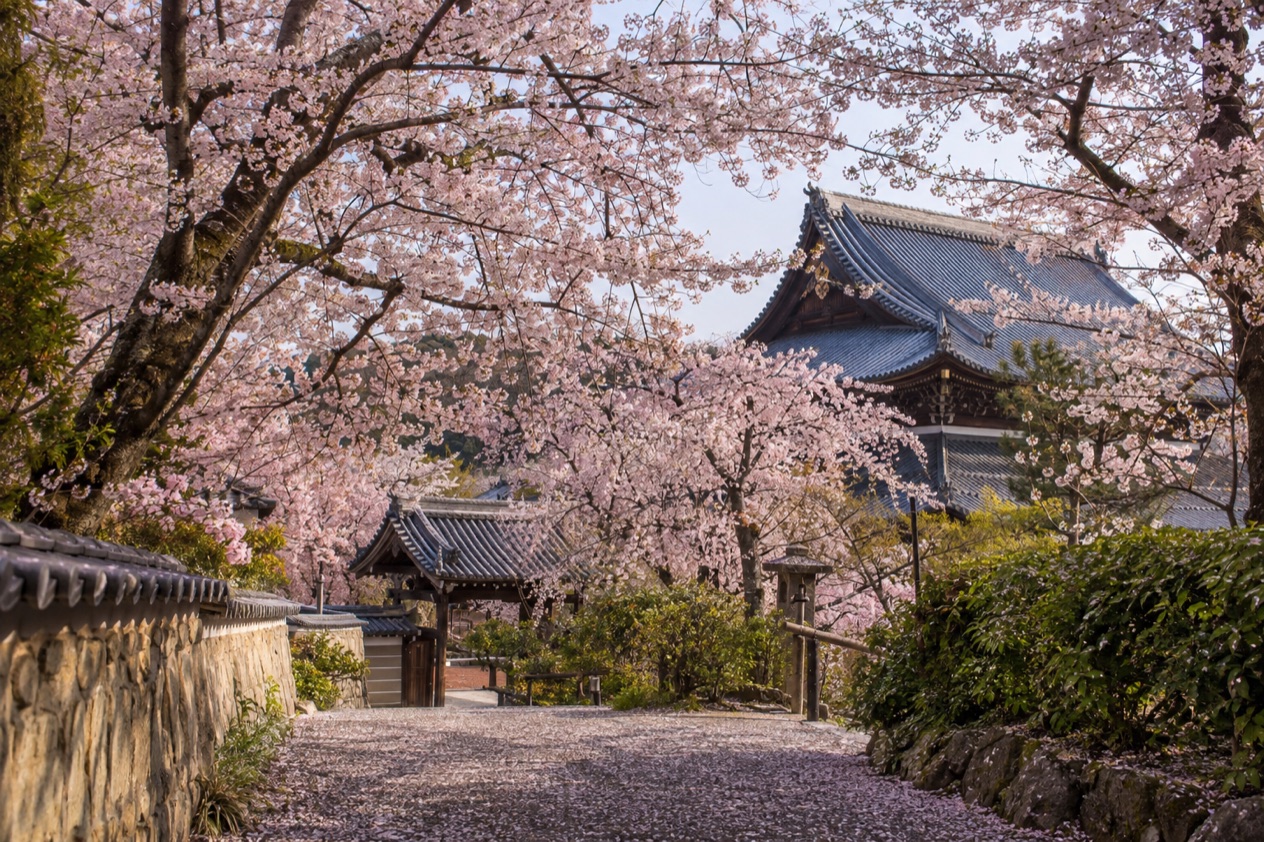
What is the cherry blossom forecast for Japan?
The forecast is a wave: the blossoms open first in the far south, travel up the main islands over the course of spring, and finish in the north of Hokkaido in mid-May. Hikan-zakura, a deep-pink cherry, begin to flower in Okinawa and Amami around mid-January, long before anyone on the main islands thinks about picnics. The familiar pale Somei-Yoshino then reach Kyushu, Chugoku, Shikoku, Kinki, Tokai and Kanto in late March.
Hokuriku and the southern Tohoku region follow around April 10. The wave then moves through northern Tohoku and arrives in northern and eastern Hokkaido in mid-May. For a traveler, that means a trip in late March and one in late April can both include blossoms, but in entirely different cities.
Usual dates by city
Two moments matter. First bloom (kaika) is the day the first flowers open, and full bloom (mankai) is the day the tree looks the way the postcards do. The table gives the usual dates for both in sixteen cities, plus the span that full bloom has covered in recent years, so you can see how wide the window really is.
| City | Usual first bloom | Usual full bloom | Full bloom in recent years |
|---|---|---|---|
| Fukuoka | March 22 | March 31 | March 22 to April 3 |
| Kagoshima | March 26 | April 5 | March 30 to April 12 |
| Hiroshima | March 25 | April 3 | March 25 to April 5 |
| Kyoto | March 26 | April 4 | March 24 to April 5 |
| Osaka | March 27 | April 4 | March 27 to April 6 |
| Kobe | March 27 | April 5 | March 30 to April 7 |
| Nara | March 28 | April 4 | March 27 to April 8 |
| Nagoya | March 24 | April 2 | March 27 to April 7 |
| Tokyo | March 24 | March 31 | March 22 to April 4 |
| Yokohama | March 25 | April 1 | March 25 to April 7 |
| Kanazawa | April 3 | April 8 | March 29 to April 8 |
| Nagano | April 11 | April 16 | April 1 to April 13 |
| Sendai | April 8 | April 13 | March 31 to April 11 |
| Aomori | April 22 | April 26 | April 11 to April 22 |
| Hakodate | April 28 | May 2 | April 20 to April 28 |
| Sapporo | May 1 | May 6 | April 21 to April 27 |
Reading the table for a trip
Tokyo, Yokohama, Nagoya and the big cities of the Kansai region sit in a tight cluster at the turn of March into April, which is why a single week can hold blossoms in Tokyo, Kyoto and Osaka on the same itinerary. Fukuoka and Hiroshima run slightly ahead or alongside them.
Kanazawa, Nagano and Sendai come in the first half of April, after the southern cities have started to shed petals. Aomori, Hakodate and Sapporo wait until the end of April or the first days of May. A route that starts in Kyoto and ends in Hokkaido can chase the blossoms north across most of a month, and a route that stays in the center catches one short burst.
What this looks like on the ground: families and office groups spread tarps beneath the trees for hanami, the flower-viewing picnic, and the same branches are often lit after dark for yozakura, evening blossom viewing. Shops fill with sakura-flavored sweets, and sakura mochi, a rice cake wrapped in a salted cherry leaf, appears in spring.
Where do forecasts come from?
Blossom dates in the news and in travel apps rest on those sightings and on the usual dates, so knowing how the sightings are defined tells you what a number really means.
What counts as first bloom and full bloom
First bloom is recorded on the first day that five or six flowers or more are open on the sample tree. That is a very small threshold, so on that day a whole hillside of trees may still look bare from a distance. Full bloom is recorded on the first day that about 80 percent or more of the buds are open, which is the moment the tree looks covered.
The species watched is mainly the Somei-Yoshino, the pale pink cherry planted along rivers, castle moats and school grounds across the country. Where it does not grow, the agency watches something else: the Hikan-zakura in Okinawa and Amami, and the Ezo-yamazakura in Hokkaido. So the earliest dates of the year, in the far south, belong to a different tree than the ones you see in Tokyo or Kyoto.
How often the numbers change
From December to June, the agency updates the current year’s cherry blossom flowering status three times a day, at around 08:30, 11:30 and 17:30. Full bloom status follows the same rhythm. Recent phenology data in general is refreshed once a day at around 08:35. In practice, during the season the picture of which cities have opened and which have not is rewritten several times between breakfast and dinner.
The same agency observes the first day of ume, the Japanese apricot, whose blossoms come earlier and are a quieter prelude to the cherry. Its list of observed plant events also includes hydrangea flowering, ginkgo yellowing and leaf fall, maple red leaves and leaf fall, and the flowering of Japanese pampas grass. Cherry blossom is one entry in a calendar of seasonal markers that the agency follows through the year.
Who is looking at the trees
Many of these seasonal observations are now carried out in collaboration with citizen surveyors, coordinated by the National Institute for Environmental Studies. That fits the way the country treats the blossom: it is a shared event that people follow closely. The sample tree at each point is a kind of official representative of a whole city’s spring, and it is watched day after day.
For a visitor, the useful consequence is simple. The date of a city is the date of one tree in one spot, and other parks, hillsides and neighborhoods in the same city can run a little ahead or behind it. Tree by tree, cherry blossom is local.
How reliable are they?
A usual date is a good guide to the week but a poor guide to the day, because the blossoms have moved by days and sometimes by two weeks from one spring to the next. The recent ranges in the table show it. Full bloom in Tokyo has landed anywhere from late March to the first days of April, and Kagoshima’s full bloom has ranged across about two weeks.
Where the spread is wide, and where it is tighter
In Kagoshima, full bloom in recent years has started before April and run on well into the second week of the month. Nagano and Sendai show similar looseness, with full bloom sometimes arriving in the first days of April and sometimes close to the usual mid-April date.
A tighter band is no guarantee, but it means a trip planned around the usual date has a better chance of meeting open flowers. A wide band means the same plan could land before the buds or after the petals have gone. When one city is the point of the trip, it helps to know which kind of city it is.
The north has recently come in ahead of the usual date
Look at Aomori, Hakodate and Sapporo. In recent years the first and full bloom in all three have arrived on dates that sit at or ahead of the usual one, and in several cases well ahead.
Aomori’s first bloom, usually in the last third of April, has come as early as the first half of the month. Hakodate and Sapporo show the same pattern, with full bloom in late April when the usual date points to early May.
That is a reason to treat the northern dates in the table with a cushion. A trip built on the usual early-May date in Hokkaido could meet petals already scattered, and the usual date there is better read as the late edge of the window than as its middle.
Using the dates well
A flexible plan fits the way the blossoms behave. Once the season opens, the three daily updates show whether the trees in your city have started. Since full bloom is the stage the postcards show, the first-bloom report is the signal that the best days are close.
If a route crosses several regions, the south-to-north movement works in your favor. A city that has just passed its peak is usually followed within days by another one farther along the line, and the trip can follow the wave rather than sit at one spot.
Good to know before you go
Blossom viewing in Japan is a habit more than an event: people spread a sheet beneath the trees, bring food and drink, and stay as long as the afternoon allows. Spring also brings variable weather around the blossom weeks, so a light layer and something for a passing shower fit most days under the trees. Petals fall quickly after full bloom, and the walks beneath bare branches and fresh green leaves that follow have their own pleasure.
Sources
- Japan Meteorological Agency, cherry blossom first-bloom dates 2021-2026 and 1991-2020 normal (https://www.data.jma.go.jp/sakura/data/sakura003_07.html), checked October 11, 2026
- Japan Meteorological Agency, cherry blossom full-bloom dates 2021-2026 and 1991-2020 normal (https://www.data.jma.go.jp/sakura/data/sakura004_07.html), checked October 11, 2026
- Japan Meteorological Agency, sakura2020.pdf (https://www.data.jma.go.jp/sakura/data/sakura2020.pdf), checked October 11, 2026
- Japan Meteorological Agency, biological season observations (cherry blossom and autumn leaves) (https://www.data.jma.go.jp/sakura/data/index.html), checked October 11, 2026
To plan your stay
- Japan Rainy Season (Tsuyu): Dates, Regions and How to Plan Your Trip
- Seasons in Japan: Blossoms, Fall Color, Snow Festivals and Summer Matsuri
- Typhoon Season in Japan: When It Hits, Which Regions Take the Brunt and How the Warning Alerts Work
- Autumn Leaves Dates by City: Usual Maple Dates, 2025 Results and How Much They Shift