
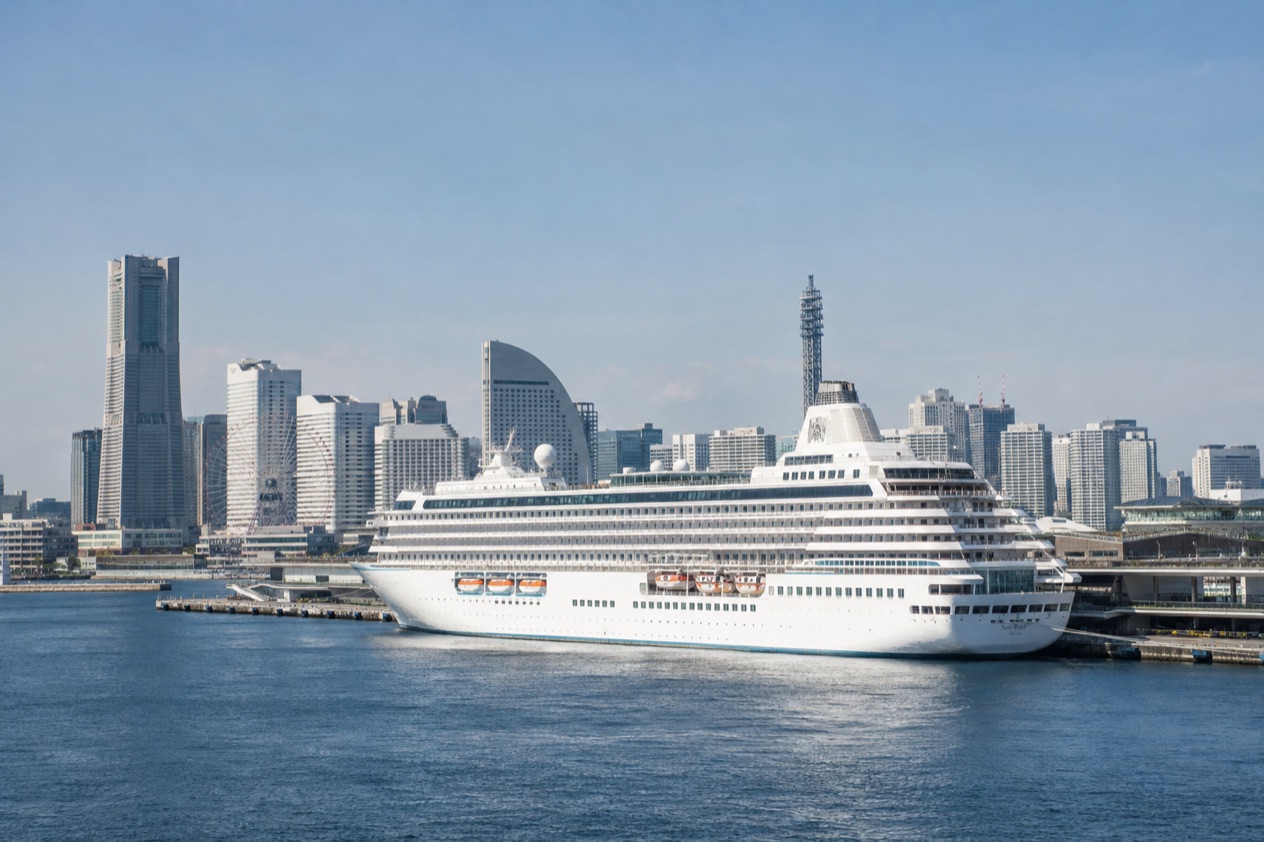
On the Kobe waterfront the red Port Tower rises over Meriken Park, and across the water a large white ship sits against the harbor lights. Travelers who see it start to wonder whether a cruise could be the way to see Japan. Two home-port lines are named for Kobe, Princess and Holland America, and Yokohama has a pier built to receive cruise passengers.
Which cruise lines sail to Japan?
Princess Cruises and Holland America Line are the two lines tied by name to a Japanese home port, Kobe. A home port is where a voyage begins and ends, so passengers board and leave the ship there rather than joining midway. Other lines may call at Japanese ports, but these two are the ones the record links to Kobe.
Princess Cruises and Holland America at Kobe
Kobe is a home port for certain cruise ships, including those of Holland America Line and Princess Cruise Line. For a traveler this means the trip can start in the Kansai region without a long positioning leg first. You step off a flight or a train, go to the harbor and board.
The best-documented example is Sun Princess. In the summer of 2014, Princess sailed that ship on eight-day roundtrip Asia cruises from Kobe.
What is included in the fare
Dining on almost all cruise ships is included in the cruise price. That covers the main dining rooms and the buffet, so mealtimes at sea do not add to the bill. Drinks work differently. The majority of cruise lines leave alcoholic beverages out of their fares, and passengers pay for drinks as they consume them.
The exception in the record is Regent Seven Seas. Its base fare includes most alcoholic beverages on board, most shore excursions in ports of call and all the gratuities that would normally be paid to hotel staff. If you compare lines for a Japan itinerary, set the fare structure beside the route, because the same-looking price can cover very different things.
The kind of ship you may find
Nine or more newly built ships catering to a North American clientele have been added every year since 2001, so the lines that sell to Americans keep refreshing their fleets. The average age of a cruise ship in 2024 is 17.5 years, which means a mix of older vessels and recent ones. On board, casino floors typically open when the ship enters international waters, usually 12 nautical miles from the coastline.
When is the Japan cruise season?
The sailing documented for a Japan home port falls in summer: in the summer of 2014, Sun Princess ran eight-day roundtrip Asia cruises out of Kobe. That is the one season the record puts on a Japan sailing, and it is written with its year because it belongs to that year alone.
Summer sailings from Kobe
A summer cruise from Kobe fits the rhythm of the Japanese calendar, when the harbor towns host matsuri, the local festivals with drums, lanterns and street food stalls. Summer is also a month-by-month question of weather, so before choosing dates it is worth looking at the climate of the cities you will visit, rather than assuming one forecast fits the whole coast.
The eight-day roundtrip shape is useful when planning. A loop that starts and ends in Kobe lets you arrive in Japan a day or two ahead, enjoy the city, then board with time in hand, and do the same on the way out. Kobe has Meriken Park, Kobe Port Tower and Harborland, all built for the public along the port, and they give a first or last afternoon something to do.
What the rest of the year looks like
Beyond that summer sailing, no other dated season is on record for Japan cruises, so the sensible approach is to look at each line’s published schedule for the months you want rather than counting on a fixed cruising window. What stays constant is how a cruise day is shaped: the ship moves while you sleep, and the day belongs to whatever port it reaches.
Seasons on shore change what you find at each stop. Spring brings cherry blossoms, autumn brings colored maple leaves, and summer brings festivals. A ship’s schedule and those natural dates do not always line up, so a traveler who cares about one of them should ask which port the ship will be in on the dates it might be at its peak.
Where do Japan cruises leave from?
The home port named in the record is Kobe, in Hyogo, within the Keihanshin area, and Yokohama on Tokyo Bay has a pier built for cruise passengers. Kobe is the starting point for certain Holland America and Princess ships.
Kobe, a port built on islands
The Port of Kobe sits in front of the Hanshin Industrial Region. Flat land is limited here, so artificial islands were built, among them Port Island, Rokko Island and the island that holds Kobe Airport. The waterfront you see is largely made land, and the public side of it is Meriken Park, Kobe Port Tower and Harborland.
Kobe was the world’s busiest container port from 1973 to 1978 and remains Japan’s fourth busiest. That working-harbor history explains the scale of the cranes and berths, and the harbor also sends passenger ferries abroad on the routes below. A sister-port tie with Rotterdam goes back to 1967.
| Route from Kobe | Passenger service |
|---|---|
| Busan, South Korea | Twice a week |
| Shanghai, China | Once a week |
| Tianjin, China | Once a week |
Yokohama and Osanbashi Pier
Yokohama’s passenger traffic, cruises included, is handled at Osanbashi Pier, which has customs, immigration and quarantine facilities for international travel. The port is run by the Port and Harbor Bureau of the City of Yokohama and opens onto Tokyo Bay.
The port formally opened to foreign trade on June 2, 1859, so the city has long been a place where ships arrive from abroad. Around the waterfront you find the sort of sights people associate with a port city, such as the Minato Mirai skyline and Chinatown, which suit a day before or after sailing.
Getting to the ship
A cruise line can sell a transfer pass for the trip between the airport and the cruise terminal. Buying one from the cruise line guarantees that the ship will not leave until the passenger is aboard. That is a guarantee a traveler arriving by air may want to weigh against making their own way to the pier.
Which Japanese ports do ships visit?
The ports in the record are Kobe, Yokohama, Osaka and Tokyo, and of these, Kobe and Yokohama are the two linked to cruise passengers. Osaka and Tokyo are described as major harbors rather than as cruise stops.
Kobe and Osaka around the bay
The Port of Osaka is the main port in Japan and lies in Osaka Bay, with a sister-port relationship with Busan. It shares its bay with Kobe, so a traveler on a Kobe-based cruise is within reach of the Kansai region’s cities and food. Kobe’s own waterfront gives the first look, with its tower and park.
Kobe has 34 container berths, and that scale shows a port where freight and passenger traffic share a coastline. Ashore, Kobe is a city of harbor views, bakeries, and a beef its name is attached to everywhere. Osaka, nearby in the same bay, is known for street food such as takoyaki and okonomiyaki.
Yokohama and Tokyo on the bay
Yokohama has ten major piers, each with its own job. Honmoku is the core facility, Daikoku sits on an artificial island, Minami Honmoku takes larger container ships, and Mizuho is used by the United States Forces Japan. Osanbashi is the one for passengers.
| Pier | What it is known for |
|---|---|
| Osanbashi | Passenger traffic including cruises, with customs, immigration and quarantine facilities |
| Honmoku | Core facility, 24 berths including 14 container berths |
| Daikoku | Artificial island of 321 hectares |
| Minami Honmoku | Two 350 meter berths, 16 meters deep |
| Mizuho | Seven berths used by the United States Forces Japan |
The Port of Tokyo is owned by the Tokyo Port Authority and is both a natural and an artificial harbor, with a total size of 6,325 hectares. It is a vast working harbor, and it gives context to a city whose seafront has been reshaped over time.
On shore with the ship
If you book a shore excursion with the cruise line and the tour runs late, the ship is obliged to remain until you return. That rule applies to excursions bought from the line, not to a day you plan yourself. It is a point worth keeping in mind when choosing between the two.
Good to know before you go
A cruise changes how you spend money, because meals are inside the fare while most drinks are not, and a line’s gratuity rules are part of what you are comparing. Ashore, Japanese cities reward a day on foot with a harbor park, a market stall or a bowl of noodles. Casino floors on board open only once the ship is out in international waters.
Sources
- Wikipedia, Cruise ship (https://en.wikipedia.org/wiki/Cruise_ship), checked October 11, 2026
- Wikipedia, Port of Kobe (https://en.wikipedia.org/wiki/Port_of_Kobe), checked October 11, 2026
- Wikipedia, Port of Osaka (https://en.wikipedia.org/wiki/Port_of_Osaka), checked October 11, 2026
- Wikipedia, Port of Tokyo (https://en.wikipedia.org/wiki/Port_of_Tokyo), checked October 11, 2026
- Wikipedia, Yokohama Port (https://en.wikipedia.org/wiki/Yokohama_Port), checked October 11, 2026
All our pages
When to go
- Japan Cruise in March: Weather by Port, Cherry Blossom Timing and What You See
- Japan Cruise in April: Cherry Blossoms, Spring Weather and What You See From Port
- Japan Cruise in May: Golden Week, Spring Weather and Festivals
- Japan Cruise in June: Weather, Hydrangeas, Ports and What to Expect Aboard
- Japan Cruise in September: Weather by Port, Ports of Call and What to See
- Japan Cruise in October: Weather from Hokkaido to Okinawa, Autumn Scenery and Ports of Call
- Japan Cruise in November: Weather, Autumn Color and Ports
- Best Time for a Japan Cruise: Seasons, Kobe Port, Typhoon Season and What Your Fare Covers
Things to do
- Celebrity Japan Cruises: Asia Voyages, Hiroshima and Tokyo Sights, and the Port of Kobe
- Holland America Japan Cruises: Asia Sailings, Ports and Ships
- Japan Cruise Excursions: Yokohama, Tokyo and Kobe Ports, Rail Links and What to Settle Before Booking
- Passport and Entry for a Japan Cruise: Passport Validity, Customs at the First Port and Visa Rules
- Seto Inland Sea Cruises: Kobe, Hiroshima, Naoshima and the Naruto Whirlpools
- Princess Japan Cruises: Diamond Princess, Yokohama Sailings and Kobe
- Royal Caribbean Japan Cruises: The Line, Its Private Destinations and Kobe Port
Getting there
- Cruises from Los Angeles to Japan: Departure Port, Yokohama Arrival and Crossing Length
- Cruises from Seattle to Japan: Seattle Terminals, Yokohama's Osanbashi Pier and Repositioning Voyages
- Cruises from Singapore to Japan: Ports, Routes and Voyage Length
- Cruises from Vancouver to Japan: Repositioning Voyages, Canada Place and Yokohama's Osanbashi Pier
- Hakodate Cruise Port: Where Ships Dock, Getting to Town and a Port Day
- Hiroshima Cruise Port: Where You Arrive, the Peace Memorial Park and What to Do in a Port Day
- Japan Cruise Ports: Yokohama, Kobe, Tokyo and Osaka Explained
- Kagoshima Cruise Port: Arriving Under Sakurajima, the Ferry and a Day Ashore
- Kobe Cruise Port: Home-Port Ships, Osaka and Kyoto Links, and Waterfront Stops
- Kyoto from a Cruise Port: Ports, Rail Links and Time Needed
- Mount Fuji from a Cruise Port: Shimizu, Yokohama, Tokyo and What the Mountain Asks of You
- Nagasaki Cruise Port: Where Ships Dock, Getting Around and a Port Day
- Naha Cruise Port: Arriving in Okinawa, Getting Around Town and Port Day Ideas
- Osaka Cruise Port: Where Ships Dock, Getting into the City and Day Excursions
- Tokyo Cruise Port: Where Ships Dock, Getting Into the City and a Port Day in Tokyo
- Yokohama Cruise Port: Osanbashi Pier, Getting to Tokyo and Shore Excursions