
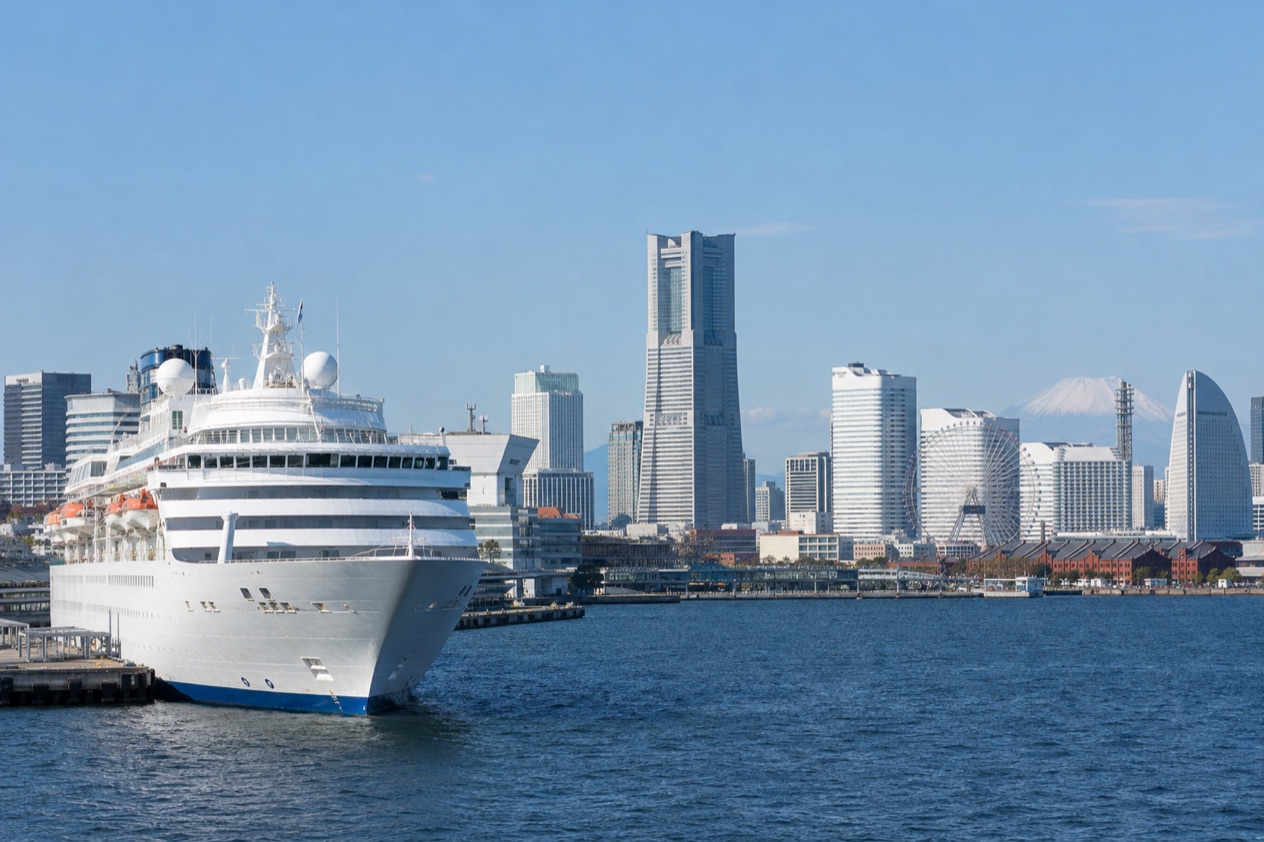
On the deck of a ship sliding into Tokyo Bay, passengers line the rail to watch the harbor cranes and the city skyline come into view. Japan’s cruise itineraries are built around a handful of big working harbors, each tied to a major city. Yokohama, Kobe, Tokyo and Osaka are the four that the story of a Japan cruise keeps returning to.
Which ports do cruise ships visit in Japan?
Cruise ships visit Japan’s big harbor cities, and four of them stand out for a first look: Yokohama on Tokyo Bay, Tokyo itself, Kobe and Osaka in the Keihanshin area around Osaka Bay. Each one is a large commercial port first and a cruise stop second, which shapes what you see from the deck: container cranes, piers, warehouses and, behind them, a city.
Yokohama: the cruise pier on Tokyo Bay
The Port of Yokohama opens onto Tokyo Bay and is run by the Port and Harbor Bureau of the City of Yokohama. It has ten major piers, and the one that matters to a cruise passenger is Osanbashi Pier, which handles passenger traffic including cruises.
Osanbashi has its own customs, immigration and quarantine facilities for international travel, so arriving or leaving on an international sailing is built into the pier itself. The other piers are working cargo grounds: Honmoku, Daikoku and Minami Honmoku handle containers, and seven berths at Mizuho Pier are used by the United States Forces Japan.
Kobe and Osaka: two harbors on one bay
The Port of Kobe sits in Kobe, in Hyogo, within the Keihanshin area, and the Port of Osaka lies in Osaka within Osaka Bay. They are neighboring harbor cities, and a Japan cruise can call at one, the other, or both.
Kobe is a home port for certain cruise ships, including those of Holland America Line and Princess Cruise Line. Osaka is described as the main port in Japan, and it shares a sister port relationship with the Port of Busan in South Korea.
Tokyo: a vast harbor of its own
The Port of Tokyo is owned by the Tokyo Port Authority and is a mix of natural and artificial harbor. Its total size is 6,325 hectares, made up of 5,292 hectares of harbor water and 1,033 hectares of land.
That scale tells you what the port is: a major piece of infrastructure for a city that sits on the same bay as Yokohama. For a traveler, the two ports are two ways into the same bay region.
Which are the most common?
Among the four, Yokohama and Kobe are the ones the sources tie most directly to cruising, Yokohama through its dedicated passenger pier and Kobe through its role as a home port. Tokyo and Osaka are the large harbors of their cities, and they round out the picture of where ships go.
Why Yokohama and Kobe come up first
Yokohama has a pier built with passengers in mind, complete with the facilities for international arrivals. Kobe, for its part, is where ships of Holland America Line and Princess Cruise Line begin and end certain voyages.
One example from Kobe: in the summer of 2014, Princess Cruises’ Sun Princess sailed eight-day roundtrip Asia cruises from the Port of Kobe. A home port means passengers can step aboard there at the start rather than only seeing the city as a stop along the way.
How the four compare
| Port | Where | Cruise detail |
|---|---|---|
| Yokohama | Tokyo Bay | Osanbashi Pier handles cruises, with customs, immigration and quarantine facilities |
| Kobe | Hyogo, Keihanshin area | Home port for certain Holland America Line and Princess Cruise Line ships |
| Tokyo | Tokyo | Natural and artificial harbor owned by the Tokyo Port Authority |
| Osaka | Osaka Bay | Described as the main port in Japan |
Reading across the table, you can see two patterns. Yokohama and Kobe have a clear cruise role. Tokyo and Osaka are described by their size and standing as harbors.
What is each port known for?
Each port has a different claim to fame: Yokohama for its history and its passenger pier, Kobe for its waterfront parks and its artificial islands, Tokyo for sheer harbor scale, and Osaka for its standing as the main port of Japan.
Yokohama: a port opened to the world
Yokohama formally opened to foreign trade on June 2, 1859, and that history still shapes the waterfront. Today the port is a working mix of container piers and the cruise-ready Osanbashi Pier.
Honmoku Pier is the core facility, with 24 berths including 14 container berths. Daikoku Pier stands on an artificial island of 321 hectares with a million square meters of warehouse space, and Minami Honmoku has two operational berths of 350 meters each, deep enough for larger post-Panamax container ships.
Kobe: islands built from scratch
Flat land around Kobe is limited, so the city built artificial islands: Port Island, Rokko Island and the island of Kobe Airport. Looking at the harbor, you are seeing land that was made for the port.
For visitors, the public side of the harbor is Meriken Park, Kobe Port Tower and Harborland, all amusement facilities at the Port of Kobe. The port was the world’s busiest container port from 1973 to 1978 and remains Japan’s fourth busiest, with 34 container berths.
Passenger services also run from Kobe to Busan twice a week, and to Shanghai and Tianjin once a week each. Kobe has been a sister port of Rotterdam since 1967.
Tokyo and Osaka: the big harbors
Tokyo’s port is known above all for its extent, over sixty-three square kilometers of water and land combined. It blends natural shoreline with built-up harbor, and it belongs to the Tokyo Port Authority.
Osaka’s port is described as the main port in Japan and lies within Osaka Bay, close to Kobe in the same wider region. Its sister port relationship with Busan links it to the South Korean harbor that Kobe’s ferry service also reaches.
Good to know before you go
Dining is included in the price on almost all cruise ships, so meals aboard are usually settled before you sail. These ports are busy working harbors, so what you see from the ship is often cranes, piers and warehouses, with the cities just beyond. Keep some yen for anything you buy ashore, and remember that the typhoon season is part of the Japanese summer and autumn.
Sources
- Wikipedia, Port of Kobe (https://en.wikipedia.org/wiki/Port_of_Kobe), checked October 11, 2026
- Wikipedia, Port of Osaka (https://en.wikipedia.org/wiki/Port_of_Osaka), checked October 11, 2026
- Wikipedia, Port of Tokyo (https://en.wikipedia.org/wiki/Port_of_Tokyo), checked October 11, 2026
- Wikipedia, Yokohama Port (https://en.wikipedia.org/wiki/Yokohama_Port), checked October 11, 2026
- Wikipedia, Cruise ship (https://en.wikipedia.org/wiki/Cruise_ship), checked October 11, 2026
To plan your stay
- Japan Cruise in March: Weather by Port, Cherry Blossom Timing and What You See
- Celebrity Japan Cruises: Asia Voyages, Hiroshima and Tokyo Sights, and the Port of Kobe
- How Much Does a Japan Cruise Cost?: What the Fare Covers, Drinks and Shore Excursions
- Japan Cruise in April: Cherry Blossoms, Spring Weather and What You See From Port