
On the last morning before a Japan port call, passengers drift to the rail with coffee and scan the horizon for a single pale cone. Sometimes the haze lets it through and sometimes it keeps it. Mount Fuji can be seen from a cruise port, most clearly from Shimizu on Suruga Bay, while the capital-region ports offer glimpses on clear days and climbing it is a separate matter with its own season and rules.
Can you visit Mount Fuji from a cruise port?
You can see Mount Fuji from a cruise port and, with a longer outing, go to the mountain’s own country, but how far you get depends on the port and on the sky. The mountain rises about 62 miles southwest of Tokyo, and it is visible from the capital on clear days. That phrase, clear days, is the honest summary of the whole question: Fuji shows itself when it chooses to, and a port call is a single visit to a place that often keeps its cloud.
It helps to separate three ambitions. The first is simply a look at the summit, which asks for nothing but a clear sky and a good vantage point. The second is a day among the lakes and viewpoints around the mountain.
The third is a climb, which belongs to a short summer season and a strict set of trail rules. Most cruise travelers are choosing between the first two, and the climb is usually a trip of its own rather than a port day.
Looking at Fuji from the shore
The classic way to see Fuji from a port is across water. At Shimizu, on the coast of Suruga Bay, the view from Miho no Matsubara, a shoreline known for its pines, looking over the bay to the mountain appears in many pictures and paintings. If you have seen a woodblock-style Fuji floating above a curve of dark trees and sea, that is the kind of scene this coast has supplied for artists.
Farther along the coast, Lake Hamana is another place where Fuji can be seen under clear skies. The mountain stands at a distance there, a pale outline above the water instead of a looming mass.
Around the five lakes
Fuji is ringed by five lakes: Lake Kawaguchi, Lake Yamanaka, Lake Sai, Lake Motosu and Lake Shoji. Together they make up the mountain’s lake country, and the idea of a Fuji day usually means picking one shoreline, reading the view across the water and letting the rest of the day follow. Lake Kawaguchi is the name travelers meet first when they plan a Fuji outing.
A lake day is a different kind of port excursion from a harbor view. It is about reflections, boat docks and the way the cone changes color with the light, and it asks for a ship schedule that leaves room for the trip out and back. It suits travelers who would rather stand in front of the mountain than glimpse it from the deck.
Climbing Fuji is a different trip
The summit stands at 12,389 feet, and the most popular period for hiking it is July to August, when the huts and other facilities are operating and the weather is warmest. Climbing from October to May is discouraged. For a cruise passenger, that means a Fuji climb is tied to the summer calendar and cannot be improvised on a port day in the colder months.
The rules are specific to each trail. On the Yoshida trail, the Yamanashi prefectural government imposed a mandatory fee and a daily limit beginning in the summer season of 2024, and the trail is closed overnight except for guests in mountain lodges. The Shizuoka prefectural government closed the Subashiri, Gotemba and Fujinomiya trails during the same hours with the same exceptions.
| Yoshida trail rule | Detail |
|---|---|
| Mandatory hiker fee (from the summer season of 2024) | ¥2,000 |
| Daily limit (from the summer season of 2024) | 4,000 hikers |
| Closed | 4 p.m. to 3 a.m., except for guests in mountain lodges |
Which ports are closest?
Shimizu is the port with Fuji in its own backyard view, while Yokohama and Tokyo are the capital-region ports from which the mountain is visible only when the air is clear. Which one counts as closest depends on whether you mean the view or the journey, and each port has a different character on the day you arrive.
Shimizu, on Suruga Bay
The Port of Shimizu is a long-established mid-size sea port that handles container ships, dry bulk ships and cruise ships, and it sits on the Pacific coast of Suruga Bay. An Imperial decree in July 1899 made it an open port for trade with the United States and the United Kingdom, so it has been receiving foreign ships for a long time. Today it is part of Shizuoka, a city designated by government ordinance, and Shimizu-ku became one of its wards on April 1, 2005.
What matters for a Fuji seeker is the bay itself. The area around Shimizu Station was once the city center, where the Shimizu Ekimae Ginza shopping area stood, a reminder that the town has a life apart from the port.
The climate is hot and humid in summer and relatively mild in winter. July is the wettest month, and August is the warmest, with highs around 80.8 degrees on average, so a summer call can bring haze or rain that hides the cone even when the calendar says Fuji season.
Yokohama and Osanbashi Pier
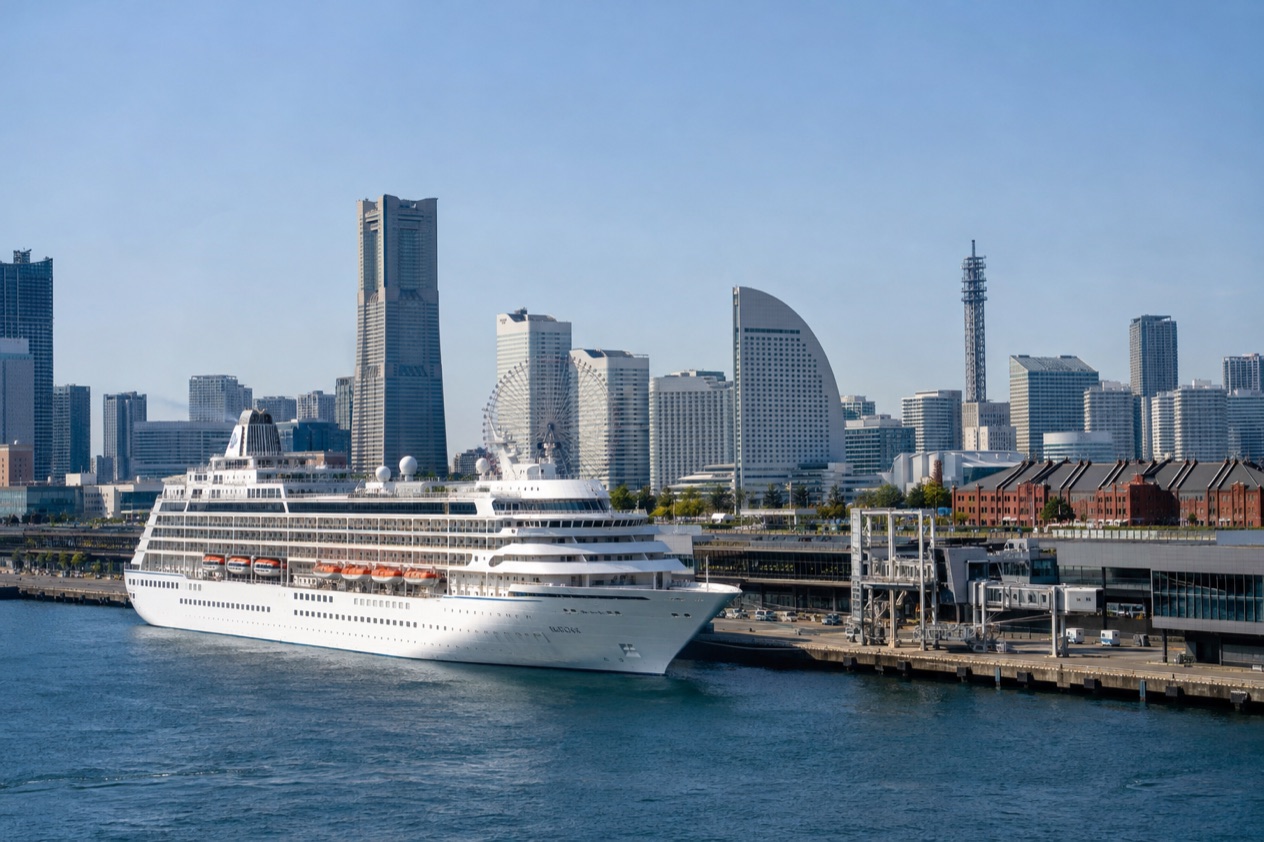
Osanbashi Pier is the main international passenger pier at the Port of Yokohama, in Naka Ward. The pier is the oldest in Yokohama, and the port itself opened in 1859 after the signing of the Treaty of Amity and Commerce and the Ansei Treaties. The current terminal opened in 2002. Its second floor holds the arrival lobby, ticketing booth, customs, immigration, a multipurpose hall, shops and a cafe, with parking on the first floor.
The rooftop is the part a Fuji hunter will like. An extensive, gently curving observation deck with planted grass areas is open to the public, and Osanbashi is known as one of the best places to see the Yokohama Three Towers, nicknamed the King, the Queen and the Jack.
From a deck like this you can look out over the harbor and see whether the sky is clear, but the mountain itself is not promised. Very large ships such as MS Queen Elizabeth are often obliged to use nearby container terminals rather than Osanbashi.
Tokyo’s Aomi terminal
The Tokyo International Cruise Terminal opened on September 10, 2020, in the Aomi area, and is operated by the Tokyo Port Terminal Corporation on behalf of the Tokyo Metropolitan Government. It is a four-story building with a single berth at opening, and on foot it is about an eight-minute walk from Tokyo International Cruise Terminal Station on the Yurikamome line.
The terminal has already seen milestones: the German ship MS Amadea became the first foreign-flag cruise ship to call there on March 2, 2023, and MSC Bellissima made the largest call Tokyo Port had seen on March 12, 2024. Disney Cruise Line is to use it as a home port, with service scheduled to begin in 2029. For Fuji, Tokyo is the city where the mountain shows on clear days, so the view is a bonus of a good sky.
How much time do you need?
Seeing Fuji from a port needs only as much time as the sky allows, a visit to the lakes needs a full port day, and a climb needs more than a port call can give. The ship’s departure sets the outer limit for everything except the climb, so the practical question is how much of the day you want to spend looking versus traveling.
A look from the harbor
If the aim is just a glimpse, the time cost is small. In Yokohama you can walk the Osanbashi rooftop, and in Tokyo the capital’s clear days are the ones that matter. In Shimizu the bay view is part of what draws people to the coast, so a stroll by the water fits around other plans for the day.
What you are really investing is flexibility. Fuji is visible from Tokyo on clear days, and the whole question becomes whether the day is one of them. A traveler with a loose schedule can wait for the haze to lift. A traveler tied to a tour clock gets whatever the sky offers at that hour.
A day at the lakes
A Fuji lake day, at Lake Kawaguchi or another of the five, is a trip out and a trip back with a shoreline in between. The mountain stands about 62 miles from Tokyo, so the journey from a port is part of the plan rather than an afterthought, and the ship’s all-aboard time is the line you cannot cross.
Because the ship’s schedule rules the day, it makes sense to choose one lake and one view and let the rest go. Cloud can close the view while you are there, and a lake day without a visible summit is still a day by the water, with the mountain’s shape often hinted at by the surrounding hills.
The climb: more than a port day
A climb works on a different clock. The trails close overnight, and only guests in mountain lodges are exempt, so a hiker who wants the summit is planning around huts and the summer season, not around a ship that sails the same evening. That is why climbing sits outside the usual shape of a cruise call.
If the climb matters to you, treat it as its own trip in July or August, the months when the huts and facilities are operating. A cruise port is then a place where the trip begins or ends, not the place where the mountain is visited between breakfast and the ship’s whistle.
Good to know before you go
Prices and fees on the mountain are in yen, and the Yoshida trail fee is a yen amount set by Yamanashi prefecture. Dining on almost all cruise ships is included in the cruise price, so a Fuji day off the ship is a matter of the outing itself.
Shimizu has its wettest month in July, and its summers are hot and humid, so the same season that opens the climbing huts can also bring cloud over the cone. Because the mountain is a matter of luck with the sky, give the day a second plan, such as the Osanbashi rooftop or a lakeside stroll.
Sources
- CruiseMapper, Yokohama cruise port (https://www.cruisemapper.com/ports/yokohama-port-1), checked October 11, 2026
- Wikipedia, Mount Fuji (https://en.wikipedia.org/wiki/Mount_Fuji), checked October 11, 2026
- Wikipedia, Osanbashi Pier (https://en.wikipedia.org/wiki/Osanbashi_Pier), checked October 11, 2026
- Wikipedia, Shimizu-ku, Shizuoka (https://en.wikipedia.org/wiki/Shimizu-ku,_Shizuoka), checked October 11, 2026
- Wikipedia, Tokyo International Cruise Terminal (https://en.wikipedia.org/wiki/Tokyo_International_Cruise_Terminal), checked October 11, 2026
- Wikipedia, Cruise ship (https://en.wikipedia.org/wiki/Cruise_ship), checked October 11, 2026
- Wikipedia, Port of Kobe (https://en.wikipedia.org/wiki/Port_of_Kobe), checked October 11, 2026
To plan your stay
- Japan Cruise in March: Weather by Port, Cherry Blossom Timing and What You See
- Celebrity Japan Cruises: Asia Voyages, Hiroshima and Tokyo Sights, and the Port of Kobe
- How Much Does a Japan Cruise Cost?: What the Fare Covers, Drinks and Shore Excursions
- Japan Cruise in April: Cherry Blossoms, Spring Weather and What You See From Port