
In June the air over Japan’s harbors turns soft and heavy, and hydrangeas start to color the hillsides in blue, violet and pink. A ship sliding into Osaka Bay or out toward Okinawa meets a country in the middle of its rainy stretch, with warm days, green slopes and humid evenings on deck. June can suit a Japan cruise very well if you like lush scenery and are happy to carry an umbrella ashore.
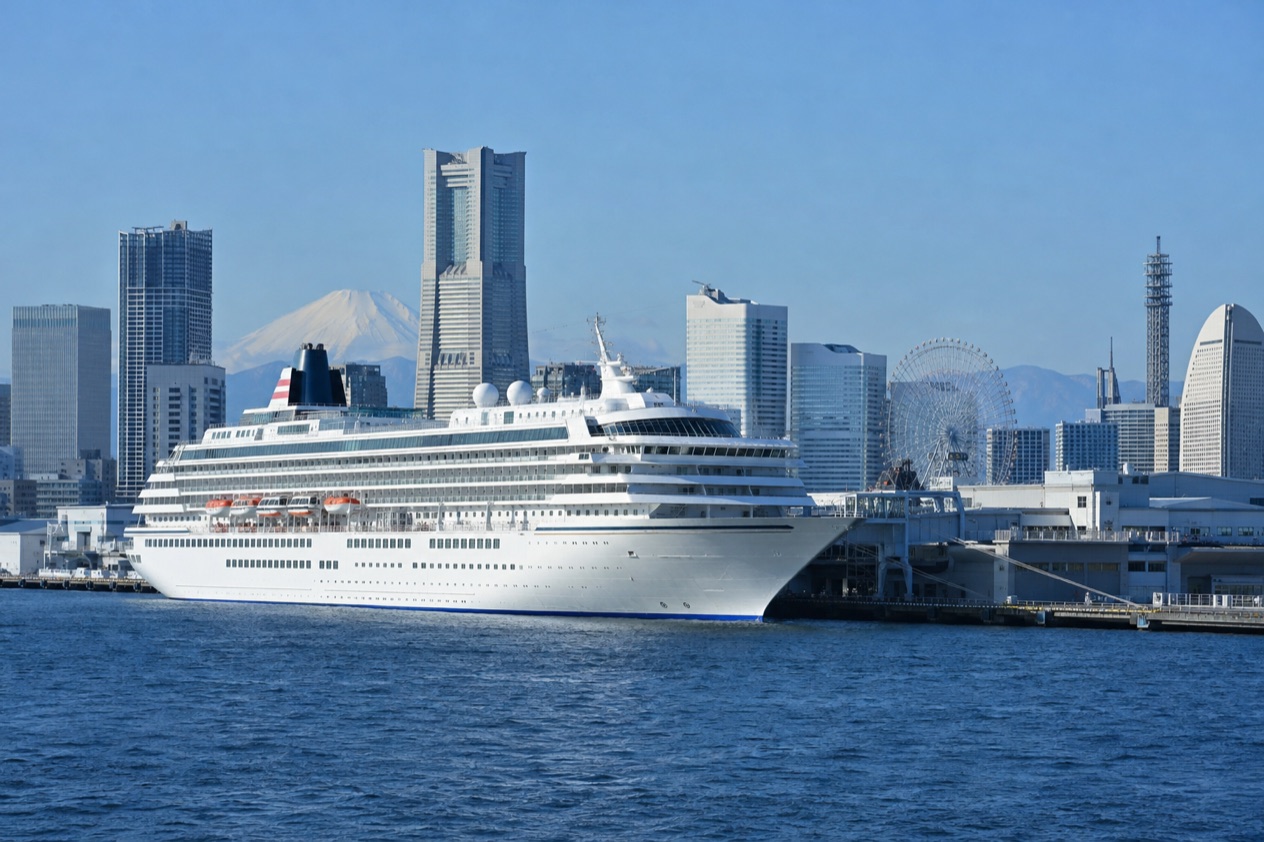
What is a Japan cruise like in June?
A Japan cruise in June is a warm, green and often damp voyage, with ports in a country that stretches from the cool island of Hokkaido to the subtropical waters of Okinawa. Aboard, life follows the usual cruise rhythm.
A cruise ship is a large passenger vessel built mainly for vacations, and dining is included in the cruise price on almost all of them. Alcoholic drinks are the exception on most lines, where passengers pay for each drink as they have it.
What changes the feel of the trip is the geography. Japan reaches from Hokkaido, near Russia, down to Okinawa, close to the islands of Yonaguni, with South Korea and Taiwan among its nearest neighbors. A ship that calls at several ports in one week can move between very different air, from the cooler north to the sticky south, so the clothes you pack are a bigger question here than on a single-coast voyage.
Osaka and Kobe, the Bay Ports
Two ports share the same stretch of coast. The Port of Osaka sits within Osaka Bay and is described as the main port in Japan, with a sister port relationship with Busan. Kobe’s port lies in Hyogo, in the Keihanshin area, and because flat land is scarce there, the city built artificial islands: Port Island, Rokko Island and the island that holds Kobe Airport.
For a traveler this means a cruise can open or close in a working harbor city rather than a resort. The stories here are about trade and reclaimed land.
Kobe was the world’s busiest container port from 1973 to 1978, a fact that explains the cranes, bridges and man-made islands you pass on the way in. In June, expect the harbor air to be warm and humid, with a gray sky as likely as a bright one.
Okinawa and the Southern Waters
Okinawa is the subtropical end of the country. Around Naha the sea surface averages 79.8°F in June, which makes the water feel warm in the way a southern cruise promises. The ship’s pool deck suits this part of the itinerary, and the long daylight lets you linger outside after dinner.
Sapporo, on Hokkaido, is the opposite pole. If your ship touches both ends of the country, you will pack a light jacket and a rain layer side by side.
What is the weather in June?
June weather depends on where the ship is, with warm and humid conditions on Honshu, hotter and wetter weather in Okinawa and a cooler, drier feel in Sapporo. Honshu and Kyushu are known for very humid, hot and sultry summers, and June is when that mood begins to settle in. Rain falls on roughly one day in three in most of the southern and central ports.
| Port area | Average high (°F) | Average low (°F) | Precipitation (inches) | Days with rain (1 mm or more) | Sunshine (hours) | Humidity (%) | Daylight on June 15 |
|---|---|---|---|---|---|---|---|
| Tokyo | 79.0 | 65.3 | 6.61 | 11.6 | 124 | 75 | 14 h 33 min |
| Osaka | 82.4 | 68.5 | 7.29 | 11.3 | 154 | 68 | 14 h 28 min |
| Naha, Okinawa | 85.6 | 77.4 | 11.20 | 11.3 | 160 | 83 | 13 h 46 min |
| Sapporo | 71.2 | 56.1 | 2.38 | 7.5 | 180 | 72 | 15 h 21 min |
Honshu Ports: Tokyo and Osaka
In Tokyo, afternoons are warm and nights stay mild, and the air is damp enough that a light shirt feels heavy by midday. Sunshine is limited, so many days are overcast. Osaka runs a little hotter and noticeably sunnier, with the lower humidity of the two, though the rain still arrives on a similar number of days.
Pack for showers rather than for one long storm: a compact umbrella, breathable layers and shoes that dry quickly. Evenings stay mild in both places, so a light layer is enough once the sun goes down.
Okinawa and Sapporo, the Two Extremes
Naha is the warmest and wettest of the four, and its humidity is the highest. Nights barely cool, so cabins and shore excursions both call for light, quick-drying clothes. It also gets the most precipitation of any port in the table, with showers on about as many days as in Osaka but heavier in total.
Sapporo is the relief. Highs sit in the low 70s, nights are cool enough for a sweater, and it has the fewest rainy days and the most sunshine. The daylight is also the longest, so the evening on deck lasts well past dinner.
What do you see in June?
June is the month of hydrangeas, and they set the mood ashore. Hydrangea species are native to Japan, and eastern Asia, notably China, Korea and Japan, holds the greatest diversity of the plant. The rounded blooms appear in gardens, temple grounds and along paths in the rain, and the wet gray weather suits them better than sunshine does.
Hydrangeas also end up in the cup. Ama-cha, meaning sweet tea, is an herbal tea made from Hydrangea serrata, whose leaves contain phyllodulcin, which develops a sweet taste. It is a small curiosity to look for if a port visit includes a tea stop.
Green Country and Warm Harbors
What stands out from the rail of the ship is color. Hillsides behind the harbors are thick with green, the sky shifts between gray and pale blue, and the humidity softens the skyline. Around Kobe the artificial islands and the hills behind the city make a layered view as you arrive.
In Osaka Bay you see the working side of Japan, with the port, cranes and the Hanshin industrial region behind it. In Okinawa, the scene changes to warm sea and a subtropical shoreline. Between the two lies a country that does not look like one place.
What Is Not Here Yet
Cherry blossoms, the most famous flower in the country and a harbinger of spring, belong to an earlier season, and so do the peach trees of Toyota in Aichi Prefecture, with their kilometer-long stretch of weeping peach in white, red and pink. June comes after both. Mount Fuji’s climbing season typically runs from the beginning of July to about the first week of September, so a June call does not coincide with it.
That leaves the rain, the leaves and the hydrangeas as the real subject of the month, and they are enough for a satisfying week.
Is June a good month for a Japan cruise?
June is a good month if you enjoy green landscapes, long evenings and warm air, and you accept that rain and humidity come with it. Rain falls on about eleven days in Tokyo, Osaka and Naha, and Sapporo has fewer. None of this is a reason to stay home, but it is a reason to plan shore days with a flexible mood.
Who It Suits
It suits travelers who like gardens and quiet gray light, who are comfortable in warm, damp weather and who enjoy a ship’s deck, pool and dining room as part of the day. If the ship includes Okinawa, the warm sea and the long daylight add a resort feel to the voyage.
If your idea of a cruise is dry heat and constant sun, the Honshu ports will test that, since sunshine is limited in Tokyo in particular. A ship that touches Sapporo gives you a cooler, brighter break and the longest light of the month.
How to Plan the Days
Leave room for weather. A day in port can start gray and turn bright, so a folding umbrella and a light rain layer are sensible. Spend damp hours in a garden, a temple or a covered market, and keep a drier hour for the open-air stop.
Back on board, drinks are billed as you go on most lines, while meals are part of the fare, so a long dinner after a wet day costs little extra. With daylight stretching beyond 14 hours in Tokyo and Osaka, you can still catch the harbor lights at the end of the day.
Good to know before you go
June is part of the humid, hot and sultry summer pattern that Honshu and Kyushu are known for, so light, quick-drying clothing is the most useful thing to carry. Meals are included in the cruise price on almost all ships, while alcoholic drinks are paid for as you have them on most lines. The weather varies from the cool north to the subtropical south, so read the ports on your own route and pack for the warmest and the wettest of them.
Sources
- Japan Meteorological Agency (JMA), Normal values 1991-2020, monthly (https://www.data.jma.go.jp/stats/etrn/view/nml_sfc_ym.php?prec_no=44&block_no=47662), station Tokyo, elevation 25 m, checked October 11, 2026
- Computed from the date and the latitude of the place (sunrise equation, solar elevation -0.833 degrees), October 11, 2026
- Japan Meteorological Agency (JMA), Normal values 1991-2020, monthly (https://www.data.jma.go.jp/stats/etrn/view/nml_sfc_ym.php?prec_no=62&block_no=47772), station Osaka, elevation 23 m, checked October 11, 2026
- Japan Meteorological Agency (JMA), Normal values 1991-2020, monthly (https://www.data.jma.go.jp/stats/etrn/view/nml_sfc_ym.php?prec_no=91&block_no=47936), station Naha, elevation 28 m, checked October 11, 2026
- Open-Meteo Marine API, average 2015-2024, checked October 11, 2026
- Japan Meteorological Agency (JMA), Normal values 1991-2020, monthly (https://www.data.jma.go.jp/stats/etrn/view/nml_sfc_ym.php?prec_no=14&block_no=47412), station Sapporo, elevation 17 m, checked October 11, 2026
- Japan National Tourism Organization, weather and seasons in Japan (https://www.japan.travel/en/plan/weather/), checked October 11, 2026
- Wikipedia, Climate of Japan (https://en.wikipedia.org/wiki/Climate_of_Japan), checked October 11, 2026
- Japan National Tourism Organization, flowers by season: cherry blossom, plum, wisteria, hydrangea, where and when (https://www.japan.travel/en/see-and-do/flowers/), checked October 11, 2026
- Wikipedia, Hydrangea (https://en.wikipedia.org/wiki/Hydrangea), checked October 11, 2026
- Japan National Tourism Organization, summer in Japan (https://www.japan.travel/en/guide/summer-guide/), checked October 11, 2026
- Wikipedia, Cruise ship (https://en.wikipedia.org/wiki/Cruise_ship), checked October 11, 2026
- Wikipedia, Port of Kobe (https://en.wikipedia.org/wiki/Port_of_Kobe), checked October 11, 2026
- Wikipedia, Port of Osaka (https://en.wikipedia.org/wiki/Port_of_Osaka), checked October 11, 2026
To plan your stay
- Celebrity Japan Cruises: Asia Voyages, Hiroshima and Tokyo Sights, and the Port of Kobe
- Cruises from Los Angeles to Japan: Departure Port, Yokohama Arrival and Crossing Length
- How Much Does a Japan Cruise Cost?: What the Fare Covers, Drinks and Shore Excursions
- Holland America Japan Cruises: Asia Sailings, Ports and Ships