
Squid is sold live in the markets of Hakodate, red-brick warehouses line the waterfront, and the hill behind the harbor is lit at night over the water on both sides. A ship arriving here puts passengers straight into a port city at the southern tip of Hokkaido. This is a page for cruise travelers about the port, the way into town and what a day ashore can hold.
Where do cruise ships dock in Hakodate?
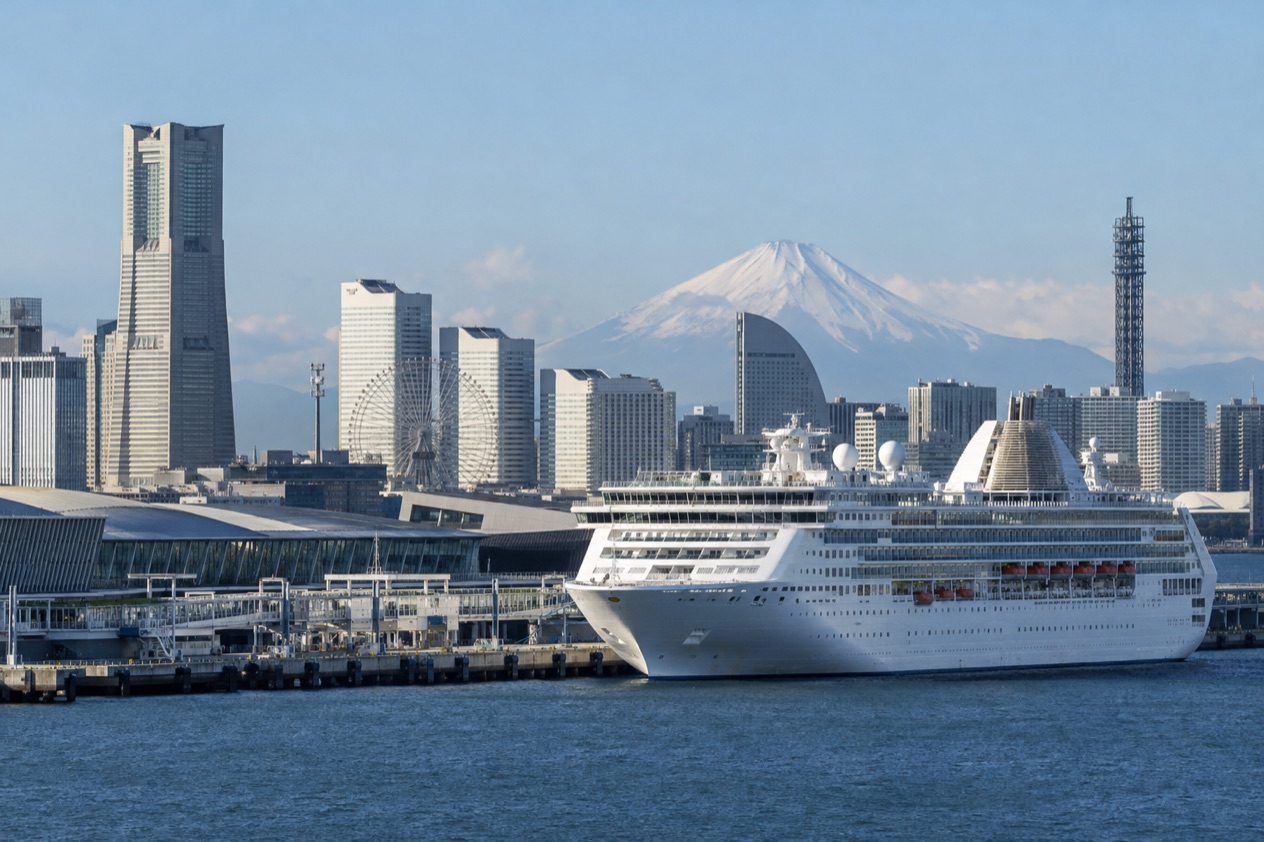
Ships dock at the Port of Hakodate, which lies in the city of Hakodate on the northern island of Hokkaido. The port has a draft depth of 48 feet, which tells you it is a harbor built for deep-hulled vessels and not only for ferries and fishing boats.
The city sits at the southern tip of Hokkaido, with the Tsugaru Strait separating it from Honshu. That position has shaped the place for centuries. Hakodate was the first city in Japan whose port opened to foreign trade, in 1854, after the Convention of Kanagawa. You feel that history as soon as you leave the harbor, because the old foreign quarter, the churches and the warehouses all grew out of that trade.
A working harbor with a long memory
Hakodate is a port first and a sightseeing stop second. Fishing boats, ferries and cargo vessels share the water, and the city’s food reflects it: squid, crab, sea urchin and salmon roe appear on menus all over town. When your ship sails in, you are arriving in a place that has received outsiders from across the sea for a very long time.
The port was damaged in the March 2011 earthquake. It is part of the story of the waterfront, which has been rebuilt and continues to handle ships. Nothing about that history changes what you see on a visit today, but it explains why the harbor is spoken of with a certain seriousness by people who live here.
The city around the port
Hakodate is the third largest city in Hokkaido, after Sapporo and Asahikawa, and it is the capital of Oshima Subprefecture. The scale matters for a port day, because the main sights are inside one city and do not require crossing the island. The harbor, the warehouse district, the old churches, the morning market and the hill with the night view all belong to the same urban area.
Think of the port as the doorstep to a city you can sample in pieces. A first-time visitor will want to match the day to the ship’s schedule and pick a few stops with care, rather than try to see all of Hakodate in one go.
| Port detail | What it is |
|---|---|
| Location | Hakodate, southern Hokkaido |
| Draft depth | 48 ft |
| Subprefecture | Oshima |
| Opened to foreign trade | 1854 |
How do you get into town?
The port is in Hakodate itself, so the town is where your ship leaves you, and the main question is how you move between the waterfront and the places you want to see. Many passengers also come to Hakodate to join or leave a cruise, and for them the way in is by air or by rail.
Arriving by air
Hakodate Airport has direct flights from Sapporo (Okadama on JAL, Shin-Chitose on ANA), Tokyo-Haneda, Nagoya-Centrair, Osaka-Itami and Taipei-Taoyuan. Within Hokkaido, the city is also reached from Chitose, Okadama and Okushiri airports, and from major Japanese airports on direct flights.
For a traveler who flies from the United States, this usually means connecting through one of the large Japanese airports and continuing on a domestic flight. A cruise that begins or ends here fits that pattern, with the last leg landing you in the city where the ship waits.
Arriving by Shinkansen
The JR Tohoku/Hokkaido Shinkansen runs from Tokyo to Shin-Hakodate-Hokuto Station in 4 hours. That station is the northernmost terminal of the bullet train, and it lies 11 miles north of Hakodate Station, so the ride does not end in the center of the city.
From Shin-Hakodate-Hokuto, a local train covers the last leg of the journey to Hakodate. For a traveler who prefers rail to flying, this is a way to watch Japan roll by on the way to a cruise, finishing the trip at the water’s edge.
| Route | Details |
|---|---|
| Tokyo to Shin-Hakodate-Hokuto by Shinkansen | 4 hours |
| Shin-Hakodate-Hokuto to Hakodate | Local train |
| Hakodate Airport | Direct flights from Sapporo, Tokyo-Haneda, Nagoya-Centrair, Osaka-Itami, Taipei-Taoyuan |
Once you are in the city
Hakodate is a place where the sights cluster around the harbor and the slopes behind it. Plan the day around two or three stops that suit your interests, such as the warehouses and market for food, the old quarter for churches and views, or the star-shaped fort for history.
Walking is how many people take in the waterfront and the streets of the old foreign quarter, and the city’s streetcars are part of its character. The point is to let the shape of the city guide you, and to look at the map before you set out so the stops you choose sit naturally together.
What can you do in a port day?
A port day in Hakodate is mostly about eating well, walking by the water and climbing the hill for the view of the city between two seas. The food alone could fill the hours, but the old streets and the fort give the day some shape.
Seafood, markets and ramen
Hakodate is built around the catch. The morning market, known as Asaichi, is a place to see crab, squid, roe and sea urchin laid out, and to sit down to a kaisen-don, a bowl of rice topped with raw seafood. Squid is the local emblem, and in some places you can pick one from a tank and have it prepared for you.
Shio ramen, a clear salt-flavored noodle soup, is the dish tied to the city’s table. It is lighter than the miso ramen associated with Sapporo, and it suits a pause between sights. Sweets and baked goods made with Hokkaido dairy turn up in cafés near the waterfront.
The red-brick warehouses and the waterfront
The red-brick warehouse area faces the harbor and has been turned into shops, restaurants and event spaces. You walk between the old buildings with the water beside you, and you can browse glass, music boxes and local food products. The setting recalls the years when the port opened to foreign trade.
From December 1 to 25, the Hakodate Christmas Fantasy festival fills this area with lights, and a giant Christmas tree floats on the sea. If your cruise calls in that window, the warehouses become the center of the evening, and the harbor takes on a very different look from the rest of the year.
The old foreign quarter and the hill
Motomachi is the district where the churches, Western-style buildings and sloping streets reflect the 1854 opening of the port. You walk uphill past church spires, and the harbor opens behind you with each turn. It is a way to see how foreign influence settled into a Japanese city.
Mount Hakodate is the hill behind the city, and the view of the city shaped like a narrow neck of land between two bays is what draws visitors. The night view is the reason many people take the ropeway, though what you see depends on the weather and on the schedule of your ship.
Goryokaku and the city’s history
Goryokaku is a star-shaped fort with a moat, built in the style of Western fortresses. Seen from above, the star shape stands out, and on the ground you walk the grassy embankments and the paths along the water. It ties into the story of a city that opened early to outsiders and saw a great deal of change.
Pair it with the rest of the day in whatever order suits the ship’s timing. A meal at the market, a walk through the warehouses and an hour in the old quarter can easily be combined with a visit to the fort if you want something more historical.
Good to know before you go
Dining on almost all cruise ships is included in the cruise price, which makes a meal ashore a choice and not a need, and in Hakodate the seafood is reason enough to make it. Carry some yen for market stalls, small cafés and souvenirs.
Hakodate lies at the southern tip of Hokkaido, so dress for the weather of the day you sail in, and keep in mind that the sea and the hill can feel cooler than the streets. The city is easier to enjoy if you decide on two or three stops before you step off the ship, and leave room for a bowl of shio ramen.
Sources
- Wikipedia, Port of Hakodate (https://en.wikipedia.org/wiki/Port_of_Hakodate), checked October 11, 2026
- Wikipedia, Cruise ship (https://en.wikipedia.org/wiki/Cruise_ship), checked October 11, 2026
- Wikipedia, Port of Kobe (https://en.wikipedia.org/wiki/Port_of_Kobe), checked October 11, 2026
- Japan National Tourism Organization, Hakodate (https://www.japan.travel/en/destinations/hokkaido/hokkaido/hakodate-and-hokkaido-south/), checked October 11, 2026
- Wikipedia, Hakodate (https://en.wikipedia.org/wiki/Hakodate), checked October 11, 2026
- Wikivoyage, Hakodate (https://en.wikivoyage.org/wiki/Hakodate), checked October 11, 2026
To plan your stay
- Japan Cruise in March: Weather by Port, Cherry Blossom Timing and What You See
- Celebrity Japan Cruises: Asia Voyages, Hiroshima and Tokyo Sights, and the Port of Kobe
- How Much Does a Japan Cruise Cost?: What the Fare Covers, Drinks and Shore Excursions
- Japan Cruise in April: Cherry Blossoms, Spring Weather and What You See From Port