
A cruise ship slides in under the lights of a harbor city that climbs from the water straight up to the hills, and the first question on deck is always the same: what is here, and how far does the day reach? Kobe is a port that sends ships out as well as receiving them, and it sits in the middle of the Kansai region. For anyone planning a cruise that touches Japan, it is both a place to stay for the day and a doorway to Osaka and Kyoto.
Where do cruise ships dock in Kobe?
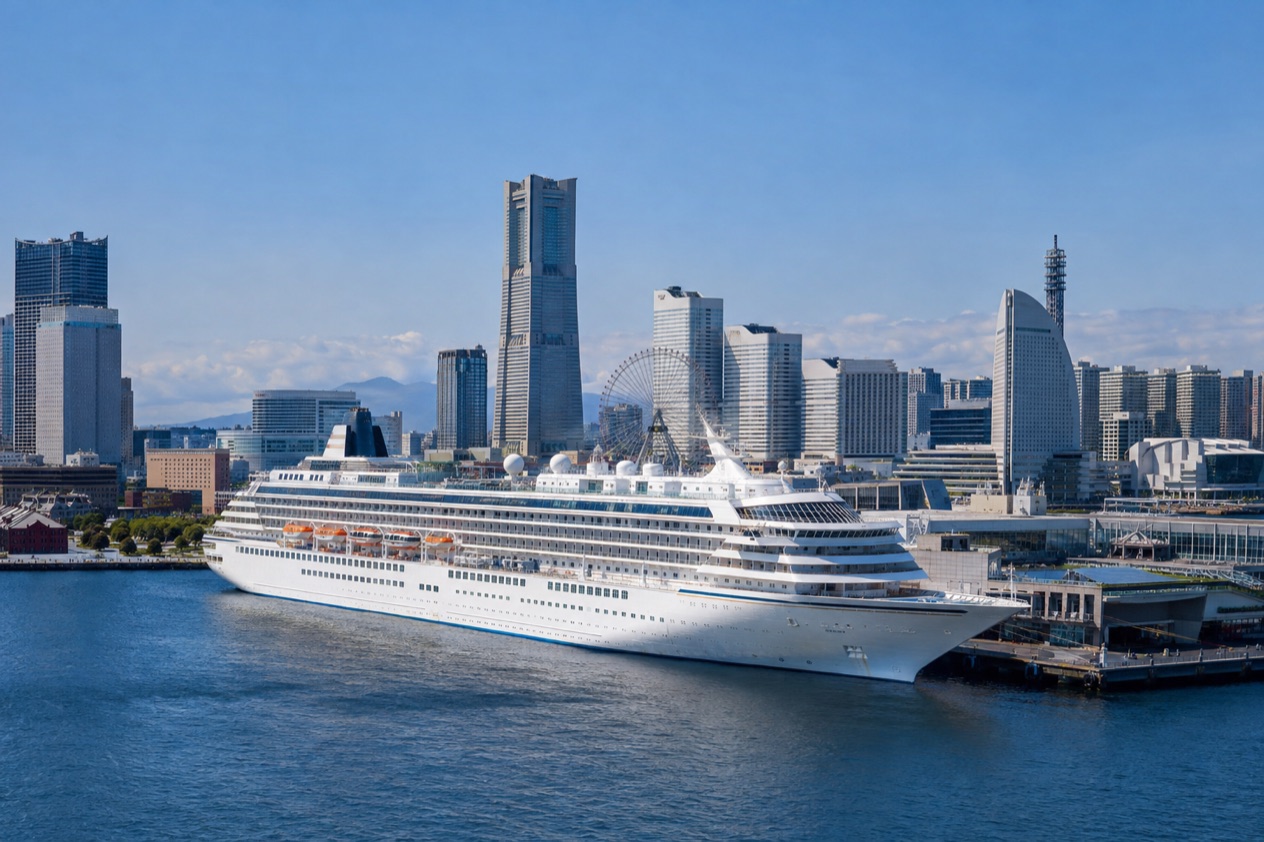
Cruise ships call at the Port of Kobe, a harbor on the north shore of Osaka Bay in Hyogo Prefecture. It is a working port first of all, with container berths and cranes along the waterfront, and the cruise traffic shares that setting with cargo and passenger services. The city behind it is the capital of Hyogo, and it forms part of the Keihanshin area together with Kyoto and Osaka.
Flat land is scarce here, so much of the modern harbor stands on islands built from fill. Port Island, Rokko Island and the island that carries Kobe Airport were all made this way, and they give the waterfront its look of straight quays, bridges and tidy blocks set against the mountain slope. Arriving by ship, you see the city the way it was designed to be seen: from the water.
Kobe as a home port
Kobe is a home port for certain cruise ships, including those of Holland America Line and Princess Cruise Line. A home port is where a voyage begins and ends, so passengers may be boarding here rather than just stopping for a day. In the summer of 2014, for instance, Princess Cruises’ Sun Princess sailed eight-day roundtrip Asia cruises from the Port of Kobe.
For a traveler, a home-port call changes the rhythm of the visit. You may have an evening on land before embarkation or a morning after disembarking, which leaves time for a proper meal in a city known for its beef, its sake and its coffee houses. Dining on almost all cruise ships is included in the cruise price, so a meal ashore becomes a choice for pleasure and not a necessity.
The waterfront parks and towers
The harbor has its own public side. Meriken Park, Kobe Port Tower and Harborland are amusement facilities for the public at the Port of Kobe, which means that the area where ships and cargo move is also where residents come to stroll, shop and look at the water in the evening.
Meriken Park is the open green stretch beside the water, a place for a slow walk after the confinement of a ship. The Port Tower rises as a red lattice above it and is a landmark you will spot from the deck. Harborland adds shops, restaurants and the lit-up promenade that gives the port its evening glow. This is the stretch of Kobe that rewards an unhurried afternoon without any plan.
Other passenger sailings from the same harbor
Cruise ships are not the only passengers to leave from the Port of Kobe. Passenger service runs to Busan in South Korea twice a week, and to Shanghai and Tianjin in China once a week each. These sailings are separate from a cruise, but they say something about the port: it has long looked outward across the water to its neighbors on the Asian mainland.
The harbor has deep roots in this kind of trade. It was the world’s busiest container port from 1973 to 1978 and remains Japan’s fourth busiest, with 34 container berths. It has also been a sister port of Rotterdam in the Netherlands since 1967. When you watch a cruise ship slip past the stacked containers, you are looking at the reason Kobe exists.
How do you get to Kyoto and Osaka?
Kyoto and Osaka belong to the same urban region as Kobe, the Keihanshin area, which is why a cruise call here puts both cities within reach of a day’s plan. Kobe is located across the bay from Osaka, and the three cities together make up the heart of Kansai.
Osaka, across the bay
Osaka faces Kobe over the water of Osaka Bay, and the two cities feel like neighbors with different tempers. Osaka is the city of appetite: takoyaki (octopus dumplings cooked in round molds), okonomiyaki (savory griddle pancakes) and the neon-lit canal streets where people eat standing up. Kobe is more reserved and more polished, with its hillside and its harbor.
A day in Osaka suits travelers who want to eat their way through a city and see a large castle, a busy entertainment district and a very different pace from the one on the ship. If your priority is food and city energy, Osaka is the destination that delivers it. Those who prefer a calmer day can stay in Kobe and treat Osaka as a later chapter of the trip.
Kyoto, in the same region
Kyoto is part of the Keihanshin area with Kobe and Osaka, and it is the choice for temples, shrines, gardens and old wooden streets. It rewards a day with a focused list: a handful of temples, a garden, a stroll through a traditional district, a bowl of something seasonal for lunch. Trying to see everything in one pass tends to blur the experience.
Kyoto’s pleasures are slower than Osaka’s. Tea houses, tofu cooking, pickles and sweets made with matcha are part of a visit as much as the temples are. If your time is tighter, one or two sites and a good meal will feel more satisfying than a long checklist.
Shin-Kobe and the bullet train
Shin-Kobe is the bullet train station in Kobe. Kobe is directly connected to Tokyo by the JR Tokaido/Sanyo Shinkansen, and the journey from Tokyo to Shin-Kobe Station takes between 2 hours 40 minutes and 3 hours 15 minutes. That matters for travelers who combine a cruise with time in the capital, since the two ends of a trip can be joined by rail.
The trip between Tokyo and Shin-Kobe Station is covered by the Japan Rail Pass if you take a Hikari train. The station itself is a name worth knowing when you read a rail timetable, because Shin-Kobe is the stop for the shinkansen and not the harbor.
Which excursions leave from Kobe?
The excursions that begin in Kobe are, above all, the ones that reach Osaka and Kyoto, along with a day spent in Kobe itself. The city rewards those who stay put, because it has a waterfront, a hillside and a food culture of its own.
A day in Kobe itself
Start at the harbor, where Meriken Park, Kobe Port Tower and Harborland offer open space, a landmark and a shopping and dining district at the water’s edge. It makes a natural first stretch of a day on land, and it is the part of Kobe that feels most connected to the ships.
For a wider view of the city, the observation deck on the 24th floor of Kobe City Hall looks over the harbor and the hills. Kobe is also known for its beef, served in steakhouses and grills in many forms, and for the sweets and bread shops that grew up with the port’s foreign trade. A relaxed lunch fits the mood of the place.
| Site | Open |
|---|---|
| Kobe City Hall observation deck (24th floor) | Monday to Friday 08:15-22:00, Saturdays, Sundays and holidays 10:00-22:00 |
Osaka and Kyoto as day outings
Osaka and Kyoto are the two outings that most cruise passengers consider from Kobe, since they lie in the same Keihanshin area. Osaka is the day for street food, a castle and a big-city evening. Kyoto is the day for temples, gardens and tea. Each suits a different mood, and combining both in a single day usually leaves little room to enjoy either.
If you are weighing the two, think about what you want to come home with. Memories of eating and wandering point to Osaka. Memories of quiet courtyards and wooden halls point to Kyoto. A third option is to keep the day in Kobe and let the other two cities wait for a longer stay on land.
Crossing to Korea or China by passenger service
Beyond the cruise itself, passenger sailings leave the Port of Kobe for Busan twice a week and for Shanghai and Tianjin once a week each. These are services for travelers who want to continue across the sea after Japan, and they are a different kind of trip from a cruise excursion, with their own tickets and their own pace.
Good to know before you go
Spring in Kobe is mild, with temperatures from 10°C to 20°C between March and May, while summer from June to September is hot, from 28°C to 35°C. A day ashore in summer calls for water, light clothes and a plan that includes shade and indoor stops.
Shoes come off at the entrance of many traditional restaurants and inns, so socks without holes are a small courtesy. Japan’s rainy season and typhoon season can affect a summer or early autumn trip, so keep your plans flexible.
Sources
- Wikipedia, Port of Kobe (https://en.wikipedia.org/wiki/Port_of_Kobe), checked October 11, 2026
- Wikipedia, Cruise ship (https://en.wikipedia.org/wiki/Cruise_ship), checked October 11, 2026
- Japan National Tourism Organization, Kobe (https://www.japan.travel/en/destinations/kansai/hyogo/kobe-and-around/), checked October 11, 2026
- Visit Kobe, the official travel guide (https://www.feel-kobe.jp/en/), checked October 11, 2026
- Wikipedia, Kobe (https://en.wikipedia.org/wiki/Kobe), checked October 11, 2026
- Wikivoyage, Kobe (https://en.wikivoyage.org/wiki/Kobe), checked October 11, 2026
To plan your stay
- Japan Cruise in March: Weather by Port, Cherry Blossom Timing and What You See
- Celebrity Japan Cruises: Asia Voyages, Hiroshima and Tokyo Sights, and the Port of Kobe
- How Much Does a Japan Cruise Cost?: What the Fare Covers, Drinks and Shore Excursions
- Japan Cruise in April: Cherry Blossoms, Spring Weather and What You See From Port