
On a November morning in Osaka Bay, the air has the clean, cool feel of autumn, and the first maples on the hillsides behind the port are starting to turn. A cruise this month trades the heat of summer for mild afternoons and color that moves southward week by week. It suits travelers who want to sleep in one cabin while the country changes from the cold north to the warm islands of Okinawa.
What is a Japan cruise like in November?
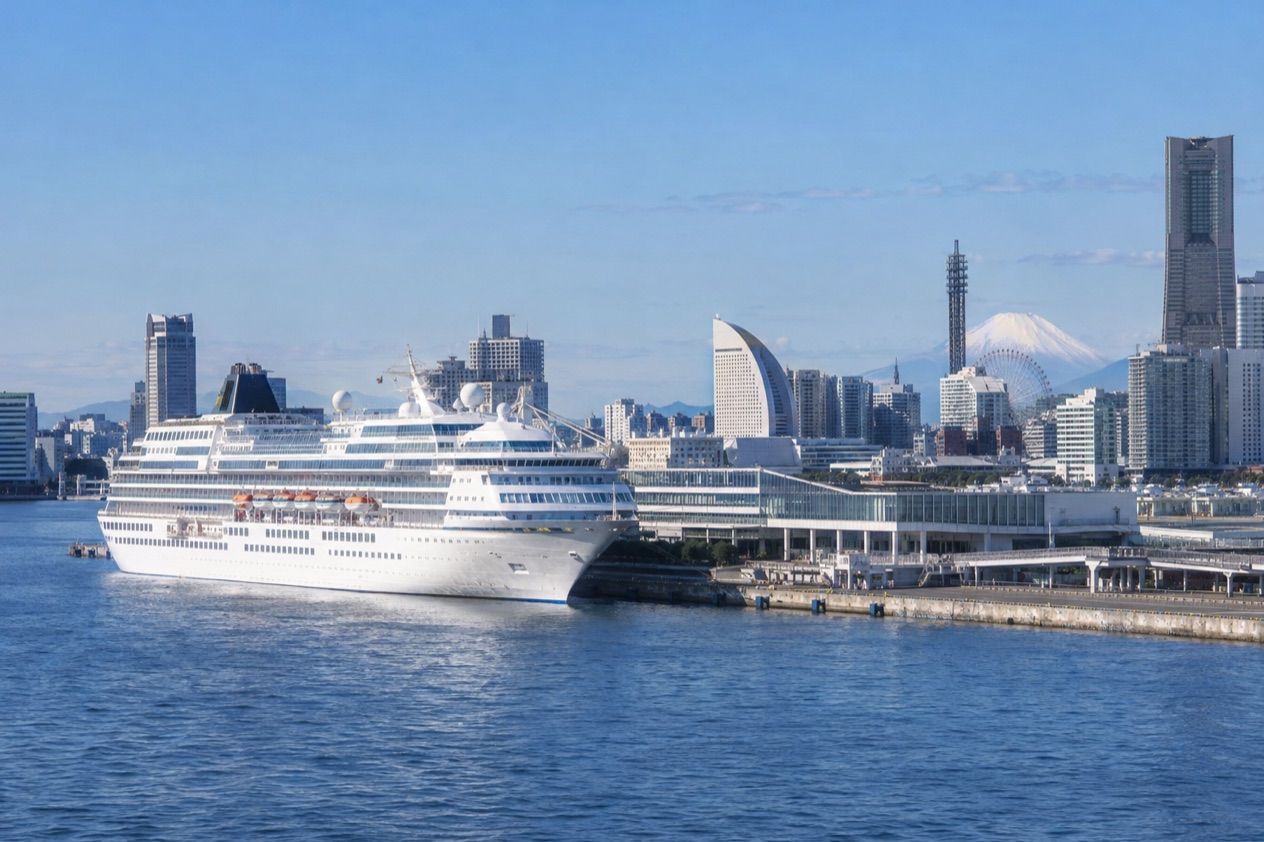
A Japan cruise in November is a floating hotel pointed at autumn: large passenger ships built mainly for vacationing, with the weather turning cooler on deck and the leaves changing along the way. The ship becomes your base, and the days are shaped by which port you reach and how the season is advancing there.
Dining on almost all cruise ships is included in the cruise price, so breakfast, lunch and dinner on board are part of the fare. Alcoholic drinks are a different matter. The majority of cruise lines leave them out of their fares, and passengers pay for drinks as they consume them. That habit shapes an evening: a glass of something at the bar after dinner is a separate small purchase.
Osaka and Kobe, the ports of Osaka Bay
Two ports sit side by side on Osaka Bay. The Port of Osaka is the main port in Japan, located in Osaka within the bay. The Port of Kobe lies in Kobe, in Hyogo, in the Keihanshin area, with the industrial region of Hanshin behind it.
Kobe’s waterfront has a story of its own. Flat land is limited there, so the city built artificial islands: Port Island, Rokko Island and the island that holds Kobe Airport.
Looking at the harbor from the deck, you see a shoreline made largely by people, with the mountains rising close behind it. Kobe was also the world’s busiest container port from 1973 to 1978, which tells you how much the water shaped the city.
What a day on board looks like
In November, the shorter daylight sets the rhythm: Tokyo gets about ten hours of it in mid-month, Osaka a little more, so the afternoon light fades while you are still wandering a market or a garden.
Evenings return to the ship. Dinner is included, drinks are not, and . Travelers who like to unpack once and wake up somewhere new tend to enjoy this format, especially in a season when each port looks different from the last.
What is the weather in November?
November weather in Japan runs from crisp in Tokyo and Osaka to snowy in Sapporo and still summery in Okinawa, so the answer depends on which port you stand in. The national mood is autumn: Japan gradually becomes milder after summer, with moderate temperatures that suit walking.
| Place | Avg high (°F) | Avg low (°F) | Precipitation (in) | Days with rain or snow | Sunshine (hours) | Daylight on Nov 15 |
|---|---|---|---|---|---|---|
| Tokyo | 62.1 | 47.8 | 3.79 | 7.4 | 150 | 10 h 19 min |
| Osaka | 64.0 | 50.4 | 2.85 | 6.2 | 153 | 10 h 23 min |
| Naha, Okinawa | 77.0 | 68.7 | 4.69 | 8.2 | 122 | 10 h 53 min |
| Sapporo | 47.7 | 34.9 | 4.48 | 14.6 | 99 | 9 h 46 min |
Tokyo and Osaka: cool days, mostly dry
Tokyo is cool in the afternoon and chilly at night, with a handful of rainy days and plenty of sunshine for a month this late in the year. Osaka runs a couple of degrees warmer and a little drier. In both cities a sweater and a light coat cover most hours, and the humidity sits at a comfortable middle level.
Rain falls on a minority of days on average, but conditions can vary from one week to the next. Pack layers you can take off on a sunny afternoon and put back on when the light drops early.
Okinawa: still warm enough for the water
Naha stays warm, with afternoons in the upper 70s and nights that barely cool. It is also the wettest of the four places in the table, with showers on roughly eight days and less sunshine than the mainland cities. The sea near Naha averages about 79°F this month, a warmth that keeps the water inviting on the days the sky cooperates.
Sapporo: winter arrives first
Sapporo is where November turns wintry. Highs stay in the 40s, nights fall below freezing, and snow or sleet shows up on more than half the days in an average month, adding up to about a foot over the month.
Rain or snow of some kind falls on most days, and the sun is scarce. In winter, heavy snow regularly covers the mountains and northern regions of Japan, and Sapporo gives a first taste of it.
What do you see in November?
In November you see autumn leaves, and you see them at different stages depending on the port. From mid-November to early December, trees display brilliant colors ranging from red to yellow and orange, so a cruise lets you meet the season several times over.
Maples moving south
The Japan Meteorological Agency defines the maple color-change day as the first day when most of a sample tree’s leaves have turned red. The change starts in mid-October in eastern Hokkaido, reaches the Tohoku region and eastern Hokuriku around November 20, and arrives in Kanto, Hokuriku, Tokai, Chugoku, Shikoku and northern Kyushu around November 30.
At Aomori, the usual date falls on November 13. At Fukuoka it comes around December 1. For a ship moving between regions, this means a November sailing can bring leaves at their red peak in the north while the Pacific coasts of Kanto and Tokai, and the Kinki region around Osaka and Kobe, are still waiting for early to mid December.
Harbors, islands and city lights
Even without foliage, the ports give you plenty to look at. Osaka Bay is a working waterfront, and Kobe’s artificial islands show up from the deck as flat, ordered shapes against the mountains. With darkness falling before six in the evening in the cities, the lights come on while you are still ashore, and the walk back to the ship happens in the blue hour.
Cool air, clear days and the first snow
The season also changes what you see in the sky. Tokyo and Osaka collect around 150 hours of sunshine this month, enough for plenty of bright days. Sapporo sees far less, and the first snow gives the northern streets a white edge. In Naha, the scene is still green, with warm air and sea.
Is November a good month for a Japan cruise?
November is a good month for a Japan cruise if you like cool, walkable weather and autumn color, and less so if you want beach heat across the whole itinerary. Moderate temperatures suit days on foot, and the foliage adds a reason to step off the ship.
Who it suits
It suits travelers who prefer a light jacket to summer sweat. Honshu and Kyushu have very humid, hot, sultry summers, and November leaves that behind. Leaf-watchers get the most from a route that includes northern or inland-facing stops, where the color arrives first.
It also suits anyone who likes variety on one trip. Conditions differ sharply by itinerary, from wintry Sapporo to warm Okinawa.
What to weigh
Daylight is short, around ten hours in the main cities, so port days have a built-in end. Sapporo’s snow and frequent precipitation call for warm layers and waterproof shoes. Okinawa’s showers mean a rain layer even on a warm day. Mount Fuji’s climbing season ends in early September, so climbing is not part of a November plan.
Late in the month, some regions are still ahead of their color. Around Osaka and Kobe the maples turn in December, so the foliage there comes later than in the north.
Good to know before you go
Meals on board are included in the fare, but alcoholic drinks are paid for as you order them, so keep a small allowance for evenings. Pack in layers: a warm coat for Sapporo, a light jacket for Tokyo and Osaka, and a rain shell for Okinawa.
Sources
- Japan Meteorological Agency (JMA), Normal values 1991-2020, monthly (https://www.data.jma.go.jp/stats/etrn/view/nml_sfc_ym.php?prec_no=44&block_no=47662), station Tokyo, elevation 25 m, checked October 11, 2026
- Computed from the date and the latitude of the place (sunrise equation, solar elevation -0.833 degrees), October 11, 2026
- Japan Meteorological Agency (JMA), Normal values 1991-2020, monthly (https://www.data.jma.go.jp/stats/etrn/view/nml_sfc_ym.php?prec_no=62&block_no=47772), station Osaka, elevation 23 m, checked October 11, 2026
- Japan Meteorological Agency (JMA), Normal values 1991-2020, monthly (https://www.data.jma.go.jp/stats/etrn/view/nml_sfc_ym.php?prec_no=91&block_no=47936), station Naha, elevation 28 m, checked October 11, 2026
- Open-Meteo Marine API, average 2015-2024, checked October 11, 2026
- Japan Meteorological Agency (JMA), Normal values 1991-2020, monthly (https://www.data.jma.go.jp/stats/etrn/view/nml_sfc_ym.php?prec_no=14&block_no=47412), station Sapporo, elevation 17 m, checked October 11, 2026
- Japan Meteorological Agency, maple color-change dates 2025-2026 with difference from the 1991-2020 normal (https://www.data.jma.go.jp/sakura/data/phn_014.html), checked October 11, 2026
- Japan Meteorological Agency, kaede2020.pdf (https://www.data.jma.go.jp/sakura/data/kaede2020.pdf), checked October 11, 2026
- Japan National Tourism Organization, winter in Japan (https://www.japan.travel/en/guide/winter-guide/), checked October 11, 2026
- Japan National Tourism Organization, autumn in Japan (https://www.japan.travel/en/guide/autumn-guide/), checked October 11, 2026
- Japan National Tourism Organization, spring in Japan (https://www.japan.travel/en/guide/spring-guide/), checked October 11, 2026
- Japan National Tourism Organization, summer in Japan (https://www.japan.travel/en/guide/summer-guide/), checked October 11, 2026
- Wikipedia, Cruise ship (https://en.wikipedia.org/wiki/Cruise_ship), checked October 11, 2026
- Wikipedia, Port of Kobe (https://en.wikipedia.org/wiki/Port_of_Kobe), checked October 11, 2026
- Wikipedia, Port of Osaka (https://en.wikipedia.org/wiki/Port_of_Osaka), checked October 11, 2026
To plan your stay
- Celebrity Japan Cruises: Asia Voyages, Hiroshima and Tokyo Sights, and the Port of Kobe
- Cruises from Los Angeles to Japan: Departure Port, Yokohama Arrival and Crossing Length
- How Much Does a Japan Cruise Cost?: What the Fare Covers, Drinks and Shore Excursions
- Holland America Japan Cruises: Asia Sailings, Ports and Ships